

24th July 1469 Battle of Edgecote Moor aka Danes Moor aka Banbury is in 1469-1471 Wars of the Roses: Warwick Rebels, Battles of the Wars of the Roses.
On 24th July 1469 the Yorkist army suffered a defeat against a Lancastrian army led by Robin of Redesdale at the Battle of Edgecote Moor at Danes Moor, Edgecote, Banbury [Map]. The Yorkist army was commanded by Humphrey Stafford 1st Earl Devon [aged 30] and William Herbert 1st Earl Pembroke [aged 46].
Thomas Vaughan [aged 69], John Wogan, Henry Neville [aged 32], John Conyers [aged 36], and brothers John Dudley [aged 42] and Oliver Dudley were killed.
Humphrey Stafford 1st Earl Devon, John Conyers [aged 58] and William Parr [aged 35] fought.
Richard Woodville 1st Earl Rivers [aged 64] and John Woodville [aged 24] were captured.
On 26th July 1469 Richard Herbert [aged 46] was executed following his capture at the Battle of Edgecote Moor.
On 27th July 1469 William Herbert 1st Earl Pembroke [aged 46] was executed following his capture at the Battle of Edgecote Moor. His son William [aged 18] succeeded 2nd Earl Pembroke, 2nd Baron Herbert of Raglan. Mary Woodville Countess Pembroke and Huntingdon [aged 13] by marriage Countess Pembroke.
 Chronicle of England by Jean de Waurin. 24th July 1469. So they stayed there all night, and the next day each side advanced to reach the river crossing, but the Welsh never got there before finding those from the North. Sir William Herbert had not brought many men, and they were still on horseback, while those on foot had been left to come at their leisure behind because he did not expect the Northerners to be there so soon. This forced him to defend and guard the crossing, where there was a fierce skirmish and many people were killed, but the Welsh held the passage. After the Earl of Pembroke had won the passage, those from the North withdrew because they had suffered heavy losses, waiting until after dinner for the arrival of the Earl of Warwick, and likewise the Welsh did the same to await the remainder of their forces.
But when it came after dinner, two knights approached the Northerners controversially, one was Sir William Parr143 and the other Sir Geoffrey Gates, who, upon being informed of their repulse, immediately rallied and brought them back to the passage, where the skirmish recommenced vigorously. This prompted the Welsh to come in force, but the Northerners outnumbered the Welsh significantly. Also, when the Earl Stafford144 learned that the Duke of Clarence was coming to aid the Northerners, he abandoned the Welsh and took with him seven to eight thousand men. As a result, the Welsh lost the day, with many killed and captured, among whom were the two brothers of Herbert as mentioned above.
Ainsi doncques furent illec toute la nuit, et lendemain chascun de son coste sadvancha pour prevenir au passage de la riviere, mais oncques sitost ny parvindrent les Gallois quilz ny trouverent ceulz du North; si ny avoit amene messire Guillamme de Herbert gueres de gens, ancores estoient ilz de cheval, et avoit ceulz de pie laissies venir a leur aise derriere, car il ne cuidoit pas ceulz du North si prestz comme il fist, par lesquelz il fut constraint deffendre et garder le passage, ou il eut grosse escarmuche et moult de gens tuez; mais les Gallois tindrent le passage. Aprez que le comte de Pennebrocq eut le pas concquis, ceulz du North se retrayrent, car ilz avoient beaucop perdu, jusques a laprez disner que ilz atendoient le comte de Warewic, et aussi firent pareillement les Gallois pour atendre le residu de leurs gens.
Mais quant ce vint aprez disner vindrent devers ceulz du North litigieusement deux chevalliers, lun estoit messire Guillamme Apparre et lautre messire Geffroy Guat, lesquelz advertis de leur rebouttement tantost les recoeillerent et ramenerent au passage, ou lescarmuche recommenca moult grosse; pourquoy les Gallois y vindrent a puissance, mais ceulz du North estoient beaucop plus grant nombre que les Galles; et aussi quant le comte de Stamfort fut adcertene que le duc de Clarence venoit en layde de ceulz du North il habandonna les Gallois et emmena avec luy de sept a huit mille hommes, pourquoy ceulz de Galles perdirent la journee, si -en eut plusieurs mors et prins, entre lesquelz y furent prisonniers comme dit a este cydessus les deux freres de Herbert.
Note 143. William Parr, 1434-1484. Yorkist. Fought at the battles of Edgecote and Barnet. Garter Knight. Attended the funeral of King Edward IV in 1483. Refused to attend coronation of King Richard III.
Note 144. The original French text has "Stamfort". However, the Earldom of Stamford wasn't created until 1628. The person referred to is Humphrey Stafford, 1st Earl Devon, 1439-1469, who is known to have commanded at the battle.
Warkworth's Chronicle [1461-1474]. 24th July 1469. And Robyne of Riddesdale came uppone the Walschemenne in a playne byyonde Banbury toune1, and ther they faughthe strongly togedere, and ther was the Earl of Penbroke takene, and his brother withe hym, and two Ml, Walschmenne slayne, and so the Walschmen loste the felde the xxvj, day of Juylle the same yere. The names of the gentylmen that were slayne2 of Walsche party in the same batelle, -Sere Rogere Vaghan, knyght, Herry Organ sonne and heyre3, Thomas Aprossehere Vaghan, squyere, William Harbarde of Breknoke, squyere, Watkyn Thomas, sonne to Rogere Vaghan, Yvan ap Jhon of Merwyke, Davy ap Jankyn of Lymmeryke, Harry Done ap Pikton, John Done of Kydwelle, Ryse ap Morgon ap Ulston, Jankyn Perot ap Scottesburght, John Eneand of Penbrokeschire, and Jhon Contour of Herforde, And of the north party ther was slayne Sere Herry Latymere [aged 32]4, sonne and heyre to the Lorde Latymere, Sere Rogere Pygot, knyghte, James Conya[r]s [aged 36]5, sonne and heyre to Sere Jhon Conya[r]s [aged 58], knyght, Olivere Audley6, squyere, Thomas Wakes sonne and heyre, William Mallerye, squyere, and many othere comyners, &c.
Note 1. A playne byyonde Banbury toune. Danesmoor is in the parish of Edgecote, near three hills of unequal size, and in their relative position approaching a triangle; "the spot now called Danesmoor is a small plantation of a few acres, but the name at this period had doubtless a much more extended application." - Baker's Northamptonshire, I. 500. This battle is commemorated in "Marwnad Thomas ab Rhosser, arglwydd Herast" of Lewis Glyn Cothi. Three things ought to be remarked, viz. that Herbert, who was beheaded, only made a codicil to his will, and not a new one, as commonly stated; that the battle took place on the Monday:
"Dyw Llun y bu waed a lladd:" [On Monday, there was bloodshed and slaughter.]
and that Herbert and his fellow captives were executed on the Wednesday-
"Marchog a las ddyw Merclur," [A knight was slain on Wednesday.]
as Gutto Glyn remarks in his poetical language. Cf. MS. Cotton. Otho, B. XIV. fol. 221, vo, where an erroneous date is given to the battle, - in quo cœsi multa milia [in which many thousands were slain]. In MS. Tann. Bodl. 2, fol. 104, vo. we find the field called "prelium ad Hegecote, seu Danysmore, prope Banburiam, dictam Banbery-Feld, seu Hegecote-Fyld [The battle at Hedgecote, or Danesmoor, near Banbury, called Banbury Field, or Hedgecote Field]." Hearne's fragment informs us that the land on which the battle was fought belonged to a person named Clarell. In the valuable collection of manuscripts at the seat of W. Ormsby Gore, Esq. are some verses in the Welsh language on this battle; see Sir Thomas Phillipps's Catalogue of these Manuscripts, p. 1.
Note 2. The names of the gentylmen that were slayne. See another and more extensive list in Itinerarium Willelmi de Worcestre, p. 120.1, although the major part of this catalogue differs from his. Worcester says that at least 168 of the nobility and gentry of Wales fell in this battle, and 1500 men on the English side.
Note 3. Herry Organ. sonne and heyre, i.e. the son and heir of Henry Organ.
Note 4. Sere Herry Latymere. Rather Sir Henry Neville, paternally a cousin-german of the great Earl of Warwick, and whose mother was Lady Elizabeth Beauchamp [aged 52], half-sister to the heiress Anne [aged 43], whom the Earl of Warwick married. Leland, in describing the Beauchamp Chapel at Warwick, says: "There lyeth buried (as some saye) in the west end of our Lady Chapell one of the Nevilles L. Latemer, slayne at Edgcote field by Banbury (as some suppose), but there is neither tombe nor scripture seene. This was Sir Hen. Neville, sonne and heire of George Neville, Lord Latemer. But he was never Lord, for he dyed before his father. This Henry Neville was grandfather to the Lord Latemer now livinge." The fact of Sir Henry Neville, and of his brother-in-law John Dudley [aged 42], also slain in the same battle, having been buried in the Beauchamp Chapel, is proved by the will of his mother Lady Latimer, who on the field of Edgcote lost her only son and the husband of her daughter. Before the close of the same year, (on the 30th Dec.) her husband died insane, Nichols's Beauchamp Monuments, 4to. p. 40. - J.G.N.
Note 5. Sir John Conyers of Hornby, com. Ebor. Kt.
Note 6. Olivere Audley, squyere. For Audley read Dudley. He was a son of John Lord Dudley, K.G. and brother of that John who was grandfather of John Duke of Northumberland. Beauchamp Monuments, p. 39.-J.G.N.
Croyland Chronicle 1469. 24th July 1469. While, however, the said earl of Pembroke was hastening with all speed at the head of a considerable body of troops to meet the king, behold! the army of the northmen unexpectedly met him on the plain of Hegge-cote, near Banbury, in the county of Northampton; whereupon, the two armies engaging, a great battle was fought, and a most dreadful slaughter, especially of the Welch, ensued; so much so, that four thousand men of the two armies are said to have been slain. The earl of Pembroke and several other nobles and gentlemen of Wales were made prisoners, and were, by order of the before-named earl of Warwick, without any opportunity of ransom, beheaded at Northampton.
Collectanea by John Leland [1502-1552]. [24th July 1469] Syr William Conyers Knight caullid hymself Robyn of Rydefdale, and gatherid an Host of xx.M. Men yn the North.
The Lorde Herbert Erle of Penbroke cam with 18. thousand Walsch Men, and Lord Staforde of Southwike, newly made Erle of Devonshire, cam with syx M. Men agayne Robyn of Rydefdale.
The Erle of Devonshir faulling at Debate with the Erle of Penbrok for Logging lefte hym, and Robyn of Rydefdale mette with the Erle of Penbroke, and flew 2. M. Walsch Men aboute Banbyri, and toke the Erle of Penbroke and hys Brother. And thes Men of Name slayne of the Walsch Party, Syr Roger Vahan Knight, Henry ap Morgan Sun and Heire, Thomas ap Richard Vahan Squier, William Herebert of Breknok Esquier, Watkin Thomas Sun to Roger Vahan, Juan ap John ap Meridik, Dany ap Jankin ap Limerik, Harridon ap Pikton, John Done of Kidwelly, Rise ap Margan ap Ulston, Jankin Perot ap Scottes burg, John Eneand of Penbrokeshire, John Courtor of Herford.And of the Northen Men of Name were flain Syr Henry Latimer Sun and Heyre to the Lorde Latimer, Syr Roger Pigot Knight, Jamys Coniers Sun and Heire to Syr John Coniers Knight, Oliver Andeley Efquier, Thomas Wakes Sun and Heire to William Mallery Esquier.
St Mary's Church, Kington [Map]. Thomas Vaughan killed 24th July 1469 at the Edgecote Moor and wife Elena "Terrible" Gethen so called because she murdered her cousin who had murdered her brother. Alabaster. Early Plate Bascinet Period. Tassets. Believed to have been moved from the Chancel since it is decorated on all sides. Possible Harpur and Moorecock of Burton on Trent - see the folds at the base of her dress and the possible little dog between them. Chest with Angels with Rounded Wings holding Shields.


A Brief Latin Chronicle. 24th July 1469. In this same year, on the Vigil of Saint James the Apostle (July 24), a battle took place between the northern knights and warriors against Lord Harberd [aged 46] and his Welsh followers. Many fell on both sides, and Lord Harberd, along with his two brothers, were captured and soon beheaded at Northampton. This W. Harberd, a notorious oppressor and plunderer of churchmen and many others for many years, at last received his due reward for his crimes and wickedness by the just judgment of God.
Hoc etiam anno in vigilia Sancti Jacobi Apostoli, facto conflictu militum et belligerorum borealium contra dominum Harberd cum suis Wallensibus, ceciderunt hine et inde multi; et dominus Harberd cum duobus fratribus sus captus est, et infra breve apud Northampton decapitatus est. His W. Harberd, gravissimus et oppressor et spoliator ecclesiasticorum et aliorum multorum per annos multos, hanc tandem justi Dei judicio pro suis sceleribus et nequiciis receipt mercedem.
Annals of Kings Richard II and Henry IV 1393-1406
The Annals of Kings Richard II and Henry IV offers a vivid contemporary account of one of the most turbulent periods in late medieval England. Covering the reigns of Richard II and Henry IV, the chronicle records royal ceremonies, political conflict, rebellion, war, taxation, religious controversy, executions, popular unrest and remarkable portents. Its pages include a detailed description of Richard II’s coronation, the fall and deposition of the king, Henry IV’s seizure of the throne, the Percy rebellion, the execution of Archbishop Richard Scrope, the campaigns of Owain Glyndŵr, and England’s relations with Scotland, France, Portugal and Scandinavia. Alongside affairs of state, the annalist preserves reports of miracles, eclipses, prophecies, supernatural events and the experiences of ordinary townspeople, clergy, soldiers and travellers. Written from a monastic perspective, the work combines political observation with moral judgement, presenting victories and disasters as evidence of divine favour or punishment. At once a historical record and a reflection of medieval belief, the Annals provides an invaluable window into the challenges, ceremonies and conflicts of England at the turn of the fifteenth century.
Available at Amazon in eBook and Paperback format.
Coventry Leet Book. [24th July 1469] Lord Herbert (Earl of Pembroke) was taken in a battle by Banbury with Robin of Redesdale and his fellows on S. James' Eve (Jul 24) 1469, and was taken to Northampton, and there beheaded, and Lord Richard Herbert likewise with others.
Memorandum, quod dominnus Herbert fuit captus in bello juxta Banbery cum Robarto Ryddesdale & sociis suis in vigilia S. Jacobi apostoli, a. r. Edwardi ixo & fuit ductus ad villam de Northehampton & ibi erat decollatus, & dominus Ric. Herber similiter cum aliis.
A Brief Latin Chronicle. 24th July 1469. In this year also, on the eve of Saint James the Apostle, a conflict [Battle of Edgecote Moor] occurred between the northern soldiers and warriors against Lord Herbert [aged 46] and his Welshmen. Many fell on both sides; and Lord Herbert, along with two brothers, was captured. He was shortly thereafter beheaded at Northampton [Map]. This W. Herbert, a most severe oppressor and despoiler of ecclesiastics and many others over many years, finally received this reward by the just judgment of God for his crimes and wickedness.
Hoc etiam anno in vigilia Sancti Jacobi Apostoli, facto conflictu militum et belligerorum borealium contra dominum Harberd cum suis Wallensibus, ceciderunt hine et inde multi; et dominus Harberd cum duobus fratribus sus captus est, et infra breve apud Northampton decapitatus est. His W. Harberd, gravissimus et oppressor et spoliator ecclesiasticorum et aliorum multorum per annos multos, hanc tandem justi Dei judicio pro suis sceleribus et nequiciis receipt mercedem.
Holinshed's Chronicle [1525-1582]. [24th July 1469] The king likewise assembled people to aid the erle of Penbroke, but before either part receiued succour from his freend or partaker, both the armies met by chance in a faire plaine, néere to a towne called Hedgecote, foure miles distant fiom Banberie, where there are thre'e hilles, not in equall quantitie, but liengin maner (although not fullie) triangle. The Welshmen got first the west hill, hoping to haue recouered the east hill also, which if they might haue obteined, the victorie had beene theirs, as their foolish prophesiers told them before. These northerne men incamped on the south hill; the earle of Penbroke and the lord Stafford of Southwike were lodged in Banberie, the daie before the field, which was saint lames daie, and there the earle of Penbroke put the lord Stafford out of an Inne, wherein he delighted much to be, for the loue of a damosell that dwelled in the house: and yet it was agreed betwixt lodging, should not be displaced.
The lord Stafford in great despite departed with his whole band of archers, leaving the earle of Penbroke almost desolate in the towne, who with all diligence returned to his host, lieng in the field unpurveied of archers. Sir Henrie Neuill, sonne to the lord Latimer, tooke with him certeine light horssemen, and skirmished with the Welshmen in the euening, just before their campe, where dooing right valiantlie, but a little too hardilie aduenturing himselfe, was taken and yeelded, and yet cruellie slaine. Which unmercifull act the Welshmen sore rued the next day yer night: for the northerne men sore displeased for the death of this nobleman, in the next morning valiantlie set on the Welshmen, and by force of archers caused them quicklie to descend the hill, into the vallie, where both the hoasts fought.
The earle of Penbroke did right valiantlie, and so likewise did his brother sir Richard Herbert, in so much that with his polax in his hand, he twise by fine force passed thorough the battell of his adversaries, and without anie hurt or mortall wound returned. But see the hap, even as the Welshmen were at point to haue obteined the victorie, lohn Clappam esquier, seruant to the earle of Warwike, mounted up the side of the east hill, accompanied onelie with five hundred men, gathered of the rascals of the towne of Northampton, and other villages about, having borne before them the standard of the earle of Warwike, with the white beare, crieng; A Warwike, a Warwike.
The Welshmen, thinking that the earle of Warwike had come on them with all his puissance, suddenlie as men amazed, fled: the northerne men them pursued, and slue without merci, so that there died of the Welshmen that daie, above five thousand, besides them that fled and were taken. The earle of Penbroke, and his brother sir Richard Herbert, with diverse gentlemen, were taken and brought to Banberie, where the earle with his brother, and other gentlemen, to the number of ten, that were likewise taken, lost their heads. But great mone was made for that noble and hardie gentleman, sir Richard Herbert, being able for his goodlie personage and high valiancie to have serued the greatest prince in christendome. [But what policie or puissance can either preuent or impugne the force of fate, whose law as it standeth upon an inevitable necessitie; so was it not to be dispensed withall; and therfore destinie having preordained the maner of his deth, it was patientlie to be suffered, sith puissantlie it could not be auoided, nor politikelie preuented, nor violentlie resisted: for sua quenq; dies ad funera raptat i.e. Fate seizes each man on his appointed day for the grave.]
Chronicle of Edward Hall [1496-1548]. 26th July 1469. The Northern men incamped themself on the Southe hill. The erle of Penbroke and the lorde Stafford of Southwike [aged 30], wer lodged at Banbery the daie before the feld whiche was sainct James daie, and there the erle of Pembroke, putte the Lorde Stattorde out of an Inne wherein he delighted muche to be, for the loue of a damosell that dwelled in the house: contrary to their mutuall agrement by them taken, whiche was, that whosoever obteined first a lodgyng, should not be deceiued nor remoued. After many great woordes and crakes, had betwene these twoo capitaines, the lorde Stafford of Southwyke, in greate dispite departed with his whole compaignie and band of Archers, leauyng the erle of Pembroke almoste desolate in the toune, whiche, with all diligence returned to his host, liyng in the feld vnpurueied of Archers, abidyng suche fortune as God would sende and prouide. Sir Henry Neuell [deceased] sonne to the Lorde Latimer [aged 62], tooke with hym certain light horssemen, and skirmished with the Welshemen in the evenyng, even before their Campe, where he did diverse valiaunt feates of armes, but a litle to hardy, he went so farre forward that he was taken and yelded, and yet cruelly slain: whiche vnmercifull acte, the Welshemen sore ruled the next daie or night. For the Northren men beyng inflamed, & not a litle discontented, with the death of this noble man, in the mornyng valiauntly set on the Welshemenne, and by force of archers, caused theim quickely to descende the hill into the valey, where bothe the hostes fought. Therle of Penbroke behaved hymself like a hardy knight, and expert capitain, but his brother sir Richarde Herbert so valiauntly acquited hymself, that with his Polleaxe in his hand (as his enemies did afterward reporte) he twise by fine force passed through the battaill of his aduersaries, and without any mortall wounde returned. If every one of his felowes and compaignions in armes, hud doen but halfe thactes, whiche he that daie by his noble prowes achiued, the Northremen had obteined neither sauetie nor victory.

After 26th July 1469. Grave marker of Henry Neville [deceased] at the Beauchamp Chapel, St Mary's Church, Warwick [Map] killed at the Battle of Edgecote.
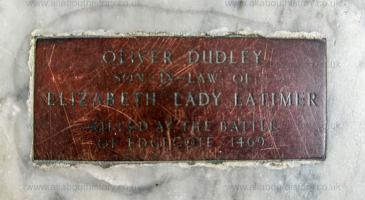
After 26th July 1469. Grave marker of Oliver Dudley at the Beauchamp Chapel, St Mary's Church, Warwick [Map] killed at the Battle of Edgecote.
Oliver Dudley: he was born to John Sutton 1st Baron Dudley and Elizabeth Berkeley Baroness Cherleton Baroness Dudley.
Works of Gutor Glyn. Poem about the death of William Herbert 1st Earl Pembroke [aged 46] who was executed on Thursday 27th July 1469 following his capture at the Battle of Edgecote Moor aka Danes Moor aka Banbury fought on Monday 24th July 1469.
| LIII MARWNAD WILIAM HERBART IARLL PENFRO | 53. Elegy for William Herbert, Earl of Pembroke | |
| Dawns o Bowls, doe'n ysbeiliwyd, | The Dance of St Paul’s1, yesterday we were plundered, | |
| Dwyn yr holl dynion i'r rhwyd. | All men were drawn into the net. | |
| Dawns gwŷr dinas y Garrai, | The dance of the men of the City of the Thong2 [Doncaster], | |
| Dawns yr ieirll (dawn nes i rai). | The dance of the earls, it draws nearer to some. | |
| Duw Llun y bu waed a lladd, | On Monday there were bloodshed and slaughter, | 5 |
| Dydd amlwg, diwedd ymladd. | A conspicuous day, the end of battle. | |
| Duw a ddug y dydd dduw Iau | On Thursday God took away | |
| Iarll Dwywent a'r holl Deau. | The Earl of the two Gwents and of all the South. | |
| Marchog a las dduw Merchyr, | A knight [deceased] was slain on Wednesday, | |
| Mwy ei ladd no mil o wŷr; | His death outweighed that of a thousand men, | 10 |
| Syr Risiart, ni syr lesu | Sir Richard, Jesus will not be angry | |
| Wrtho, er lladd North a'r llu. | With him for slaying the North and its host. | |
| Duw-Mawrth, gwae ni am Domas, | On Tuesday, alas for us, Thomas [deceased]4 fell, | |
| Duw Llun gyda'i frawd y llas. | On Monday he was slain beside his brother. | |
| Dwyn yr iarll a'i bedwarllu, | The taking of the earl and his fourfold host | 15 |
| Dydd farn yr anrhydedd fu. | Was a Day of Judgement for honour. | |
| Arglwydd difwynswydd Defnsir | The dishonourable Lord of Devon [aged 30]5 | |
| A ffoes, ni chafas oes hir. | Fled, and did not live long. | |
| Bradwyr a droes brwydr a drwg | Traitors turned battle and calamity | |
| Banbri i'r iarll o Benbrwg. | At Banbury against the Earl of Pembroke. | 20 |
| Cad drycin am y drin draw, | A storm of battle arose from that conflict, | |
| Carliaid a wnaeth y curlaw. | Base men brought about the deluge. | |
| Ymladd tost am laddiad hwn | The journey to Northampton | |
| A wna'r hynt i Norhantwn. | Will bring fierce fighting in vengeance for this death. | |
| Awn oll i ddial ein iaith | Let us all go to avenge our nation | 25 |
| Ar ddannedd y Nordd unwaith ; | Upon the teeth of the North at once. | |
| A dyludwn hyd Lydaw | And let us pursue them as far as Brittany, | |
| Dan draed y cyffredin draw, | Trampling those common men beneath our feet. | |
| Ef â'r gwyr, a fu ar gam, | May he and the men who acted wrongfully | |
| Oll i ddiawl, yn lladd Wiliam. | All go to the devil for killing William. | 30 |
| O rhoed, lle'i bu anrhydedd, | Where honour once rested, let armour or a sword | |
| Ar fwnwgl iarll arf neu gledd, | Now be placed upon an earl’s neck. | |
| (Och Fair!) gnodach fu arwain | Alas, Mary, more often he was accustomed to wear | |
| Aerwy mawr o aur a main. | A great collar of gold and precious stones. | |
| Doe'dd aeth dan y blaned ddu | Yesterday he went beneath the dark planet, | 35 |
| Drwy'r Fâl draw i ryfelu. | Through the Vale [Map], to wage war. | |
| Och finnau, ucho f'anhun, | Alas for me, above my sleep, | |
| Nad arhôi'n ei dir ei hun! | That he did not remain in his own land! | |
| Ymddiried I'r dynged wan | He trusted in frail fate, | |
| A'i twyllodd o Went allan. | Which deceived him out of Gwent. | 40 |
| Tair merched, tair tynged hon, | Three maidens, these three Fates7, | |
| Y sy'n dwyn oes ein dynion. | Are carrying away the lives of our men. | |
| Un a gynnail cogeilyn ; | One holds the distaff, | |
| Arall a nydd dydd pob dyn. | Another spins each man’s days. | |
| Trydedd yn torri edau | The third cuts the thread, | 45 |
| Er lladd iarll a'r llu dduw Iau. | To slay the earl and the host on Thursday. | |
| Mynnwn fy mod ymannos | I wish that I had been nearby, | |
| Yn torri pen Atropôs. | Cutting off Atropos’s head. | |
| Nid rhan y tair a henwais | It is not the task of the three I have named | |
| Nyddu oes hir yn nydd Sais. | To spin a long life in an Englishman’s day. | 50 |
| Os gwir i blant Alis gau, | If it is true that the false children of Alis8, | |
| Draeturiaid, dorri tyrau, | Traitors, have broken the towers, | |
| Ni ddói'r iangwyr, ni ddringynt | The young men would not come, nor would they climb | |
| I dai'r gWr na'i dyrau gynt. | To the man’s halls or his towers as before. | |
| Gwinllan fu Raglan ir iaith, | Raglan was a vineyard for our nation, | 55 |
| Gwae ni wjl ei gwin eilwaith ! | Alas for us to see its wine once more! | |
| Gwae a weles ar galan | Alas for him who saw, at the New Year, | |
| Gynnal gwledd ar ganol glan ! | A feast held beside the riverbank! | |
| Gwae a geisio rodio rhawg | Alas for anyone who seeks to wander long | |
| Gwent dlawd oedd gynt oludawg! | Through poor Gwent, which once was rich! | 60 |
| Ei farw oedd well i fardd iach | His death was better for a sound poet | |
| Heb ei bwyll no byw bellach. | Who had lost his wits than living on. | |
| Merddin Wyllt am ei urddas | Myrddin Wyllt9, for his lord’s honour, | |
| Amhorfryn, aeth i'r glyn glas; | Son of Morfryn, went to the green valley, | |
| Af yn wyllt o fewn elltydd | I shall go mad among the wooded slopes, | 65 |
| I eiste' rhwng clustiau'r hydd. | To sit between the stag’s ears. | |
| Ef a'm llas i am nasiwn | He killed me for my nation | |
| Yr awr y llas yr iarll hwn. | At the hour when this earl was slain. | |
| Cymro oedd yn ffrwyno Ffrainc, | He was a Welshman who curbed France, | |
| Camreol Cymry ieuainc. | A leader of young Welshmen. | 70 |
| Ofn i bawb tra fu'n y byd, | He was feared by all while he lived, | |
| Yn iach ofn, oni chyfyd. | Farewell to fear, unless he rises again. | |
| Ymgyrchu i Gymru a gân', | They will march against Wales and sing, | |
| Ymsaethu 'Mhowys weithian. | They will shoot in Powys now. | |
| Doed aliwns, nis didolir, | Let an alliance come, they will not be divided, | 75 |
| O dôn', pwy a'u lludd i dir? | From overseas, who will prevent their landing? | |
| Llusgynt wŷr, llosgen' eu tai, | They will drag men away and burn their houses, | |
| Lladdwyd y neb a'u lluddiai. | The man who hindered them has been slain. | |
| Traws eto rhag trais atyn', | There is still a defence against violence against us, | |
| Tra ater Syr Rosier ynn. | So long as Sir Roger [aged 59]10 remains with us. | 80 |
| Tri mab iarll, nid trwm y byd, | Three sons of an earl11, the world is not bleak, | |
| Tri a ostwng ein tristyd. | Three who will lessen our sorrow. | |
| Un o'i hil yn neheuwlad | One of his line in the southern land | |
| A gyrraedd dwyn gradd ei dad. | Will attain and inherit his father’s rank. | |
| Iarll oedd, Cymru oll iddo, | He was an earl, all Wales was his, | 85 |
| Iarll o'i fab arall a fo. | May another of his sons become an earl. |
Note 1. The Dance of St Paul’s. The Dance of Death was a popular performance, in which Death led twenty-four representatives of every age and social class to the grave. This dance was depicted in many forms, media and places. 'There was a Dance of Death painted round the cloister of old St Paul’s in London, in the reign of Henry VI'. Guto had seen the image, and to him the slaughter at Banbury was an imitation of the Dance of St Paul’s, with Death 'drawing all the men into the net'. Line 2. On that day Death took a great prey from among both the English and the Welsh, but Guto was thinking chiefly of the earls.
Note 2. the City of the Thong: Hengist asked for as much land on which to build a castle as a thong could enclose. Vortigern promised him this. Hengist then took an ox-hide, cut it into a single thong and enclosed a considerable piece of land. There he built a fortress, 'which was formerly called Caer y Garrai by the Britons, but is now called Doncaster by the English, that is, Thong-Chester'.
Note 3. It was Richard Herbert who was executed on Wednesday 26th July 1469 although Ifor Evans suggests Henry Neville [deceased].
Note 4. Thomas Vaughan of Bredwardine, executed Tuesday 25th July 1469.
Note 5. Humphrey Stafford 1st Earl Devon.
Note 6. Dore Abbey, Herefordshire [Map], in the Golden Valley.
Note 7. The Fates, namely Clotho, who spins the thread of life, Lachesis, who determines the length of the thread, and Atropos, who cuts it.
Note 8. That is, the English, the children of Alis Rhonwen.
Note 9. Myrddin ap Morfryn: that is, Myrddin Wyllt, who went mad and fled to the Caledonian Forest after losing his patron, Gwenddolau, at the Battle of Arfderydd.
Note 10. Probably Roger Vaughan, brother of Thomas who is referred to in line 13.
Note 11. 81. Three sons of an earl: Richard [aged 27], William [aged 18] and Walter [aged 17], sons of the Earl of Pembroke.
Poems of Guto'r Glyn. 24. Elegy for William Herbert of Raglan, first earl of Pembroke
Written after the execution of William Herbert [deceased] on 27th July 1469 following his capture at the Battle of Edgecote Moor
| Dawns o Bowls! Doe'n ysbeiliwyd, | A dance of Death! Yesterday, the raid struck, |
| Dwyn yr holl dynion i'r rhwyd. | All the men were dragged into the snare. |
| Dawns gwŷr Dinas y Garrai, | The dance of the men of Doncaster moves, |
| Dawns yr ieirll: daw'n nes i rai! | The earls' dance — it draws near to some! |
| Duw Llun y bu waed a lladd, | O God, Monday was blood and killing, |
| Dydd amliw, diwedd ymladd. | A many-hued day — the end of the fighting. |
| Duw a ddug y dydd dduw Iau | God took away on Thursday |
| Iarll Dwywent a'r holl Deau. | The Earl of Gwent and all the South. |
| Marchog a las dduw Merchyr, | A knight was slain on Wednesday, |
| Mwy ei ladd no mil o wŷr: | His death more costly than a thousand men. |
| Syr Rhisiart, ni syr Iesu | Sir Richard — not the Lord Jesus — |
| Wrthaw er lladd North a'r llu. | By him were the North and his host brought down. |
| Duwmawrth gwae ni am Domas: | O God Tuesday — woe to us for Thomas: |
| Duw Llun gyda'i frawd y'i llas. | On God's Monday he was slain with his brother. |
| Dwyn yr iarll a'i bedwarllu, | The earl was seized with all his fourfold host, |
| Dydd Farn ar anrhydedd fu. | A Judgment Day upon the honour that was. |
| Arglwydd difwynswydd Defnsir | A lord without honour from Devonshire |
| A ffoes – ni chafas oes hir! | Fled — and did not live long! |
| Bradwyr a droes brwydr a drwg | Traitors turned the battle to evil, |
| Banbri i'r iarll o Benbrwg. | Banbury was ruin to the Earl of Pembroke. |
| Cad drycin am y drin draw, | A storm of battle raged in that far fight, |
| Carliaid a wnaeth y curlaw. | Carls unleashed the blood-rain's blight. |
| Ymladd tost am laddiad hwn | Fierce was the fight that led to his doom, |
| A wna'r hynt yn Norhantwn. | And his path ends at Northampton's gloom. |
| Awn oll i ddial ein iaith | Let us all rise to avenge our tongue, |
| Ar ddannedd y Nordd unwaith | On the teeth of the North, ere long! |
| A dyludwn hyd Lydaw | Let us march as far as fair Brittany, |
| Dan draed y cyffredin draw. | To crush the common foe beneath our feet. |
| Ef â'r gwŷr a fu ar gam | He and the men who dealt in wrong |
| Oll i ddiawl, yn lladd Wiliam. | All to the devil — for slaying William. |
| O rhoed, lle bu anrhydedd, | Alas that, where once honor stood, |
| Ar fwnwgl iarll arf neu gledd, | A blade or weapon struck the earl's proud throat. |
| Och Fair, cnodach fu arwain | O Mary! Harsh was the leading forth |
| Aerwy mawr o aur a main. | Of a great collar of gold and stone to death. |
| Doe 'dd aeth dan y blaned ddu | Yesterday he passed beneath the darkened star, |
| Drwy'r fâl draw i ryfelu. | Through the mist beyond, to make his war. |
| Och finnau – uwch yw f'anun – | Alas for me — higher is my soul's own pain — |
| Nad arhôi 'n ei dir ei hun. | That he found no rest in his native plain. |
| Ymddiried i'r dynged wan | He trusted in frail, false fate — |
| A'i twyllodd o Went allan. | And it betrayed him out of Gwent. |
| Tair merched, tair tynged ton | Three women — three tidal fates — |
| Y sy'n dwyn oes ein dynion: | Who bear the lives of all our men: |
| Un a gynnail cogeilyn, | One who gathers mocking kin, |
| Arall a nydd dydd pob dyn, | Another spins each mortal's day, |
| Trydedd yn torri edau | The third cuts the thread — and so they slew |
| Er lladd iarll a'r llu dduw Iau. | The earl and all his host on Thursday too. |
| Mynnwn fy mod ymannos | Would that I stood, sword in hand, |
| Yn torri pen Atropos. | To strike off Atropos's head! |
| Nid rhan i'r tair a henwais | No right have those three whom I named |
| Nyddu oes hir yn nydd Sais. | To spin long life on an English day. |
| Os gwir i blant Alis gau, | If it's true that Alice's lying sons — |
| Draeturiaid, dorri tyrau, | Traitor-born — have broken towers down, |
| Ni ddôi'r iangwyr, ni ddringynt | Then let no young men come nor climb |
| I dai'r gŵr na'i dyrau gynt. | The house or halls of that good man's line. |
| Gwinllan fu Raglan i'r iaith, | Raglan was a vineyard for our tongue, |
| Gwae ni wŷl ei gwin eilwaith! | Woe — we shall not taste its wine again! |
| Gwae a weles ar Galan | Woe was the sight I saw at Calan, |
| Gynnal gwledd ar ganol glan! | A feast held high on a bloodied plain. |
| Gwae a geisio rhodio rhawg | Woe to him who walks too proud, |
| Gwent dlawd oedd gynt oludawg! | Gwent — once rich — lies poor and bowed. |
| Ei farw oedd well i fardd iach | Better dead to a sound-minded bard, |
| Heb ei bwyll, no byw bellach. | Than living now, so lost and marred. |
| Merddin Wyllt am ei urddas, | Merddin the Wild, for honor's sake, |
| Amhorfryn, aeth i'r glyn glas. | To shadowed glen his leave did take. |
| Af yn wyllt o fewn elltydd | So I go mad among the trees, |
| I eiste rhwng clustiau'r hydd. | To sit between the wild stag's ears. |
| Ef a'm llas, mi a'm nasiwn, | He killed me — and my nation too — |
| Yr awr y llas yr iarll hwn, | The hour this earl was struck and slew. |
| Cymro oedd yn ffrwyno Ffrainc, | A Welshman once who reined in France, |
| Camreol Cymry ieuainc. | Now misrules the youth of Cymru's chance. |
| Ofn i bawb tra fu 'n y byd, | He was feared by all while in the world, |
| Yn iach ofn oni chyfyd! | A wholesome fear — unless it stirs! |
| Ymgyrchu i Gymru a gân', | Let songs now march into Cymru's heart, |
| Ymsaethu 'm Mhowys weithian. | Let Powys rise and fire its darts! |
| Doed aliwns, nis didolir, | Let the alliance come — it won't be turned, |
| O dôn', pwy a'u lludd i dir? | From the wave, who can drive them to ground? |
| Llusgent wŷr, llosgent eu tai, | They dragged our men, burned down their homes, |
| Lladdwyd y gŵr a'u lluddiai. | And slew the man who held them down. |
| Traws eto rhag trais atyn' | May a path still turn from force toward us, |
| Tra ater Syr Rhosier ynn. | While Sir Roger stands to answer fate. |
| Trimaib iarll, os trwm y byd, | Three sons of the earl — though the world be grim — |
| Tri a ostwng ein tristyd. | Three who may lower our sorrow's weight. |
| Un o'i hil yn Neheuwlad | One of his line in the southern land |
| A gyrredd dwyn gradd ei dad. | Strives to reclaim his father's stand. |
| Iarll oedd, Cymru oll eiddo, | He was an earl — all Wales his due — |
| Iarll o'i fab arall a fo! | An earl his son shall be anew! |