

Paternal Family Tree: Herbert
After 1415 [his father] William ap Thomas "Blue Knight of Gwent" Herbert [aged 35] and [his mother] Gwladys ferch Dafydd Gam "Star of Abergavenny" Brecon were married.
Before 25th October 1415 Roger Vaughan of Bredwardine [aged 38] and [his mother] Gwladys ferch Dafydd Gam "Star of Abergavenny" Brecon were married.
Around 1423 William Herbert 1st Earl Pembroke was born to William ap Thomas "Blue Knight of Gwent" Herbert [aged 43] and Gwladys ferch Dafydd Gam "Star of Abergavenny" Brecon.
Around 1442 [his son] George Herbert of St Julians was born to William Herbert 1st Earl Pembroke [aged 19] and [his future wife] Anne Devereux [aged 12].
Around 1442 [his illegitimate son] Richard Herbert was born illegitimately to William Herbert 1st Earl Pembroke [aged 19].
In 1445 [his father] William ap Thomas "Blue Knight of Gwent" Herbert [aged 65] died.
Before 5th March 1451 William Herbert 1st Earl Pembroke [aged 28] and Anne Devereux [aged 21] were married.
On 5th March 1451 [his son] William Herbert 2nd Earl Pembroke 1st Earl Huntingdon was born to William Herbert 1st Earl Pembroke [aged 28] and [his wife] Anne Devereux [aged 21]. He married 1. Mary Woodville Countess Pembroke and Huntingdon, daughter of Richard Woodville 1st Earl Rivers and Jacquetta of Luxembourg Duchess Bedford, and had issue 2. 1484 his sixth cousin Katherine York Countess Huntingdon.
Around 1452 [his son] Walter Herbert was born to William Herbert 1st Earl Pembroke [aged 29] and [his wife] Anne Devereux [aged 22]. He married 1503 Anne Stafford Countess Huntingdon, daughter of Henry Stafford 2nd Duke of Buckingham and Catherine Woodville Duchess Buckingham and Bedford.
On 5th January 1453 brothers John Neville 1st Marquess Montagu [aged 22] and Thomas Neville [aged 23], William Herbert 1st Earl Pembroke [aged 30], brothers Edmund Tudor 1st Earl Richmond [aged 23] and Jasper Tudor 1st Duke Bedford [aged 21] and Roger Lewknor were knighted by King Henry VI [aged 31] at Greenwich, Kent [Map].
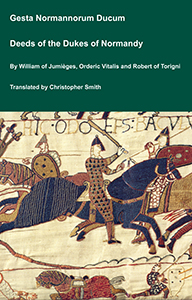
The Deeds of the Dukes of Normandy
The Gesta Normannorum Ducum [The Deeds of the Dukes of Normandy] is a landmark medieval chronicle tracing the rise and fall of the Norman dynasty from its early roots through the pivotal events surrounding the Norman Conquest of England. Originally penned in Latin by the monk William of Jumièges shortly before 1060 and later expanded at the behest of William the Conqueror, the work chronicles the deeds, politics, battles, and leadership of the Norman dukes, especially William’s own claim to the English throne. The narrative combines earlier historical sources with firsthand information and oral testimony to present an authoritative account of Normandy’s transformation from a Viking settlement into one of medieval Europe’s most powerful realms. William’s history emphasizes the legitimacy, military prowess, and governance of the Norman line, framing their expansion, including the conquest of England, as both divinely sanctioned and noble in purpose. Later chroniclers such as Orderic Vitalis and Robert of Torigni continued the history, extending the coverage into the 12th century, providing broader context on ducal rule and its impact. Today this classic work remains a foundational source for understanding Norman identity, medieval statesmanship, and the historical forces that reshaped England and Western Europe between 800AD and 1100AD.
Available at Amazon in eBook and Paperback format.
In 1458 [his daughter] Maud Herbert Countess Northumberland was born to William Herbert 1st Earl Pembroke [aged 35] and [his wife] Anne Devereux [aged 28]. She married before 14th January 1478 her sixth cousin Henry Percy 4th Earl of Northumberland, son of Henry Percy 3rd Earl of Northumberland and Eleanor Poynings Countess Northumberland, and had issue.
In 1461 William Herbert 1st Earl Pembroke [aged 38] was created 1st Baron Herbert of Raglan.
Patent Rolls. 8th May 1461. York [Map]. Grant for life to William Herbert [aged 38], knight, of the offices of office of chief justice and chamberlain of South Wales, steward of the commontes in the counties of Caermarthen and Cardigan, and chief forester in those counties (Carmarthenshire,Cardiganshire).
Warkworth's Chronicle [1461-1474]. [27th June 1461] As for alle thynges that folowe, referre them to my copey, in whyche is wretyn a remanente lyke to this forseyd werke: that is to wytt, that, at the coronacyone1 of the forseyde Edwarde, he create and made dukes his two brythir, the eldere George [aged 11] Duke of Clarence, and his yongere brothir Richard [aged 8] Duke of Gloucetre; and the Lord Montagu [aged 30]2, the Earl of Warwick [aged 32]'s brothere, the Earl of Northumberlonde; and one William Stafford squiere, Lord Stafforde of Southwyke; and Sere Herbard [aged 38], Lorde Herbard, and after Lorde Earl of Penbroke3; and so the seide Lorde Stafforde [aged 22] was made Earl of Devynschire4; the Lorde Gray Ryffyne [aged 44], Earl of Kent6; the Lorde Bourchyer [aged 57], Earl of Essex; the Lorde Jhon of Bokyngham [aged 33], the Earl of Wyltschyre5; Sere Thomas [Walter] Blount [aged 45]7, knyghte, Lord Mont[joy]; Sere Jhon Hawarde, Lorde Hawarde [aged 36]8; William Hastynges [aged 30] he made Lorde Hastynges and grete Chamberlayne; and the Lorde Ryvers; Denham squyere, Lorde Dynham; and worthy as is afore schewed; and othere of gentylmen and yomenne he made knyghtes and squyres, as they hade desserved.
Note. The Warkworth Chronicle, in Bernard's Catalogue of the Peterhouse manuscripts, taken from James's Eclogæ, is numbered - 230. It may be as well to observe that John Bagford mentions a contemporary Chronicle in English MS. of the events of the commencement of Edward's reign, in MS. Tann. Bodl. 453.
Note 1. At the coronacyone. King Edward was crowned in Westminster Abbey, on the 29th of June 1461. Warkworth's first passage is both imperfect and incorrect, and would form a very bad specimen of the value of the subsequent portions of his narrative; yet we find it transferred to the Chronicle of Stowe. It must, however, be regarded rather as a memorandum of the various creations to the peerage made during Edward's reign, than as a part of the chronicle. Not even the third peerage mentioned, the Earldom of Northumberland, was conferred at the Coronation, but by patent dated 27 May 1464: and the only two Earldoms bestowed in Edward's first year (and probably at the Coronation) were, the Earldom of Essex, conferred on Henry Viscount Bourchier, Earl of Eu in Normandy, who had married the King's aunt, the Princess Isabel of York; and the Earldom of Kent, conferred on William Neville, Lord Fauconberg, one of King Edward's generals at Towton. The former creation is mentioned by Warkworth lower down in his list; the latter is omitted altogether. - J.G.N.
Note 2. The Lord Montagu. And then Kyng Edward, concidering the greate feate doon by the said Lord Montagu, made hym Earl of Northumberlond; and in July next folowyng th'Earl of Warwyk, with th'ayde of the said Earl of Northumberland, gate agayn the castell of Bamborugh, wheryn was taken Sir Raaf Gray [aged 29], which said Ser Raaf was after behedid and quartred at York. Also, in this yere, the first day of May, the Kyng wedded Dame Elizabeth Gray [aged 24], late wif unto the lord Gray of Groby, and doughter to the Lord Ryvers." - The London Chronicle, MS. Cotton. Vitell. A. xvi. fol. 126, ro. The MS. of the London Chronicle, from which Sir Harris Nicolas printed his edition, does not contain this passage. It is almost unnecessary to remark the chronological incorrectness of the above, but it serves to show how carelessly these slight Chronicles were compiled. Cf. MS. Add. Mus. Brit. 6113, fol. 192, rº. and MS. Cotton. Otho, B. XIV. fol. 221, ro.
Note 3. Lord Earl of Pembroke. William Lord Herbert of Chepstow, the first of the long line of Herbert Earls of Pembroke, was so created the 27th May 1468. His decapitation by the Duke of Clarence at Northampton in 1469, is noticed by Warkworth in p. 7.-J.G.N.
Note 4. Earl of Devynschire. Humphery Stafford, created Baron Stafford of Southwick by patent 24th April 1464, was advanced to the Earldom of Devon 7th May 1469; but beheaded by the commons at Bridgwater before the close of the same year, as related by Warkworth, ubi supra. - J.G.N.
Note 5. Earl of Wyltschyre. John Stafford, created Earl of Wiltshire, 5th Jan. 1470; he died in 1473.—J.G.N.
Note 6."The Lorde Gray Ryffyne, Earl of Kent". The Earl of Kent, of the family of Neville, died without male issue, a few months after his elevation to that dignity; and it was conferred on the 30th May 1465, on Edmund Lord Grey de Ruthyn, on occasion of the Queen's coronation. He was cousin-german to Sir John Grey, of Groby, the Queen's first husband. On the same occasion the Queen's son Sir Thomas Grey [aged 6] was created Marquess of Dorset; her father Richard Wydevile [aged 56] lord Ryvers was advanced to the dignity of Earl Ryvers; and her brother Anthony [aged 21] married to the heiress of Scales, in whose right he was summoned to Parliament as a Baron. - J.G.N.
Note 7.Sere Thomas Blount. This should be Walter, created Lord Montjoy 20th June 1465; he died in 1474.-J.G.N.
Note 8. Sere Jhon Hawarde, Lord Hawarde. John Howard 1st Duke of Norfolk. This peerage dates its origin, by writ of summons to Parliament, during the short restoration of Henry VI. in 1470, a circumstance more remarkable as "evidence exists that he did not attach himself to the interest of that Prince, being constitued by Edward, in the same year, commander of his fleet." See Sir Harris Nicolas's memoir of this distinguished person (afterwards the first Duke of Norfolk) in Cartwright's History of the Rape of Bramber, p. 189.-J.G.N.
In 1462 King Edward IV of England [aged 19] appointed new Garter Knights:
187th John "Butcher of England" Tiptoft 1st Earl of Worcester [aged 34].
188th William Hastings 1st Baron Hastings [aged 31].
189th John Neville 1st Marquess Montagu [aged 31].
190th William Herbert 1st Earl Pembroke [aged 39].
191st John Astley.
Warkworth's Chronicle [1461-1474]. [December 1462] And after that, the castelle of Bamburght was yoldene to the Kynge, by treyatte and apoyntment by Herry the Duke of Somersett [aged 26] that kept it, and came in to Kynge Edwardes grace, whiche graunted to hym a Ml, marke by yere, whereof he was not payede, the[r]for he departed oute of England after halff yere into Scotlonde, &c, And so Kynge Edward was possessed of alle England, excepte a castelle in Northe Wales called Harlake [Map]1, whiche Sere Richard Tunstall [aged 35] kepte, the qwhiche was gotene afterwarde by the Lorde Harberde [aged 39]7,
Note 1. Excepte a castelle in Northe Wales called Harlake. I cannot resist the temptation of taking the following lines from the poems of Lewis Glyn Cothi, relative to the future siege of Harlech
"Doves â'i wyr, divasw wedd,
Dareni daiar Wynedd;
Jarll, ond ev a'r llu, nid â
Ar wddv Eryri Wyddva.
Dau er ei chael dri a chwech,-
Un dân harddlun yw Harddlech.
Tynu â gwyr tònau gwin
Peiriannus, val mab brenin.
Uchel ewri a chlariwns,
A tharvu gwyr â thwrv gwns;
Saethu 'mhob parth saith mil pen,
A'u bwa o bob ywen:
Clod wellwell, cludaw allan
Goed mawr a fagodau mân;
O wartha 'r rhai'n, hyd yr hwyr,
Arvogion a'u rhyvagwyr.
Trwy'r tair gwart Herbart hirborth
Ty'nu'r pen capten i'r porth.
Ennillodd, eu ewyllys,
Y brenin lech Bronwen Lys.
Hywel Davydd ab Jevan ab Rhys.
As no translation is added in the published works of Glyn Cothi, may be as well to give one here;
"He tamed, in no trifling manner,
The lofty heights of Gwyneth2; No earl, save him and his followers, could ever mount
Upon the neck of Snowdon, the Alpine of Eryri.3
There would climb up, to gain the ascent,
Now three, -now six men, all at once;
One beautifully formed fiery blaze is Harddlech4
Men drawing from men waves of wine5, -
Loud the shouting - loud the blasts of clarions;
Scattering of men, thundering of guns;
Arrows flying in every quarter from seven thousand men,
Using bows made of the yew.
Bravo! bravo! they bring out large trees and faggots;
They pile them up, and, behind the pile,
Armed men are placed to continue there ' til night.
Then Herbert, through the three wards,
Brings forth the head captain in the porch.
Thus King Edward, as it were, with one volition,
Gained possession of Bronwen's Court."
This place was possessed in 1468 by Dafydd ap Jeuan ap Einion, - a strong friend of the house of Lancaster, distinguished for his valour and great stature. He was besieged here by William Herbert, Earl of Pembroke, after a march through the heart of our Alps, attended with incredible difficulties; for in some parts, the soldiers were obliged to climb; in others, to precipitate themselves down the rocks; and, at length, invested a place till that time deemed impregnable.
The Earl committed the care of the siege to Sir Richard, a hero equal in size to the British commandant. Sir Richard sent a summons of surrender, but Dafydd stoutly answered that he had kept a castle in France so long, that he made all the old women in Wales talk of him; and that he would keep this so long, that all the old women in France should also talk of him. He at last surrendered, and Herbert had a hard struggle with Edward's barbarous policy to save the noble defender's life. - Pennant's Tour in Wales, vol. II. p. 121-2. Margaret of Anjou found refuge in this Castle after the unfortunate battle of Northampton; and it has been conjectured that the song of "Farwel iti Peggy Ban" was composed on the occasion of her quitting it. On the peculiar advantages of the position of this castle, see The Cambrian Traveller's Guide, p. 574.
Note 2. North Wales.
Note 3. The mountains surrounding Snowdon.
Note 4. This couplet is metaphorical of the rapidity of Herbert's motions.
Note 5. i.e. streams of blood.
Note 6. The castle was anciently called Twr Bronwen, after Bronwen, daughter of Llyr (King Lear), and aunt to the great Caractacus. See The Cambro - Briton, ii. 71. She is the subject of an old Welsh Romance.
Note 7. By the Lorde Harberde. "Et castrum forte in Wallia per dominum Harbarde captum est, et Dominus Ricardus Tunstalle, cum ceteris ibi inventis, captus est, et in Turri Londonie clausus, qui tum in breve gratiam a Rege consecutus est. Duo nobiles ex illic capti decollati sunt [And a strong castle in Wales was captured by Lord Harbarde, and Lord Richard Tunstalle, along with others found there, was captured and imprisoned in the Tower of London, who then shortly obtained favour from the King. Two nobles captured there were beheaded]." - MS. Arundel, Coll. Arm. 5, fol. 171, rº. There is a grant to Lord Herbert for his services in Rot. Pat. 3 Edw. IV.
Around 1464 [his daughter] Katherine Herbert Countess Kent was born to William Herbert 1st Earl Pembroke [aged 41] and [his wife] Anne Devereux [aged 34] at Raglan Castle [Map]. She married before 1485 her sixth cousin George Grey 2nd Earl Kent, son of Edmund Grey 1st Earl Kent and Katherine Percy, and had issue.
On 1st September 1466 a double wedding ceremony was held whereby two siblings, children of William Herbert, 1st Earl of Pembroke [aged 43] married:
William Herbert 2nd Earl Pembroke 1st Earl Huntingdon [aged 15] and Mary Woodville Countess Pembroke and Huntingdon [aged 10] were married. See Woodville Marriages. She the daughter of Richard Woodville 1st Earl Rivers [aged 61] and Jacquetta of Luxembourg Duchess Bedford [aged 51]. He the son of William Herbert 1st Earl Pembroke and Anne Devereux [aged 36].
Thomas Talbot 2nd Viscount Lisle [aged 17] and Margaret Herbert Viscountess Lisle were married. She the daughter of William Herbert 1st Earl Pembroke and Anne Devereux. They were half fifth cousin once removed. He a great x 5 grandson of King Edward I of England.
On 27th May 1468 William Herbert 1st Earl Pembroke [aged 45] was created 1st Earl Pembroke.
On 24th July 1469 the Yorkist army suffered a defeat against a Lancastrian army led by Robin of Redesdale at the Battle of Edgecote Moor at Danes Moor, Edgecote, Banbury [Map]. The Yorkist army was commanded by Humphrey Stafford 1st Earl Devon [aged 30] and William Herbert 1st Earl Pembroke [aged 46].
[his half-brother] Thomas Vaughan [aged 69], John Wogan, Henry Neville [aged 32], John Conyers [aged 36], and brothers John Dudley [aged 42] and Oliver Dudley were killed.
Humphrey Stafford 1st Earl Devon, John Conyers [aged 58] and William Parr [aged 35] fought.
Richard Woodville 1st Earl Rivers [aged 64] and John Woodville [aged 24] were captured.
On 27th July 1469 William Herbert 1st Earl Pembroke [aged 46] was executed following his capture at the Battle of Edgecote Moor. His son William [aged 18] succeeded 2nd Earl Pembroke, 2nd Baron Herbert of Raglan. Mary Woodville Countess Pembroke and Huntingdon [aged 13] by marriage Countess Pembroke.
A Brief Latin Chronicle. 24th July 1469. In this year also, on the eve of Saint James the Apostle, a conflict [Battle of Edgecote Moor] occurred between the northern soldiers and warriors against Lord Herbert [aged 46] and his Welshmen. Many fell on both sides; and Lord Herbert, along with two brothers, was captured. He was shortly thereafter beheaded at Northampton [Map]. This W. Herbert, a most severe oppressor and despoiler of ecclesiastics and many others over many years, finally received this reward by the just judgment of God for his crimes and wickedness.
Hoc etiam anno in vigilia Sancti Jacobi Apostoli, facto conflictu militum et belligerorum borealium contra dominum Harberd cum suis Wallensibus, ceciderunt hine et inde multi; et dominus Harberd cum duobus fratribus sus captus est, et infra breve apud Northampton decapitatus est. His W. Harberd, gravissimus et oppressor et spoliator ecclesiasticorum et aliorum multorum per annos multos, hanc tandem justi Dei judicio pro suis sceleribus et nequiciis receipt mercedem.
Works of Gutor Glyn. Poem about the death of William Herbert 1st Earl Pembroke [aged 46] who was executed on Thursday 27th July 1469 following his capture at the Battle of Edgecote Moor aka Danes Moor aka Banbury fought on Monday 24th July 1469.
| LIII MARWNAD WILIAM HERBART IARLL PENFRO | 53. Elegy for William Herbert, Earl of Pembroke | |
| Dawns o Bowls, doe'n ysbeiliwyd, | The Dance of St Paul’s1, yesterday we were plundered, | |
| Dwyn yr holl dynion i'r rhwyd. | All men were drawn into the net. | |
| Dawns gwŷr dinas y Garrai, | The dance of the men of the City of the Thong2 [Doncaster], | |
| Dawns yr ieirll (dawn nes i rai). | The dance of the earls, it draws nearer to some. | |
| Duw Llun y bu waed a lladd, | On Monday there were bloodshed and slaughter, | 5 |
| Dydd amlwg, diwedd ymladd. | A conspicuous day, the end of battle. | |
| Duw a ddug y dydd dduw Iau | On Thursday God took away | |
| Iarll Dwywent a'r holl Deau. | The Earl of the two Gwents and of all the South. | |
| Marchog a las dduw Merchyr, | A knight [deceased] was slain on Wednesday, | |
| Mwy ei ladd no mil o wŷr; | His death outweighed that of a thousand men, | 10 |
| Syr Risiart, ni syr lesu | Sir Richard, Jesus will not be angry | |
| Wrtho, er lladd North a'r llu. | With him for slaying the North and its host. | |
| Duw-Mawrth, gwae ni am Domas, | On Tuesday, alas for us, Thomas [deceased]4 fell, | |
| Duw Llun gyda'i frawd y llas. | On Monday he was slain beside his brother. | |
| Dwyn yr iarll a'i bedwarllu, | The taking of the earl and his fourfold host | 15 |
| Dydd farn yr anrhydedd fu. | Was a Day of Judgement for honour. | |
| Arglwydd difwynswydd Defnsir | The dishonourable Lord of Devon [aged 30]5 | |
| A ffoes, ni chafas oes hir. | Fled, and did not live long. | |
| Bradwyr a droes brwydr a drwg | Traitors turned battle and calamity | |
| Banbri i'r iarll o Benbrwg. | At Banbury against the Earl of Pembroke. | 20 |
| Cad drycin am y drin draw, | A storm of battle arose from that conflict, | |
| Carliaid a wnaeth y curlaw. | Base men brought about the deluge. | |
| Ymladd tost am laddiad hwn | The journey to Northampton | |
| A wna'r hynt i Norhantwn. | Will bring fierce fighting in vengeance for this death. | |
| Awn oll i ddial ein iaith | Let us all go to avenge our nation | 25 |
| Ar ddannedd y Nordd unwaith ; | Upon the teeth of the North at once. | |
| A dyludwn hyd Lydaw | And let us pursue them as far as Brittany, | |
| Dan draed y cyffredin draw, | Trampling those common men beneath our feet. | |
| Ef â'r gwyr, a fu ar gam, | May he and the men who acted wrongfully | |
| Oll i ddiawl, yn lladd Wiliam. | All go to the devil for killing William. | 30 |
| O rhoed, lle'i bu anrhydedd, | Where honour once rested, let armour or a sword | |
| Ar fwnwgl iarll arf neu gledd, | Now be placed upon an earl’s neck. | |
| (Och Fair!) gnodach fu arwain | Alas, Mary, more often he was accustomed to wear | |
| Aerwy mawr o aur a main. | A great collar of gold and precious stones. | |
| Doe'dd aeth dan y blaned ddu | Yesterday he went beneath the dark planet, | 35 |
| Drwy'r Fâl draw i ryfelu. | Through the Vale [Map], to wage war. | |
| Och finnau, ucho f'anhun, | Alas for me, above my sleep, | |
| Nad arhôi'n ei dir ei hun! | That he did not remain in his own land! | |
| Ymddiried I'r dynged wan | He trusted in frail fate, | |
| A'i twyllodd o Went allan. | Which deceived him out of Gwent. | 40 |
| Tair merched, tair tynged hon, | Three maidens, these three Fates7, | |
| Y sy'n dwyn oes ein dynion. | Are carrying away the lives of our men. | |
| Un a gynnail cogeilyn ; | One holds the distaff, | |
| Arall a nydd dydd pob dyn. | Another spins each man’s days. | |
| Trydedd yn torri edau | The third cuts the thread, | 45 |
| Er lladd iarll a'r llu dduw Iau. | To slay the earl and the host on Thursday. | |
| Mynnwn fy mod ymannos | I wish that I had been nearby, | |
| Yn torri pen Atropôs. | Cutting off Atropos’s head. | |
| Nid rhan y tair a henwais | It is not the task of the three I have named | |
| Nyddu oes hir yn nydd Sais. | To spin a long life in an Englishman’s day. | 50 |
| Os gwir i blant Alis gau, | If it is true that the false children of Alis8, | |
| Draeturiaid, dorri tyrau, | Traitors, have broken the towers, | |
| Ni ddói'r iangwyr, ni ddringynt | The young men would not come, nor would they climb | |
| I dai'r gWr na'i dyrau gynt. | To the man’s halls or his towers as before. | |
| Gwinllan fu Raglan ir iaith, | Raglan was a vineyard for our nation, | 55 |
| Gwae ni wjl ei gwin eilwaith ! | Alas for us to see its wine once more! | |
| Gwae a weles ar galan | Alas for him who saw, at the New Year, | |
| Gynnal gwledd ar ganol glan ! | A feast held beside the riverbank! | |
| Gwae a geisio rodio rhawg | Alas for anyone who seeks to wander long | |
| Gwent dlawd oedd gynt oludawg! | Through poor Gwent, which once was rich! | 60 |
| Ei farw oedd well i fardd iach | His death was better for a sound poet | |
| Heb ei bwyll no byw bellach. | Who had lost his wits than living on. | |
| Merddin Wyllt am ei urddas | Myrddin Wyllt9, for his lord’s honour, | |
| Amhorfryn, aeth i'r glyn glas; | Son of Morfryn, went to the green valley, | |
| Af yn wyllt o fewn elltydd | I shall go mad among the wooded slopes, | 65 |
| I eiste' rhwng clustiau'r hydd. | To sit between the stag’s ears. | |
| Ef a'm llas i am nasiwn | He killed me for my nation | |
| Yr awr y llas yr iarll hwn. | At the hour when this earl was slain. | |
| Cymro oedd yn ffrwyno Ffrainc, | He was a Welshman who curbed France, | |
| Camreol Cymry ieuainc. | A leader of young Welshmen. | 70 |
| Ofn i bawb tra fu'n y byd, | He was feared by all while he lived, | |
| Yn iach ofn, oni chyfyd. | Farewell to fear, unless he rises again. | |
| Ymgyrchu i Gymru a gân', | They will march against Wales and sing, | |
| Ymsaethu 'Mhowys weithian. | They will shoot in Powys now. | |
| Doed aliwns, nis didolir, | Let an alliance come, they will not be divided, | 75 |
| O dôn', pwy a'u lludd i dir? | From overseas, who will prevent their landing? | |
| Llusgynt wŷr, llosgen' eu tai, | They will drag men away and burn their houses, | |
| Lladdwyd y neb a'u lluddiai. | The man who hindered them has been slain. | |
| Traws eto rhag trais atyn', | There is still a defence against violence against us, | |
| Tra ater Syr Rosier ynn. | So long as Sir Roger [aged 59]10 remains with us. | 80 |
| Tri mab iarll, nid trwm y byd, | Three sons of an earl11, the world is not bleak, | |
| Tri a ostwng ein tristyd. | Three who will lessen our sorrow. | |
| Un o'i hil yn neheuwlad | One of his line in the southern land | |
| A gyrraedd dwyn gradd ei dad. | Will attain and inherit his father’s rank. | |
| Iarll oedd, Cymru oll iddo, | He was an earl, all Wales was his, | 85 |
| Iarll o'i fab arall a fo. | May another of his sons become an earl. |
Note 1. The Dance of St Paul’s. The Dance of Death was a popular performance, in which Death led twenty-four representatives of every age and social class to the grave. This dance was depicted in many forms, media and places. 'There was a Dance of Death painted round the cloister of old St Paul’s in London, in the reign of Henry VI'. Guto had seen the image, and to him the slaughter at Banbury was an imitation of the Dance of St Paul’s, with Death 'drawing all the men into the net'. Line 2. On that day Death took a great prey from among both the English and the Welsh, but Guto was thinking chiefly of the earls.
Note 2. the City of the Thong: Hengist asked for as much land on which to build a castle as a thong could enclose. Vortigern promised him this. Hengist then took an ox-hide, cut it into a single thong and enclosed a considerable piece of land. There he built a fortress, 'which was formerly called Caer y Garrai by the Britons, but is now called Doncaster by the English, that is, Thong-Chester'.
Note 3. It was Richard Herbert who was executed on Wednesday 26th July 1469 although Ifor Evans suggests Henry Neville [deceased].
Note 4. Thomas Vaughan of Bredwardine, executed Tuesday 25th July 1469.
Note 5. Humphrey Stafford 1st Earl Devon.
Note 6. Dore Abbey, Herefordshire [Map], in the Golden Valley.
Note 7. The Fates, namely Clotho, who spins the thread of life, Lachesis, who determines the length of the thread, and Atropos, who cuts it.
Note 8. That is, the English, the children of Alis Rhonwen.
Note 9. Myrddin ap Morfryn: that is, Myrddin Wyllt, who went mad and fled to the Caledonian Forest after losing his patron, Gwenddolau, at the Battle of Arfderydd.
Note 10. Probably Roger Vaughan, brother of Thomas who is referred to in line 13.
Note 11. 81. Three sons of an earl: Richard [aged 27], William [aged 18] and Walter [aged 17], sons of the Earl of Pembroke.
Warkworth's Chronicle [1461-1474]. 12th August 1469 And at that tyme was the Lorde Ryvers [aged 64] takene, and one of his sonnes [aged 24], in the forest of Dene, and brought to Northamtone, and the Earl of Penbroke [deceased] a[nd] Sere Richard Herbarde [deceased] his brother were behedede at Northamtone, alle iiij, by the commawndement of the Duke of Clarence and the Earl of Warwick [aged 40], and Thomas Harbarde was slayne at Brystow, &c.
Note 1. "Hic W. Harberde, gravissimus et oppressor et spoliator ecclesiasticorum et aliorum multorum per annos multos, hunc tandem, justo Dei judicio pro suis sceleribus et nequiciis, receepit.mercedem. Die Sabbati proximo ante assumpcionem beatissime semper Virginis Marie, captus est Dominus de Rywaus, cum domino Johanne filio suo, et, juxta castrum de Kelingworthe, pariter decollati sunt [Here W. Herbert, the most grievous oppressor and plunderer of the Church and many others for many years, finally received the just reward for his crimes and wickedness by the judgment of God. On the Saturday next before the assumption of the most blessed Virgin Mary, the Lord Rivers was captured, along with his son John, and they were both beheaded near the castle of Kelingworth]." - MS. Arundel, Coll. Arm. fol. 171 rº.
After 1486 [his former wife] Anne Devereux [deceased] died.
Chronicle of Walter of Guisborough
A canon regular of the Augustinian Guisborough Priory, Yorkshire, formerly known as The Chronicle of Walter of Hemingburgh, describes the period from 1066 to 1346. Before 1274 the Chronicle is based on other works. Thereafter, the Chronicle is original, and a remarkable source for the events of the time. This book provides a translation of the Chronicle from that date. The Latin source for our translation is the 1849 work edited by Hans Claude Hamilton. Hamilton, in his preface, says: 'In the present work we behold perhaps one of the finest samples of our early chronicles, both as regards the value of the events recorded, and the correctness with which they are detailed; Nor will the pleasing style of composition be lightly passed over by those capable of seeing reflected from it the tokens of a vigorous and cultivated mind, and a favourable specimen of the learning and taste of the age in which it was framed.'
Available at Amazon in eBook and Paperback format.
In 1557 Giles Strangeways [aged 28] saw military service in France under William Herbert 1st Earl Pembroke.
[his daughter] Anne Herbert Baroness Grey Powis was born to William Herbert 1st Earl Pembroke and Anne Devereux. She married before 1485 John Grey 1st Baron Grey of Powis, son of Richard Grey 3rd Earl Tankerville and Margaret Tuchet Countess Tankerville, and had issue.
[his daughter] Cecilie Herbert was born to William Herbert 1st Earl Pembroke and Anne Devereux.
[his daughter] Margaret Herbert Viscountess Lisle was born to William Herbert 1st Earl Pembroke and Anne Devereux. She married her half fifth cousin once removed Thomas Talbot 2nd Viscount Lisle, son of John Talbot 1st Viscount Lisle and Joan Cheddar Viscountess Lisle.
[his daughter] Isabel Herbert was born to William Herbert 1st Earl Pembroke and Anne Devereux. She married 1482 Thomas Greville.
[his son] George Herbert was born to William Herbert 1st Earl Pembroke.
[his father] William ap Thomas "Blue Knight of Gwent" Herbert and Elizabeth Bluet were married.
[his son] Philip Herbert was born to William Herbert 1st Earl Pembroke and Anne Devereux.
[his son] William Herbert was born to William Herbert 1st Earl Pembroke.
A Brief Latin Chronicle. Also in this year, the Earl of Worcester accomplished many praiseworthy deeds in Ireland, and a strong castle in Wales [Harlech Castle [Map]] was captured by Lord Herbert. Sir Richard Tunstall, along with others found there, was taken prisoner and confined in the Tower of London; however, he soon after obtained the king's pardon. Two noblemen captured there were beheaded.
Hoc etiam anno Comes de Wircester multa laude digna peregit in Hibernia, et castrum forte in Wallia per dominum Harbard captum est, et dominus Ricardus Tunstall cum ceteris ibi inventis captus est et in Turri London. Clausus, qui tamen in breve graciam a rege consecutus est. Duo nobiles ex illic captis decollati sunt.
William Herbert 1st Earl Pembroke 
Great x 4 Grandfather: Enion Sais Brecon
Great x 3 Grandfather: Hywel Brecon
Great x 2 Grandfather: Hywel Fychan Brecon
Great x 1 Grandfather: Llewellyn Brecon
Grandfather: Dafydd Gam Brecon
Mother: Gwladys ferch Dafydd Gam "Star of Abergavenny" Brecon