

On 17th August 1755 Thomas Stothard was born. His parent's only child.
In 1778 Thomas Stothard [aged 22] became a student at the Royal Academy.
In 1783 Thomas Stothard [aged 27] and Rebecca Watkins were married. They had eleven children, of whom six – five sons and one daughter – survived infancy.

1785. Thomas Stothard [aged 29]. Engraving of General, future President, George Washington [aged 52].
On 5th July 1786 [his son] Charles Alfred Stothard was born to Thomas Stothard [aged 30] and [his wife] Rebecca Watkins. He married February 1818 Anna Eliza Kempe.
In 1792 Thomas Stothard [aged 36] was elected Associate of the Royal Academy.
In 1794 Thomas Stothard [aged 38] was elected Fellow of the Royal Academy.
In 1797 [his son] Robert Thomas Stothard was born to Thomas Stothard [aged 41] and [his wife] Rebecca Watkins.
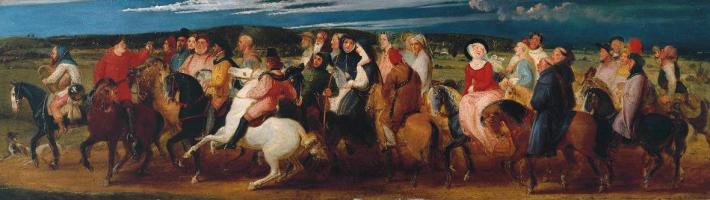
1806 to 1807. Thomas Stothard [aged 50]. The Pilgrimage to Canterbury.

The True Chronicles of Jean le Bel Volume 1 Chapters 1-60 1307-1342
The True Chronicles of Jean le Bel offer one of the most vivid and immediate accounts of 14th-century Europe, written by a knight who lived through the events he describes, and experienced some of them first hand. Covering the early decades of the Hundred Years’ War, this remarkable chronicle follows the campaigns of Edward III of England, the politics of France and the Low Countries, and the shifting alliances that shaped medieval warfare. Unlike later historians, Jean le Bel writes with a strong sense of eyewitness authenticity, drawing on personal experience and the testimony of fellow soldiers. His narrative captures not only battles and sieges, but also the realities of military life, diplomacy, and the ideals of chivalry that governed noble society. A key source for Jean Froissart, Le Bel’s chronicle stands on its own as a compelling and insightful work, at once historical record and literary achievement. This translation builds on the 1905 edition published in French by Jules Viard, adding extensive translations from other sources Rymer's Fœdera, the Chronicles of Adam Murimuth, William Nangis, Walter of Guisborough, a Bourgeois of Valenciennes, Geoffrey le Baker of Swinbroke and Richard Lescot to enrich the original text and Viard's notes.
Available at Amazon in eBook and Paperback format.
Georgian Memoirs. In 1810, he painted a picture of the death of Richard the Second in Pomfret Castle [Map], in which the costume of the period was strictly adhered to, and the portrait of Richard taken from his effigy in Westminster Abbey. It was received with unanimous approbation upon its exhibition at Somerset House, and indicated superior talents, in the artist, for historical painting. This branch of his art, however, he was also induced to forego, in consequence of an attachment he had formed with a [his future daughter-in-law] Miss Kempe [aged 19], to whom he was subsequently married. A more lucrative mode of occupation than that of historical portrait painting, had suggested itself to him as far back as the year 1802, when he accompanied his father to Burleigh House, the seat of the Marquess of Exeter. Mr. Stothard, senior [aged 54], was employed to decorate the staircase of this mansion; and, whilst thus occupied, observed to his son, it would be to his future advantage, to fill up his time, by making drawings from the monuments in the neighbouring churches, as useful authorities for costume. His son followed his advice, and thus received the first bias of his mind towards a subject which he now resolved to make his pursuit. The hint for the design, which he afterwards carried into effect, was first given him by a sight of some very clever unpublished etchings, by the Rev. P. Kerrich, of Cambridge, from monuments in the Dominicans and other churches in Paris. This suggested to him the idea of a work on The Monumental Effigies of Great Britain, of which the first number appeared in June, 1811, accompanied by an advertisement, stating that the objects of the undertaking were to afford the historical painter a complete knowledge of the costume adopted in England, from an early period of history to the reign of Henry the Eighth; to illustrate, at the same time, history and biography; and, lastly, to assist the stage in selecting its costume with propriety, for the plays of our great dramatic bard. Such a work was, undoubtedly, a great desideratum; for, whatever information is to be derived from Mr. Gough's writings, in his voluminous publication of the same kind, the delineating part, as Mr. Stothard observes, in an essay found after his death, is so extremely incorrect and full of errors, that, at a future period, when the originals no longer exist, it will be impossible to form any correct idea of what they really were.
In 1810 Thomas Stothard [aged 54] was appointed Deputy Librarian to the Royal Academy.
In February 1818 Charles Alfred Stothard [aged 31] and Anna Eliza Kempe [aged 27] were married. He the son of Thomas Stothard [aged 62] and Rebecca Watkins.

1819. George Henry Harlow [aged 31]. Portrait of Thomas Stothard [aged 63].
On 28th May 1821 [his son] Charles Alfred Stothard [aged 34] died as a consequence of falling off a ladder while tracing a portrait from one of the windows at St Andrew's Church, Bere Ferrers [Map] in which churchyard he was subsequently buried.
In 1825 [his wife] Rebecca Watkins died.
On 27th April 1834 Thomas Stothard [aged 78] died.
Life of Thomas Stothard RA with Personal Reminiscences by Mrs Bray. LIFE OF THOMAS STOTHARD, R.A WITH PERSONAL REMINISCENCES By [his former daughter-in-law] MRS. BRAY [aged 60], Author of "The Borders of the Tamar and the Tary", "Memoirs of Charles A. Stothard, F.S.A", "Trelawny", "Trials of the Heart," &c.,&c.
[his son] Alfred Stothard was born to Thomas Stothard and Rebecca Watkins.