

County Meath is in Province of Leinster.
Around 1435 Richard Dillon was born to Robert Dillon [aged 43] at County Meath.
In 1553 Margaret Eliot was born at Balriske.
In 1468 Thomas Fitzgerald 7th Earl Desmond and Thomas Fitzgerald 7th Earl of Kildare [aged 47] attended Parliament in Drogheda [Map] to answer charges of treason. Both were found guilty and attainted. Thomas Fitzgerald 7th Earl Desmond sought sanctuary in Drogheda Priory [Map] where he was captured by John "Butcher of England" Tiptoft 1st Earl of Worcester [aged 40]. On 14th February 1468 Thomas Fitzgerald 7th Earl Desmond was summarily beheaded. He was buried initially in St Peter's Church Drogheda [Map] then Christ Church Cathedral, Dublin [Map]. Some accounts claim John "Butcher of England" Tiptoft 1st Earl of Worcester also murdered two of his young sons. Thomas Fitzgerald 7th Earl of Kildare escaped and was subsequently pardoned and attainder reversed when King Edward IV found Ireland was ungovernable without him. In 1470 Thomas Fitzgerald 7th Earl of Kildare was appointed Lord Deputy of Ireland under George York 1st Duke of Clarence [aged 18] which position he held until the Duke's death in 1478.
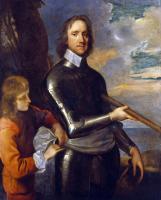
Between 3rd September 1649 and 11th September 1649, Drogheda [Map], under the command of the Royalist Arthur Aston [aged 59], was besieged by the Parliamentary army commanded by Oliver Cromwell [aged 50].
On 11th September 1649 Oliver Cromwell had a letter delivered to Sir Arthur Aston, which proposed his Aston's surrender; Aston refused.
At 5:00 PM Cromwell ordered simultaneous assaults on the southern and eastern breaches in the walls of Drogheda.
At the southern breach, the defenders counterattacked. The death of their commander, Colonel Wall, caused them to fall back, allowing further Parliamentary reinforcements to be funnelled into the breach. In the fighting at the walls some 150 Parliamentarian troops, including Colonel Castle, were killed.
After the death of Colonel Wall with more and more Parliamentary soldiers streaming into the breaches, the Royalist resistance at the walls collapsed.
In Cromwell's words, "In the heat of the action, I forbade them [his soldiers] to spare any that were in arms in the town...and, that night they put to the sword about two thousand men".
The execution of Royalists constinued as and when they were discovered.
Around one hundred Royalists were discovered in St Peter's Church - Cromwell ordered the church and those inside to be burned.
Arthur Aston was killed.
John Evelyn's Diary. 24th June 1690. Dined with Mr. Pepys [aged 57], who the next day was sent to the Gatehouse, and several great persons to the Tower [Map], on suspicion of being affected to King James [aged 56]; among them was the Earl of Clarendon, the Queen's [aged 28] uncle. King William [aged 39] having vanquished King James in Ireland, there was much public rejoicing. It seems the Irish in King James's army would not stand, but the English-Irish and French made great resistance. Schomberg [aged 74] was slain, and Dr. Walker, who so bravely defended Londonderry. King William received a slight wound by the grazing of a cannon bullet on his shoulder, which he endured with very little interruption of his pursuit. Hamilton [aged 55], who broke his word about Tyrconnel [aged 60], was taken. It is reported that King James is gone back to France. Drogheda [Map] and Dublin [Map] surrendered, and if King William be returning, we may say of him as Cæsar said, "Veni, vidi, vici". But to alloy much of this, the French fleet rides in our channel, ours not daring to interpose, and the enemy threatening to land.
In 1756 Thomas Marlay [aged 76] died at Drogheda [Map].
In 1468 Thomas Fitzgerald 7th Earl Desmond and Thomas Fitzgerald 7th Earl of Kildare [aged 47] attended Parliament in Drogheda [Map] to answer charges of treason. Both were found guilty and attainted. Thomas Fitzgerald 7th Earl Desmond sought sanctuary in Drogheda Priory [Map] where he was captured by John "Butcher of England" Tiptoft 1st Earl of Worcester [aged 40]. On 14th February 1468 Thomas Fitzgerald 7th Earl Desmond was summarily beheaded. He was buried initially in St Peter's Church Drogheda [Map] then Christ Church Cathedral, Dublin [Map]. Some accounts claim John "Butcher of England" Tiptoft 1st Earl of Worcester also murdered two of his young sons. Thomas Fitzgerald 7th Earl of Kildare escaped and was subsequently pardoned and attainder reversed when King Edward IV found Ireland was ungovernable without him. In 1470 Thomas Fitzgerald 7th Earl of Kildare was appointed Lord Deputy of Ireland under George York 1st Duke of Clarence [aged 18] which position he held until the Duke's death in 1478.
In 1468 Thomas Fitzgerald 7th Earl Desmond and Thomas Fitzgerald 7th Earl of Kildare [aged 47] attended Parliament in Drogheda [Map] to answer charges of treason. Both were found guilty and attainted. Thomas Fitzgerald 7th Earl Desmond sought sanctuary in Drogheda Priory [Map] where he was captured by John "Butcher of England" Tiptoft 1st Earl of Worcester [aged 40]. On 14th February 1468 Thomas Fitzgerald 7th Earl Desmond was summarily beheaded. He was buried initially in St Peter's Church Drogheda [Map] then Christ Church Cathedral, Dublin [Map]. Some accounts claim John "Butcher of England" Tiptoft 1st Earl of Worcester also murdered two of his young sons. Thomas Fitzgerald 7th Earl of Kildare escaped and was subsequently pardoned and attainder reversed when King Edward IV found Ireland was ungovernable without him. In 1470 Thomas Fitzgerald 7th Earl of Kildare was appointed Lord Deputy of Ireland under George York 1st Duke of Clarence [aged 18] which position he held until the Duke's death in 1478.
In 1794 Francis Johnston [aged 34] designed Townley Hall Drogheda built between 1794 and 1798.


On or before 4th February 1699, the date she was buried at Killeen, County Meath, Mabel Barnewall Countess Fingall died. She was buried on 4th February 1699.
On 18th August 1848 Captain Richard Kirby Ridgeway was born at Oldcastle, County Meath.
See Prehistoric Ireland.

1908. Robert Welch [aged 48]. Loughcrew Burial Mounds [Map].
See Prehistoric Ireland.
Druids Altar aka Rathkenny Portal Tomb [Map] is located in pastureland to the east of Rathkenny House. The tomb consists of a large capstone, approximately 3.25 meters long, 2.55 meters wide, and 0.85 meters thick, leaning diagonally on the ground. It leans against the only upright stone, the sole surviving orthostat. The underside of the capstone, estimated to weigh around 20 tons, and the north side of the orthostat are adorned with carved arches and cup-like markings known as "cups."
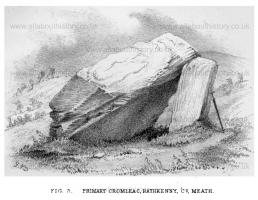
Journal of the Historical and Archaeological Association of Ireland 1868 Pages 40-46. The next illustration (see Plate facing p. 42, fig. 3) represents the "primary" or "earth-fast" cromleac of Rathkenny, Co. Meath [Druids Altar aka Rathkenny Portal Tomb [Map]]. Its general similarity to that at Headfort is at once apparent, but it is a far finer example of rude constructive skill. The inclined slab measures 10' 10" + 8' 6" + 3' 0," it slopes to the N.N.E. at an angle of 37° to the horizon, and rests against an angular undressed block of grit, measuring four feet above the ground, and 2 + 1' 6" at its sides.
The upper surface of the large stone is profusely covered with small cup-shaped hollows, some of which may be natural, and due to unequal weathering away of the calcareous portion of the grit; but many of them are certainly artificial.
Near the lower edge of this slab, and over the space between the cup-hollows, there are numerous scraped oghamic looking "graffiti," many of which are somewhat similar in character to those markings on the "earth-fast" rock at Ryefield, Co. Cavan, which I have already figured and described in our "Journal." The under surface of this stone is ornamented near its N. W. angle by a group of seven small circles, produced by rude punchings; the largest measures nine inches, and the smallest four and a half inches in diameter. The supporting stone of this cromleac is similarly decorated on its inner face by another group of semicircles, equal in size, but differently arranged to the former. My friend, Mr. Eugene Conwell, has described this singularly interesting "earth-fast" cromleac, and fully illustrated it from my sketches in the "Proceedings of the Royal Irish Academy;" vol. ix. p. 541; and he has there expressed his conviction, that this remain was never more perfect than as we now see it — an idea in which I fully concur.
Before 25th December 1230 Gilbert Lacy [aged 24] died at Trim, County Meath.
On 21st October 1314 Geoffrey Geneville 1st Baron Geneville [aged 88] died at Trim, County Meath. He was buried at Black Friary, Trim, County Meath. His granddaughter Joan [aged 28] succeeded 2nd Baroness Geneville. She and her husband Roger Mortimer 1st Earl March [aged 27] inherited the vast legacy of the de Lacy dynasty, including Ludlow Castle [Map].
Around 1592 Lucas Dillon [aged 61] died at Trim, County Meath.
On 7th May 1642 Charles Coote 1st Baronet [aged 61] was killed in Trim, County Meath during an Irish Confederacy counter-attack. His son Charles [aged 32] succeeded 2nd Baronet Coote of Castle Cuffe.
On 18th January 1425 Edmund Mortimer 5th Earl March 7th Earl of Ulster [aged 33] died at Trim Castle. He was buried at Clare Priory, Suffolk [Map]. His nephew Richard [aged 13] succeeded 6th Earl March, 5th Earl of Ulster, 8th Baron Mortimer of Wigmore.
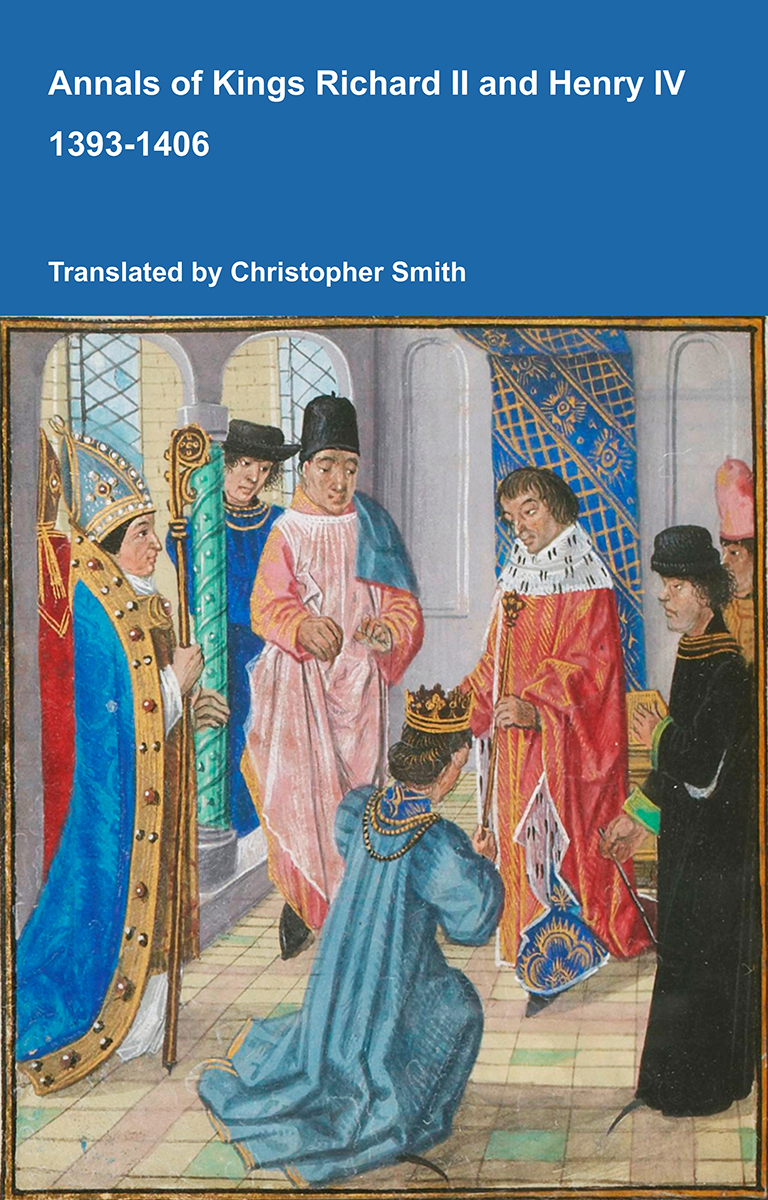 Annals of Kings Richard II and Henry IV. Meanwhile, when the King in Ireland heard the most troubling rumours of the Duke’s landing, his riding through the country, and the support given to him by the nobles and the commons of the realm, at first, as though concealing the grief he had conceived, he called to him the eldest son of the Duke of Lancaster, who had scarcely reached the years of adolescence, and said to him: "See, Henry1, my son," he said, "what your father has done to me. Truly, he has entered my land and rides through it in hostile fashion, after the manner of war, taking captive and killing my liegemen without mercy or pity. Certainly, my son, I grieve for your person, because, on account of this misfortune of your father’s, you will perhaps be deprived of your inheritance." To this the boy, although a child, nevertheless did not answer childishly, in these words: "Truly, gracious King and lord, I am greatly grieved by these rumours. But it is also clear to your lordship, as I believe, that I am innocent of my father’s deed." To him the King replied: "I know indeed that the matter carried out by your father has nothing to do with you, and therefore I hold you excused from the deed." The King then ordered the said boy to be shut up in Trim Castle, together with the son [Humphrey] of the Duke of Gloucester2, for the King had taken him too with him into Ireland, as he had also taken several sons of other lords. This was so that, if their fathers, friends, or kinsmen wished to plot anything against the King while he was acting in distant parts, they might at least, out of regard for the boys, restrain their hand and desist from what they had conceived.
Inter hæe, cum Rex audisset in Hibernia rumores molestissimos de Ducis applicatione, pariter et equitatione, atque favore procerum et regni communitatum, primo quidem, quasi dissimulans conceptam tristitiam, vocavit ad se fillium Ducis Lancastriæ seniorem, vix ad annos adolescentiæ pertingentem, et dixit ei;— "Ecce," ait, "Henrice fili, quid pater tuus fecit mihi. Revera terram meam ingressus hostiliter equitat, guerrarum more, captivans et perimens meos ligeos sine misericordia et pietate. Certe, [fili,] pro persona [tua] doleo, quia pro patris hoc infortunio privandus eris tuo fortassis patrimonio." Cui ille, licet puer, non tamen respondit pueriliter, sub hiis verbis; — "Vere, gratiose Rex, et Domine, deistis rumoribus multum doleo; sed et constat vestræ dominationi, prout æstimo, quod ego sum innocens de patris facto." Cui Rex, — "Novi autem quod nihil ad te pertinet per patrem tuum perpetratum negotium; et ideo te de facto teneo excusatum." Rex igitur dictum puerum, cum filio Ducis Gloucestriæ, jussit recludi in Castro de Trym; nam et ipsum secum Rex duxerat in Hiberniam, sieut ef plures aliorum dominorum filios; ut si eorum patres, amici, vel affines, aliquid machinari voluissent contra Regem, dum in remotis ageret, saltem intuitu puerorum manum contraherent, et desisterent à conceptis.
Note 1. Henry of Monmouth, 1386-1422, the future King Henry V.
Note 2. Humphrey, 1381-1399. His father Thomas of Woodstock's title of Duke of Gloucester was forfeit when he was executed in 1397. Humphrey succeeded his father as Earl of Buckingham; it isn't clear why the Earldom wasn't subject to his father's attainder.
