

Leeds Castle, Kent is in Leeds, Kent, Castles in Kent.
In 1312 Bartholomew Badlesmere 1st Baron Badlesmere [aged 36] was appointed Constable of Leeds Castle.
In October 1321 Margaret Clare Baroness Badlesmere [aged 34] refused entry to Isabella of France Queen Consort England [aged 26] at Leeds Castle, Kent [Map].
On 13th October 1321 Isabella of France Queen Consort England [aged 26] was returning from Canterbury, Kent [Map] to London. She sought accommodation at Leeds Castle, Kent [Map] which was under the protection of Margaret Clare Baroness Badlesmere [aged 34] the wife of Bartholomew Badlesmere 1st Baron Badlesmere [aged 46]. Margaret Clare Baroness Badlesmere refused entry to the Queen killing around six of her retinue when they tried to force entry. King Edward II of England [aged 37] commenced the Siege of Leeds Castle. Once King Edward II of England gained possession of the castle, he had the garrison hanged from the battlements. His wife Margaret Clare Baroness Badlesmere, her five children (Margery Badlesmere Baroness Ros of Helmsley [aged 13], Maud Badlesmere Countess of Oxford [aged 13], Elizabeth Badlesmere Countess Northampton [aged 8], Giles Badlesmere 2nd Baron Badlesmere [aged 6] and Margaret Badlesmere Baroness Tibetot [aged 6]), and her nephew Bartholomew "The Elder" Burghesh 1st Baron Burghesh [aged 34], were imprisoned in the Tower of London [Map].

Letters of Horace Walpole. Rochester, Kent [Map], Sunday.
We have finished our progress sadly! Yesterday after twenty mishaps we got to Sissinghurst to dinner. There is a park in ruins, and a house in ten times greater ruins, built by Sir John Balier, chancellor of the exchequer to Queen Mary. You go through an arch of the stables to the house, the court of which is perfect and very beautiful. The Duke of Bedford has a house at Cheneys, in Buckinghamshire, which seems to have been very like it, but is more ruined. This has a good apartment, and a fine gallery, a hundred and twenty feet by eighteen, which takes up one side: the wainscot is pretty and entire: the ceiling vaulted, and painted in a light genteel grotesque. The whole is built for show: for the back of the house is nothing but lath and plaster. From thence we Went to Bocton-Malherbe, where are remains of a house of the Wottons, and their tombs in the church; but the roads were so exceedingly bad that it was dark before we got thither, and still darker before we got to Maidstone: from thence we passed this morning to Leeds Castle [Map].347 Never was such disappointment! There are small remains: the moat is the only handsome object, and is quite a lake, supplied by a cascade which tumbles through a bit of a romantic grove. The Fairfaxes have fitted up a pert, bad apartment in the fore-part of the castle, and have left the only tolerable rooms for offices. They had a gleam of Gothic in their eyes, but it soon passed off into some modern windows, and some that never were ancient. The only thing that at all recompensed the fatigues we have undergone was the picture of the Duchess of Buckingham348, la Ragotte, who is mentioned in Grammont-I say us, for I trust that Mr. Chute is as true a bigot to Grammont as I am. Adieu? I hope you will be as weary with reading our history as we have been in travelling it. Yours ever.
Note 347. A very ancient and magnificent structure, built throughout of stone, at different periods, formerly belonging to the family of Crovequer. In the fifteenth of Edward II Sir Thomas de Colepeper, who was castellan of the castle, was hanged on the drawbridge for having refused admittance to Isabel, the Queen-consort, in her progress in performing a pilgrimage to the shrine of St. Thomas a Becket at Canterbury. The manor and castle were forfeited to the crown by his attainder, but restored to his son, Sir Thomas Colepeper. By his Diary of May 8, 1666, it appears to have been hired by Evelyn for a prison. "Here," he says, "I flowed the dry moat, made a new drawbridge, brought spring-water into the court of the castle to an old fountain, and took order for the repairs."-E.
Note 348. Mary, Duchess of Buckingham, only daughter of Thomas, Lord Fairfax.-E.
Archaeologia Volume 35 1853 XXXIII. Oct 1357. About the middle of October — the actual date is lost by injury of the document - the Queen [aged 62] set out from Hertford on a pilgrimage to Canterbury. She rested at Tottenham, London, Eltham, Dartford, and Rochester, in going or returning visited Leeds Castle [Map], and was again at Hertford at the beginning of November.
She gave alms to the nuns minoresses without Aldgate; to the rector of St. Edmund's in London, in whose parish her hostel was situated — it was in Lombard Street; and to the prisoners in Newgate.
Archaeologia Volume 35 1853 XXXIII. On the 4th of June [1358], Isabella [aged 63] set out on a pilgrimage to Canterbury, and a visit of nearly three weeks' duration to Leeds Castle [Map]. She rested at Tottenham on the 4th, at London on the 5th and 6th, where she received the Countess of Warren [aged 62] to dinner, and many noblemen after dinner. At Dartford on the 7th; at Rochester on the 8th, the Countess of Warren again dining with her. At Ospringe on the 9th, and at Canterbury on the 10th and 11th; entertaining there the Abbot of St. Augustine's both days. Under the division of "Alms" are recorded the Queen's oblations at the tomb of St. Thomas; the crown of his head ( the part having the tonsure, cut off by his assassins ), and point of the sword (with which he had been slain); and her payment to minstrels playing "in volta;" as also her oblations in the Church of St. Augustine, and her donations to various hospitals and religious houses in the city.
On 1st March 1378 John Devereux 1st Baron Devereux [aged 41] was appointed Constable of Leeds Castle.
Chronicle of Gregory. 1441. And in the same year there were take certayne traytourys, the whyche purposyd to slee our lege lord the kyng [aged 19] by crafte of egremauncey1, and there instrumentys were opynly shewyde to alle men at the Crosse [Map] in Powlys chyrche yerde a-pon a schaffolde i-made there-for. Att the whyche tyme was present one of the same traytours, whiche was callyd Roger Bulbroke, a clerke of Oxforde, and for that same tresoun my Lady of Glouceter [aged 41] toke sayntwerye at Westemyster; and the xj day of Auguste thenne next folowynge she toke the way to the castelle of Lesnes [Map].
Note 1. Necromancy.
Before 11th November 1470 Ralph St Leger [aged 40] was appointed Constable of Leeds Castle.
Around 1606 Katherine St Leger was born to Warham St Leger [aged 26] at Leeds Castle, Kent [Map]. She married 10th July 1628 Thomas Culpepper and had issue.
John Evelyn's Diary. 17th October 1665. I went to Gravesend, Kent [Map]; next day to Chatham, Kent [Map]; thence to Maidstone, Kent [Map], in order to the march of 500 prisoners to Leeds Castle, Kent [Map], which I had hired of Lord Culpeper [aged 39]. I was earnestly desired by the learned Sir Roger Twysden [aged 68], and Deputy-Lieutenants, to spare Maidstone from quartering any of my sick flock. Here, Sir Edward Brett [aged 57] sent me some horse to bring up the rear. This country, from Rochester, Kent [Map] to Maidstone, Kent [Map] and the Downs, is very agreeable for the prospect.
William of Worcester's Chronicle of England
William of Worcester, born around 1415, and died around 1482 was secretary to John Fastolf, the renowned soldier of the Hundred Years War, during which time he collected documents, letters, and wrote a record of events. Following their return to England in 1440 William was witness to major events. Twice in his chronicle he uses the first person: 1. when writing about the murder of Thomas, 7th Baron Scales, in 1460, he writes '… and I saw him lying naked in the cemetery near the porch of the church of St. Mary Overie in Southwark …' and 2. describing King Edward IV's entry into London in 1461 he writes '… proclaimed that all the people themselves were to recognize and acknowledge Edward as king. I was present and heard this, and immediately went down with them into the city'. William’s Chronicle is rich in detail. It is the source of much information about the Wars of the Roses, including the term 'Diabolical Marriage' to describe the marriage of Queen Elizabeth Woodville’s brother John’s marriage to Katherine, Dowager Duchess of Norfolk, he aged twenty, she sixty-five or more, and the story about a paper crown being placed in mockery on the severed head of Richard, 3rd Duke of York.
Available at Amazon in eBook and Paperback format.
John Evelyn's Diary. 8th May 1666. Went to visit my cousin, Hales, at a sweetly-watered place at Chilston, near Bockton. The next morning, to Leeds Castle [Map], once a famous hold, now hired by me of my Lord Culpeper [aged 40] for a prison. Here I flowed the dry moat, made a new drawbridge, brought spring water into the court of the Castle to an old fountain, and took order for the repairs.
John Evelyn's Diary. 15th November 1666. To Leeds Castle, Kent [Map].
John Evelyn's Diary. 24th August 1667. I was appointed, with the rest of my brother commissioners, to put in execution an order of Council for freeing the prisoners at war in my custody at Leeds Castle, Kent [Map], and taking off his Majesty's [aged 37] extraordinary charge, having called before us the French and Dutch agents. The peace was now proclaimed, in the usual form, by the heralds-at-arms.
On 1st November 1831 Fiennes Wykeham-Martin Cornwallis was born to Charles Wykeham-Martin [aged 30] and Jemima Isabella Mann at Leeds Castle, Kent [Map]. He married 29th July 1863 Harriet Elizabeth Mott and had issue.
The River Len rises at Platts Heath, Kent [Map] after which it flows past Pollhill, Kent [Map], Chegworth, Kent [Map], to Leeds Castle, Kent [Map], where it forms the Great Water and moat, past Downswood, Kent [Map] to Maidstone, Kent [Map] where it joins the River Medway.
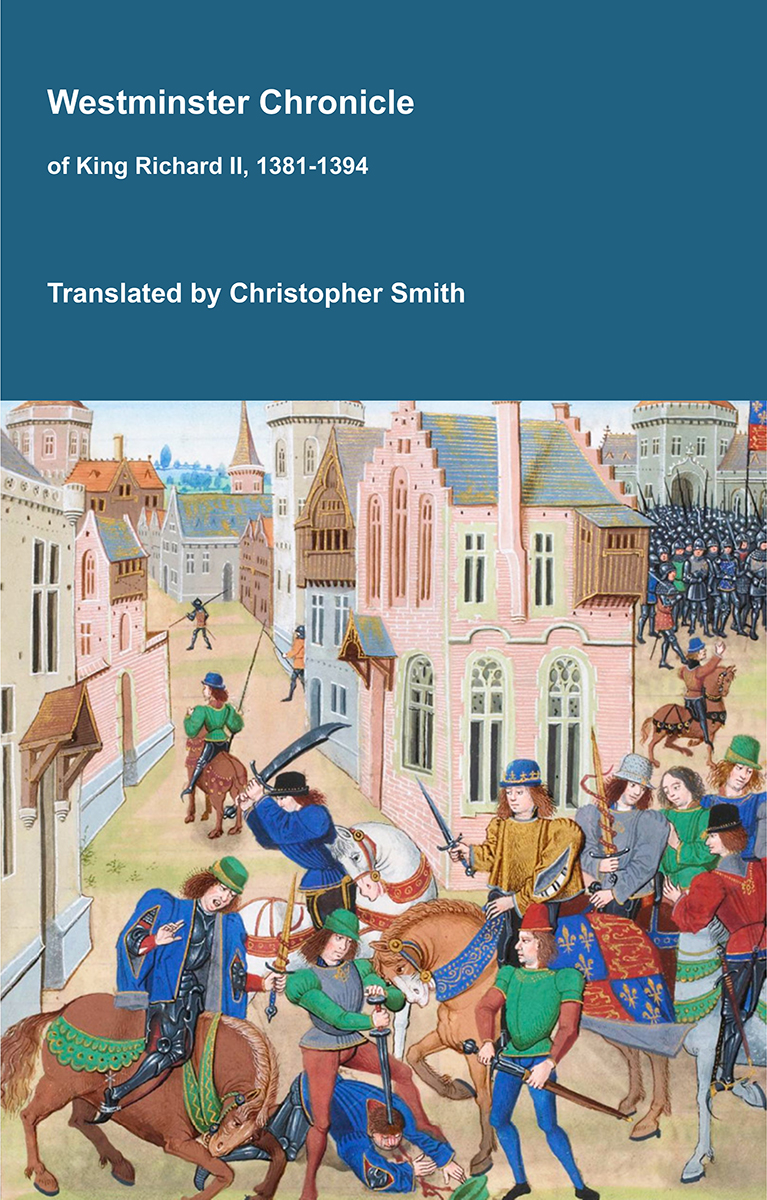 Westminster Chronicle. Shortly before Christmas, the emperor’s sister landed at Dover1. The duke of Lancaster went to meet her, and, having received her most honourably, led her as far as Leeds Castle [Map], where she stayed throughout Christmas. Within these Christmas days, at midnight between the feast of Saint Stephen [26th December] and the feast of Saint John the Evangelist [27th December], the earl of March2 died on the coasts of Ireland. The guardianship of all Ireland had been entrusted to him by the king, so that by force of arms he might restrain the insolence of the rebels. He was mature in bearing, pleasant in speech, loyal to the kingdom, and supported by the highest prudence in the conduct of affairs.
Modicum ante Natale Domini soror Imperatoris Dovoriam applicuit, cui fuit obvius dux Lancastriæ, quam honestissime receptam usque ad castrum de Ledys perduxit, ubi per totum Natale morata est. Infra hujus Natalis dies nocte media inter festum sancti Stephani et festum sancti Johannis Evangelistæ obiit comes Marchiæ in oris Hibernicis. Huic per regem totius Hiberniæ fuerat commissa tutela ut armorum virtute rebellium insolentiam refrenaret. Erat is gestu maturus, affatu suavis, regno fidelis et in rebus agendis summa prudentia fultus.
Note 1. Walsingham, St Albans Chronicle: The Chronica Maiora describes her landing a Dover: "On that day there occurred a marvellous omen for all, according to the opinion of many, foreshadowing the favour of God and the happy fortunes that would come to the land. For when she [Anna] had set foot on land from the ship, and when all had safely disembarked, with the rest of the vessel remaining, there followed immediately such a disturbance of the sea as had not been seen for a long time before. It so shook the ships stationed in the harbour that they were suddenly scattered and dashed together, the ship in which the queen had sat being first broken apart and horribly shattered into many pieces."
Note 2. Edmund Mortimer, 1352-1381, 3rd Earl of March. Son of Roger Mortimer 2nd Earl March and Philippa Montagu Countess March. He married in 1369 Phillippa, daughter of Lionel, Duke of Clarence, 2nd son of King Edward III. Their granddaughter Anne was the mother of Richard Plantagenet, 3rd Duke of York, father of King's Edward IV and Richard III.