

Paternal Family Tree: Perceval
Maternal Family Tree: Mary Harvey Lady Dering 1629-1704
Before 12th July 1683 [his father] John Perceval 3rd Baronet [aged 23] and [his mother] Catherine Dering were married. A sibling marriage. John's sister [his aunt] Helena Perceval [aged 28] was married to, or would marry, Catherine's brother [his uncle] Daniel Dering.
On 12th July 1683 John Perceval 1st Earl Egmont was born to John Perceval 3rd Baronet [aged 23] and Catherine Dering at Burton, County Cork.
On 29th April 1686 [his father] John Perceval 3rd Baronet [aged 26] died. His son [his brother] Edward [aged 3] succeeded 4th Baronet Perceval of Kanturk in County Cork.
On 9th November 1691 Edward Perceval 4th Baronet [aged 9] died. His brother John [aged 8] succeeded 5th Baronet Perceval of Kanturk in County Cork.
In 1703 John Perceval 1st Earl Egmont [aged 19] was elected MP County Cork which seat he held until 1715.
In 1710 John Perceval 1st Earl Egmont [aged 26] and Catherine Parker Countess Egmont [aged 20] were married.

On 25th February 1711 [his son] John Perceval 2nd Earl Egmont was born to John Perceval 1st Earl Egmont [aged 27] and [his wife] Catherine Parker Countess Egmont [aged 21]. He married 1. 15th February 1737 Catherine Cecil Countess Egmont, daughter of James Cecil 5th Earl Salisbury and Anne Tufton Countess of Salisbury, and had issue 2. after 16th August 1752 Catherine Compton Countess Egmont and had issue.
On 21st April 1715 John Perceval 1st Earl Egmont [aged 31] was created 1st Baron Perceval of Burton in County Cork with a special remainder to his [his father] father's heirs male.
In 1722 John Perceval 1st Earl Egmont [aged 38] was elected MP Harwich which seat he held until 1734.
On 25th February 1723 John Perceval 1st Earl Egmont [aged 39] was created 1st Viscount Perceval of Kanturk in County Cork.
On 6th November 1733 John Perceval 1st Earl Egmont [aged 50] was created 1st Earl Egmont. [his wife] Catherine Parker Countess Egmont [aged 43] by marriage Countess Egmont.
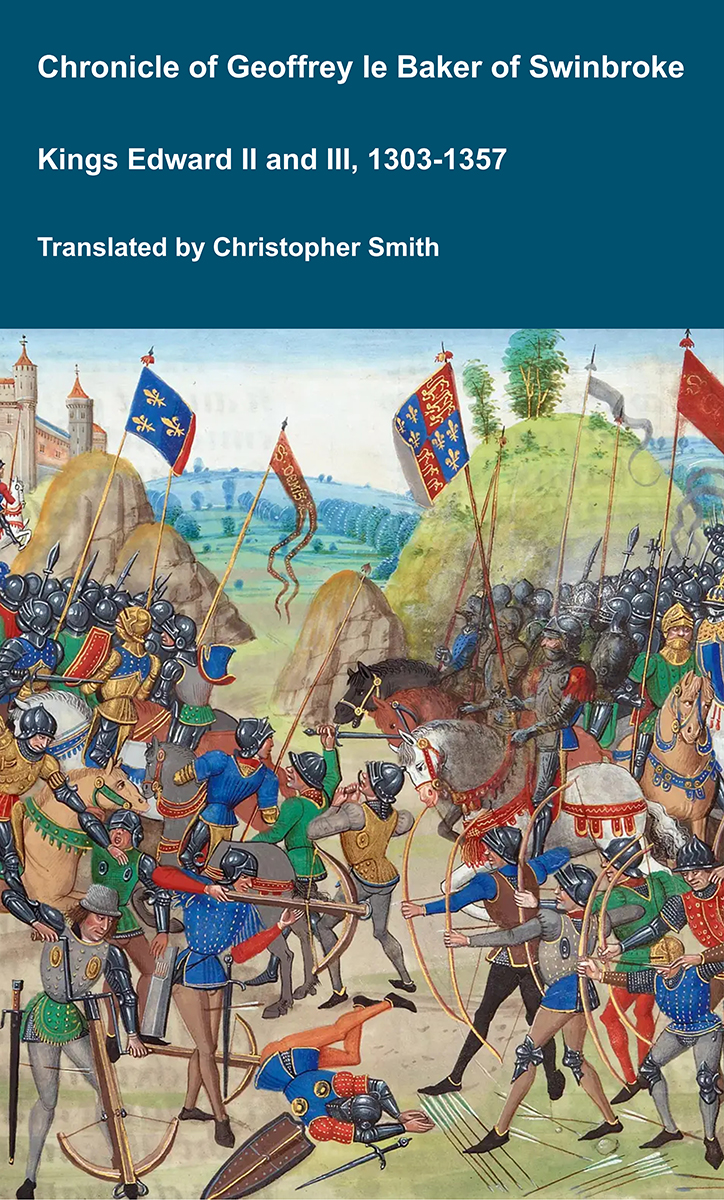
Chronicle of Geoffrey le Baker of Swinbroke
Baker was a secular clerk from Swinbroke, now Swinbrook, an Oxfordshire village two miles east of Burford. His Chronicle describes the events of the period 1303-1356: Gaveston, Bannockburn, Boroughbridge, the murder of King Edward II, the Scottish Wars, Sluys, Crécy, the Black Death, Winchelsea and Poitiers. To quote Herbert Bruce 'it possesses a vigorous and characteristic style, and its value for particular events between 1303 and 1356 has been recognised by its editor and by subsequent writers'. The book provides remarkable detail about the events it describes. Baker's text has been augmented with hundreds of notes, including extracts from other contemporary chronicles, such as the Annales Londonienses, Annales Paulini, Murimuth, Lanercost, Avesbury, Guisborough and Froissart to enrich the reader's understanding. The translation takes as its source the 'Chronicon Galfridi le Baker de Swynebroke' published in 1889, edited by Edward Maunde Thompson.
Available at Amazon in eBook and Paperback format.
On 15th February 1737 John Perceval 2nd Earl Egmont [aged 25] and Catherine Cecil Countess Egmont [aged 15] were married. She the daughter of James Cecil 5th Earl Salisbury and Anne Tufton Countess of Salisbury. He the son of John Perceval 1st Earl Egmont [aged 53] and Catherine Parker Countess Egmont [aged 47].
On 1st May 1748 John Perceval 1st Earl Egmont [aged 64] died. His son John [aged 37] succeeded 2nd Earl Egmont, 2nd Viscount Perceval of Kanturk in County Cork, 2nd Baron Perceval of Burton in County Cork, 6th Baronet Perceval of Kanturk in County Cork. Catherine Cecil Countess Egmont [aged 26] by marriage Countess Egmont.
In 1749 [his former wife] Catherine Parker Countess Egmont [aged 59] died.
Letters of Horace Walpole. 4th March 1749. Strawberry Hill. To Horace Mann 1st Baronet [aged 42].
I have been so shut up in the House of Commons for this last fortnight or three weeks, that I have not had time to write you a line: we have not had such a session since the famous beginning of last Parliament. I am come hither for a day or two of rest and air, and find the additional pleasure of great beauty in my improvements: I could talk to you through the whole sheet, and with much more satisfaction, upon this head; but I shall postpone my own amusement to yours, for I am sure you want much more to know what has been doing in Parliament than at Strawberry Hill. You will conclude that we have been fighting over the peace; but we have not. It is laid before Parliament, but will not be taken up; the Opposition foresee that a vote of approbation would pass, and therefore will not begin upon it, as they wish to reserve it for censure in the next reign-or perhaps the next reign does not care to censure now what he must hereafter maintain-and the ministry do not seem to think their treaty so perfect as not to be liable to blame, should it come to be canvassed. We have been then upon several other matters: but first I should tell you, that from the utmost tranquillity and impotence of a minority, there is at once started up so formidable an Opposition as to divide 137 against 203.(1) The minority is headed by the Prince, who has continued opposing, though very unsuccessfully, ever since the removal of Lord Granville [aged 58], and the desertion of the patriots. He stayed till the Pelhams had brought off every man of parts in his train, and then began to form his party. Lord Granville has never come into it, for fear of breaking with the King; and seems now to be patching up again with his old enemies. If Lord Bath has dealt with the Prince, it has been underhand. His ministry has had at the head of it poor Lord Baltimore [aged 49], a very good-natured, weak, honest man; and Dr. Lee, a civilian, who was of Lord Granville's admiralty, and is still much attached to him. He is a grave man, and a good speaker, but of no very bright parts, and, from his way of life and profession, much ignorant of, and unfit for, a ministry. You will wonder what new resources the Prince has discovered-why, he has found them all in Lord Egmont [aged 38], whom you have heard of under the name of Lord Perceval; but his father, an Irish Earl, is lately dead. As he is likely to make a very considerable figure in our history, I shall give you a more particular account of him. He has always earnestly studied our history and constitution and antiquities, with very ambitious views; and practised speaking early in the Irish Parliament. Indeed, this turn is his whole fund, for though he is between thirty and forty, he knows nothing of the world, and is always unpleasantly dragging the conversation to political dissertations. When very young, as he has told me himself, he dabbled in writing Craftsmen and penny-papers; but the first event that made him known, was his carrying the Westminster election at the end of my father's ministry,-which he amply described in the history of his own family, a genealogical work called "The History of the House of Yvery,"(2) a work which cost him three thousand pounds, as the heralds informed Mr. Chute and me, when we went to their office on your business; and which was so ridiculous, that he has since tried to suppress all the copies. It concluded with the description of the Westminster election, in these or some such words, "And here let us leave this young nobleman struggling for the dying liberties of his country!" When the change in the ministry happened, and Lord Bath was so abused by the remnant of the patriots, Lord Egmont published his celebrated pamphlet, called "Faction Detected," a work which the Pitts and Lytteltons have never forgiven him; and which, though he continued voting and sometimes speaking with the Pelhams, made him quite unpopular during all the last Parliament. When the new elections approached, he stood on his own bottom at Weobly in Herefordshire; but his election being contested, be applied for Mr. Pelham's support, who carried it for him in the House of Commons. This will always be a material blot in his life; for he had no sooner secured his seat, than he openly attached himself to the Prince, and has since been made a lord of his bedchamber. At the opening of this session, he published an extreme good pamphlet, which has made infinite noise, called "An Examination of the Principles and Conduct of the two Brothers," (the Pelhams,) and as Dr. Lee has been laid up with the gout, Egmont has taken the lead in the Opposition, and has made as great a figure as perhaps was ever made in so short a time. He is very bold and resolved, master of vast knowledge, and speaks at once with fire and method. His words are not picked and chosen like Pitt's, but his language is useful, clear, and strong. He has already by his parts and resolution mastered his great unpopularity, so far as to be heard with the utmost attention, though I believe nobody had ever more various difficulties to combat. All the old corps hate him on my father and Mr. Pelham's [aged 54] account; the new part of the ministry on their own. The Tories have not quite forgiven his having left them in the last Parliament: besides that, they are now governed by one Prowse, a cold, plausible fellow. and a great well-wisher to Mr. Pelham. Lord Strange [aged 33],(3) a busy Lord of a party by himself, yet voting generally with the Tories, continually clashes with Lord Egmont; and besides all this, there is a faction in the Prince's family, headed by Nugent, who are for moderate measures.
(1) Upon the last clause of the Mutiny-bill, an amendment to render half pay officers subject to the act, only in case of actual war, insurrection, rebellion, or invasion, was rejected by 203 to 137.-E.
(2) Compiled principally for Lord Egmont by Anderson, the genealogist. It was printed, but not published, in 1742. "Some," says Boswell, in his Life of Johnson, "have affected to laugh at the History of the House of Very: it would be well if many others would transmit their pedigrees to posterity, with the same accuracy and generous zeal with which the noble Lord who compiled that work has honoured and perpetuated his ancestry. Family histories, like, the imagines majorum of the ancients, excite to virtue." Vol. viii. p. 188.-E.
(3) James, Lord Strange, eldest son of Edward Stanley, eleventh Earl of Derby [aged 59]. In 1762 he was made Chancellor of the Duchy of Lancaster, and died during his father's life-time, in 1771. He always called himself Lord Strange; though the title, which was a barony in fee, had in fact descended to the Duke of Atholl, as heir general of James, seventh Earl of Derby. D.


Kings Wessex: Great x 22 Grand Son of King Edmund "Ironside" I of England
Kings Gwynedd: Great x 19 Grand Son of Owain "Great" King Gwynedd
Kings Seisyllwg: Great x 25 Grand Son of Hywel "Dda aka Good" King Seisyllwg King Deheubarth
Kings Powys: Great x 20 Grand Son of Maredudd ap Bleddyn King Powys
Kings Godwinson: Great x 23 Grand Son of King Harold II of England
Kings England: Great x 13 Grand Son of King Edward III of England
Kings Scotland: Great x 19 Grand Son of King William I of Scotland
Kings France: Great x 15 Grand Son of King Philip IV of France
Kings Duke Aquitaine: Great x 26 Grand Son of Ranulf I Duke Aquitaine
Kings Spain: Great x 18 Grand Son of Alfonso VII King Castile VII King Leon
Grandfather: John Perceval 1st Baronet 
Father: John Perceval 3rd Baronet
Great x 1 Grandfather: Robert Southwell 
Grandmother: Catherine Southwell
Great x 1 Grandmother: Helena Gore
John Perceval 1st Earl Egmont 13 x Great Grandson of King Edward III of England
Great x 2 Grandfather: Anthony Dering of Surrenden Dering in Pluckley in Kent
Great x 1 Grandfather: Edward Dering 1st Baronet
Great x 3 Grandfather: Robert Bell
Great x 2 Grandmother: Frances Bell
Great x 4 Grandfather: Edmonde Beaupré of Beaupré Hall Norfolk
Great x 3 Grandmother: Dorothie Beaupré
Grandfather: Edward Dering 2nd Baronet 11 x Great Grandson of King Edward III of England
Great x 3 Grandfather: John Ashburnham
Great x 2 Grandfather: John Ashburnham
Great x 1 Grandmother: Anne Ashburnham Lady Dering 10 x Great Granddaughter of King Edward III of England
Great x 4 Grandfather: Nicholas Beaumont of Coleorton in Leicestershire  7 x Great Grandson of King Edward III of England
Great x 3 Grandfather: Thomas Beaumont 8 x Great Grandson of King Edward III of England
Great x 4 Grandmother: Anne Saunders
Great x 2 Grandmother: Elizabeth Beaumont 9 x Great Granddaughter of King Edward III of England
Great x 4 Grandfather: Thomas Farnham
Great x 3 Grandmother: Katherine Farnham
Mother: Catherine Dering 12 x Great Granddaughter of King Edward III of England
Great x 1 Grandfather: Daniel Harvey
Grandmother: Mary Harvey Lady Dering