Norwich Cathedral is in Norwich, Norfolk [Map], Cathedrals in England.
Chronicon ex Chronicis by Florence and John of Worcester. 1094. On the death of Herfast, who had been a chaplain to earl William and afterwards to king William, and in process of time bishop of Thetford, and the death also of William, his successor, Herbert, surnamed Losing, for his address in flattery, from being prior of Fecamp and abbot of Ramsey, became by purchase bishop of Thetford; and his father Robert, of the same surname, became intrusive abbot of Winchester. But he was absolved by penitence from the errors of his faults; for going to Rome in more mature years he there laid down his simoniacal staff and ring, which were restored to him by the indulgence of that most merciful see. Returning home, he transferred the seat of his bishopric to a town celebrated as a place of trade and general resort, called Norwich [Map], and founded there a convent of monks.
In 1096 Bishop Herbert of Losinga commissioned the building of Norwich Cathedral [Map] and was appointed Bishop of Norwich.
Chronicon ex Chronicis by Florence and John of Worcester. 12th June 1121. After a few days, one named Everard, attached to the king's chapel, was elected bishop of Norwich, and consecrated at Canterbury [Map] by archbishop Ralph on the second of the ides [the 12th] of June; Arnulph, bishop of Rochester, Richard, bishop of Hereford, and Robert, bishop of Coventry, having met for the purpose.
In 1147 Bishop William Turbeville [aged 52] was appointed Bishop of Norwich.
In 1200 Bishop Geoffrey Burgh [aged 20] was appointed Archdeacon of Norwich.
Around 7th September 1200 Bishop John de Gray was appointed Bishop of Norwich.
On 20th December 1226 Bishop Thomas Blunville was consecrated Bishop of Norwich.
On 4th February 1335 Bishop Thomas Percy was appointed Bishop of Norwich.
On 23rd January 1344 Bishop William Bateman [aged 46] was elected Bishop of Norwich.
The True Chronicles of Jean le Bel Volume 2 Chapters 61-109 1342-1361
The Chronicle of Jean le Bel, Volume 2 continues one of the most important fourteenth-century accounts of the early Hundred Years’ War. Written by the Liège chronicler Jean le Bel, this vivid narrative follows the fortunes of Edward III, Jean II of France, the Black Prince, the great nobles of France and England, and the soldiers, captains and companies who shaped the conflict. This volume covers some of the most dramatic events of the period, including the battles of Crécy and Poitiers, the siege and capture of Calais, the captivity of King John, the rise of the Jacquerie, the turmoil in Paris under Étienne Marcel and Charles of Navarre, the devastation caused by the free companies, Edward III’s great campaign of 1359–1360, and the negotiations leading to the Treaty of Brétigny. Jean le Bel’s chronicle is especially valuable for its lively detail, its interest in chivalry, warfare, politics and reputation, and its influence on later chroniclers, most famously Froissart. This English translation presents the text in clear, readable British English while preserving the force and character of the original narrative. The translation includes extensive notes to help the reader better understand Jean le Bel's text. Volume 2 also includes translated appendices drawn from royal and administrative records, many from the English Record Office, which illuminate Edward III’s campaigns in Brittany, the siege and occupation of Calais, naval preparations, military finance, appointments, safe conducts and related affairs.
Available at Amazon in eBook and Paperback format.
On 3rd April 1370 Bishop Henry Despencer [aged 29] was appointed Bishop of Norwich.
In 1385 Bishop Richard Mitford was appointed Archdeacon of Norwich which he held until 1390.
In 1413 Bishop Richard Courtenay was appointed Bishop of Norwich.
On 21st September 1437 Bishop Thomas Brunce [aged 49] was collated to Bishop of Norwich.
On 17th July 1472 Bishop James Goldwell was elected Bishop of Norwich.
On 4th October 1472 Bishop James Goldwell was consecrated Bishop of Norwich at Saints Blaise and Charles in Catinari Church.
In 1500 Christopher Urswick [aged 52] was appointed Archdeacon of Norwich.
In 1501 Bishop Richard Nix aka Nykke [aged 54] was appointed Bishop of Norwich.
In 1554 Bishop John Christopherson was appointed Dean of Norwich which post he held until 1557.
In 1558 Dean John Harpsfield [aged 42] was appointed Dean of Norwich.
Abbot John Whethamstede’s Chronicle of the Abbey of St Albans
Abbot John Whethamstede's Register aka Chronicle of his second term at the Abbey of St Albans, 1451-1461, is a remarkable text that describes his first-hand experience of the beginning of the Wars of the Roses including the First and Second Battles of St Albans, 1455 and 1461, respectively, their cause, and their consequences, not least on the Abbey itself. His text also includes Loveday, Blore Heath, Northampton, the Act of Accord, Wakefield, and Towton, and ends with the Coronation of King Edward IV. In addition to the events of the Wars of the Roses, Abbot John, or his scribes who wrote the Chronicle, include details in the life of the Abbey such as charters, letters, land exchanges, visits by legates, and disputes, which provide a rich insight into the day-to-day life of the Abbey, and the challenges faced by its Abbot.
Available at Amazon in eBook and Paperback format.
On 13th April 1560 Bishop John Parkhurst [aged 48] was elected Bishop of Norwich.
In September 1560 Bishop John Parkhurst [aged 48] was installed as Bishop of Norwich.
In 1585 Bishop Edmund Scambler [aged 65] was translated to Bishop of Norwich.
In 1603 Bishop George Montgomery [aged 34] was appointed Dean of Norwich.
In 1611 Bishop John King [aged 52] was appointed Bishop of Norwich.
In 1618 Bishop Thomas Morton [aged 53] was appointed Bishop of Norwich.
On 22nd January 1629 Bishop Francis White [aged 65] was elected Bishop of Norwich.
In 1635 Bishop Matthew Wren [aged 49] was appointed Bishop of Norwich.
In 1641 Bishop Joseph Hall [aged 66] was translated to Bishop of Norwich.
John Evelyn's Diary. 2nd December 1657. Dr. Raynolds [aged 58] (since Bishop of Norwich) preached before the company at St. Andrew Under-shaft [Map], on Nehemiah xiii. 31, showing, by the example of Nehemiah, all the perfections of a trusty person in public affairs, with many good precepts apposite to the occasion, ending with a prayer for God's blessing on the company and the undertaking.
John Evelyn's Diary. 17th October 1671. Next morning, I went to see Sir Thomas Browne [aged 65] (with whom I had some time corresponded by letter, though I had never seen him before); his whole house and garden being a paradise and cabinet of rarities; and that of the best collection, especially medals, books, plants, and natural things. Among other curiosities, Sir Thomas had a collection of the eggs of all the fowl and birds he could procure, that country (especially the promontory of Norfolk) being frequented, as he said, by several kinds which seldom or never go further into the land, as cranes, storks, eagles, and variety of water fowl. He led me to see all the remarkable places of this ancient city, being one of the largest, and certainly, after London, one of the noblest of England, for its venerable cathedral [Map], number of stately churches, cleanness of the streets, and buildings of flint so exquisitely headed and squared, as I was much astonished at; but he told me they had lost the art of squaring the flints, in which they so much excelled, and of which the churches, best houses, and walls, are built. The Castle [Map] is an antique extent of ground, which now they call Marsfield, and would have been a fitting area to have placed the Ducal palace in. The suburbs are large, the prospects sweet, with other amenities, not omitting the flower gardens, in which all the inhabitants excel. The fabric of stuffs brings a vast trade to this populous town.
In 1681 Archbishop John Sharp [aged 35] was appointed Dean of Norwich.
Westminster Chronicle of King Richard II, 1381-1394
The Westminster Chronicle is one of the most vivid and important narrative sources for the reign of Richard II. Written by an anonymous chronicler closely connected with Westminster Abbey, it covers the years 1381 to 1394, from the Peasants’ Revolt to the political tensions, court ceremonies, diplomatic negotiations, royal progresses, and public crises of Richard’s later reign. Rich in detail the chronicle records major events such as the conflicts between the King and Lords Appellant, King and the City of London, negotiations with France and Scotland, the death and funeral of Queen Anne of Bohemia, the illness of Charles VI of France, and the changing fortunes of leading nobles including John of Gaunt, Thomas of Gloucester, Robert de Vere, and the Earl of Arundel. The Chronicle offers readers a remarkable window into late fourteenth-century England, combining political observation, courtly spectacle, urban drama, ecclesiastical affairs, and moral judgement. It is an essential source for anyone interested in medieval monarchy, London, Westminster, and the troubled reign of Richard II.
Available at Amazon in eBook and Paperback format.
In 1685 Bishop William Lloyd [aged 48] was appointed Bishop of Norwich.
In 1691 Bishop John Moore [aged 45] was appointed Bishop of Norwich.
John Evelyn's Diary. 5th June 1698. Dr. White, late Bishop of Norwich, who had been ejected for not complying with Government, was buried in St. Gregory's Churchyard, or vault, at St. Paul's. His hearse was accompanied by two non-juror bishops, Dr. Turner of Ely, and Dr. Lloyd, with forty other non-juror clergymen, who would not stay the Office of the burial, because the Dean of St. Paul's had appointed a conforming minister to read the Office; at which all much wondered, there being nothing in that Office which mentioned the present King.
On 15th March 1706 Rose Moore [aged 25] died. She was buried in Norwich Cathedral [Map] under a white marble tablet with an inscription to her memory.
On 11th June 1718 Frances Preston [aged 40] died. She was buried on the south side of the bishop's chapel in Norwich Cathedral [Map].
In 1721 Bishop Thomas Green [aged 63] was appointed Bishop of Norwich.
In 1st November 1724 Humphrey Prideaux [aged 76] was appointed Dean of Norwich.
On 13th October 1749 Bishop Thomas Hayter [aged 47] was elected Bishop of Norwich.
On 3rd December 1749 Bishop Thomas Hayter [aged 47] was consecrated Bishop of Norwich.
In 1761 Dean Edward Townshend [aged 41] was appointed Dean of Norwich.
In 1783 Bishop Lewis Bagot [aged 42] was appointed Bishop of Norwich.
In 1837 Bishop Edward Stanley [aged 57] was appointed Bishop of Norwich.
Chronicle of Walter of Guisborough
A canon regular of the Augustinian Guisborough Priory, Yorkshire, formerly known as The Chronicle of Walter of Hemingburgh, describes the period from 1066 to 1346. Before 1274 the Chronicle is based on other works. Thereafter, the Chronicle is original, and a remarkable source for the events of the time. This book provides a translation of the Chronicle from that date. The Latin source for our translation is the 1849 work edited by Hans Claude Hamilton. Hamilton, in his preface, says: 'In the present work we behold perhaps one of the finest samples of our early chronicles, both as regards the value of the events recorded, and the correctness with which they are detailed; Nor will the pleasing style of composition be lightly passed over by those capable of seeing reflected from it the tokens of a vigorous and cultivated mind, and a favourable specimen of the learning and taste of the age in which it was framed.'
Available at Amazon in eBook and Paperback format.
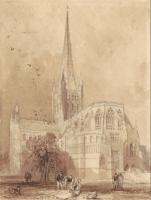
Before 1854. Frederick Mackenzie [aged 65]. Norwich Cathedral [Map]. This work comes from one of sixteen volumes of Royal Academy Annual Exhibition catalogues that were collected and extra-illustrated by the lawyer and antiquarian Edward Basil Jupp F.S.A. (1812 - 1877). The catalogues span the period from the first annual exhibition in 1769 up to 1875. Jupp added drawings, prints, letters and autographs by, or referring to, Academicians and other exhibitors at the Academy's annual exhibition.
Before March 1870 Venerable Charles Nourse Wodehouse [aged 79] was appointed Archdeacon of Norwich.
In 1942 Bishop Percy Herbert [aged 56] was appointed Bishop of Norwich whic office he held until 1959.
On 19th July 1549 Edmund Sheffield 1st Baron Sheffield [aged 27] was killed at Cathedral Close, Norwich Cathedral [Map] during Kett's Rebellion. His son John [aged 11] succeeded 2nd Baron Sheffield of Butterwick in Lincolnshire.
On 13th August 1444 William Paston [aged 66] died. He was buried at Lady Chapel Norwich Cathedral [Map].