

Malvern, Worcestershire is in Worcestershire.
In 1290 Bishop Thomas Cantilupe had a dispute with Gilbert "Red Earl" Clare 7th Earl Gloucester 6th Earl Hertford [aged 46] over hunting rights in Malvern, Worcestershire.
On 30th August 1819 Annabella Candler died. She was buried at Malvern, Worcestershire.
On 7th October 1869 George Rice Trevor 4th Baron Dynevor [aged 74] died at Malvern, Worcestershire. His first cousin Francis [aged 65] succeeded 5th Baron Dynevor of Dynevor in Camarthenshire.


See Priories in England.
Great Malvern Priory [Map] was a Benedictine monastery founded around 1075.
On 3rd May 1834 Spencer Bulkeley Wynn 3rd Baron Newborough [aged 30] and Frances Maria De Winton Baroness Newborough were married at Great Malvern Priory [Map]. She by marriage Baroness Newborough of Newborough in County Wexford. They were half first cousins.
Around 1540 Cecily Lygon was born to William Lygon [aged 28] and Eleanor Denys [aged 31] at Madresfield, Court Malvern. She married in or before 1565 her fourth cousin once removed Edward Gorges and had issue.
On 8th September 1567 or 29th September 1567 William Lygon [aged 55] died at Madresfield, Court Malvern.
In 1568 William Lygon was born to Richard Lygon [aged 31] and Mary Russell [aged 26] at Madresfield, Court Malvern.
Around 1590 William Lygon was born to William Lygon [aged 22] at Madresfield, Court Malvern.
In 1608 William Lygon [aged 40] died at Madresfield, Court Malvern.
On 12th May 1823 William Lygon 2nd Earl Beauchamp [aged 40] died at Madresfield, Court Malvern. His brother John [aged 39] succeeded 3rd Earl Beauchamp, 3rd Viscount Elmley of Worcestershire, 3rd Baron Beauchamp Powick in Worcestershire.
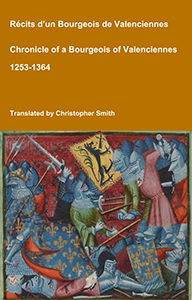
Chronicle of a Bourgeois of Valenciennes
Récits d’un bourgeois de Valenciennes aka The Chronicle of a Bourgeois of Valenciennes is a vivid 14th-century vernacular chronicle written by an anonymous urban chronicler from Valenciennes in the County of Hainaut. It survives in a manuscript that describes local and regional history from about 1253 to 1366, blending chronology, narrative episodes, and eyewitness-style accounts of political, military, and social events in medieval France, Flanders, and the Low Countries. The work begins with a chronological framework of events affecting Valenciennes and its region under rulers such as King Philip VI of France and the shifting allegiances of local nobility. It includes accounts of conflicts, sieges, diplomatic manoeuvres, and the impact of broader struggles like the Hundred Years’ War on urban life in Hainaut. Written from the perspective of a burgher (bourgeois) rather than a monastery or royal court, the chronicle offers a rare lay viewpoint on high politics and warfare, reflecting how merchants, townspeople, and civic institutions experienced the turbulence of the 13th and 14th centuries. Its narrative style combines straightforward reporting of events with moral and civic observations, making it a valuable source for readers interested in medieval urban society, regional politics, and the lived experience of war and governance in pre-modern Europe.
Available at Amazon in eBook and Paperback format.
The Times. 20th February 1891. We regret to announce that EARL BEAUCHAMP [deceased], Lord Lieutenant of Worcestershire, died suddenly yesterday at Madresfield Court, his Worcestershire seat. He was taken ill while at luncheon, after a journey to a neighbouring town, and died before medical aid could be obtained, the cause of death being heart disease. His death will be felt as a serious loss, both in the English Church and in the Conservative party. A strong and moderately "high" Churchman, he took a leading position in his own diocese and in the Church at large in the promotion and defence of Anglican interests and; though he did not come prominently before the public as a politician, he exercised for many years considerable influence in the councils of the Tory' leaders. Frederic Lygon was the second son of the fourth Earl Beauchamp by Lady Susan Caroline Eliot, daughter of the secoud earl of St. Germans. He was born in 1830, and was educated at Eton and Christ Church, Oxford. In 1852 he was elected a Fellow of All Souls, and the received tho degree of D.C.L. from his University in 1870. As the Hon. Frederick Lygon, he entered Parliament as member for Tewkesbury in 1857, for which place be sat till 1863, when be was elected for West Worcestershire. At his elder brother's death, without issue, in 1866, he succeeded to the peerage as sixth Earl. Both as a member of the House of Commons and as a peer he hold posts in Conservative Governments. In 1859 he was for a short time a Lord of the Admiralty. During the whole of Mr. Disraeli's Ministry which lasted from 1874 to 1880 he was Lord Steward of the Queen's Household. On the return of the Conservatives to power in 1885 he ras Paymaster-General of the Forces for the few months that the Government lasted, and he returned the same post when the general election put an end to Mr. Gladstone's short-lived Administration in 1886. He did not, however, remain in the Goverornent for a year, as he resigned in June, 1887. Since 1876 he had been Lord Lieutenant of Worcestershire. The deceased earl was twice married, 1st, in 1868, to Lady Mary Catharine, only daughter of the sixth Earl Stanhope (she died in 1876), and, secondly, to Lady Emily Annora Charlotte [aged 37], daughter of the third Earl Mdanvers [aged 66]. He is succeeded by his eldest son, William, Viscount Elmley, who was born in 1872.

