

Stanton Harcourt, Oxfordshire is in Oxfordshire.
Around 1203 Richard Harcourt was born to William Harcourt [aged 28] at Stanton Harcourt, Oxfordshire [Map]. He married Arabella Quincy, daughter of Saer Quincy 1st Earl Winchester and Margaret Beaumont Countess Winchester, and had issue.
Around 1204 Robert de Harcourt [aged 52] died at Stanton Harcourt, Oxfordshire [Map].
Around 1227 William Harcourt was born to Richard Harcourt [aged 24] and Arabella Quincy [aged 41] at Stanton Harcourt, Oxfordshire [Map]. He married (1) Alice Zouche and had issue (2) his half third cousin once removed Hilaria or Eleanor Hastings and had issue (3) Isabel Mansel.
On 9th December 1256 Richard Harcourt was born to William Harcourt [aged 29] and Hilaria or Eleanor Hastings [aged 23] at Stanton Harcourt, Oxfordshire [Map]. He married (1) Joan Unknown (2) Margaret Beke, daughter of John Beke 1st Baron Beke and Sarah Furnival, and had issue.
Around 1258 Arabella Quincy [aged 72] died at Stanton Harcourt, Oxfordshire [Map].
On 1st November 1275 John Harcourt was born to Richard Harcourt [aged 18] and Margaret Beke [aged 19] at Stanton Harcourt, Oxfordshire [Map]. He married (1) 1299 his sixth cousin Eleanor Zouche and had issue (2) after 1320 Alice Corbet.
On 19th April 1278 William Harcourt [aged 51] died at Stanton Harcourt, Oxfordshire [Map].
Before 1st March 1293 Richard Harcourt [aged 36] died at Stanton Harcourt, Oxfordshire [Map].
Around 1300 Eleanor Zouche [aged 27] died at Stanton Harcourt, Oxfordshire [Map].
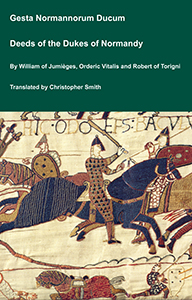
The Deeds of the Dukes of Normandy
The Gesta Normannorum Ducum [The Deeds of the Dukes of Normandy] is a landmark medieval chronicle tracing the rise and fall of the Norman dynasty from its early roots through the pivotal events surrounding the Norman Conquest of England. Originally penned in Latin by the monk William of Jumièges shortly before 1060 and later expanded at the behest of William the Conqueror, the work chronicles the deeds, politics, battles, and leadership of the Norman dukes, especially William’s own claim to the English throne. The narrative combines earlier historical sources with firsthand information and oral testimony to present an authoritative account of Normandy’s transformation from a Viking settlement into one of medieval Europe’s most powerful realms. William’s history emphasizes the legitimacy, military prowess, and governance of the Norman line, framing their expansion, including the conquest of England, as both divinely sanctioned and noble in purpose. Later chroniclers such as Orderic Vitalis and Robert of Torigni continued the history, extending the coverage into the 12th century, providing broader context on ducal rule and its impact. Today this classic work remains a foundational source for understanding Norman identity, medieval statesmanship, and the historical forces that reshaped England and Western Europe between 800AD and 1100AD.
Available at Amazon in eBook and Paperback format.
In 1300 William Harcourt was born to John Harcourt [aged 24] and Eleanor Zouche [aged 27] at Stanton Harcourt, Oxfordshire [Map]. He married his fourth cousin once removed Joan Grey, daughter of Richard Grey 2nd Baron Grey of Codnor and Joan Fitzpayn Baroness Grey Codnor, and had issue.
Around 1303 Margaret Beke [aged 47] died at Stanton Harcourt, Oxfordshire [Map].
On 2nd May 1330 John Harcourt [aged 54] died at Stanton Harcourt, Oxfordshire [Map].
On 6th June 1349 William Harcourt [aged 49] died of plague at Stanton Harcourt, Oxfordshire [Map].
On 20th September 1410 Robert Harcourt was born to Thomas Harcourt [aged 33] at Stanton Harcourt, Oxfordshire [Map]. He married before 1440 Margaret Byron and had issue.
On 1st February 1416 Richard Harcourt was born to Thomas Harcourt [aged 39] and Joan Francis [aged 33] at Stanton Harcourt, Oxfordshire [Map].
On 6th July 1420 Thomas Harcourt [aged 43] died at Stanton Harcourt, Oxfordshire [Map].
Around 1440 John Harcourt was born to Robert Harcourt [aged 29] and Margaret Byron [aged 28] at Stanton Harcourt, Oxfordshire [Map]. He married Anne Norreys and had issue.
Around 1443 Robert Harcourt was born to Robert Harcourt [aged 32] and Margaret Byron [aged 31] at Stanton Harcourt, Oxfordshire [Map].
Around 1444 Christopher Harcourt was born to Richard Harcourt [aged 27] at Stanton Harcourt, Oxfordshire [Map].
Around 1445 Thomas Harcourt was born to Robert Harcourt [aged 34] and Margaret Byron [aged 33] at Stanton Harcourt, Oxfordshire [Map].
Around 1447 George Harcourt was born to Robert Harcourt [aged 36] and Margaret Byron [aged 35] at Stanton Harcourt, Oxfordshire [Map].
Around 1470 Letitia Harcourt was born to John Harcourt [aged 30] and Anne Norreys [aged 20] at Stanton Harcourt, Oxfordshire [Map]. She married Thomas Neville.
On 14th November 1470 Robert Harcourt [aged 60] was killed by an adherent of the Staffords with whom he had a long running feud for Robert having murdered Robert Stafford in 1448 at Stanton Harcourt, Oxfordshire [Map].
Chronicle of Walter of Guisborough
A canon regular of the Augustinian Guisborough Priory, Yorkshire, formerly known as The Chronicle of Walter of Hemingburgh, describes the period from 1066 to 1346. Before 1274 the Chronicle is based on other works. Thereafter, the Chronicle is original, and a remarkable source for the events of the time. This book provides a translation of the Chronicle from that date. The Latin source for our translation is the 1849 work edited by Hans Claude Hamilton. Hamilton, in his preface, says: 'In the present work we behold perhaps one of the finest samples of our early chronicles, both as regards the value of the events recorded, and the correctness with which they are detailed; Nor will the pleasing style of composition be lightly passed over by those capable of seeing reflected from it the tokens of a vigorous and cultivated mind, and a favourable specimen of the learning and taste of the age in which it was framed.'
Available at Amazon in eBook and Paperback format.
In 1474 Christopher Harcourt [aged 30] died at Stanton Harcourt, Oxfordshire [Map].
On 25th May 1486 Margaret Byron [aged 74] died at Stanton Harcourt, Oxfordshire [Map]. She was buried at Stanton Harcourt, Oxfordshire [Map].
Around 1500 Simon Harcourt was born to Simon Harcourt [aged 28] in Stanton Harcourt, Oxfordshire [Map].
Around 1517 Simon Harcourt was born to Simon Harcourt [aged 17] at Stanton Harcourt, Oxfordshire [Map]. He married (1) 1545 Mary Aston and had issue (2) after 1562 Grace Fitzherbert (3) after 1563 Jane Spencer.
On 16th January 1546 Simon Harcourt [aged 74] died in Stanton Harcourt, Oxfordshire [Map].
Around 1553 Walter Harcourt was born to Simon Harcourt [aged 36] and Mary Aston [aged 23] in Stanton Harcourt, Oxfordshire [Map].
On 19th February 1566 Simon Harcourt [aged 66] died in Stanton Harcourt, Oxfordshire [Map].
On 25th July 1577 Simon Harcourt [aged 60] died at Stanton Harcourt, Oxfordshire [Map].
In 1603 Simon Harcourt was born to Robert Harcourt [aged 29] in Stanton Harcourt, Oxfordshire [Map]. He married before 1652 Anne Paget, daughter of William Paget 4th Baron Paget Beaudasert and Lettice Knollys Baroness Geneville Beaudasert.
In 2nd February 1608 Robert Harcourt [aged 34] died in Stanton Harcourt, Oxfordshire [Map].
William of Worcester's Chronicle of England
William of Worcester, born around 1415, and died around 1482 was secretary to John Fastolf, the renowned soldier of the Hundred Years War, during which time he collected documents, letters, and wrote a record of events. Following their return to England in 1440 William was witness to major events. Twice in his chronicle he uses the first person: 1. when writing about the murder of Thomas, 7th Baron Scales, in 1460, he writes '… and I saw him lying naked in the cemetery near the porch of the church of St. Mary Overie in Southwark …' and 2. describing King Edward IV's entry into London in 1461 he writes '… proclaimed that all the people themselves were to recognize and acknowledge Edward as king. I was present and heard this, and immediately went down with them into the city'. William’s Chronicle is rich in detail. It is the source of much information about the Wars of the Roses, including the term 'Diabolical Marriage' to describe the marriage of Queen Elizabeth Woodville’s brother John’s marriage to Katherine, Dowager Duchess of Norfolk, he aged twenty, she sixty-five or more, and the story about a paper crown being placed in mockery on the severed head of Richard, 3rd Duke of York.
Available at Amazon in eBook and Paperback format.
In 1616 George Cornwall [aged 70] died at Stanton Harcourt, Oxfordshire [Map].
Around 1639 Walter Harcourt [aged 86] died in Stanton Harcourt, Oxfordshire [Map].

In December 1661 Simon Harcourt 1st Viscount Harcourt was born to Philip Harcourt [aged 24] in Stanton Harcourt, Oxfordshire [Map]. He married 30th September 1724 Elizabeth Vernon Viscountess Harcourt.
On 20th March 1688 Philip Harcourt [aged 51] died at Stanton Harcourt, Oxfordshire [Map].
Around January 1699 Elizabeth Evelyn died at Stanton Harcourt, Oxfordshire [Map].
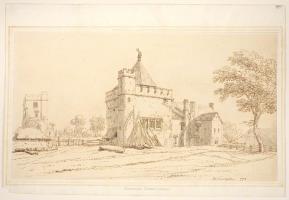
1792. Joseph Farington [aged 44]. Stanton Harcourt, Oxfordshire [Map].
Time Team Series 3 Episode 2: Hunting for Mammoth was filmed between 21st April 1995 and 23rd April 1995. It was originally shown on 14th January 1996.
Location: Stanton Harcourt, Oxfordshire [Map].
Alice Noel died at Stanton Harcourt, Oxfordshire [Map].
Devil's Quoits [Map]. The henge ditch enclosed a circular area up to 120 metres across, with opposed entrances facing almost due east and west. The northern half of the henge appears to have had a second enclosing ditch circuit. Within the henge was a stone circle and a central stone setting which may have been put up after the henge had been in use for some time, in the Early Bronze Age. The Devil's Quoits were restored between 2002 and 2008, with the original quoits A, B, and C re-erected along with other conglomerate stones found at the site. Twenty new replacement stones were placed in the original holes for a total of 28 stones, and the surrounding earthworks re-built.
Folklore 13 1902 Pages 288-295. The Devil's Quoits [Map] at Stanton Harcourt are three large standing stones, which are all that remain of what was probably a circle considerably larger than that at Avebury, and which doubtless gave their name to the neighbouring village (Stanton = A.S. Stántún, the stone enclosure).1 Beacon Hill is a very conspicuous landmark, just above Eynsham Bridge, on the Berkshire side of the Thames, about two and a half miles in a straight line from the "Quoits." It is very steeply scarped on three sides, and it has been suggested that it was the British fortress of Egonesham, captured by the Saxons under Cuthwulf in 571."2
The devil was playing quoits on Beacon Hill on a Sunday, and in a rage at being told it was wrong, he threw these three to where they are now.
One of the quoits standing in Walker's Field was once taken away, and put over a ditch called the "Back Ditch" in the "Farm Close" to make a bridge ; but it was always slipping, and although often put back, it would not rest, and they were obliged at last to take it back to where it now stands. Wheel marks can still be seen on it. — (From Chas. Batts, labourer, of Stanton Harcourt, aged 35, who had it from his father. January i, 1898.)
Mr. Akerman,3 in 1858, records a rationalised version of the same story, as follows : "There is a tradition in the neighbourhood that the northernmost stone was once removed by an occupier of the land, and laid across a watercourse, where it served as a bridge over which waggons and carts for some time passed, and that it was restored to its old locality at the request of one of the Harcourt family. A groove in this stone, eight inches from the top, seven inches in width, and about three inches deep, is believed to have been caused by the wheels of the vehicles when it lay prostrate."
Joseph Goodlake of Stanton Harcourt (now of Yarnton), aged 63, in March, 1901, gave me the following particulars which he had from his father: "When the war was in England, the fighting ended at Stanton by those stones, and from there across to Stanlake Down by Cut Mill. Harcourt was the general; he was Emperor in England; he is buried in the church with his sword and gun and clothes." Further : "When the war was in England the officers used to hide behind them" (the Devil's Quoits) "from the bullets," and the men used to pick the bullets out of them when my informant was young.
The legend connecting the Quoits with a battle is confirmed by a story told by Tom Hughes:4 "An old man in that village" (Stanton Harcourt) "told me that a battle was fought there, which the English were very near losing, when the general rode up to one of his captains, named Harcourt, who was in the thick of it, and called out, 'Stan' to un, Harcourt, stan' to un, Harcourt,' and that Harcourt won the battle, and the village has been called Stanton Harcourt ever since."
Note 1. J. Y. Akerman, "Ancient Limits of the Forest of Wychwood," Archaeologia, xxxvii., 430 ; A. J. Evans, "Rollright Stones and their Folklore," Folk-Lore, vi., 10.
Note 2. J. Parker, Early History of Oxford (Oxf. Hist. Soc), p. 81.
Note 3. Akerman, I.c. p. 431.
Note 4. T. Hughes, Scouring of the White Horse (1859), p. 32. There are several monuments to the Harcourt family in the church, the most conspicuous of which are two altar tombs with effigies in full armour ; one to Sir Robert Harcourt, K.G., and his wife Margaret, 1471, the other to his grandson, Sir Robert, who was Henry VH.'s standard-bearer at Bosworth, and died some time after 1501. One of these two is apparently assigned to "the general."
The story of the fighting may well have arisen from the numerous discoveries of British and Anglo-Saxon remains that have been made in the neighbourhood. A tumulus close to the "Quoits" was destroyed by the grandfather of the present farmer, and on Stanlake Down many Anglo-Saxon burials have been found.
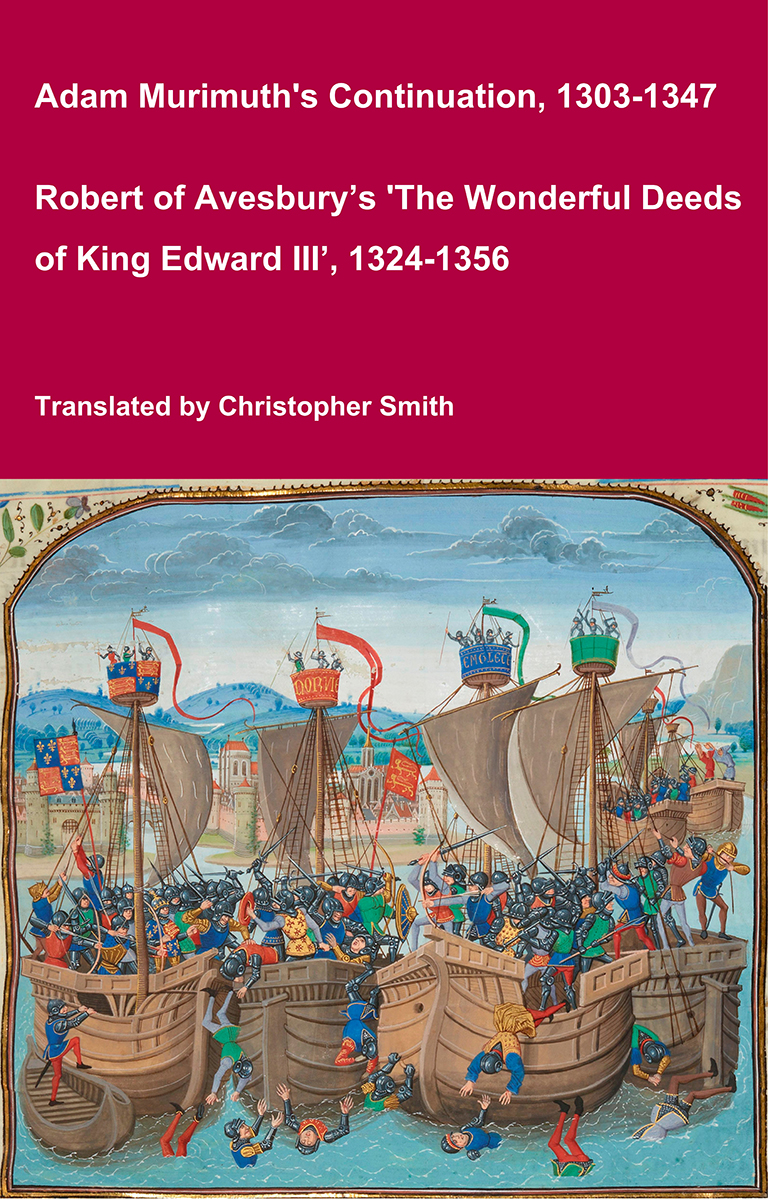
Adam Murimuth's Continuation and Robert of Avesbury’s 'The Wonderful Deeds of King Edward III'
This volume brings together two of the most important contemporary chronicles for the reign of Edward III and the opening phases of the Hundred Years’ War. Written in Latin by English clerical observers, these texts provide a vivid and authoritative window into the political, diplomatic, and military history of fourteenth-century England and its continental ambitions. Adam Murimuth Continuatio's Chronicarum continues an earlier chronicle into the mid-fourteenth century, offering concise but valuable notices on royal policy, foreign relations, and ecclesiastical affairs. Its annalistic structure makes it especially useful for establishing chronology and tracing the development of events year by year. Complementing it, Robert of Avesbury’s De gestis mirabilibus regis Edwardi tertii is a rich documentary chronicle preserving letters, treaties, and official records alongside narrative passages. It is an indispensable source for understanding Edward III’s claim to the French crown, the conduct of war, and the mechanisms of medieval diplomacy. Together, these works offer scholars, students, and enthusiasts a reliable and unembellished account of a transformative period in English and European history. Essential for anyone interested in medieval chronicles, the Hundred Years’ War, or the reign of Edward III.
Available at Amazon in eBook and Paperback format.
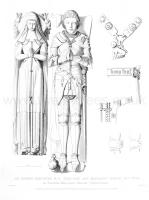
Monumental Effigies. Sir Robert Harcourt KG (died 1471) and Margaret (Byron) [aged 59] his wife in Stanton Harcourt Church, Oxfordshire.
Robert Harcourt: On 20th September 1410 he was born to Thomas Harcourt at Stanton Harcourt, Oxfordshire [Map]. Before 1440 Robert Harcourt and Margaret Byron were married. On 14th November 1470 Robert Harcourt was killed by an adherent of the Staffords with whom he had a long running feud for Robert having murdered Robert Stafford in 1448 at Stanton Harcourt, Oxfordshire [Map].