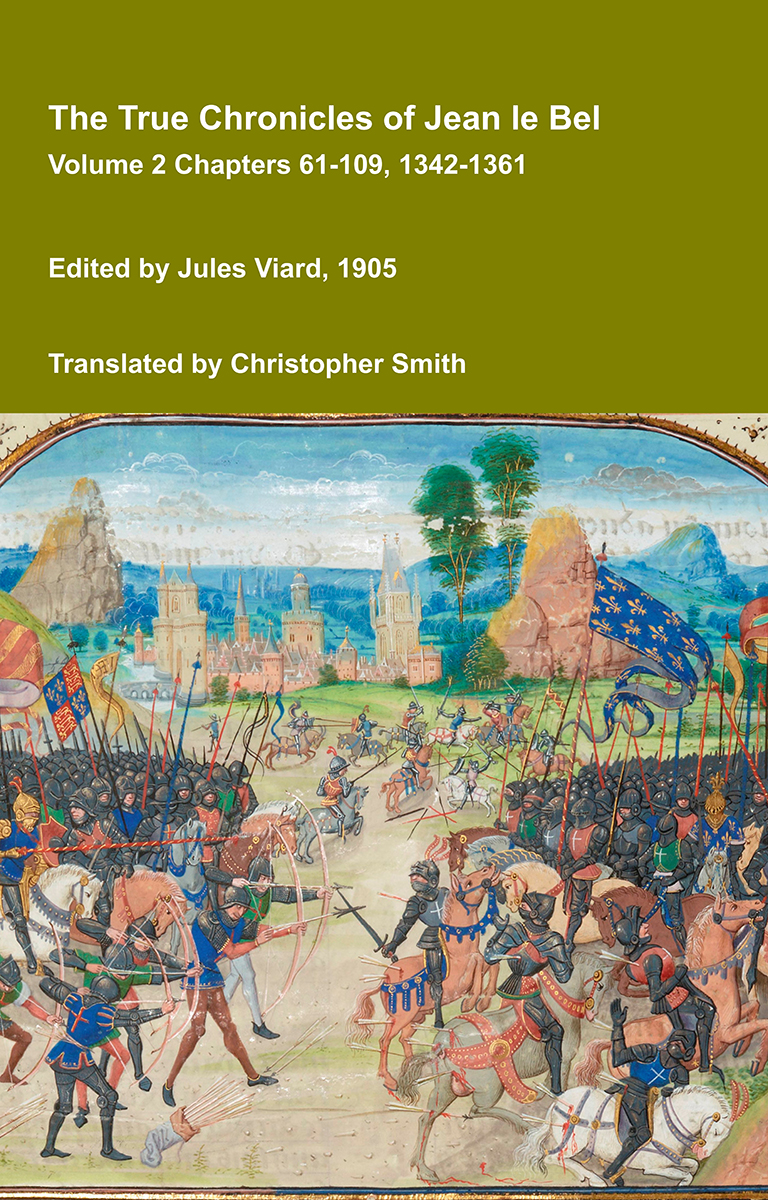
The True Chronicles of Jean le Bel Volume 2 Chapters 61-109 1342-1361

The Chronicle of Jean le Bel, Volume 2 continues one of the most important fourteenth-century accounts of the early Hundred Years’ War. Written by the Liège chronicler Jean le Bel, this vivid narrative follows the fortunes of Edward III, Jean II of France, the Black Prince, the great nobles of France and England, and the soldiers, captains and companies who shaped the conflict. This volume covers some of the most dramatic events of the period, including the battles of Crécy and Poitiers, the siege and capture of Calais, the captivity of King John, the rise of the Jacquerie, the turmoil in Paris under Étienne Marcel and Charles of Navarre, the devastation caused by the free companies, Edward III’s great campaign of 1359–1360, and the negotiations leading to the Treaty of Brétigny. Jean le Bel’s chronicle is especially valuable for its lively detail, its interest in chivalry, warfare, politics and reputation, and its influence on later chroniclers, most famously Froissart. This English translation presents the text in clear, readable British English while preserving the force and character of the original narrative. The translation includes extensive notes to help the reader better understand Jean le Bel's text. Volume 2 also includes translated appendices drawn from royal and administrative records, many from the English Record Office, which illuminate Edward III’s campaigns in Brittany, the siege and occupation of Calais, naval preparations, military finance, appointments, safe conducts and related affairs.

Available at Amazon in eBook and Paperback format.

Pope Vitalian -672

Pope Vitalian was born at Segni.

On 2nd or 3rd July 657 Pope Vitalian was elected Pope.

On 30th July 657 Pope Vitalian was consecrated Pope.

Bede. 664. Deusdedit, Archbishop Of Canterbury, Dying, Wighard was sent to Rome to succeed him in that dignity; But he dying there, Theodore was ordained Archbishop, and sent into Britain with the Abbot Hadrian.

In the above-mentioned year of the aforesaid eclipse, which was presently followed by the pestilence, in which also Bishop Colman, being overcome by the unanimous consent of the Catholics, returned home, Deusdedit, the sixth bishop of the church of Canterbury, died on the 14th of July. Erconbert, also, king of Kent, departed this life the same month and day; leaving his kingdom to his son Egbert, which he held nine years. The see then became vacant for some considerable time, until the priest Wighard, a man skilled in ecclesiastical discipline, of the English race, was sent to Rome by the said King Egbert, and Oswy, king of the Northumbrians, as was briefly mentioned in the foregoing book, with a request that he might be ordained bishop of the church of England; sending at the same time presents to the apostolic pope, and many vessels of gold and silver. Arriving at Rome, where Vitalian presided at that time over the Apostolic See, and having made known to the aforesaid pope the occasion of his journey, he was not long after snatched away, with almost all his companions that went with him, by a pestilence which happened at that time.

Bede. 668. There was at that time in Rome, a monk, called Theodore [aged 66], well known to Hadrian [aged 31], born at Tarsus in Cilicia, a man well instructed in worldly and Divine literature, as also in Greek and Latin; of known probity of life, and venerable for age, being sixty-six years old. Hadrian offered him to the pope to be ordained bishop, and prevailed; but upon these conditions, that he should conduct him into Britain, because he had already travelled through France twice upon several occasions, and was, therefore, better acquainted with the way, and was, moreover, sufficiently provided with men of his own; as also that being his fellow-labourer in doctrine, he might take special care that Theodore should not, according to the custom of the Greeks, introduce any thing contrary to the true faith into the church where he presided. Hadrian, being ordained subdeacon, waited four months for his hair to grow, that it might be shorn into the shape of a crown; for he had before the tonsure of St. Paul, the apostle, after the manner of the eastern people. He was ordained by Pope Vitalian, in the year of our Lord 668, on Sunday, the 26th of March, and on the 27th of May was sent with Hadrian into Britain.

On 27th January 672 Pope Vitalian died.

Bede. But the apostolic pope having consulted about that affair, made diligent inquiry for some one to send to be archbishop of the English churches. There was then in the Niridan monastery, which is not far from the city of Naples [Map] in Campania, an abbot, called Hadrian, by nation an African, well versed in holy writ, experienced in monastical and ecclesiastical discipline, and excellently skilled both in the Greek and Latin tongues. The pope, sending for him, commanded him to accept of the bishopric, and repair into Britain; he answered, that he was unworthy of so great a dignity, but said he could name another, whose learning and age were fitter for the episcopal office. And having proposed to the pope a certain monk, belonging to a neighbouring monastery of virgins, whose name was Andrew, he was by all that knew him judged worthy of a bishopric; but bodily infirmity prevented his being advanced to the episcopal station. Then again Hadrian was pressed to accept of the bishopric; but he desired a respite for a time, to see whether he could find another fit to be ordained bishop.