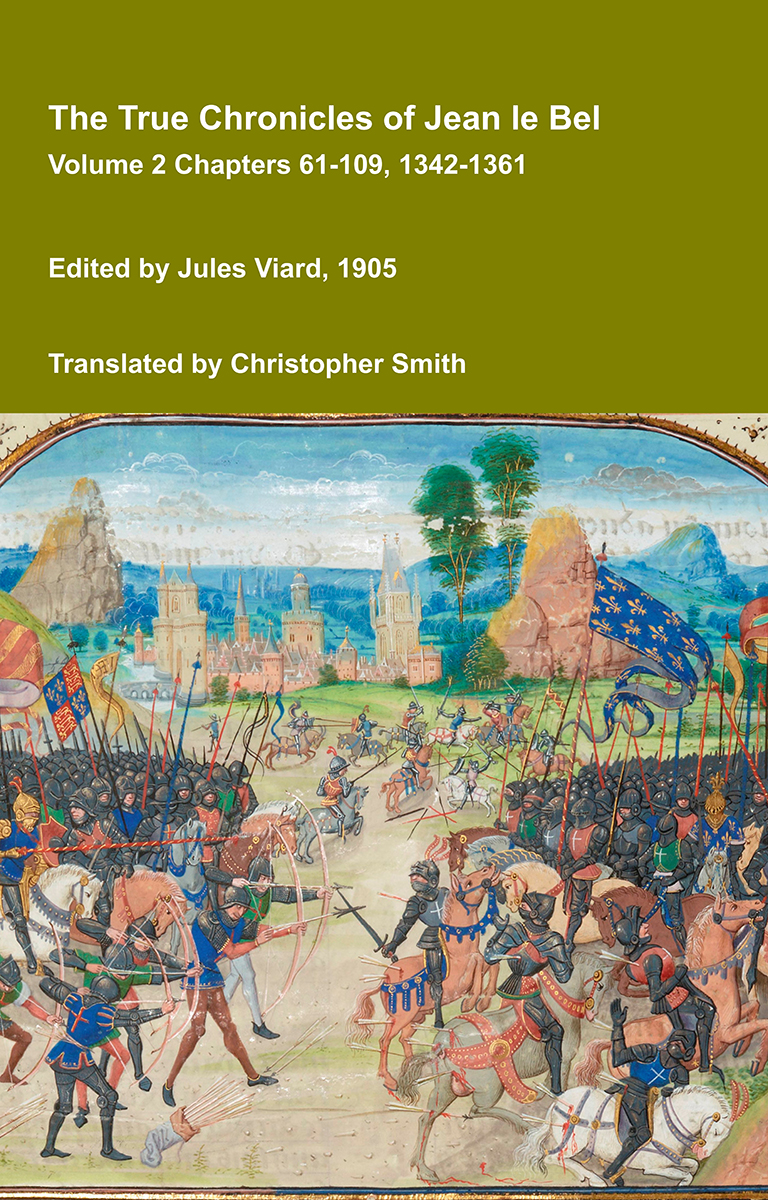
The True Chronicles of Jean le Bel Volume 2 Chapters 61-109 1342-1361

The Chronicle of Jean le Bel, Volume 2 continues one of the most important fourteenth-century accounts of the early Hundred Years’ War. Written by the Liège chronicler Jean le Bel, this vivid narrative follows the fortunes of Edward III, Jean II of France, the Black Prince, the great nobles of France and England, and the soldiers, captains and companies who shaped the conflict. This volume covers some of the most dramatic events of the period, including the battles of Crécy and Poitiers, the siege and capture of Calais, the captivity of King John, the rise of the Jacquerie, the turmoil in Paris under Étienne Marcel and Charles of Navarre, the devastation caused by the free companies, Edward III’s great campaign of 1359–1360, and the negotiations leading to the Treaty of Brétigny. Jean le Bel’s chronicle is especially valuable for its lively detail, its interest in chivalry, warfare, politics and reputation, and its influence on later chroniclers, most famously Froissart. This English translation presents the text in clear, readable British English while preserving the force and character of the original narrative. The translation includes extensive notes to help the reader better understand Jean le Bel's text. Volume 2 also includes translated appendices drawn from royal and administrative records, many from the English Record Office, which illuminate Edward III’s campaigns in Brittany, the siege and occupation of Calais, naval preparations, military finance, appointments, safe conducts and related affairs.

Available at Amazon in eBook and Paperback format.

King Eorcenberht of Kent -664

Paternal Family Tree: Oisingas

On 24th February 616 King Æthelberht of Kent [aged 66] died. His son Eadbald succeeded King of Kent. Emma Austrasia Queen Consort Kent by marriage Queen Consort Kent.

Anglo-Saxon Chronicle. 640. This year died Eadbald, King of Kent, after a reign of twenty-five winters. He had two sons, Ermenred and Erkenbert; and Erkenbert reigned there after his father. He overturned all the idols in the kingdom, and first of English kings appointed a fast before Easter. His daughter was called Ercongota - holy damsel of an illustrious sire! whose mother was Sexburga, the daughter of Anna, king of the East-Angles. Ermenred also begat two sons [Note. Æthelberht Oiscingas and Æthelred Oiscingas], who were afterwards martyred by Thunnor.

Anglo-Saxon Chronicle. 661. This year, at Easter, Kenwal fought at Pontesbury; and Wulfere [aged 21], the son of Penda, pursued him as far as Ashdown. Cuthred, the son of Cwichelm, and King Kenbert, died in one year. Into the Isle of Wight [Map] also Wulfere, the son of Penda, penetrated, and transferred the inhabitants to Ethelwald, king of the South-Saxons, because Wulfere adopted him in baptism. And Eoppa, a mass-priest, by command of Wilfrid and King Wulfere, was the first of men who brought baptism to the people of the Isle of Wight [Map].

Anglo-Saxon Chronicle. 664. This year the sun was eclipsed, on the eleventh of May; and Erkenbert, King of Kent, having died, Egbert his son succeeded to the kingdom. Colman with his companions this year returned to his own country. This same year there was a great plague in the island Britain, in which died Bishop Tuda, who was buried at Wayleigh-Chad and Wilferth were consecrated-And Archbishop Deus-dedit died.

Bede. 664. Deusdedit, Archbishop Of Canterbury, Dying, Wighard was sent to Rome to succeed him in that dignity; But he dying there, Theodore was ordained Archbishop, and sent into Britain with the Abbot Hadrian.

In the above-mentioned year of the aforesaid eclipse, which was presently followed by the pestilence, in which also Bishop Colman, being overcome by the unanimous consent of the Catholics, returned home, Deusdedit, the sixth bishop of the church of Canterbury, died on the 14th of July. Erconbert, also, king of Kent, departed this life the same month and day; leaving his kingdom to his son Egbert, which he held nine years. The see then became vacant for some considerable time, until the priest Wighard, a man skilled in ecclesiastical discipline, of the English race, was sent to Rome by the said King Egbert, and Oswy, king of the Northumbrians, as was briefly mentioned in the foregoing book, with a request that he might be ordained bishop of the church of England; sending at the same time presents to the apostolic pope, and many vessels of gold and silver. Arriving at Rome, where Vitalian presided at that time over the Apostolic See, and having made known to the aforesaid pope the occasion of his journey, he was not long after snatched away, with almost all his companions that went with him, by a pestilence which happened at that time.

On 14th July 664 King Eorcenberht of Kent died. His son Ecgberht succeeded I King of Kent.

Around 699 Seaxburh Wuffingas Queen Consort Kent died. She was buried at Ely Abbey [Map].

Bede. In the fourth year of the reign of Osred [aged 12], Coenred, who had for some time nobly governed the kingdom of the Mercians, much more nobly quitted the sceptre of his kingdom. For he went to Rome, Italy [Map], and there receiving the tonsure and becoming a monk, when Constantine [aged 45] was pope, he continued to his last hour in prayer and fasting and alms-deeds at the threshold of the Apostles. He was succeeded in the throne by Ceolred, the son of Ethelred, who had governed the kingdom before Coenred. With him went the son of Sighere, the king of the East Saxons whom we mentioned before, by name Offa, a youth of a most pleasing age and comeliness, and greatly desired by all his nation to have and to hold the sceptre of the kingdom. He, with like devotion, quitted wife, and lands, and kindred and country, for Christ and for the Gospel, that he might "receive an hundred-fold in this life, and in the world to come life everlasting." He also, when they came to the holy places at Rome, received the tonsure, and ending his life in the monastic habit, attained to the vision of the blessed Apostles in Heaven, as he had long desired.

The same year that they departed from Britain, the great bishop, Wilfrid, ended his days in the province called Inundalum [Map], after he had been bishop forty-five years. His body, being laid in a coffin, was carried to his monastery, which is called Inhrypum, and buried in the church of the blessed Apostle Peter, with the honour due to so great a prelate. Concerning whose manner of life, let us now turn back, and briefly make mention of the things which were done. Being a boy of a good disposition, and virtuous beyond his years, he conducted himself so modestly and discreetly in all points, that he was deservedly beloved, respected, and cherished by his elders as one of themselves. At fourteen years of age he chose rather the monastic than the secular life; which, when he had signified to his father, for his mother was dead, he readily consented to his godly wishes and desires, and advised him to persist in that wholesome purpose. Wherefore he came to the isle of Lindisfarne [Map], and there giving himself to the service of the monks, he strove diligently to learn and to practise those things which belong to monastic purity and piety; and being of a ready wit, he speedily learned the psalms and some other books, having not yet received the tonsure, but being in no small measure marked by those virtues of humility and obedience which are more important than the tonsure; for which reason he was justly loved by his elders and his equals. Having served God some years in that monastery, and being a youth of a good understanding, he perceived that the way of virtue delivered by the Scots was in no wise perfect, and he resolved to go to Rome, to see what ecclesiastical or monastic rites were in use at the Apostolic see. When he told the brethren, they commended his design, and advised him to carry out that which he purposed. He forthwith went to Queen Eanfled, for he was known to her, and it was by her counsel and support that he had been admitted into the aforesaid monastery, and he told her of his desire to visit the threshold of the blessed Apostles. She, being pleased with the youth's good purpose, sent him into Kent, to King Earconbert,8 who was her uncle's son, requesting that he would send him to Rome, Italy [Map] in an honourable manner. At that time, Honorius, one of the disciples of the blessed Pope Gregory [aged 41], a man very highly instructed in ecclesiastical learning, was archbishop there. When he had tarried there for a space, and, being a youth of an active spirit, was diligently applying himself to learn those things which came under his notice, another youth, called Biscop, surnamed Benedict, of the English nobility, arrived there, being likewise desirous to go to Rome, of whom we have before made mention.

Click to read more ...
King Eorcenberht of Kent appears on the following Descendants Family Trees:

Royal Descendants of King Eorcenberht of Kent -664
Number after indicates the number of unique routes of descent. Descendants of Kings and Queens not included.

King Ecgberht I of Kent [1]

Ancestors of King Eorcenberht of Kent -664

Great x 2 Grandfather: Octa King of Kent

Great x 1 Grandfather: Eormenric King of Kent

Grandfather: King Æthelberht of Kent

Father: King Eadbald of Kent

Grandmother: Bertha Merovingian Queen Consort Kent

Great x 1 Grandmother: Ingoberga Unknown Queen Consort Paris

King Eorcenberht of Kent