William of Worcester's Chronicle of England

William of Worcester, born around 1415, and died around 1482 was secretary to John Fastolf, the renowned soldier of the Hundred Years War, during which time he collected documents, letters, and wrote a record of events. Following their return to England in 1440 William was witness to major events. Twice in his chronicle he uses the first person: 1. when writing about the murder of Thomas, 7th Baron Scales, in 1460, he writes '… and I saw him lying naked in the cemetery near the porch of the church of St. Mary Overie in Southwark …' and 2. describing King Edward IV's entry into London in 1461 he writes '… proclaimed that all the people themselves were to recognize and acknowledge Edward as king. I was present and heard this, and immediately went down with them into the city'. William’s Chronicle is rich in detail. It is the source of much information about the Wars of the Roses, including the term 'Diabolical Marriage' to describe the marriage of Queen Elizabeth Woodville’s brother John’s marriage to Katherine, Dowager Duchess of Norfolk, he aged twenty, she sixty-five or more, and the story about a paper crown being placed in mockery on the severed head of Richard, 3rd Duke of York.

Available at Amazon in eBook and Paperback format.

Derby Cathedral Chatsworth House, Derbyshire

Robert Smythson 1570-1634

See Sculptors.

Around 1570 Robert Smythson was born.

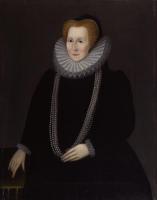
On 13th February 1608 Bess of Hardwick [aged 81] died. She was buried in All Saints Church, Derby [Map]. Her monument, which she had constructed before her death, was designed by Robert Smythson [aged 38]. She left nothing in her will for her 'bad son' Henry Cavendish [aged 57]. He did, however, inherit Chatsworth House, Derbyshire [Map] which he subsequently sold in 1609 to his brother William Cavendish 1st Earl Devonshire [aged 55] for £10,000.

The date of her funeral somewhat complicated. Rawsons 1910 book "Bess of Hardwick and her Circle" quotes Simpson's National Records of Derby for 1608: "The old Countess of Shrewsbury died about Candlemas this year, whose funeral was about Holy Thursday. A great frost this year. The witches of Bakewell hanged." Holy Thursday, the Feast of the Ascension, is thirty-nine days after Easter. Easter in 1608 was on the 6th of April, putting Holy Thursday on the 15th of May.

Ethel Carleton Williams "Bess of Hardwick", 1959, has a note: "9. The date of Bess of Hardwick's funeral is uncertain. The date on the coffin plate is said to be February 1608 (Cox and Hope, Chronicles of the Collegiate Church of All Saints, Derby), but on 31 March 1608 Gilbert Talbot wrote to Robert Cecil, excusing himself for not attending St George's Feast on the ground that his mother-in-law's funeral was to be on St George's Day (23 April). Later, on 3rd of April, the Earl of Arundel wrote to Gilbert (his father-in-law), 'the funeral at Derby is appointed to be either on the fourth or fifth of May, which Garter yet knoweth not, but rather thinketh on the fourth because the other is a holy day'".

Neither of which provide a definite answer. The former being around the 15th of May, the latter 'rather thinketh' the 4th of May. Are there any other contemporary sources available?

Click to read more ...

In 1634 Robert Smythson [aged 64] died.