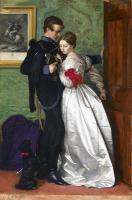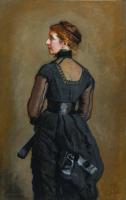
Charles Edward Perugini 1839-1918

On 1st September 1839 Charles Edward Perugini was born in Naples [Map]. He moved to England aged six.

In 1860 Charles Allston Collins [aged 31] and [his future wife] Catherine "Kate" Perugini nee Dickens [aged 20] were married.

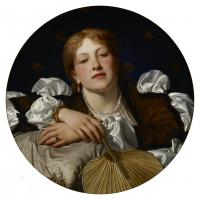
1870. Charles Edward Perugini [aged 30]. "I Know A Maiden Fair To See, Take Care".

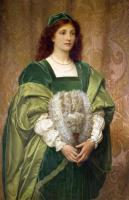
1870. Charles Edward Perugini [aged 30]. "Greensleeves". Model the artist's future wife Catherine "Kate" Perugini nee Dickens [aged 30].

1872. Charles Edward Perugini [aged 32]. "Playing at Work".

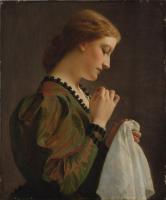
1872. Charles Edward Perugini [aged 32]. "La Cucitrice" aka Seamstress.

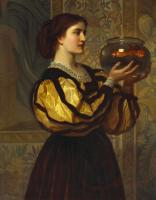
1872. Charles Edward Perugini [aged 32]. "The Goldfish Bowl".

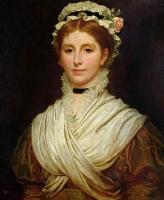
After 1874. Charles Edward Perugini [aged 34]. Portrait of Catherine "Kate" Perugini nee Dickens [aged 34], the artist's wife.

On 4th June 1874 Charles Edward Perugini [aged 34] and Catherine "Kate" Perugini nee Dickens [aged 34] were married at St. Paul's Church in Wilton Place, Knightsbridge. The guests included Georgina Hogarth, Mamie Dickens, Francis Jeffrey Dickens, Henry Fielding Dickens and Sir John Everett Millais [aged 44]. They had married earlier, 1st September 1839, at a registry office, with witnesses, and strangers, Henry Thomas Mitcham and Ernest Edward Earle.

1878. Charles Edward Perugini [aged 38]. "Faithful".

Westminster Chronicle of King Richard II, 1381-1394

The Westminster Chronicle is one of the most vivid and important narrative sources for the reign of Richard II. Written by an anonymous chronicler closely connected with Westminster Abbey, it covers the years 1381 to 1394, from the Peasants’ Revolt to the political tensions, court ceremonies, diplomatic negotiations, royal progresses, and public crises of Richard’s later reign. Rich in detail the chronicle records major events such as the conflicts between the King and Lords Appellant, King and the City of London, negotiations with France and Scotland, the death and funeral of Queen Anne of Bohemia, the illness of Charles VI of France, and the changing fortunes of leading nobles including John of Gaunt, Thomas of Gloucester, Robert de Vere, and the Earl of Arundel. The Chronicle offers readers a remarkable window into late fourteenth-century England, combining political observation, courtly spectacle, urban drama, ecclesiastical affairs, and moral judgement. It is an essential source for anyone interested in medieval monarchy, London, Westminster, and the troubled reign of Richard II.

Available at Amazon in eBook and Paperback format.

1878. Charles Edward Perugini [aged 38]. "A Girl Reading".

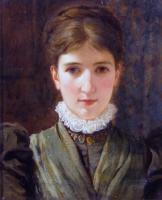
Before 1882. Charles Edward Perugini [aged 42]. Portrait of Sophie Gray [aged 38].

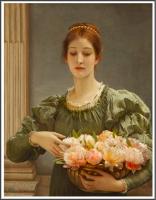
1887. Charles Edward Perugini [aged 47]. "Peonies".

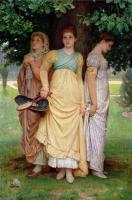
1888. Charles Edward Perugini [aged 48]. "A Summer Shower".

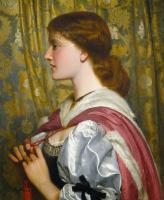
1888. Charles Edward Perugini [aged 48]. "Silvia".

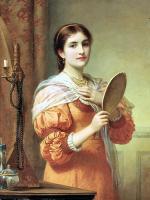
Before 1890. Charles Edward Perugini [aged 50]. "Girl With Mirror".

Before 1890. Charles Edward Perugini [aged 50]. "Dressing Up".

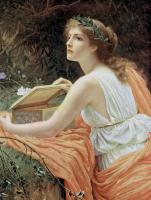
1893. Charles Edward Perugini [aged 53]. "Pandora's Box.

Before 1918. Circle of Charles Edward Perugini [aged 78]. Portrait of Sophia Castila Rosamund Campbell Countess Granville [aged 70].

Sophia Castila Rosamund Campbell Countess Granville: On 24th July 1847 she was born to Walter Frederick Campbell and Katherine Isabella Cole. Coefficient of inbreeding 1.56%. On 26th September 1865 Granville Leveson-Gower 2nd Earl Granville and she were married. The difference in their ages was 32 years. He the son of Granville Leveson-Gower 1st Earl Granville and Harriet Cavendish Countess Granville. They were half third cousin twice removed. On 12th November 1938 she died.

On 22nd December 1918 Charles Edward Perugini [aged 79] died.

The Deeds of the Dukes of Normandy

The Gesta Normannorum Ducum [The Deeds of the Dukes of Normandy] is a landmark medieval chronicle tracing the rise and fall of the Norman dynasty from its early roots through the pivotal events surrounding the Norman Conquest of England. Originally penned in Latin by the monk William of Jumièges shortly before 1060 and later expanded at the behest of William the Conqueror, the work chronicles the deeds, politics, battles, and leadership of the Norman dukes, especially William’s own claim to the English throne. The narrative combines earlier historical sources with firsthand information and oral testimony to present an authoritative account of Normandy’s transformation from a Viking settlement into one of medieval Europe’s most powerful realms. William’s history emphasizes the legitimacy, military prowess, and governance of the Norman line, framing their expansion, including the conquest of England, as both divinely sanctioned and noble in purpose. Later chroniclers such as Orderic Vitalis and Robert of Torigni continued the history, extending the coverage into the 12th century, providing broader context on ducal rule and its impact. Today this classic work remains a foundational source for understanding Norman identity, medieval statesmanship, and the historical forces that reshaped England and Western Europe between 800AD and 1100AD.

Available at Amazon in eBook and Paperback format.

On 9th May 1929 [his former wife] Catherine "Kate" Perugini nee Dickens [aged 89] died.