

The Manuscripts of His Grace the Duke of Rutland 1640. 4th January 1640. Savoy.
F. Lord Willoughby to his uncle, the Earl of Rutland [aged 60], at Belvoir Castle [Map].
When we ate your venison my wife and I drank your health and my Lady's and did not forget little Mr. George, whom, I am glad to hear, grows towards a man. "There hath beene a marriage at the court betweene one of my Lord of Corcke [aged 73] sonnse [aged 21] and my Lady Elizabeth Feelding, about which there is a greate stur, for it seemes he did not prove eoe rite as a man should be to goo about such a business. For the report goese that his manly part had lost something in his former serviocesse, and beside that he was soe full of severall disceases ... as that it was tould the Queene [aged 30], whoe sent for my Lady Elizabeth, and tould her that she must desier her not to lett her husband lye with her that night, whoe put of, modilestly making little answere, but she seemed so lothe to understand the Queene, as that she tould her she must command her not to come in a pair of sheets with him, and tould her the reasons; soe as that he is gone out of the way some say into France, others thinks he is in London under cower. It was discovered by his sister [aged 30] Mr. Goring's [aged 31] wife, to whom he had imparted his grevancess, and she had plotted it soe, to make an excuse for him, that he should falie downe stares that day, and she would come and take him up, and soe he should complane how he had breused himselfe and strained his back with the fale, that he should be soe ill he was not fitt to goe to bed to his wife that night. But could not keepe her counsel but must tell her husband Jorge Goring, and he presently ran and tould the Queene, and soe it was discovered and then it was presently in every buddy's mouth.".
My Lord Keeper is so ill that the physicians think he cannot recover. My Lord Chief Justice Bramstone is talked of to be Lord Keeper, and Bishop Wren [aged 54]. It is known to be between those two. My Lord Finch [aged 12] will be Chief Justice of the King's Bench and the Attorney General to be Chief Justice of the Common Pleas. Signet.


John Evelyn's Diary. 3rd August 1656. I went to London, to receive the Blessed Sacrament, the first time the Church of England was reduced to a chamber and conventicle; so sharp was the persecution. The parish churches were filled with sectaries of all sorts, blasphemous and ignorant mechanics usurping the pulpits everywhere. Dr. Wild preached in a private house in Fleet Street [Map], where we had a great meeting of zealous Christians, who were generally much more devout and religious than in our greatest prosperity. In the afternoon, I went to the French Church in the Savoy, where I heard Monsieur d'Espagne catechize, and so returned to my house.
Samuel Pepys' Diary. 28th September 1662. At last I rose, and with Tom to the French Church at the Savoy, where I never was before-a pretty place it is-and there they have the Common Prayer Book read in French, and, which I never saw before, the minister do preach with his hat off, I suppose in further conformity with our Church.
John Evelyn's Diary. 20th March 1670. A stranger preached at the Savoy French church; the Liturgy of the Church of England being now used altogether, as translated into French by Dr. Durell.

Vesta Monumenta. 1750. Plate 2.5. Savoy Palace [Map] with C. St Mary le Strand Church, F. Savoy French Church.
On 15th June 1644 Edward Montagu 1st Baron Montagu [aged 81] died at the Savoy Hospital. His son Edward [aged 27] succeeded 2nd Baron Montagu of Boughton in Northamptonshire.
John Evelyn's Diary. 8th June 1665. I went again to his Grace, thence to the Council, and moved for another privy seal for £20,000, and that I might have the disposal of the Savoy Hospital for the sick and wounded; all which was granted. Hence to the Royal Society, to refresh among the philosophers.
John Evelyn's Diary. 17th August 1666. Dined with the Lord Chancellor [aged 57], whom I entreated to visit the Hospital of the Savoy, and reduce it (after the great abuse that had been continued) to its original institution for the benefit of the poor, which he promised to do.


John Evelyn's Diary. 25th August 1666. Waited on Sir William D'Oyly [aged 52], now recovered, as it were, miraculously. In the afternoon, visited the Savoy Hospital, where I stayed to see the miserably dismembered and wounded men dressed, and gave some necessary orders. Then to my Lord Chancellor [aged 57], who had, with the Bishop of London [aged 74] and others in the commission, chosen me one of the three surveyors of the repairs of Paul's [Map], and to consider of a model for the new building, or, if it might be, repairing of the steeple, which was most decayed.
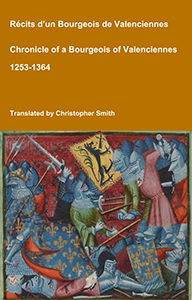
Chronicle of a Bourgeois of Valenciennes
Récits d’un bourgeois de Valenciennes aka The Chronicle of a Bourgeois of Valenciennes is a vivid 14th-century vernacular chronicle written by an anonymous urban chronicler from Valenciennes in the County of Hainaut. It survives in a manuscript that describes local and regional history from about 1253 to 1366, blending chronology, narrative episodes, and eyewitness-style accounts of political, military, and social events in medieval France, Flanders, and the Low Countries. The work begins with a chronological framework of events affecting Valenciennes and its region under rulers such as King Philip VI of France and the shifting allegiances of local nobility. It includes accounts of conflicts, sieges, diplomatic manoeuvres, and the impact of broader struggles like the Hundred Years’ War on urban life in Hainaut. Written from the perspective of a burgher (bourgeois) rather than a monastery or royal court, the chronicle offers a rare lay viewpoint on high politics and warfare, reflecting how merchants, townspeople, and civic institutions experienced the turbulence of the 13th and 14th centuries. Its narrative style combines straightforward reporting of events with moral and civic observations, making it a valuable source for readers interested in medieval urban society, regional politics, and the lived experience of war and governance in pre-modern Europe.
Available at Amazon in eBook and Paperback format.
John Evelyn's Diary. 6th September 1666. Thursday. I represented to his Majesty [aged 36] the case of the French prisoners at war in my custody, and besought him that there might be still the same care of watching at all places contiguous to unseized houses. It is not indeed imaginable how extraordinary the vigilance and activity of the King and the Duke [aged 32] was, even laboring in person, and being present to command, order, reward, or encourage workmen; by which he showed his affection to his people, and gained theirs. Having, then, disposed of some under cure at the Savoy, I returned to Whitehall [Map], where I dined at Mr. Offley's [Note. Not clear who Mr Offley is? John Evelyn's [aged 45] brother George Evelyn of Wotton [aged 49] was married to Mary Offley], the groom-porter, who was my relation.

Vesta Monumenta. 1753. Plate 2.12. The prison and chapel buildings in the Savoy Hospital in 1736. The Hospital Chapel, depicted from two different sides in the lower half and the upper right portion of this plate, is the only Savoy building that survives today. Engraving by George Vertue [aged 69] after his own drawings.