

 John Evelyn's Diary January 1656
 John Evelyn's Diary February 1656
 John Evelyn's Diary April 1656
 John Evelyn's Diary July 1656
 John Evelyn's Diary August 1656
 John Evelyn's Diary October 1656
John Evelyn's Diary 1656 is in John Evelyn's Diary 1650s.
5th January 1656. Came to visit me my Lord Lisle [aged 36], son to the Earl of Leicester [aged 60], with Sir Charles Ouseley, two of the Usurper's council; Mr. John Hervey, and John Denham [aged 41], the poet.


18th January 1656. Went to Eltham on foot, being a great frost, but a mist falling as I returned, gave me such a rheum as kept me within doors near a whole month after.
5th February 1656. Was shown me a pretty perspective and well represented in a triangular box, the great Church of Haarlem in Holland, to be seen through a small hole at one of the corners, and contrived into a handsome cabinet. It was so rarely done, that all the artists and painters in town flocked to see and admire it.

10th February 1656. I heard Dr. Wilkins [aged 41] preach before the Lord Mayor in St. Paul's [Map], showing how obedience was preferable to sacrifice. He was a most obliging person, who had married the Protector's [aged 56] sister, and took great pains to preserve the Universities from the ignorant, sacrilegious commanders and soldiers, who would fain have demolished all places and persons that pretended to learning.
14th February 1656. I dined with Mr. Berkeley, son of Lord Berkeley [aged 54], of Berkeley Castle, where I renewed my acquaintance with my Lord Bruce, my fellow-traveler in Italy.
19th February 1656. Went with Dr. Wilkins [aged 42] to see Barlow [aged 30], the famous painter of fowls, beasts, and birds.
4th March 1656. This night I was invited by Mr. Roger L'Estrange [aged 39] to hear the incomparable Lubicer [aged 26] on the violin. His variety on a few notes and plain ground, with that wonderful dexterity, was admirable. Though a young man, yet so perfect and skillful, that there was nothing, however cross and perplexed, brought to him by our artists, which he did not play off at sight with ravishing sweetness and improvements, to the astonishment of our best masters. In sum, he played on the single instrument a full concert, so as the rest flung down their instruments, acknowledging the victory. As to my own particular, I stand to this hour amazed that God should give so great perfection to so young a person. There were at that time as excellent in their profession as any were thought to be in Europe, Paul Wheeler, Mr. Mell, and others, till this prodigy appeared. I can no longer question the effects we read of in David's harp to charm evil spirits, or what is said some particular notes produced in the passions of Alexander, and that King of Denmark.

12th April 1656. Mr. Berkeley [aged 7] and Mr. Robert Boyle [aged 29] (that excellent person and great virtuoso), Dr. Taylor [aged 43], and Dr. Wilkins [aged 42], dined with me at Sayes Court [Map], when I presented Dr. Wilkins with my rare burning-glass. In the afternoon, we all went to Colonel Blount's [aged 52], to see his newly-invented plows.
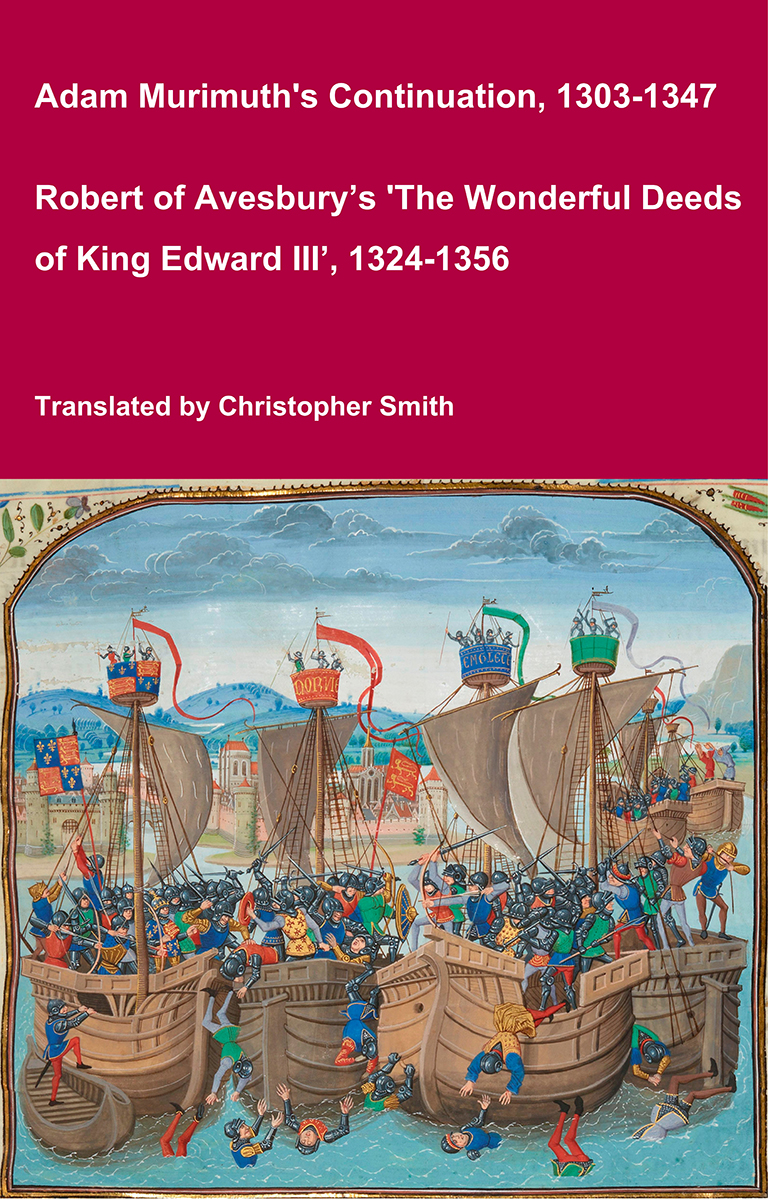
Adam Murimuth's Continuation and Robert of Avesbury’s 'The Wonderful Deeds of King Edward III'
This volume brings together two of the most important contemporary chronicles for the reign of Edward III and the opening phases of the Hundred Years’ War. Written in Latin by English clerical observers, these texts provide a vivid and authoritative window into the political, diplomatic, and military history of fourteenth-century England and its continental ambitions. Adam Murimuth Continuatio's Chronicarum continues an earlier chronicle into the mid-fourteenth century, offering concise but valuable notices on royal policy, foreign relations, and ecclesiastical affairs. Its annalistic structure makes it especially useful for establishing chronology and tracing the development of events year by year. Complementing it, Robert of Avesbury’s De gestis mirabilibus regis Edwardi tertii is a rich documentary chronicle preserving letters, treaties, and official records alongside narrative passages. It is an indispensable source for understanding Edward III’s claim to the French crown, the conduct of war, and the mechanisms of medieval diplomacy. Together, these works offer scholars, students, and enthusiasts a reliable and unembellished account of a transformative period in English and European history. Essential for anyone interested in medieval chronicles, the Hundred Years’ War, or the reign of Edward III.
Available at Amazon in eBook and Paperback format.
22nd April 1656. Came to see Mr. Henshaw [aged 38] and Sir William Paston's [aged 46] son [aged 24], since Earl of Yarmouth. Afterward, I went to see his Majesty's [aged 25] house at Eltham [Map], both palace and chapel in miserable ruins, the noble woods and park destroyed by Rich [aged 68], the rebel.


6th May 1656. I brought Monsieur le Franc, a young French Sorbonnist, a proselyte, to converse with Dr. Taylor [aged 43]; they fell to dispute on original sin, in Latin, upon a book newly published by the Doctor, who was much satisfied with the young man. Thence, to see Mr. Dugdale [aged 16], our learned antiquary and herald. Returning, I was shown the three vast volumes of Father Kircher's, "Obeliscus Pamphilius" and "Ægyptiacus"; in the second volume I found the hieroglyphic I first communicated and sent to him at Rome by the hands of Mr. Henshaw [aged 38], whom he mentions; I designed it from the stone itself brought me to Venice from Cairo by Captain Powell.
7th May 1656. I visited Dr. Taylor [aged 43], and prevailed on him to propose Monsieur le Franc to the Bishop that he might have Orders, I having sometime before brought him to a full consent to the Church of England, her doctrine and discipline, in which he had till of late made some difficulty; so he was this day ordained both deacon and priest by the Bishop of Meath. I paid the fees to his lordship, who was very poor and in great want; to that necessity were our clergy reduced! In the afternoon I met Alderman Robinson, to treat with Mr. Papillion about the marriage of my cousin, George Tuke, with Mrs. Fontaine.
8th May 1656. I went to visit Dr. Wilkins [aged 42], at Whitehall [Map], when I first met with Sir P. Neal [aged 43], famous for his optic glasses. Greatorix, the mathematical instrument maker, showed me his excellent invention to quench fire.
12th May 1656. Was published my "Essay on Lucretius", with innumerable errata by the negligence of Mr. Triplet, who undertook the correction of the press in my absence. Little of the Epicurean philosophy was then known among us.
28th May 1656. I dined with Nieuport, the Holland Ambassador, who received me with extraordinary courtesy. I found him a judicious, crafty, and wise man. He gave me excellent cautions as to the danger of the times, and the circumstances our nation was in. I remember the observation he made upon the ill success of our former Parliaments, and their private animosities, and little care of the public.
28th May 1656. Came to visit me the old Marquis of Argyle [aged 49] (since executed), Lord Lothian, and some other Scotch noblemen, all strangers to me. Note, the Marquis took the turtle-doves in the aviary for owls.

28th May 1656. The Earl of Southampton [aged 49] (since Treasurer) and Mr. Spencer [aged 27], brother to the Earl of Sunderland, came to see my garden.
7th July 1656. I began my journey to see some parts of the northeast of England; but the weather was so excessively hot and dusty, I shortened my progress.
8th July 1656. To Colchester, Essex [Map], a fair town, but now wretchedly demolished by the late siege, especially the suburbs, which were all burned, but were then repairing. The town is built on a rising ground, having fair meadows on one side, and a river with a strong ancient castle, said to have been built by King Coilus, father of Helena, mother of Constantine the Great, of whom I find no memory save at the pinnacle of one of their wool-staple houses, where is a statue of Coilus, in wood, wretchedly carved. The walls are exceedingly strong, deeply trenched, and filled with earth. It has six gates, and some watchtowers, and some handsome churches. But what was shown us as a kind of miracle, at the outside of the Castle, the wall where Sir Charles Lucas [aged 43] and Sir George Lisle, those valiant and noble persons who so bravely behaved themselves in the last siege, were barbarously shot, murdered by Ireton in cold blood, after surrendering on articles; having been disappointed of relief from the Scotch army, which had been defeated with the King at Worcester. The place was bare of grass for a large space, all the rest of it abounding with herbage. For the rest, this is a ragged and factious town, now swarming with sectaries. Their trading is in cloth with the Dutch, and baize and says with Spain; it is the only place in England where these stuffs are made unsophisticated. It is also famous for oysters and eringo root, growing hereabout, and candied for sale.
8th July 1656. Went to Dedham, a pretty country town, having a very fair church, finely situated, the valley well watered. Here, I met with Dr. Stokes, a young gentleman, but an excellent mathematician. This is a clothing town, as most are in Essex, but lies in the unwholesome hundreds.

8th July 1656. Hence to Ipswich, Suffolk [Map], doubtless one of the sweetest, most pleasant, well-built towns in England. It has twelve fair churches, many noble houses, especially the Lord Devereux's; a brave quay, and commodious harbor, being about seven miles from the main; an ample market place. Here was born the great Cardinal Wolsey, who began a palace here, which was not finished.
8th July 1656. I had the curiosity to visit some Quakers here in prison; a new fanatic sect, of dangerous principles, who show no respect to any man, magistrate, or other, and seem a melancholy, proud sort of people, and exceedingly ignorant. One of these was said to have fasted twenty days; but another, endeavoring to do the like, perished on the 10th, when he would have eaten, but could not.
10th July 1656. I returned homeward, passing again through Colchester, Essex [Map]; and, by the way, near the ancient town of Chelmsford, Essex [Map], saw New Hall, built in a park by Henry VII. and VIII., and given by Queen Elizabeth to the Earl of Sussex, who sold it to the late great Duke of Buckingham, and since seized on by Oliver Cromwell [aged 57] (pretended Protector). It is a fair old house, built with brick, low, being only of two stories, as the manner then was; the gate-house better; the court, large and pretty; the staircase, of extraordinary wideness, with a piece representing Sir Francis Drake's action in the year 1580, an excellent sea-piece; the galleries are trifling; the hall is noble; the garden a fair plot, and the whole seat well accommodated with water; but, above all, I admired the fair avenue planted with stately lime trees, in four rows, for near a mile in length. It has three descents, which is the only fault, and may be reformed. There is another fair walk of the same at the mall and wilderness, with a tennis-court, and pleasant terrace toward the park, which was well stored with deer and ponds.


11th July 1656. Came home by Greenwich, Kent [Map] ferry, where I saw Sir J. Winter's project of charring sea-coal, to burn out the sulphur, and render it sweet. He did it by burning the coals in such earthen pots as the glass men melt their metal, so firing them without consuming them, using a bar of iron in each crucible, or pot, which bar has a hook at one end, that so the coals being melted in a furnace with other crude sea-coals under them, may be drawn out of the pots sticking to the iron, whence they are beaten off in great half-exhausted cinders, which being rekindled, make a clear, pleasant chamber-fire, deprived of their sulphur and arsenic malignity. What success it may have, time will discover.
3rd August 1656. I went to London, to receive the Blessed Sacrament, the first time the Church of England was reduced to a chamber and conventicle; so sharp was the persecution. The parish churches were filled with sectaries of all sorts, blasphemous and ignorant mechanics usurping the pulpits everywhere. Dr. Wild preached in a private house in Fleet Street [Map], where we had a great meeting of zealous Christians, who were generally much more devout and religious than in our greatest prosperity. In the afternoon, I went to the French Church in the Savoy, where I heard Monsieur d'Espagne catechize, and so returned to my house.

The True Chronicles of Jean le Bel Volume 1 Chapters 1-60 1307-1342
The True Chronicles of Jean le Bel offer one of the most vivid and immediate accounts of 14th-century Europe, written by a knight who lived through the events he describes, and experienced some of them first hand. Covering the early decades of the Hundred Years’ War, this remarkable chronicle follows the campaigns of Edward III of England, the politics of France and the Low Countries, and the shifting alliances that shaped medieval warfare. Unlike later historians, Jean le Bel writes with a strong sense of eyewitness authenticity, drawing on personal experience and the testimony of fellow soldiers. His narrative captures not only battles and sieges, but also the realities of military life, diplomacy, and the ideals of chivalry that governed noble society. A key source for Jean Froissart, Le Bel’s chronicle stands on its own as a compelling and insightful work, at once historical record and literary achievement. This translation builds on the 1905 edition published in French by Jules Viard, adding extensive translations from other sources Rymer's Fœdera, the Chronicles of Adam Murimuth, William Nangis, Walter of Guisborough, a Bourgeois of Valenciennes, Geoffrey le Baker of Swinbroke and Richard Lescot to enrich the original text and Viard's notes.
Available at Amazon in eBook and Paperback format.
20th August 1656. Was a confused election of Parliament called by the Usurper [aged 57].
7th September 1656. I went to take leave of my excellent neighbour and friend, Sir. H. Newton and lady, now going to dwell at Warwick; and Mr. Needham, my dear and learned friend, came to visit me.
14th September 1656. Now was old Sir Henry Vane [aged 43] sent to Carisbrook Castle, in Wight, for a foolish book he published; the pretended Protector [aged 57] fortifying himself exceedingly, and sending many to prison.

2nd October 1656. Came to visit me my cousin, Stephens, and Mr. Pierce (since head of Magdalen College, Oxford), a learned minister of Brington, Northamptonshire, in Northamptonshire, and Captain Cooke [aged 40], both excellent musicians.
2nd November 1656. There was now nothing practical preached, or that pressed reformation of life, but high and speculative points and strains that few understood, which left people very ignorant, and of no steady principles, the source of all our sects and divisions, for there was much envy and uncharity in the world; God of his mercy amend it! Now, indeed, that I went at all to church, while these usurpers possessed the pulpits, was that I might not be suspected for a Papist, and that, though the minister was Presbyterianly affected, he yet was as I understood duly ordained, and preached sound doctrine after their way, and besides was an humble, harmless, and peaceable man.
25th December 1656. I went to London, to receive the Blessed Communion, this holy festival at Dr. Wild's lodgings, where I rejoiced to find so full an assembly of devout and sober Christians.
26th December 1656. I invited some of my neighbours and tenants, according to custom, and to preserve hospitality and charity.
28th December 1656. A stranger preached on Luke xviii. 7, 8, on which he made a confused discourse, with a great deal of Greek and ostentation of learning, to but little purpose.
30th December 1656. Dined with me Sir William Paston's [aged 46] son [aged 25], Mr. Henshaw [aged 38], and Mr. Clayton.
31st December 1656. I begged God's blessing and mercies for his goodness to me the past year, and set my domestic affairs in order.