

Gospel of St Luke is in Gospels.
NIV. "Glory to God in the highest heaven, and on earth peace to those on whom his favour rests.
John Evelyn's Diary. 25th October 1660. Dr. Rainbow [aged 52] preached before the King [aged 30], on Luke II 14, of the glory to be given God for all his mercies, especially for restoring the Church and government; now the service was performed with music, voices, etc., as formerly.
NIV. He answered, "'Love the Lord your God with all your heart and with all your soul and with all your strength and with all your mind'; and, 'Love your neighbor as yourself.'".
John Evelyn's Diary. 25th April 1675. Dr. Barrow [aged 44], that excellent, pious, and most learned man, divine, mathematician, poet, traveler, and most humble person, preached at Whitehall Palace [Map] to the household, on Luke xx. 27 [Note. This reference should be Luke x. 27], of love and charity to our neighbours.
NIV. But the Lord answered and said to her, "Martha, Martha, you are worried and bothered about so many things; 42 but only one thing is necessary, for Mary has chosen the good part, which shall not be taken away from her.".
John Evelyn's Diary. 1st April 1688. In the morning, the first sermon was by Dr. Stillingfleet [aged 52], Dean of St. Paul's (at Whitehall), on Luke x. 41, 42. The Holy Communion followed, but was so interrupted by the rude breaking in of multitudes zealous to hear the second sermon, to be preached by the Bishop of Bath and Wells [aged 50], that the latter part of that holy office could hardly be heard, or the sacred elements be distributed without great trouble. The Princess being come, he preached on Mich. vii. 8, 9, 10, describing the calamity of the Reformed Church of Judah under the Babylonian persecution, for her sins, and God's delivery of her on her repentance; that as Judah emerged, so should the now Reformed Church, whenever insulted and persecuted. He preached with his accustomed action, zeal, and energy, so that people flocked from all quarters to hear him.


NIV. He said to them, "When you pray, say: "'Father, hallowed be your name, your kingdom come.
Samuel Pepys' Diary. 3rd April 1663. Waked betimes and talked half an hour with my father, and so I rose and to my office, and about 9 o'clock by water from the Old Swan [Map] to White Hall and to chappell, which being most monstrous full, I could not go into my pew, but sat among the quire. Dr. Creeton [aged 70], the Scotchman, preached a most admirable, good, learned, honest and most severe sermon, yet comicall, upon the words of the woman concerning the Virgin, "Blessed is the womb that bare thee (meaning Christ) and the paps that gave thee suck; and he answered, Nay; rather is he blessed that heareth the word of God, and keepeth it". He railed bitterly ever and anon against John Calvin, and his brood, the Presbyterians, and against the present term, now in use, of "tender consciences". He ripped up Hugh Peters (calling him the execrable skellum1 ), his preaching and stirring up the maids of the city to bring in their bodkins and thimbles.
Note 1. A villain or scoundrel; the cant term for a thief.
NIV. As Jesus was saying these things, a woman in the crowd called out, "Blessed is the mother who gave you birth and nursed you."
KJB. And it came to pass, as he spake these things, a certain woman of the company lifted up her voice, and said unto him, Blessed is the womb that bare thee, and the paps which thou hast sucked.
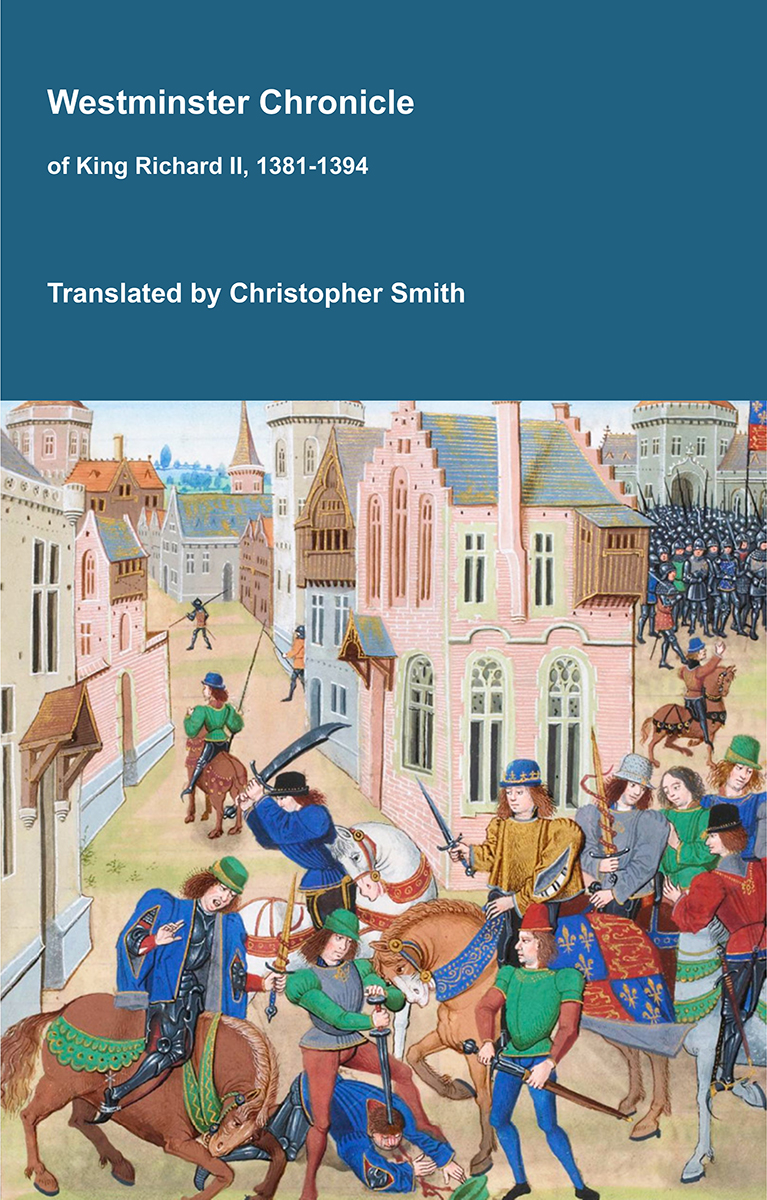
Westminster Chronicle of King Richard II, 1381-1394
The Westminster Chronicle is one of the most vivid and important narrative sources for the reign of Richard II. Written by an anonymous chronicler closely connected with Westminster Abbey, it covers the years 1381 to 1394, from the Peasants’ Revolt to the political tensions, court ceremonies, diplomatic negotiations, royal progresses, and public crises of Richard’s later reign. Rich in detail the chronicle records major events such as the conflicts between the King and Lords Appellant, King and the City of London, negotiations with France and Scotland, the death and funeral of Queen Anne of Bohemia, the illness of Charles VI of France, and the changing fortunes of leading nobles including John of Gaunt, Thomas of Gloucester, Robert de Vere, and the Earl of Arundel. The Chronicle offers readers a remarkable window into late fourteenth-century England, combining political observation, courtly spectacle, urban drama, ecclesiastical affairs, and moral judgement. It is an essential source for anyone interested in medieval monarchy, London, Westminster, and the troubled reign of Richard II.
Available at Amazon in eBook and Paperback format.
NIV. I tell you, no! But unless you repent, you too will all perish.
KJB. I tell you, Nay: but, except ye repent, ye shall all likewise perish.
John Evelyn's Diary. 11th January 1685. A young man preached upon 13 St. Luke 5 after the Presbyterian tedious method and repetition.
NIV. 23 Then one said to Him, "Lord, are there few who are saved?" And He said to them, 24 "Strive to enter through the narrow gate, for many, I say to you, will seek to enter and will not be able.

John Evelyn's Diary. 7th March 1658. To London, to hear Dr. Taylor [aged 45] in a private house on Luke xiii. 23, 24. After the sermon, followed the blessed Communion, of which I participated. In the afternoon, Dr. Gunning [aged 44], at Exeter House [Map], expounding part of the Creed.
NIV. 30 "'No, father Abraham,' he said, 'but if someone from the dead goes to them, they will repent.' 31 "He said to him, 'If they do not listen to Moses and the Prophets, they will not be convinced even if someone rises from the dead.'".
John Evelyn's Diary. 31st October 1680. I spent this whole day in exercises. A stranger preached at Whitehall [Map] on Luke xvi. 30, 31. I then went to St. Martin's [Map], where the Bishop of St. Asaph [aged 53] [Note. The next post refers to Bishop William Lloyd being made Bishop of St Asaph. The previous incumbent Isaac Barrow had died 24th June 1680] preached on 1 Peter iii. 15; the Holy Communion followed, at which I participated, humbly imploring God's assistance in the great work I was entering into. In the afternoon, I heard Dr. Sprat [aged 45], at St. Margaret's [Map], on Acts xvii. 11.
NIV. Remember Lot's wife!
KJB. Remember Lot's wife.
NIV. 7 And will not God bring about justice for his chosen ones, who cry out to him day and night? Will he keep putting them off? 8 I tell you, he will see that they get justice, and quickly. However, when the Son of Man comes, will he find faith on the earth?".
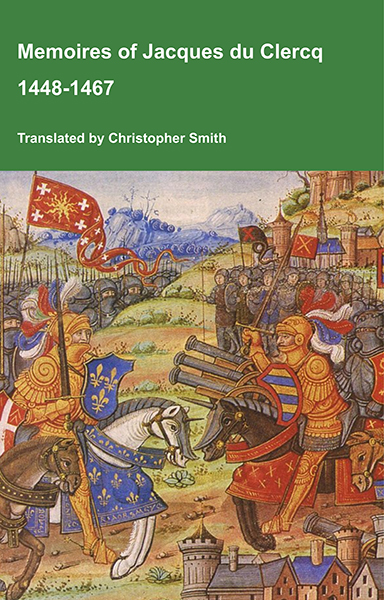
This is a translation of the 'Memoires of Jacques du Clercq', published in 1823 in two volumes, edited by Frederic, Baron de Reissenberg. In his introduction Reissenberg writes: 'Jacques du Clercq tells us that he was born in 1424, and that he was a licentiate in law and a counsellor to Philip the Good, Duke of Burgundy, in the castellany of Douai, Lille, and Orchies. It appears that he established his residence at Arras. In 1446, he married the daughter of Baldwin de la Lacherie, a gentleman who lived in Lille. We read in the fifth book of his Memoirs that his father, also named Jacques du Clercq, had married a lady of the Le Camelin family, from Compiègne. His ancestors, always attached to the counts of Flanders, had constantly served them, whether in their councils or in their armies.' The Memoires cover a period of nineteen years beginning in in 1448, ending in in 1467. It appears that the author had intended to extend the Memoirs beyond that date; no doubt illness or death prevented him from carrying out this plan. As Reissenberg writes the 'merit of this work lies in the simplicity of its narrative, in its tone of good faith, and in a certain air of frankness which naturally wins the reader’s confidence.' Du Clercq ranges from events of national and international importance, including events of the Wars of the Roses in England, to simple, everyday local events such as marriages, robberies, murders, trials and deaths, including that of his own father in Book 5; one of his last entries.
Available at Amazon in eBook and Paperback format.
John Evelyn's Diary. 28th December 1656. A stranger preached on Luke xviii. 7, 8, on which he made a confused discourse, with a great deal of Greek and ostentation of learning, to but little purpose.
NIV. As he approached Jerusalem and saw the city, he wept over it ...
John Evelyn's Diary. 10th October 1666. This day was ordered a general Fast through the Nation, to humble us on the late dreadful conflagration, added to the plague and war, the most dismal judgments that could be inflicted; but which indeed we highly deserved for our prodigious ingratitude, burning lusts, dissolute court, profane and abominable lives, under such dispensations of God's continued favour in restoring Church, Prince, and People from our late intestine calamities, of which we were altogether unmindful, even to astonishment. This made me resolve to go to our parish assembly, where our Doctor preached on Luke xix. 41: piously applying it to the occasion. After which, was a collection for the distressed losers in the late fire.
NIV. It will be good for that servant whom the master finds doing so when he returns.
KJB. Blessed is that servant, whom his lord when he cometh shall find so doing.
John Evelyn's Diary. 20th February 1672. Dr. Parr [aged 55], of Camberwell, preached a most pathetic funeral discourse and panegyric at the interment of our late pastor, Dr. Breton (who died on the 18th), on "Happy is the servant whom, when his Lord cometh", etc. This good man, among other expressions, professed that he had never been so touched and concerned at any loss as at this, unless at that of King Charles our martyr, and Archbishop Usher, whose chaplain he had been. Dr. Breton had preached on the 28th and 30th of January: on the Friday, having fasted all day, making his provisionary sermon for the Sunday following, he went well to bed; but was taken suddenly ill and expired before help could come to him.
NIV. But the one who does not know and does things deserving punishment will be beaten with few blows. From everyone who has been given much, much will be demanded; and from the one who has been entrusted with much, much more will be asked.
KJV. But the one who does not know and does things deserving punishment will be beaten with few blows. From everyone who has been given much, much will be demanded; and from the one who has been entrusted with much, much more will be asked.
NIV. There will be signs in the sun, moon and stars. On the earth, nations will be in anguish and perplexity at the roaring and tossing of the sea.