

Bishop of St Asaph is in Bishops, St Asaph Cathedral [Map].
Before 1st May 956 St Asaph was appointed Bishop of St Asaph.
In 1143 Bishop Gilbert was consecrated Bishop of St Asaph by Archbishop Baldwin of Forde [aged 18].
On 5th January 1268 Bishop Ainan II, Prior of Rhuddlan Friary [Map], was elected Bishop of St Asaph.
On 14th June 1444 Bishop Reginald Peacock [aged 49] was appointed Bishop of St Asaph.
On 13th October 1471 Bishop Richard Redman was consecrated Bishop of St Asaph.
In 1495 Bishop Michael Deacon was appointed Bishop of St Asaph.
On 6th July 1518 Bishop Henry Standish [aged 43] was consecrated as Bishop of St Asaph by Archbishop William Warham [aged 68] assisted by Bishop Robert Sherbourne [aged 65] and Bishop John Young [aged 55] (suffragan).


In 1536 Bishop William Barlow [aged 38] was consecrated Bishop of St Asaph.
On 8th June 1536 Bishop Robert Parfew aka Warton was elected Bishop of St Asaph.
On 18th August 1629 Bishop John Owen [aged 49] was elected Bishop of St Asaph.
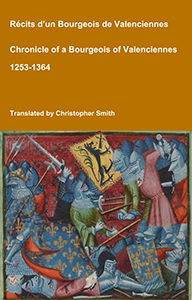
Chronicle of a Bourgeois of Valenciennes
Récits d’un bourgeois de Valenciennes aka The Chronicle of a Bourgeois of Valenciennes is a vivid 14th-century vernacular chronicle written by an anonymous urban chronicler from Valenciennes in the County of Hainaut. It survives in a manuscript that describes local and regional history from about 1253 to 1366, blending chronology, narrative episodes, and eyewitness-style accounts of political, military, and social events in medieval France, Flanders, and the Low Countries. The work begins with a chronological framework of events affecting Valenciennes and its region under rulers such as King Philip VI of France and the shifting allegiances of local nobility. It includes accounts of conflicts, sieges, diplomatic manoeuvres, and the impact of broader struggles like the Hundred Years’ War on urban life in Hainaut. Written from the perspective of a burgher (bourgeois) rather than a monastery or royal court, the chronicle offers a rare lay viewpoint on high politics and warfare, reflecting how merchants, townspeople, and civic institutions experienced the turbulence of the 13th and 14th centuries. Its narrative style combines straightforward reporting of events with moral and civic observations, making it a valuable source for readers interested in medieval urban society, regional politics, and the lived experience of war and governance in pre-modern Europe.
Available at Amazon in eBook and Paperback format.
On 17th October 1660 Bishop George Griffith [aged 59] was elected Bishop of St Asaph.

On 28th October 1660 Bishop George Griffith [aged 59] was consecrated Bishop of St Asaph at the King Henry VII Chapel, Westminster Abbey [Map] by Bishop Brian Duppa [aged 71]. It was the first consecration of bishops after the Restoration.
In 1680 Bishop William Lloyd [aged 52] was appointed Bishop of St Asaph.
John Evelyn's Diary. 31st October 1680. I began and spent the whole week in examining my life, begging pardon for my faults, assistance and blessing for the future, that I might, in some sort, be prepared for the time that now drew near, and not have the great work to begin, when one can work no longer. The Lord Jesus help and assist me! I therefore stirred little abroad till the 5th of November, when I heard Dr. Tenison [aged 44], the now vicar of St. Martin's [Map]; Dr. Lloyd [aged 53], the former incumbent, being made Bishop of St. Asaph.
John Evelyn's Diary. 31st October 1680. I spent this whole day in exercises. A stranger preached at Whitehall [Map] on Luke xvi. 30, 31. I then went to St. Martin's [Map], where the Bishop of St. Asaph [aged 53] [Note. The next post refers to Bishop William Lloyd being made Bishop of St Asaph. The previous incumbent Isaac Barrow had died 24th June 1680] preached on 1 Peter iii. 15; the Holy Communion followed, at which I participated, humbly imploring God's assistance in the great work I was entering into. In the afternoon, I heard Dr. Sprat [aged 45], at St. Margaret's [Map], on Acts xvii. 11.
In 1715 Bishop John Wynne [aged 48] was appointed Bishop of St Asaph.
The London Gazette 7069. Whitehall, February 29 [1731]. His Majesty has been pleased to grant unto John Baron, Master of Arts, the Archdeaconry of Norfolk, void by the Promotion of the Right Reverend Father in God Dr. Thomas Tanner [aged 57] to the Bishoprick of St. Asaph.
His Majesty has been pleased to confer the Dignity of a Baronet of Great Britain upon Robert Brown of the City and Liberty of Westminster, Esq;. [Note. Created with a special remainder to his brothers.]
On 23rd January 1732 Bishop Thomas Tanner [aged 57] was appointed Bishop of St Asaph.
In 1736 Bishop Isaac Maddox [aged 38] was appointed Bishop of St Asaph.
In 1783 Bishop Lewis Bagot [aged 42] was appointed Bishop of St Asaph.
In 1815 Bishop John Luxmoore [aged 49] was translated to Bishop of St Asaph.
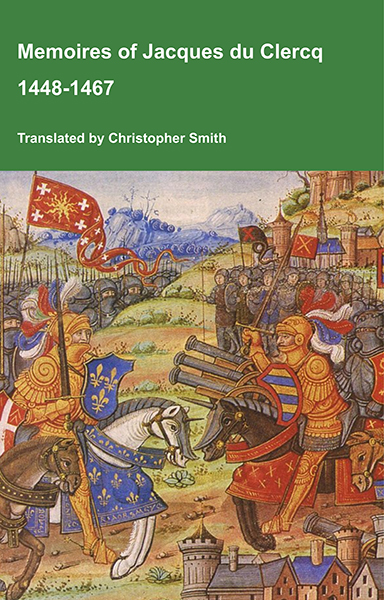
This is a translation of the 'Memoires of Jacques du Clercq', published in 1823 in two volumes, edited by Frederic, Baron de Reissenberg. In his introduction Reissenberg writes: 'Jacques du Clercq tells us that he was born in 1424, and that he was a licentiate in law and a counsellor to Philip the Good, Duke of Burgundy, in the castellany of Douai, Lille, and Orchies. It appears that he established his residence at Arras. In 1446, he married the daughter of Baldwin de la Lacherie, a gentleman who lived in Lille. We read in the fifth book of his Memoirs that his father, also named Jacques du Clercq, had married a lady of the Le Camelin family, from Compiègne. His ancestors, always attached to the counts of Flanders, had constantly served them, whether in their councils or in their armies.' The Memoires cover a period of nineteen years beginning in in 1448, ending in in 1467. It appears that the author had intended to extend the Memoirs beyond that date; no doubt illness or death prevented him from carrying out this plan. As Reissenberg writes the 'merit of this work lies in the simplicity of its narrative, in its tone of good faith, and in a certain air of frankness which naturally wins the reader’s confidence.' Du Clercq ranges from events of national and international importance, including events of the Wars of the Roses in England, to simple, everyday local events such as marriages, robberies, murders, trials and deaths, including that of his own father in Book 5; one of his last entries.
Available at Amazon in eBook and Paperback format.
In 12th March 1830 Bishop William Carey [aged 60] was elected Bishop of St Asaph.