

In 1618 John Henshaw was born.
John Evelyn's Diary. 22nd April 1656. Came to see Mr. Henshaw [aged 38] and Sir William Paston's [aged 46] son [aged 24], since Earl of Yarmouth. Afterward, I went to see his Majesty's [aged 25] house at Eltham [Map], both palace and chapel in miserable ruins, the noble woods and park destroyed by Rich [aged 68], the rebel.
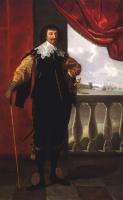


John Evelyn's Diary. 6th May 1656. I brought Monsieur le Franc, a young French Sorbonnist, a proselyte, to converse with Dr. Taylor [aged 43]; they fell to dispute on original sin, in Latin, upon a book newly published by the Doctor, who was much satisfied with the young man. Thence, to see Mr. Dugdale [aged 16], our learned antiquary and herald. Returning, I was shown the three vast volumes of Father Kircher's, "Obeliscus Pamphilius" and "Ægyptiacus"; in the second volume I found the hieroglyphic I first communicated and sent to him at Rome by the hands of Mr. Henshaw [aged 38], whom he mentions; I designed it from the stone itself brought me to Venice from Cairo by Captain Powell.
John Evelyn's Diary. 30th December 1656. Dined with me Sir William Paston's [aged 46] son [aged 25], Mr. Henshaw [aged 38], and Mr. Clayton.
John Evelyn's Diary. 3rd July 1658. To London, and dined with Mr. Henshaw [aged 40], Mr. Dorell, and Mr. Ashmole [aged 41], founder of the Oxford repository of rarities [Map], with divers doctors of physic and virtuosos.


John Evelyn's Diary. 18th June 1660. I proposed the embassy to Constantinople aka Istanbul, Turkey for Mr. Henshaw [aged 42]; but my Lord Winchelsea [aged 32] struck in.

John Evelyn's Diary. 7th September 1660. I went to Chelsea to visit Mr. Boyle [aged 33], and see his pneumatic engine perform divers experiments. Thence, to Kensington, to visit Mr. Henshaw [aged 42], returning home that evening.

John Evelyn's Diary. 9th August 1661. Sir Kenelm Digby [aged 58] presented every one of us his "Discourse of the Vegetation of Plants"; and Mr. Henshaw [aged 43], his "History of Saltpeter and Gunpowder". I assisted him to procure his place of French Secretary to the King [aged 31], which he purchased of Sir Henry De Vic [aged 62].
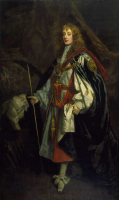
John Evelyn's Diary. 14th October 1675. Dined at Kensington with my old acquaintance, Mr. Henshaw [aged 57], newly returned from Denmark, where he had been left resident after the death of the Duke of Richmond, who died there Ambassador.

John Evelyn's Diary. 15th August 1676. Came to dine with me my Lord Halifax [aged 42], Sir Thomas Meeres [aged 42], one of the Commissioners of the Admiralty, Sir John Clayton, Mr. Slingsby [aged 55], Mr. Henshaw [aged 58], and Mr. Bridgeman.
John Evelyn's Diary. 14th June 1680. Came to dine with us the Countess of Clarendon, Dr. Lloyd [aged 52], Dean of Bangor (since Bishop of St. Asaph), Dr. Burnet [aged 36], author of the "History of the Reformation", and my old friend, Mr. Henshaw [aged 62]. After dinner we all went to see the Observatory, and Mr. Flamsted [aged 33], who showed us divers rare instruments, especially the great quadrant.

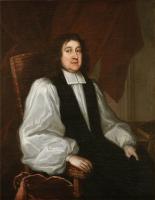
In 1700 John Henshaw [aged 82] died.