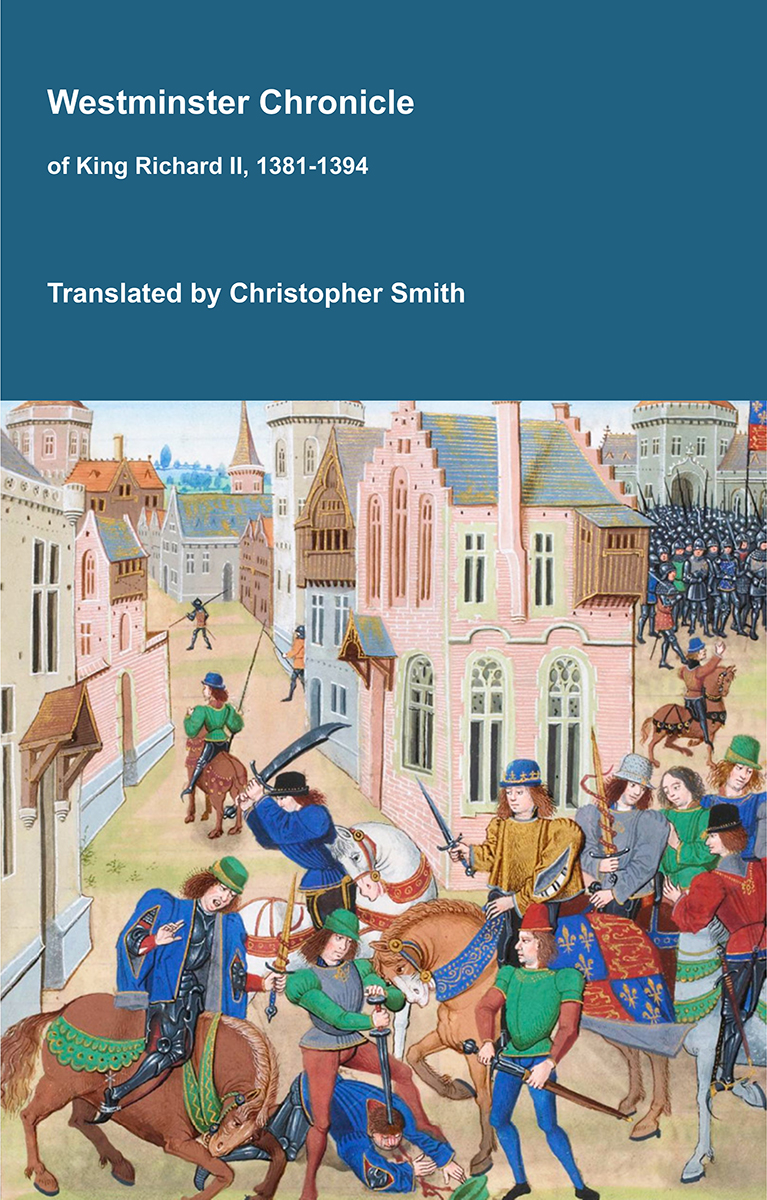
Westminster Chronicle of King Richard II, 1381-1394

The Westminster Chronicle is one of the most vivid and important narrative sources for the reign of Richard II. Written by an anonymous chronicler closely connected with Westminster Abbey, it covers the years 1381 to 1394, from the Peasants’ Revolt to the political tensions, court ceremonies, diplomatic negotiations, royal progresses, and public crises of Richard’s later reign. Rich in detail the chronicle records major events such as the conflicts between the King and Lords Appellant, King and the City of London, negotiations with France and Scotland, the death and funeral of Queen Anne of Bohemia, the illness of Charles VI of France, and the changing fortunes of leading nobles including John of Gaunt, Thomas of Gloucester, Robert de Vere, and the Earl of Arundel. The Chronicle offers readers a remarkable window into late fourteenth-century England, combining political observation, courtly spectacle, urban drama, ecclesiastical affairs, and moral judgement. It is an essential source for anyone interested in medieval monarchy, London, Westminster, and the troubled reign of Richard II.

Available at Amazon in eBook and Paperback format.

John Flamsteed 1646-1719

On 19th August 1646 John Flamsteed was born in Denby, Derbyshire [Map].

In July 1662 John Flamsteed [aged 15] read De Sphaera Mundi.

On 12th September 1662 John Flamsteed [aged 16] witnessed his first partial Eclipse of the Sun.

Around July 1663 John Flamsteed [aged 16] read Art of Dialling.

In August 1665 John Flamsteed [aged 18] wrote his first paper on astronomy, entitled Mathematical Essays, concerning the design, use and construction of an astronomer's quadrant, including tables for the latitude of Derby.

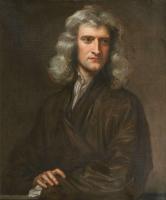
In September 1670 John Flamsteed [aged 24] visited Cambridge and entered his name as an undergraduate at Jesus College. While it seems he never took up full residence, he was there for two months in 1674, and had the opportunity to hear Isaac Newton's [aged 27] Lucasian Lectures.

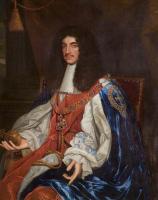
On 2nd February 1675 John Flamsteed [aged 28] arrived in London. He stayed at the Tower of London [Map] with Jonas Moore [aged 57]. He was taken by Silius Titus [aged 52] to meet King Charles II of England Scotland and Ireland [aged 44].

On 4th March 1675 John Flamsteed [aged 28] was appointed The King's Astronomical Observator with an allowance of £100 a year.

On 10th August 1675 John Flamsteed [aged 28] laid the foundation stone of the Royal Greenwich Observatory.

In February 1676 John Flamsteed [aged 29] was appointed Fellow of the Royal Society.

John Evelyn's Diary. 10th September 1676. Dined with me Mr. Flamsted [aged 30], the learned astrologer [Note. Astronomer] and mathematician, whom his Majesty [aged 46] had established in the new Observatory in Greenwich Park, furnished with the choicest instruments. An honest, sincere man.

John Evelyn's Diary. 14th June 1680. Came to dine with us the Countess of Clarendon, Dr. Lloyd [aged 52], Dean of Bangor (since Bishop of St. Asaph), Dr. Burnet [aged 36], author of the "History of the Reformation", and my old friend, Mr. Henshaw [aged 62]. After dinner we all went to see the Observatory, and Mr. Flamsted [aged 33], who showed us divers rare instruments, especially the great quadrant.

John Evelyn's Diary. 1st August 1683. Came to see me Mr. Flamsted [aged 36], the famous astronomer, from his Observatory at Greenwich, to draw the meridian from my pendule, etc.

John Evelyn's Diary. 2nd July 1684. I went to the Observatory at Greenewich, where Mr. Flamsted [aged 37] tooke his observations of the Eclipse of the Sun, now almost three parts obscured. There had been an excessive hot and dry Spring, and such a drought still continu'd as never was in my memorie.

In December 1690 John Flamsteed [aged 44] observed Uranus although he mistook it for a star.

John Evelyn's Diary. 30th June 1696. I went with a select committee of the Commissioners for Greenwich Hospital [Map], and with Sir Christopher Wren [aged 72], where with him I laid the first stone of the intended foundation, precisely at five o'clock in the evening, after we had dined together. Mr. Flamstead [aged 49], the King's Astronomical Professor, observing the punctual time by instruments.

On 31st December 1719 John Flamsteed [aged 73] died.