

Jesus College, Cambridge University is in Cambridge University.

In 1503 Archbishop Thomas Cranmer [aged 13] educated at Jesus College, Cambridge University.
Around 1520 Bishop Edmund Scambler was born at Gressingham. He was educated at Peterhouse College, Cambridge University [Map] and Jesus College, Cambridge University.
Around 1560 Francis Willoughby [aged 14] educated at Jesus College, Cambridge University.
Around 1568 Fulk Greville 13th Baron Latimer 5th Baron Willoughby 1st Baron Brooke [aged 13] educated at Jesus College, Cambridge University.
Around 1569 Henry Belasyse 1st Baronet [aged 13] was educated at Jesus College, Cambridge University.
Around 1592 Thomas Belasyse 1st Viscount Fauconberg [aged 15] educated Jesus College, Cambridge University.
On 15th June 1638 James Herbert [aged 15] matriculated at Jesus College, Cambridge University.
John Evelyn's Diary. 31st August 1654. Jesus College, Cambridge University, one of the best built, but in a melancholy situation. Next to Christ-College [Map], a very noble erection, especially the modern part, built without the quadrangle toward the gardens, of exact architecture.

In September 1670 John Flamsteed [aged 24] visited Cambridge and entered his name as an undergraduate at Jesus College. While it seems he never took up full residence, he was there for two months in 1674, and had the opportunity to hear Isaac Newton's [aged 27] Lucasian Lectures.
Around 1686 Thomas Willoughby 1st Baron Middleton [aged 13] educated at Jesus College, Cambridge University.
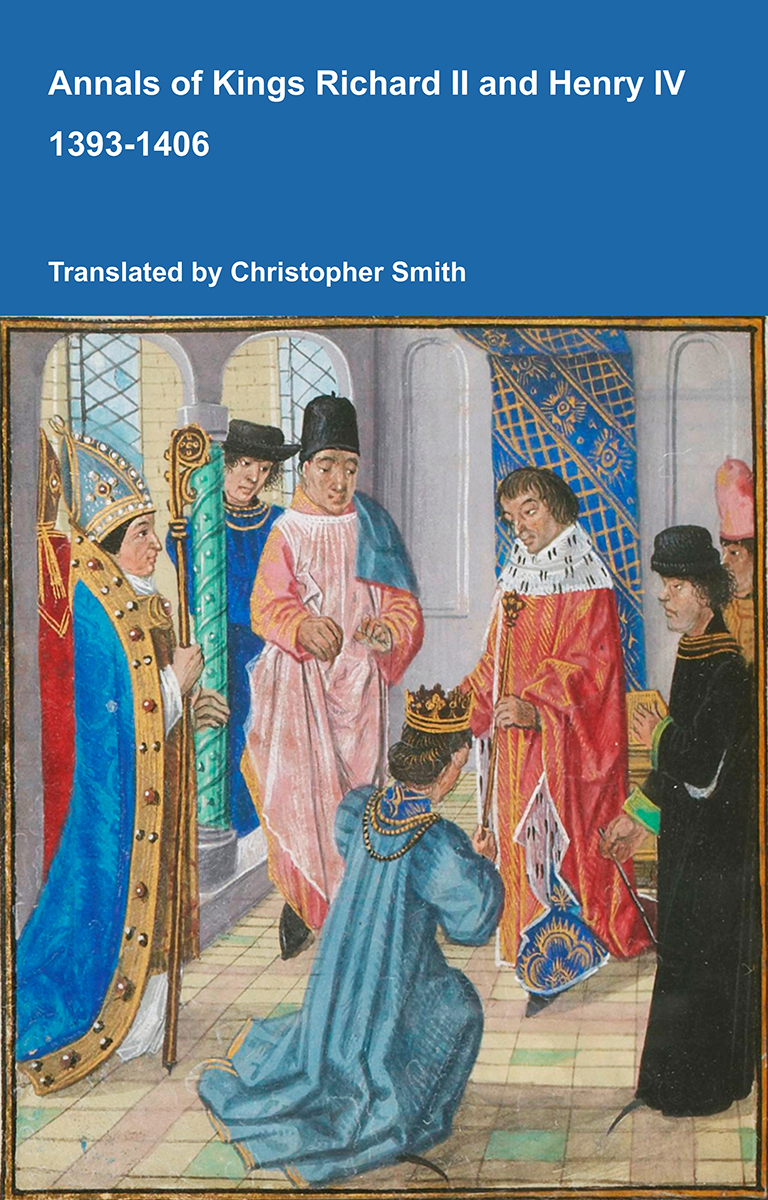
Annals of Kings Richard II and Henry IV 1393-1406
The Annals of Kings Richard II and Henry IV offers a vivid contemporary account of one of the most turbulent periods in late medieval England. Covering the reigns of Richard II and Henry IV, the chronicle records royal ceremonies, political conflict, rebellion, war, taxation, religious controversy, executions, popular unrest and remarkable portents. Its pages include a detailed description of Richard II’s coronation, the fall and deposition of the king, Henry IV’s seizure of the throne, the Percy rebellion, the execution of Archbishop Richard Scrope, the campaigns of Owain Glyndŵr, and England’s relations with Scotland, France, Portugal and Scandinavia. Alongside affairs of state, the annalist preserves reports of miracles, eclipses, prophecies, supernatural events and the experiences of ordinary townspeople, clergy, soldiers and travellers. Written from a monastic perspective, the work combines political observation with moral judgement, presenting victories and disasters as evidence of divine favour or punishment. At once a historical record and a reflection of medieval belief, the Annals provides an invaluable window into the challenges, ceremonies and conflicts of England at the turn of the fifteenth century.
Available at Amazon in eBook and Paperback format.
In 1700 Thomas Frankland 3rd Baronet [aged 15] admitted at Jesus College, Cambridge University.
In 1712 Francis Willoughby 2nd Baron Middleton [aged 19] graduated Master of Arts at Jesus College, Cambridge University.
Around 1742 Henry Willoughby 5th Baron Middleton [aged 15] educated at Jesus College, Cambridge University.
In 1744 Francis Willoughby 3rd Baron Middleton [aged 17] educated at Jesus College, Cambridge University.
In 1745 Thomas Willoughby 4th Baron Middleton [aged 16] educated at Jesus College, Cambridge University.
In 1814 John Tyssen Tyrell 2nd Baronet [aged 18] migrated to Jesus College, Cambridge University.
In 1858 Dean Herbert Mortimer Luckock [aged 24] graduated B.A. with a second class in the classical tripos at Jesus College, Cambridge University. He proceeded M.A. in 1862 and D.D. in 1879.
On 6th May 1861 Charles Michael Edgeworth Brinkley was born at Knockmaroon. He was educated at Clifton College Bristol, Jesus College, Cambridge University and the Royal Military College, Sandhurst.
In 1862 Dean Herbert Mortimer Luckock [aged 28] was elected Fellow of Jesus College, Cambridge University.
In 1904 Captain Charles Noel Ridley [aged 19] began his education at Jesus College, Cambridge University where he spent two years.
Ambrose Browne 1st Baronet educated at Jesus College, Cambridge University.