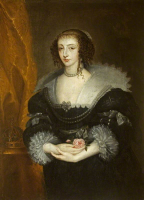
Henry Slingsby 1621-1688

Paternal Family Tree: Slingsby

In 1617 [his father] William Slingsby [aged 53] and [his mother] Elizabeth Broad were married.

Around 1621 Henry Slingsby was born to William Slingsby [aged 57] and Elizabeth Broad.

In 1634 [his father] William Slingsby [aged 70] died.

In 1662 Henry Slingsby [aged 41] was appointed Deputy Master of the Mint to 1667.

John Evelyn's Diary. 6th September 1662. Dined with me Sir Edward Walker [aged 51], Garter King of Arms, Mr. Slingsby [aged 41], master of the Mint, and several others.

John Evelyn's Diary. 27th November 1662. I dined with the Master of the Mint [aged 41], where was old Sir Ralph Freeman [aged 73]; passing my evening at the Queen-Mother's [aged 53] Court; at night, saw acted "The Committee", a ridiculous play of Sir R. Howard [aged 36], where the mimic, Lacy, acted the Irish footman to admiration.

In 1663 Henry Slingsby [aged 42] was elected Fellow of the Royal Society.

Samuel Pepys' Diary. 27th January 1665. Thence away to boat again and landed her at the Three Cranes again, and I to the Bridge [Map], and so home, and after shifting myself, being dirty, I to the 'Change [Map], and thence to Mr. Povy's [aged 51] and there dined, and thence with him and Creed to my Lord Bellasses' [aged 50], and there debated a great while how to put things in order against his going, and so with my Lord in his coach to White Hall, and with him to my Lord Duke of Albemarle [aged 56], finding him at cards. After a few dull words or two, I away to White Hall again, and there delivered a letter to the Duke of Yorke [aged 31] about our Navy business, and thence walked up and down in the gallery, talking with Mr. Slingsby [aged 44], who is a very ingenious person, about the Mint and coynage of money. Among other things, he argues that there being £700,000 coined in the Rump time, and by all the Treasurers of that time, it being their opinion that the Rump money was in all payments, one with another, about a tenth part of all their money. Then, says he, to my question, the nearest guess we can make is, that the money passing up and down in business is £7,000,000. To another question of mine he made me fully understand that the old law of prohibiting bullion to be exported, is, and ever was a folly and an injury, rather than good. Arguing thus, that if the exportations exceed importations, then the balance must be brought home in money, which, when our merchants know cannot be carried out again, they will forbear to bring home in money, but let it lie abroad for trade, or keepe in foreign banks: or if our importations exceed our exportations, then, to keepe credit, the merchants will and must find ways of carrying out money by stealth, which is a most easy thing to do, and is every where done; and therefore the law against it signifies nothing in the world. Besides, that it is seen, that where money is free, there is great plenty; where it is restrained, as here, there is a great want, as in Spayne. These and many other fine discourses I had from him.

Samuel Pepys' Diary. 2nd October 1666. So away home, and eat a short dinner, and then with Sir W. Pen [aged 45] to White Hall, and do give his boy my book of papers to hold while he went into the Committee Chamber in the Inner Court of Wards, and I walked without with Mr. Slingsby [aged 45], of the Tower, who was there, and who did in walking inform me mightily in several things; among others, that the heightening or lowering of money is only a cheat, and do good to some particular men, which, if I can but remember how, I am now by him fully convinced of. Anon Sir W. Pen went away, telling me that Sir W. Coventry [aged 38] that was within had told him that the fleete is all come into the buoy of the Nore, and that he must hasten down to them, and so went away, and I into the Committee Chamber before the Committee sat, and there heard Birch [aged 51] discourse highly and understandingly about the Navy business and a proposal made heretofore to farm the Navy; but Sir W. Coventry did abundantly answer him, and is a most excellent person.

In 1667 Henry Slingsby [aged 46] was appointed Master of the Mint.

Samuel Pepys' Diary. 9th August 1668. Thence to White Hall, and thence to visit Lord Brouncker [aged 48], and back to White Hall, where saw the Queen [aged 29] and ladies; and so, with Mr. Slingsby [aged 47], to Mrs. Williams's, thinking to dine with Lord Brouncker there, but did not, having promised my wife to come home, though here I met Knepp, to my great content.

Chronicle of a Bourgeois of Valenciennes

Récits d’un bourgeois de Valenciennes aka The Chronicle of a Bourgeois of Valenciennes is a vivid 14th-century vernacular chronicle written by an anonymous urban chronicler from Valenciennes in the County of Hainaut. It survives in a manuscript that describes local and regional history from about 1253 to 1366, blending chronology, narrative episodes, and eyewitness-style accounts of political, military, and social events in medieval France, Flanders, and the Low Countries. The work begins with a chronological framework of events affecting Valenciennes and its region under rulers such as King Philip VI of France and the shifting allegiances of local nobility. It includes accounts of conflicts, sieges, diplomatic manoeuvres, and the impact of broader struggles like the Hundred Years’ War on urban life in Hainaut. Written from the perspective of a burgher (bourgeois) rather than a monastery or royal court, the chronicle offers a rare lay viewpoint on high politics and warfare, reflecting how merchants, townspeople, and civic institutions experienced the turbulence of the 13th and 14th centuries. Its narrative style combines straightforward reporting of events with moral and civic observations, making it a valuable source for readers interested in medieval urban society, regional politics, and the lived experience of war and governance in pre-modern Europe.

Available at Amazon in eBook and Paperback format.

John Evelyn's Diary. 19th July 1670. I accompanied my worthy friend, that excellent man, Sir Robert Murray [aged 62], with Mr. Slingsby [aged 49], Master of the Mint, to see the latter's seat and estate at Burrow-Green [Map] in Cambridgeshire, he desiring our advice for placing a new house, which he was resolved to build. We set out in a coach and six horses with him and his lady, dined about midway at one Mr. Turner's, where we found a very noble dinner, venison, music, and a circle of country ladies and their gallants. After dinner, we proceeded, and came to Burrow-Green [Map] that night. This had been the ancient seat of the Cheekes (whose daughter Mr. Slingsby married), formerly tutor to King Henry VI [NOTE. Possibly a mistake for Edward VI since John Cheke was tutor to Edward VI]. The old house large and ample, and built for ancient hospitality, ready to fall down with age, placed in a dirty hole, a stiff clay, no water, next an adjoining church-yard, and with other inconveniences. We pitched on a spot of rising ground, adorned with venerable woods, a dry and sweet prospect east and west, and fit for a park, but no running water; at a mile distance from the old house.

John Evelyn's Diary. 20th July 1670. We went to dine at Lord Allington's [aged 30], who had newly built a house of great cost, I believe a little less than £20,000. His architect was Mr. Pratt [aged 50]. It is seated in a park, with a sweet prospect and stately avenue; but water still defective; the house has also its infirmities. Went back to Mr. Slingsby's [aged 49].

John Evelyn's Diary. 2nd December 1674. At Mr. Slingsby's [aged 53], Master of the Mint, my worthy friend, a great lover of music. Heard Signor Francisco on the Harpsichord, esteemed one of the most excellent masters in Europe on that instrument; then, came Nicholao with his violin, and struck all mute, but Mrs. Knight, who sung incomparably, and doubtless has the greatest reach of any English woman; she had been lately roaming in Italy, and was much improved in that quality.

In 1675 Henry Slingsby [aged 54] was expelled from the Royal Society for non-payment of dues.

John Evelyn's Diary. 15th August 1676. Came to dine with me my Lord Halifax [aged 42], Sir Thomas Meeres [aged 42], one of the Commissioners of the Admiralty, Sir John Clayton, Mr. Slingsby [aged 55], Mr. Henshaw [aged 58], and Mr. Bridgeman.

John Evelyn's Diary. 20th July 1678. I went to the Tower [Map] to try a metal at the Assay-master's, which only proved sulphur; then saw Monsieur Rotière [aged 47], that excellent graver belonging to the Mint, who emulates even the ancients, in both metal and stone; he was now molding a horse for the King's [aged 48] statue, to be cast in silver, of a yard high. I dined with Mr. Slingsby [aged 57], Master of the Mint.

John Evelyn's Diary. 25th September 1679. Mr. Slingsby [aged 58] and Signor Verrio [aged 43] came to dine with me, to whom I gave China oranges off my own trees, as good, I think, as were ever eaten.

John Evelyn's Diary. 20th November 1679. I dined with Mr. Slingsby [aged 58], Master of the Mint, with my wife [aged 44], invited to hear music, which was exquisitely performed by four of the most renowned masters: Du Prue, a Frenchman, on the lute; Signor Bartholomeo, an Italian, on the harpsichord; Nicholao on the violin; but, above all, for its sweetness and novelty, the viol d'amore of five wire strings played on with a bow, being but an ordinary violin, played on lyre-way, by a German. There was also a flute douce, now in much request for accompanying the voice. Mr. Slingsby, whose son and daughter played skillfully, had these meetings frequently in his house.

In 1680 Henry Slingsby [aged 59] was suspended from office on the grounds of incompetence. His financial accounts were so faulty that he was suspected of fraud and his property temporarily seized to make good the losses. The duties of Master were then executed by a commission pending Slingsby's resignation in 1686.

John Evelyn's Diary. 3rd December 1684. I carried Mr. Justell and Mr. Slingsby [aged 63] (Master of the Mint), to see Mr. Sheldon's collection of Medaills. The series of Popes was rare, and so were several amongst the modernes, especialy that of John Husse's martyrdome at Constance; of the Roman Emp: Consulars; some Greeke, &c. In copper, gold, and silver; not many truly antique; a Medallion of Otho, P. JEmil. &c. hardly antient. They were held at a price of, £.1000. but not worth, I judge, above £200.

Around 1688 Henry Slingsby [aged 67] died.

William of Worcester's Chronicle of England

William of Worcester, born around 1415, and died around 1482 was secretary to John Fastolf, the renowned soldier of the Hundred Years War, during which time he collected documents, letters, and wrote a record of events. Following their return to England in 1440 William was witness to major events. Twice in his chronicle he uses the first person: 1. when writing about the murder of Thomas, 7th Baron Scales, in 1460, he writes '… and I saw him lying naked in the cemetery near the porch of the church of St. Mary Overie in Southwark …' and 2. describing King Edward IV's entry into London in 1461 he writes '… proclaimed that all the people themselves were to recognize and acknowledge Edward as king. I was present and heard this, and immediately went down with them into the city'. William’s Chronicle is rich in detail. It is the source of much information about the Wars of the Roses, including the term 'Diabolical Marriage' to describe the marriage of Queen Elizabeth Woodville’s brother John’s marriage to Katherine, Dowager Duchess of Norfolk, he aged twenty, she sixty-five or more, and the story about a paper crown being placed in mockery on the severed head of Richard, 3rd Duke of York.

Available at Amazon in eBook and Paperback format.

John Evelyn's Diary. 12th January 1688. Mr. Slingsby, Master of the Mint, being under very deplorable circumstances on account of his creditors, and especially the King, I did my endeavor with the Lords of the Treasury to be favorable to him.

Royal Ancestors of Henry Slingsby 1621-1688

Kings Wessex: Great x 17 Grand Son of King Edmund "Ironside" I of England

Kings Gwynedd: Great x 14 Grand Son of Owain "Great" King Gwynedd

Kings Seisyllwg: Great x 20 Grand Son of Hywel "Dda aka Good" King Seisyllwg King Deheubarth

Kings Powys: Great x 15 Grand Son of Maredudd ap Bleddyn King Powys

Kings Godwinson: Great x 17 Grand Son of King Harold II of England

Kings England: Great x 7 Grand Son of King Edward III of England

Kings Scotland: Great x 14 Grand Son of King William I of Scotland

Kings France: Great x 9 Grand Son of King Philip IV of France

Kings Duke Aquitaine: Great x 21 Grand Son of Ranulf I Duke Aquitaine

Kings Spain: Great x 13 Grand Son of Alfonso VII King Castile VII King Leon

Ancestors of Henry Slingsby 1621-1688

father: William Slingsby 6 x Great Grandson of King Edward III of England

Great x 4 Grandfather: Henry Percy 3rd Earl of Northumberland 2 x Great Grandson of King Edward III of England

Great x 3 Grandfather: Henry Percy 4th Earl of Northumberland 3 x Great Grandson of King Edward III of England

Great x 4 Grandmother: Eleanor Poynings Countess Northumberland 6 x Great Granddaughter of King Edward I of England

Great x 2 Grandfather: Henry Percy 5th Earl of Northumberland 4 x Great Grandson of King Edward III of England

Great x 4 Grandfather: William Herbert 1st Earl Pembroke

Great x 3 Grandmother: Maud Herbert Countess Northumberland 9 x Great Granddaughter of King John of England

Great x 4 Grandmother: Anne Devereux 8 x Great Granddaughter of King John of England

Great x 1 Grandfather: Thomas Percy 4 x Great Grandson of King Edward III of England

Great x 4 Grandfather: John Winstone Churchill Spencer

Great x 3 Grandfather: Robert Spencer of Spencer Combe

Great x 2 Grandmother: Katherine Spencer Countess Northumberland 3 x Great Granddaughter of King Edward III of England

Great x 4 Grandfather: Edmund Beaufort 1st or 2nd Duke of Somerset Great Grandson of King Edward III of England

Great x 3 Grandmother: Eleanor Beaufort Countess Ormonde 2 x Great Granddaughter of King Edward III of England

Great x 4 Grandmother: Eleanor Beauchamp Duchess Somerset 4 x Great Granddaughter of King Edward I of England

Grandmother: Mary Percy 5 x Great Granddaughter of King Edward III of England

Great x 4 Grandfather: Bertram Harbottle

Great x 3 Grandfather: Ralph Harbottle 9 x Great Grandson of King Henry "Curtmantle" II of England

Great x 4 Grandmother: Joan Lumley 8 x Great Granddaughter of King Henry "Curtmantle" II of England

Great x 2 Grandfather: Guiscard Harbottle 4 x Great Grandson of King Edward III of England

Great x 4 Grandfather: Ralph Percy 2 x Great Grandson of King Edward III of England

Great x 3 Grandmother: Margaret Percy 3 x Great Granddaughter of King Edward III of England

Great x 4 Grandmother: Eleanor Acton

Great x 1 Grandmother: Eleanor Harbottle 5 x Great Granddaughter of King Edward III of England

Great x 4 Grandfather: Robert Willoughby 8 x Great Grandson of King Henry "Curtmantle" II of England

Great x 3 Grandfather: Henry Willoughby 9 x Great Grandson of King Henry "Curtmantle" II of England

Great x 4 Grandmother: Margaret Griffith

Great x 2 Grandmother: Jane Willoughby 10 x Great Granddaughter of King Henry "Curtmantle" II of England

Great x 4 Grandfather: Robert Markham

Great x 3 Grandmother: Margaret Markham

Henry Slingsby 7 x Great Grandson of King Edward III of England

Grandfather: Stephen Broad of Broadshill in Sussex

mother: Elizabeth Broad