

 John Evelyn's Diary February 1670
 John Evelyn's Diary March 1670
 John Evelyn's Diary May 1670
 Dover, Kent
 John Evelyn's Diary June 1670
 Goring House
 John Evelyn's Diary July 1670
 Burrough Green, Cambridgeshire
 Audley End House, Saffron Walden
 Bishop's Stortford, Hertfordshire
 John Evelyn's Diary August 1670
 Deptford, Kent
 Windsor, Berkshire
 John Evelyn's Diary September 1670
John Evelyn's Diary 1670 is in John Evelyn's Diary 1670s.
6th February 1670. Dr. John Breton, Master of Emmanuel College, in Cambridge (uncle to our vicar), preached on John i. 27; "whose shoe-latchet I am not worthy to unloose", etc. [Note. This is the King [aged 39] James Bible translation], describing the various fashions of shoes, or sandals, worn by the Jews, and other nations: of the ornaments of the feet: how great persons had servants that took them off when they came to their houses, and bore them after them: by which pointing the dignity of our Savior, when such a person as St. John Baptist acknowledged his unworthiness even of that mean office. The lawfulness, decentness, and necessity, of subordinate degrees and ranks of men and servants, as well in the Church as State: against the late levelers, and others of that dangerous rabble, who would have all alike.
3rd March 1670. Finding my brother [aged 47] in such exceeding torture, and that he now began to fall into convulsion-fits, I solemnly set the next day apart to beg of God to mitigate his sufferings, and prosper the only means which yet remained for his recovery, he being not only much wasted, but exceedingly and all along averse from being cut (for the stone); but, when he at last consented, and it came to the operation, and all things prepared, his spirit and resolution failed.
6th March 1670. Dr. Patrick preached in Covent Garden Church. I participated of the Blessed Sacrament, recommending to God the deplorable condition of my dear brother [aged 47], who was almost in the last agonies of death. I watched late with him this night. It pleased God to deliver him out of this miserable life, toward five o'clock this Monday morning, to my unspeakable grief. He was a brother whom I most dearly loved, for his many virtues; but two years younger than myself, a sober, prudent, worthy gentleman. He had married a great fortune, and left one only daughter, and a noble seat at Woodcot, near Epsom. His body was opened, and a stone taken out of his bladder, not much bigger than a nutmeg. I returned home on the 8th, full of sadness, and to bemoan my loss.
20th March 1670. A stranger preached at the Savoy French church; the Liturgy of the Church of England being now used altogether, as translated into French by Dr. Durell.
21st March 1670. We all accompanied the corpse of my dear brother [deceased] to Epsom Church, where he was decently interred in the chapel belonging to Woodcot House. A great number of friends and gentlemen of the country attended, about twenty coaches and six horses, and innumerable people.
22nd March 1670. I went to Westminster, where in the House of Lords I saw his Majesty [aged 39] sit on his throne, but without his robes, all the peers sitting with their hats on; the business of the day being the divorce of my Lord Ross. Such an occasion and sight had not been seen in England since the time of Henry VIII.
5th May 1670. To London, concerning the office of Latin Secretary to his Majesty [aged 39], a place of more honor and dignity than profit, the reversion of which he had promised me.
21st May 1670. Came to visit me Mr. Henry Saville [aged 28], and Sir Charles Scarborough [aged 54].
26th May 1670. Receiving a letter from Mr. Philip Howard [aged 41], Lord Almoner to the Queen, that Monsieur Evelin, first physician to Madame [aged 25] (who was now come to Dover to visit the King [aged 39] her brother), was come to town, greatly desirous to see me; but his stay so short, that he could not come to me, I went with my brother [aged 52] to meet him at the Tower [Map], where he was seeing the magazines and other curiosities, having never before been in England: we renewed our alliance and friendship, with much regret on both sides that, he being to return toward Dover, Kent [Map] that evening, we could not enjoy one another any longer. How this French family, Ivelin, of Evelin, Normandy, a very ancient and noble house is grafted into our pedigree, see in the collection brought from Paris, 1650.


16th June 1670. I went with some friends to the Bear Garden, where was cock-fighting, dog-fighting, bear and bull-baiting, it being a famous day for all these butcherly sports, or rather barbarous cruelties. The bulls did exceedingly well, but the Irish wolf dog exceeded, which was a tall greyhound, a stately creature indeed, who beat a cruel mastiff. One of the bulls tossed a dog full into a lady's lap as she sat in one of the boxes at a considerable height from the arena. Two poor dogs were killed, and so all ended with the ape on horseback, and I most heartily weary of the rude and dirty pastime, which I had not seen, I think, in twenty years before.
18th June 1670. Dined at Goring House [Map], whither my Lord Arlington [aged 52] carried me from Whitehall with the Marquis of Worcester [aged 41]; there, we found Lord Sandwich [aged 44], Viscount Stafford [aged 55], the Lieutenant of the Tower, and others. After dinner, my Lord communicated to me his Majesty's [aged 40] desire that I would engage to write the history of our late war with the Hollanders, which I had hitherto declined; this I found was ill taken, and that I should disoblige his Majesty, who had made choice of me to do him this service, and, if I would undertake it, I should have all the assistance the Secretary's office and others could give me, with other encouragements, which I could not decently refuse.


18th June 1670. Lord Stafford [aged 55] rose from the table, in some disorder, because there were roses stuck about the fruit when the dessert was set on the table; such an antipathy, it seems, he had to them as once Lady Selenger also had, and to that degree that, as Sir Kenelm Digby tells us, laying but a rose upon her cheek when she was asleep, it raised a blister: but Sir Kenelm was a teller of strange things.
24th June 1670. Came the Earl [aged 19] of Huntington and Countess [aged 16], with the Lord Sherard [aged 48], to visit us.
29th June 1670. To London, in order to my niece's marriage, Mary, daughter to my late brother Richard, of Woodcot, with the eldest son of Mr. Attorney Montague, which was celebrated at Southampton-House chapel, after which a magnificent entertainment, feast, and dancing, dinner and supper, in the great room there; but the bride was bedded at my sister's lodging, in Drury-Lane.
19th July 1670. I accompanied my worthy friend, that excellent man, Sir Robert Murray [aged 62], with Mr. Slingsby [aged 49], Master of the Mint, to see the latter's seat and estate at Burrow-Green [Map] in Cambridgeshire, he desiring our advice for placing a new house, which he was resolved to build. We set out in a coach and six horses with him and his lady, dined about midway at one Mr. Turner's, where we found a very noble dinner, venison, music, and a circle of country ladies and their gallants. After dinner, we proceeded, and came to Burrow-Green [Map] that night. This had been the ancient seat of the Cheekes (whose daughter Mr. Slingsby married), formerly tutor to King Henry VI [NOTE. Possibly a mistake for Edward VI since John Cheke was tutor to Edward VI]. The old house large and ample, and built for ancient hospitality, ready to fall down with age, placed in a dirty hole, a stiff clay, no water, next an adjoining church-yard, and with other inconveniences. We pitched on a spot of rising ground, adorned with venerable woods, a dry and sweet prospect east and west, and fit for a park, but no running water; at a mile distance from the old house.
Jean de Waurin's Chronicle of England Volume 6 Books 3-6: The Wars of the Roses
Jean de Waurin was a French Chronicler, from the Artois region, who was born around 1400, and died around 1474. Waurin’s Chronicle of England, Volume 6, covering the period 1450 to 1471, from which we have selected and translated Chapters relating to the Wars of the Roses, provides a vivid, original, contemporary description of key events some of which he witnessed first-hand, some of which he was told by the key people involved with whom Waurin had a personal relationship.
Available at Amazon in eBook and Paperback format.
20th July 1670. We went to dine at Lord Allington's [aged 30], who had newly built a house of great cost, I believe a little less than £20,000. His architect was Mr. Pratt [aged 50]. It is seated in a park, with a sweet prospect and stately avenue; but water still defective; the house has also its infirmities. Went back to Mr. Slingsby's [aged 49].
22nd July 1670. We rode out to see the great mere, or level, of recovered fen land, not far off. In the way, we met Lord Arlington [aged 52] going to his house in Suffolk, accompanied with Count Ogniati, the Spanish minister, and Sir Bernard Gascoigne [aged 56]; he was very importunate with me to go with him to Euston, being but fifteen miles distant; but, in regard of my company, I could not. So, passing through Newmarket, Suffolk, we alighted to see his Majesty's [aged 40] house there, now new-building; the arches of the cellars beneath are well turned by Mr. Samuel, the architect, the rest mean enough, and hardly fit for a hunting house. Many of the rooms above had the chimneys in the angles and corners, a mode now introduced by his Majesty, which I do at no hand approve of. I predict it will spoil many noble houses and rooms, if followed. It does only well in very small and trifling rooms, but takes from the state of greater. Besides, this house is placed in a dirty street, without any court or avenue, like a common one, whereas it might and ought to have been built at either end of the town, upon the very carpet where the sports are celebrated; but, it being the purchase of an old wretched house of my Lord Thomond's, his Majesty was persuaded to set it on that foundation, the most improper imaginable for a house of sport and pleasure.
22nd July 1670. We went to see the stables and fine horses, of which many were here kept at a vast expense, with all the art and tenderness imaginable.
22nd July 1670. Being arrived at some meres, we found Lord Wotton and Sir John Kiviet [aged 43] about their draining engines, having, it seems, undertaken to do wonders on a vast piece of marsh-ground they had hired of Sir Thomas Chicheley (master of the ordnance). They much pleased themselves with the hopes of a rich harvest of hemp and coleseed, which was the crop expected.
22nd July 1670. Here we visited the engines and mills both for wind and water, draining it through two rivers or graffs, cut by hand, and capable of carrying considerable barges, which went thwart one the other, discharging the water into the sea. Such this spot had been the former winter; it was astonishing to see it now dry, and so rich that weeds grew on the banks, almost as high as a man and horse. Here, my Lord and his partner had built two or three rooms, with Flanders white bricks, very hard. One of the great engines was in the kitchen, where!I saw the fish swim up, even to the very chimney hearth, by a small cut through the room, and running within a foot of the very fire.
22nd July 1670. Having, after dinner, ridden about that vast level, pestered with heat and swarms of gnats, we returned over Newmarket Heath, the way being mostly a sweet turf and down, like Salisbury Plain, the jockeys breathing their fine barbs and racers and giving them their heats.
23rd July 1670. We returned from Burrow Green [Map] to London, staying some time at Audley End [Map] to see that fine palace. It is indeed a cheerful piece of Gothic building, or rather antico moderno, but placed in an obscure bottom. The cellars and galleries are very stately. It has a river by it, a pretty avenue of limes, and in a park.
23rd July 1670. This is in Saffron Walden parish, famous for that useful plant, with which all the country is covered.
23rd July 1670. Dining at Bishop Stortford [Map], we came late to London.
5th August 1670. There was sent me by a neighbour a servant maid, who, in the last month, as she was sitting before her mistress at work, felt a stroke on her arm a little above the wrist for some height, the smart of which, as if struck by another hand, caused her to hold her arm awhile till somewhat mitigated; but it put her into a kind of convulsion, or rather hysteric fit. A gentleman coming casually in, looking on her arm, found that part powdered with red crosses, set in most exact and wonderful order, neither swelled nor depressed, about this shape, [Note. Diamond shape] not seeming to be any way made by artifice, of a reddish color, not so red as blood, the skin over them smooth, the rest of the arm livid and of a mortified hue, with certain prints, as it were, of the stroke of fingers. This had happened three several times in July, at about ten days' interval, the crosses beginning to wear out, but the successive ones set in other different, yet uniform order. The maid seemed very modest, and came from London to Deptford, Kent [Map] with her mistress, to avoid the discourse and importunity of curious people. She made no gain by it, pretended no religious fancies; but seemed to be a plain, ordinary, silent, working wench, somewhat fat, short, and high-colored. She told me divers divines and physicians had seen her, but were unsatisfied; that she had taken some remedies against her fits, but they did her no good; she had never before had any fits; once since, she seemed in her sleep to hear one say to her that she should tamper no more with them, nor trouble herself with anything that happened, but put her trust in the merits of Christ only.
Abbot John Whethamstede’s Chronicle of the Abbey of St Albans
Abbot John Whethamstede's Register aka Chronicle of his second term at the Abbey of St Albans, 1451-1461, is a remarkable text that describes his first-hand experience of the beginning of the Wars of the Roses including the First and Second Battles of St Albans, 1455 and 1461, respectively, their cause, and their consequences, not least on the Abbey itself. His text also includes Loveday, Blore Heath, Northampton, the Act of Accord, Wakefield, and Towton, and ends with the Coronation of King Edward IV. In addition to the events of the Wars of the Roses, Abbot John, or his scribes who wrote the Chronicle, include details in the life of the Abbey such as charters, letters, land exchanges, visits by legates, and disputes, which provide a rich insight into the day-to-day life of the Abbey, and the challenges faced by its Abbot.
Available at Amazon in eBook and Paperback format.
5th August 1670. This is the substance of what she told me, and what I saw and curiously examined. I was formerly acquainted with the impostorious nuns of Loudun, in France, which made such noise among the Papists; I therefore thought this worth the notice. I remember Monsieur Monconys (that curious traveler and a Roman Catholic) was by no means satisfied with the stigmata of those nuns, because they were so shy of letting him scrape the letters, which were Jesus, Maria, Joseph (as I think), observing they began to scale off with it, whereas this poor wench was willing to submit to any trial; so that I profess I know not what to think of it, nor dare I pronounce it anything supernatural.
20th August 1670. At Windsor, Berkshire [Map] I supped with the Duke of Monmouth [aged 21]; and, the next day, invited by Lord Arlington [aged 52], dined with the same Duke and divers Lords. After dinner my Lord and I had a conference of more than an hour alone in his bedchamber, to engage me in the History. I showed him something that I had drawn up, to his great satisfaction, and he desired me to show it to the Treasurer [aged 40].


28th August 1670. One of the Canons preached; then followed the offering of the Knights of the Order, according to custom; first the poor Knights, in procession, then, the Canons in their formalities, the Dean and Chancellor, then his Majesty [aged 40] (the Sovereign), the Duke of York [aged 36], Prince Rupert [aged 50]; and, lastly, the Earl of Oxford [aged 43], being all the Knights that were then at Court.


28th August 1670. I dined with the Treasurer [aged 40], and consulted with him what pieces I was to add; in the afternoon the King [aged 40] took me aside into the balcony over the terrace, extremely pleased with what had been told him I had begun, in order to his commands, and enjoining me to proceed vigorously in it. He told me he had ordered the Secretaries of State to give me all necessary assistance of papers and particulars relating to it and enjoining me to make it a LITTLE KEEN, for that the Hollanders had very unhandsomely abused him in their pictures, books, and libels.
28th August 1670. Windsor was now going to be repaired, being exceedingly ragged and ruinous. Prince Rupert [aged 50], the Constable, had begun to trim up the keep or high round Tower, and handsomely adorned his hall with furniture of arms, which was very singular, by so disposing the pikes, muskets, pistols, bandoleers, holsters, drums, back, breast, and headpieces, as was very extraordinary. Thus, those huge steep stairs ascending to it had the walls invested with this martial furniture, all new and bright, so disposing the bandoleers, holsters, and drums, as to represent festoons, and that without any confusion, trophy-like. From the hall we went into his bedchamber, and ample rooms hung with tapestry, curious and effeminate pictures, so extremely different from the other, which presented nothing but war and horror.
28th August 1670. The King [aged 40] passed most of his time in hunting the stag, and walking in the park, which he was now planting with rows of trees.
13th September 1670. To visit Sir Richard Lashford, my kinsman, and Mr. Charles Howard [aged 40], at his extraordinary garden, at Deepden.
15th September 1670. I went to visit Mr. Arthur Onslow [aged 46], at West Clandon, a pretty dry seat on the Downs, where we dined in his great room.
17th September 1670. To visit Mr. Hussey, who, being near Wotton, lives in a sweet valley, deliciously watered.
23rd September 1670. To Albury, to see how that garden proceeded, which I found exactly done to the design and plot I had made, with the crypta through the mountain in the park, thirty perches in length. Such a Pausilippe [Note. A word created by Evelyn meaning an underground passage.] is nowhere in England. The canal was now digging, and the vineyard planted.
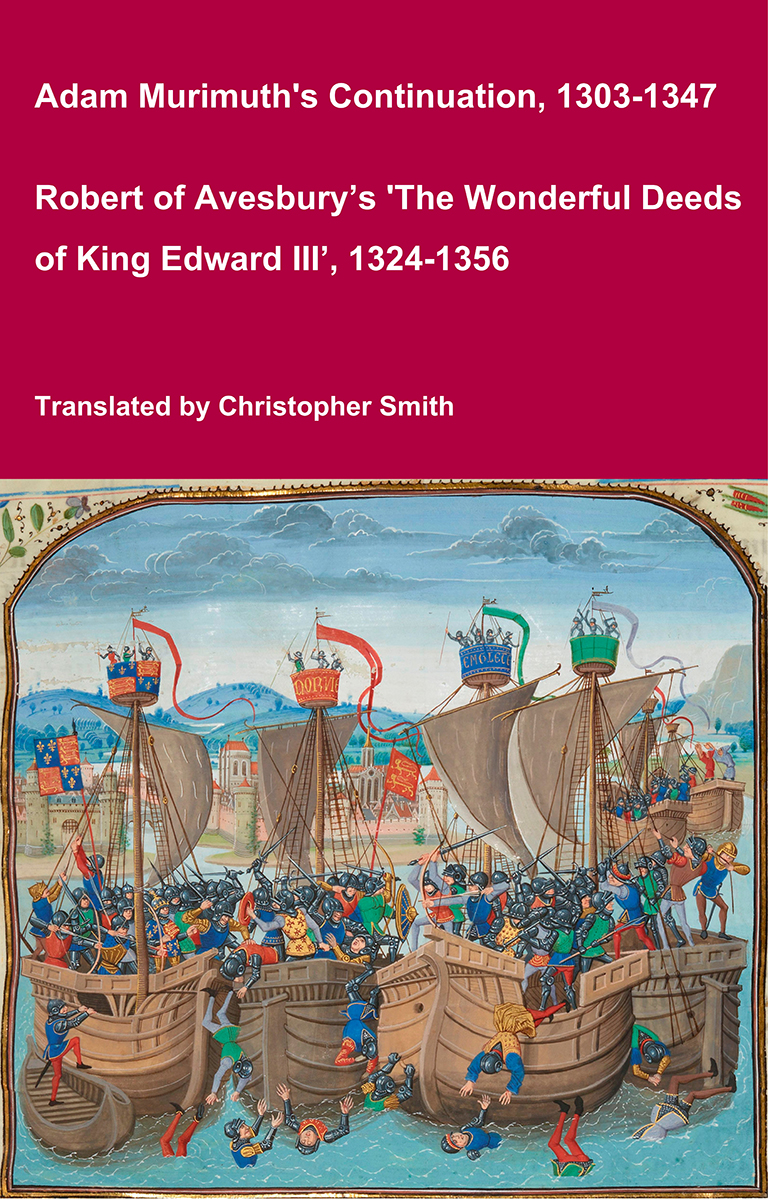
Adam Murimuth's Continuation and Robert of Avesbury’s 'The Wonderful Deeds of King Edward III'
This volume brings together two of the most important contemporary chronicles for the reign of Edward III and the opening phases of the Hundred Years’ War. Written in Latin by English clerical observers, these texts provide a vivid and authoritative window into the political, diplomatic, and military history of fourteenth-century England and its continental ambitions. Adam Murimuth Continuatio's Chronicarum continues an earlier chronicle into the mid-fourteenth century, offering concise but valuable notices on royal policy, foreign relations, and ecclesiastical affairs. Its annalistic structure makes it especially useful for establishing chronology and tracing the development of events year by year. Complementing it, Robert of Avesbury’s De gestis mirabilibus regis Edwardi tertii is a rich documentary chronicle preserving letters, treaties, and official records alongside narrative passages. It is an indispensable source for understanding Edward III’s claim to the French crown, the conduct of war, and the mechanisms of medieval diplomacy. Together, these works offer scholars, students, and enthusiasts a reliable and unembellished account of a transformative period in English and European history. Essential for anyone interested in medieval chronicles, the Hundred Years’ War, or the reign of Edward III.
Available at Amazon in eBook and Paperback format.
14th October 1670. I spent the whole afternoon in private with the Treasurer [aged 40] who put into my hands those secret pieces and transactions concerning the Dutch war, and particularly the expedition of Bergen, in which he had himself the chief part, and gave me instructions, till the King [aged 40] arriving from Newmarket, we both went up into his bedchamber.
21st October 1670. Dined with the Treasurer [aged 40]; and, after dinner, we were shut up together. I received other [further] advices, and ten paper books of dispatches and treaties; to return which again I gave a note under my hand to Mr. Joseph Williamson, Master of the Paper office.
31st October 1670. I was this morning fifty years of age; the Lord teach me to number my days so as to apply them to his glory! Amen.
4th November 1670. Saw the Prince of Orange [aged 20], newly come to see the King [aged 40], his uncle; he has a manly, courageous, wise countenance, resembling his mother and the Duke of Gloucester, both deceased.


4th November 1670. I now also saw that famous beauty, but in my opinion of a childish, simple, and baby face, Mademoiselle Querouaille [aged 21], lately Maid of Honor to Madame [aged 26], and now to be so to the Queen [aged 31].


23rd November 1670. Dined with the Earl of Arlington [aged 52], where was the Venetian Ambassador, of whom I now took solemn leave, now on his return. There were also Lords Howard, Wharton [aged 57], Windsor [aged 43], and divers other great persons.

24th November 1670. I dined with the Treasurer [aged 40], where was the Earl of Rochester [aged 23], a very profane wit.


15th December 1670. It was the thickest and darkest fog on the Thames that was ever known in the memory of man, and I happened to be in the very midst of it. I supped with Monsieur Zulestein, late Governor of to the late Prince of Orange.