

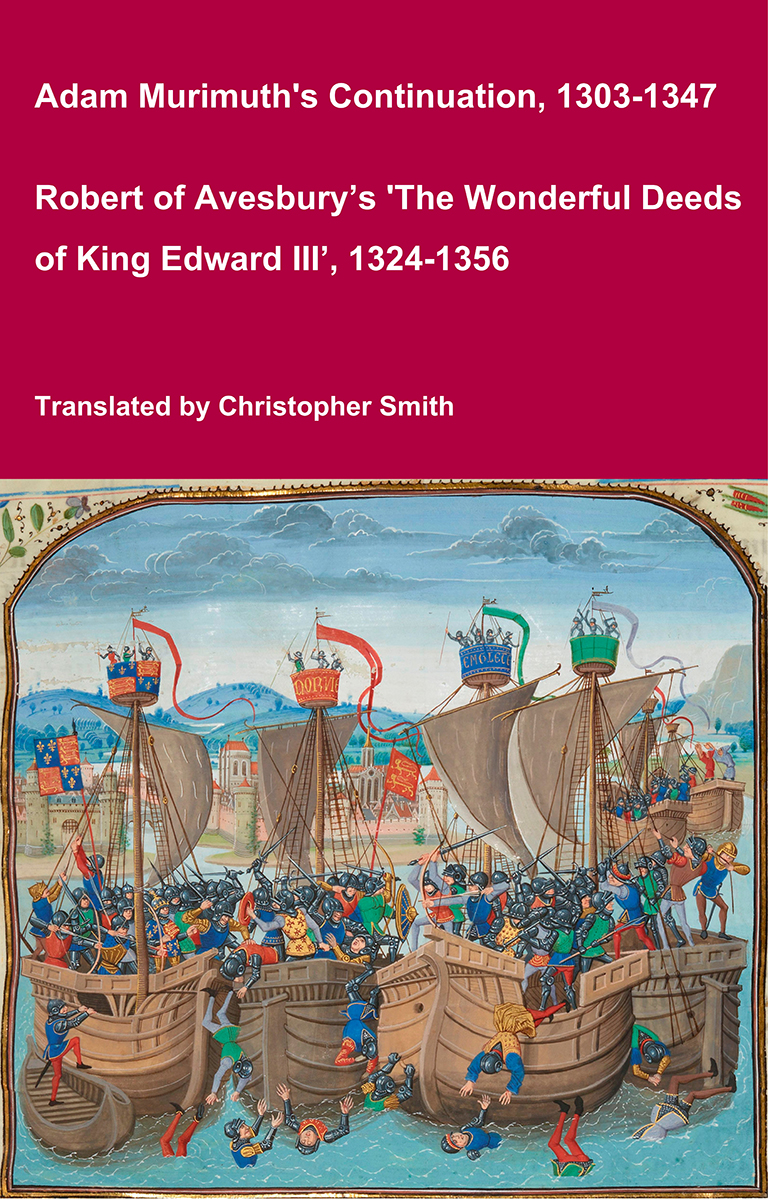
Adam Murimuth's Continuation and Robert of Avesbury’s 'The Wonderful Deeds of King Edward III'
This volume brings together two of the most important contemporary chronicles for the reign of Edward III and the opening phases of the Hundred Years’ War. Written in Latin by English clerical observers, these texts provide a vivid and authoritative window into the political, diplomatic, and military history of fourteenth-century England and its continental ambitions. Adam Murimuth Continuatio's Chronicarum continues an earlier chronicle into the mid-fourteenth century, offering concise but valuable notices on royal policy, foreign relations, and ecclesiastical affairs. Its annalistic structure makes it especially useful for establishing chronology and tracing the development of events year by year. Complementing it, Robert of Avesbury’s De gestis mirabilibus regis Edwardi tertii is a rich documentary chronicle preserving letters, treaties, and official records alongside narrative passages. It is an indispensable source for understanding Edward III’s claim to the French crown, the conduct of war, and the mechanisms of medieval diplomacy. Together, these works offer scholars, students, and enthusiasts a reliable and unembellished account of a transformative period in English and European history. Essential for anyone interested in medieval chronicles, the Hundred Years’ War, or the reign of Edward III.
Available at Amazon in eBook and Paperback format.
Paternal Family Tree: Brandon
Maternal Family Tree: Jeanne Sabran
1514 Marriage of Mary Tudor and Louis XII of France
1533 Death and Funeral of Mary Tudor
1536 Death of Catherine of Aragon
1551 Sweating Sickness Outbreak
1551 Edward VI's 14th Birthday
1553 Grey and Dudley Triple Wedding

In 1508 [her father] Charles Brandon 1st Duke of Suffolk [aged 24] and Anne Browne were married secretly at Stepney [Map]. She, Anne, being the step-daughter of his first wife's [aged 42] sister Lucy Neville [aged 40]. They, Charles and Anne, had possibly been betrothed before his marriage to Margaret Neville. They were fifth cousins.
On 9th October 1514 Louis XII King France [aged 52] and [her mother] Mary Tudor Queen Consort France [aged 18] were married at Abbeville [Map], Somme. She by marriage Queen Consort France. Thomas Grey 2nd Marquess Dorset [aged 37], Thomas West 8th Baron De La Warr 5th Baron West [aged 57], Thomas Brooke 8th Baron Cobham [aged 44] and his son George Brooke 9th Baron Cobham [aged 17], Bishop Thomas Ruthall [aged 42] and [her future mother-in-law] Margaret Wotton Marchioness Dorset [aged 27] attended. The difference in their ages was 33 years. She the daughter of [her grandfather] King Henry VII of England and Ireland and [her grandmother] Elizabeth York Queen Consort England. He the son of Charles Valois Duke Orléans and Mary de la Marck Duchess Orléans. They were second cousin twice removed.


In May 1515 [her father] Charles Brandon 1st Duke of Suffolk [aged 31] and [her mother] Mary Tudor Queen Consort France [aged 19] were married. She by marriage Duchess Suffolk. She had married Louis XII King France in Oct 1514; he had died on 01 Jan 1515. Around this time he surrendered the title Viscount Lisle which he had been created in anticipation of this marriage to Elizabeth Grey Countess Devon [aged 10] which never took place. She the daughter of [her grandfather] King Henry VII of England and Ireland and [her grandmother] Elizabeth York Queen Consort England. They were fifth cousins.
Letters and Papers Foreign and Domestic Henry VIII 1517. 17 July [1517]. Egerton, 985. f. 63b. B. M. 3489. [her father] Charles Duke of Suffolk [aged 33].
"The christening of the Lady Frances, first begotten daughter of Charles Duke of Suffolk and [her mother] Mary the French Queen [aged 21]."
Born at Bishop's Hatfield, Thursday, 17 July 1517, 9 Henry VIII., between 2 and 3 in the morning. Christened on Saturday following. The road to the church was strewed with rushes; the church porch hung with rich cloth of gold and needlework; the church with arras of the history of Holofernes and Hercules; the chancel, with arras of silk and gold; and the altar with rich cloth of tissue, and covered with images, relics, and jewels. In the said chancel were, as deputies for the Queen and Princess, Lady Boleyn [aged 37] and Lady Elizabeth Grey. The Abbot of St. Alban's was godfather. The font was hung with a canopy of crimson satin, powdered with roses, half red and half white, with the sun shining, and fleur de lis gold, and the French Queen's arms in four places, all of needlework. On the way to church were eighty torches borne by yeomen, and eight by gentlemen. The basin, covered, was borne by Mr. Sturton, the taper by Mr. Richard Long, the salt by Mr. Humphrey Barnes, the chrism by Lady Chelton. Mrs. Dorothy Verney bore the young lady, was assisted by the Lord Powes and Sir Roger Pelston, and accompanied by sixty ladies and gentlemen, and the prelates Sir Oliver Poole and Sir Christopher, and other of my Lord's chaplains. She was named Frances, being born on St. Francis's day.
On 17th July 1517 Frances Brandon Duchess of Suffolk was born to [her father] Charles Brandon 1st Duke of Suffolk [aged 33] and [her mother] Mary Tudor Queen Consort France [aged 21]. She a granddaughter of King Henry VII of England and Ireland.
In 1525 [her brother-in-law] Edward Grey 3rd Baron Grey of Powis [aged 22] and [her illegitimate half-sister] Anne Brandon Baroness Grey Powis [aged 18] were married. She by marriage Baroness Grey of Powis. She the illegitmate daughter of [her father] Charles Brandon 1st Duke of Suffolk [aged 41] and Anne Browne. They were fifth cousins. He a great x 4 grandson of King Henry IV of England.

Before 1527 [her brother-in-law] Thomas Stanley 2nd Baron Monteagle [aged 19] and [her half-sister] Mary Brandon Baroness Monteagle [aged 16] were married. She by marriage Baroness Monteagle. She the daughter of [her father] Charles Brandon 1st Duke of Suffolk [aged 42] and Anne Browne. They were third cousin once removed. He a great x 4 grandson of King Edward III of England.
On 10th October 1530 Thomas Grey 2nd Marquess Dorset [aged 53] died. His son [her future husband] Henry [aged 13] succeeded 3rd Marquess Dorset, 3rd Earl Huntingdon, 9th Baron Ferrers of Groby, 9th Baron Harington, 4th Baron Bonville.
In 1533 Henry Grey 1st Duke of Suffolk [aged 16] and Frances Brandon Duchess of Suffolk [aged 15] were married. She by marriage Marchioness Dorset. She the daughter of Charles Brandon 1st Duke of Suffolk [aged 49] and Mary Tudor Queen Consort France [aged 36]. He the son of Thomas Grey 2nd Marquess Dorset and Margaret Wotton Marchioness Dorset [aged 46]. They were half second cousins. He a great x 5 grandson of King Edward III of England. She a granddaughter of King Henry VII of England and Ireland.
On 25th June 1533 [her mother] Mary Tudor Queen Consort France [aged 37] died at Westhorpe, Suffolk [Map]. She was buried at the monastery of St. Edmondsbury [Map] on 22nd July 1533. Her daughter Frances [aged 15] was Chief Mourner.

On 7th September 1533 [her father] Charles Brandon 1st Duke of Suffolk [aged 49] and [her step-mother] Catherine Willoughby Duchess Suffolk [aged 14] were married. She by marriage Duchess Suffolk. He held her wardship and had intended to marry her to his ten years old son. In the event of the death of his wife, [her mother] Mary Tudor Queen Consort France, ten weeks earlier he decided to marry her himself instead. The difference in their ages was 35 years. They were fifth cousin once removed.
On 1st March 1534 [her brother] Henry Brandon [aged 11] died at Southwark, Surrey [Map]. Earl Lincoln extinct.
William of Worcester's Chronicle of England
William of Worcester, born around 1415, and died around 1482 was secretary to John Fastolf, the renowned soldier of the Hundred Years War, during which time he collected documents, letters, and wrote a record of events. Following their return to England in 1440 William was witness to major events. Twice in his chronicle he uses the first person: 1. when writing about the murder of Thomas, 7th Baron Scales, in 1460, he writes '… and I saw him lying naked in the cemetery near the porch of the church of St. Mary Overie in Southwark …' and 2. describing King Edward IV's entry into London in 1461 he writes '… proclaimed that all the people themselves were to recognize and acknowledge Edward as king. I was present and heard this, and immediately went down with them into the city'. William’s Chronicle is rich in detail. It is the source of much information about the Wars of the Roses, including the term 'Diabolical Marriage' to describe the marriage of Queen Elizabeth Woodville’s brother John’s marriage to Katherine, Dowager Duchess of Norfolk, he aged twenty, she sixty-five or more, and the story about a paper crown being placed in mockery on the severed head of Richard, 3rd Duke of York.
Available at Amazon in eBook and Paperback format.

In 1536 [her daughter] Lady Jane Grey was born to [her husband] Henry Grey 1st Duke of Suffolk [aged 19] and Frances Brandon Duchess of Suffolk [aged 18]. She a great granddaughter of King Henry VII of England and Ireland. She married her third cousin once removed Guildford Dudley, son of John Dudley 1st Duke Northumberland and Jane Guildford Duchess Northumberland.
Calendar of State Papers of Spain. 21st January 1536. Wien, Rep. P.C., Fasc. 236, No. 3. Eustace Chapuys [aged 46] to the Emperor [aged 35].
The good Queen [deceased] breathed her last at 2 o'clock in the afternoon. Eight hours afterwards, by the [her uncle] King's [aged 44] express commands, the inspection of her body was made, without her confessor or physician or any other officer of her household being present, save the fire-lighter in the house, a servant of his, and a companion of the latter, who proceeded at once to open the body. Neither of them had practised chirurgy, and yet they had often performed the same operation, especially the principal or head of them, who, after making the examination, went to the Bishop of Llandaff, the Queen's confessor, and declared to him in great secrecy, and as if his life depended on it, that he had found the Queen's body and the intestines perfectly sound and healthy, as if nothing had happened, with the single exception of the heart, which was completely black, and of a most hideous aspect; after washing it in three different waters, and finding that it did not change colour, he cut it in two, and found that it was the same inside, so much so that after being washed several times it never changed colour. The man also said that he found inside the heart something black and round, which adhered strongly to the concavities. And moreover, after this spontaneous declaration on the part of the man, my secretary having asked the Queen's physician whether he thought the Queen had died of poison, the latter answered that in his opinion there was no doubt about it, for the bishop had been told so under confession, and besides that, had not the secret been revealed, the symptoms, the course, and the fatal end of her illness were a proof of that.
No words can describe the joy and delight which this King and the promoters of his concubinate [aged 35] have felt at the demise of the good Queen, especially the earl of Vulcher [aged 59], and his son [aged 33], who must have said to themselves, What a pity it was that the Princess [aged 19] had not kept her mother company. The King himself on Saturday, when he received the news, was heard to exclaim, "Thank God, we are now free from any fear of war, and the time has come for dealing with the French much more to our advantage than heretofore, for if they once suspect my becoming the Emperor's friend and ally now that the real cause of our enmity no longer exists I shall be able to do anything I like with them." On the following day, which was Sunday, the King dressed entirely in yellow from head to foot, with the single exception of a white feather in his cap. His bastard daughter [aged 2] was triumphantly taken to church to the sound of trumpets and with great display. Then, after dinner, the King went to the hall, where the ladies were dancing, and there made great demonstration of joy, and at last went into his own apartments, took the little bastard, carried her in his arms, and began to show her first to one, then to another, and did the same on the following days. Since then his joy has somewhat subsided; he has no longer made such demonstrations, but to make up for it, as it were, has been tilting and running lances at Grinduys [Map]. On the other hand, if I am to believe the reports that come to me from every quarter, I must say that the displeasure and grief generally felt at the Queen's demise is really incredible, as well as the indignation of the people against the King. All charge him with being the cause of the Queen's death, which I imagine has been produced partly by poison and partly by despondency and grief; besides which, the joy which the King himself, as abovesaid, manifested upon hearing the news, has considerably confirmed people in that belief.
Whilst the sorrow and indignation of the English last, it will be, in my opinion, the fit moment for urging the present Pope to proceed against this King, and apply the requisite remedy to so many evils. The measure would be most opportune just now; for these people, thinking, as they actually do, that because the good Queen is dead, no further proceedings can be instituted against them, would be greatly astonished, and taken, as it were, by surprise. They fancy, moreover. that the Pope on his own account, and for what personally concerns him and the Church, will not dare to stir and provoke war, especially as a good portion of Germany and other countries is in the same predicament as this King is. Yet, though the Queen is no longer alive, it is due to her memory and to the honour of her royal relatives to have it declared that she actually died Queen of England. It is, moreover, important to proceed at once to the execution of the sentence in what relates to the Princess, and dissolve and annul this second marriage, which certainly has not become more valid and legitimate through the Queen's death. Another declaration would be necessary on the part of the Pope, namely, that the King could not marry this woman, nor any other, during the Queen's life, according to the rules and prescriptions of civil right, unless the Pope himself had granted a dispensation.
It would indeed seem as if these people entertained some hope of making the Pope lean to their side, for only three days ago Cromwell said at dinner (a plainne table) that possibly within a very few days one might see in England a legate and an ambassador from the Pope, who would come to confirm all their former doings. And yesterday an order was issued for the curates and other preachers to abstain from preaching anything either against or in favour of the existence of purgatory, images, the worship of saints, and other doubtful theological questions. Perhaps by this and other means they hope to cajole His Holiness and send him to sleep until Your Majesty has actually left Rome,—which in my opinion, would he a great and irreparable evil; and I fancy that the courier who has taken to France the news of the Queens decease has been instructed to proceed afterwards to Rome in haste, and prevent, if he can, the publication of the ecclesiastical censures.
There has been some rumour here that this King intended going personally to his daughter, the Princess, or sending some high personage to condole with her, and that on that ground the news of her mother's death would be kept from her as long as possible. I hear, however, that nothing of the sort is the case. Four days after the Queen's demise the governess herself went straight to the Princess, and most unceremoniously, without the least preparation, announced to her the sad event. I myself had previously written to the Princess a letter of condolence, and sent it to one of her maids in waiting with instructions to put it into her hands the moment her mother's death should be notified to her. This was done; and I must say that the Princess received such consolation and comfort through it that soon after she herself wrote to me a very good and well penned answer, in which, after thanking me immensely for the invaluable good I have done her, she begged me to let the King know that, unless she were immediately removed from the house and company in which she was, she should consider herself as good as lost; and that, following my advice, she would in the midst of her tribulations do her best to show that courage and constancy of which I had spoken to her, and at all events prepare for death.
In the evening of the day on which the Queen's death was notified to her, the Princess begged her governess to write a letter to the King, asking for the physician and apothecary who had attended on her, rather, as I imagine, to make inquiries and hear the particulars of her last illness, than because she herself wanted their services. To which request of the Princess the King answered, that her complaint, if any, was not the result of illness, but merely of natural affliction, and therefore that she needed no physician nor apothecary at all. The Princess then wrote to me, praying, among other things, that I should solicit and procure the personal attendance of those two officials on the plea that she was really unwell, and could not do without them which I did forthwith, as Your Majesty must have heard.
The day before yesterday I forwarded to her the letter which Your Majesty had written to the Queen, her mother, as well as another from the Queen Regent of Flanders, both of which arrived too late. The letters, however, have been of great consolation to the Princess, as she herself wrote to me half an hour ago; for since her mother's death she writes oftener than before, for no other purpose, as I imagine, than to give a proof of that courage and firmness which I am continually recommending to her. I must add that her good sense, incomparable virtues, and unheard-of patience under the circumstances, enable her to bear with fortitude the loss of a mother whom she loved and cherished as much, perhaps more than any daughter ever did;—the Queen, her mother, having always been her principal refuge in all her tribulations.
Great preparations are being made for the burial of the good Queen, and according to a message received from Master Cromwell [aged 51] the funeral is to be conducted with such a pomp and magnificence that those present will scarcely believe their eyes. It is to take place on the 1st of February; the chief mourner to be the King's own niece [aged 18], that is to say, the daughter of the [her father] duke of Suffolk [aged 52]; next to her will go the Duchess, her mother; then the wife of the duke of Norfolk [aged 39], and several other ladies in great numbers. And from what I hear, it is intended to distribute mourning apparel to no less than 600 women of a lower class. As to the lords and gentlemen, nothing has yet transpired as to who they are to be, nor how many. Master Cromwell himself, as I have written to Your Majesty, pressed me on two different occasions to accept the mourning cloth, which this King offered for the purpose no doubt of securing my attendance at the funeral, which is what he greatly desires; but by the advice of the Queen Regent of Flanders (Mary), of the Princess herself, and of many other worthy personages, I have declined, and, refused the cloth proffered; alleging as an excuse that I was already prepared, and had some of it at home, but in reality because I was unwilling to attend a funeral, which, however costly and magnificent, is not that befitting a Queen of England.
The King, or his Privy Council, thought at first that very solemn obsequies ought to be performed at the cathedral church of this city. Numerous carpenters and other artizans had already set to work, but since then the order has been revoked, and there is no talk of it now. Whether they meant it in earnest, and then changed their mind, or whether it was merely a feint to keep people contented and remove suspicion, I cannot say for certain.
Calendar of State Papers of Spain. 1st April 1536. Wien, Rep. P. C., Fasc. 230, 1–4. Eustace Chapuys [aged 46] to the Emperor [aged 36].
Just at this moment I receive a message from the marchioness [of Dorset] [aged 18]1, confirming the information I once had from Master Geliot [aged 46], namely, that some days ago, the King being here in London, and, the young Miss Seymour [aged 27], to whom he is paying court at Greenwich, he sent her a purse full of sovereigns, together with a letter, and that the young damsel, to whom he is paying court, after respectfully kissing the letter, returned it to the messenger without opening it, and then falling on her knees, begged the royal messenger to entreat the King in her name to consider that she was a well-born damsel, the daughter of good and honourable parents without blame or reproach of any kind; there was no treasure in this world that she valued as much as her honour, and on no account would she lose it, even if she were to die a thousand deaths. That if the King wished to make her a present of money, she requested him to reserve it for such a time as God would be pleased to send her some advantageous marriage.
The marchioness also sent me word that in consequence of this refusal the King's love for the said damsel had marvelously increased, and that he had said to her that not only did he praise and commend her virtuous behaviour on the occasion, but that in order to prove the sincerity of his love, and the honesty of his views towards her, he had resolved not to converse with her in future, except in the presence of one of her relatives, and that for this reason the King had taken away from Master Cromwell's apartments in the palace a room, to which he can, when he likes, have access through certain galleries without being seen, of which room the young lady's elder brother [aged 36] and his wife [aged 39] have already taken possession for the express purpose of her repairing thither. But I hear that the young lady has been well tutored and warned by those among this King's courtiers who hate the concubine, telling her not in any wise to give in to the King's fancy unless he makes her his Queen, upon which the damsel is quite resolved. She has likewise been advised to tell the King frankly, and without reserve, how much his subjects abominate the marriage contracted with the concubine, and that not one considers it legitimate, and that this declaration ought to be made in the presence of witnesses of the titled nobility of this kingdom, who are to attest the truth of her statements should the King request them on their oath and fealty to do so. The marchioness wishes that I or some one else, on Your Majesty's part, would take this affair in hand, and certainly, if my opinion on such a point is needed, I do not hesitate to say that whoever could help in its execution would do a meritorious work, as it would prove a further security for the person of the Princess, a remedy for the heretical doctrines and practices of the concubine—the principal cause of the spread of Lutheranism in this country—as well as be the means of clearing the King from the taint of a most abominable and adulterous marriage. The Princess herself would be glad of this, even if she were eventually deprived of her rights to the English crown by the birth of male children. I shall again inform her to-day of what is going on, and, with her advice, will act in such a manner that if we cannot gain, at least we shall lose nothing by the event—London, 1 Apr. 1536.
Signed: "Eustace Chapuys."
Addressed: "To the Emperor."
French. Original. pp. Almost entirely in cipher.
Note 1. "Just now, the marquise has sent to tell me what Maître Gelyot had already affirmed to me."
Eliot? the original reads thus: "Tout a cest instaat la marquise ma envoye dire ce que desia mavoit affirme maistre gelyot."
Note 2. Namely, that in these past days, while the king was in this town and the young lady Mistress Seymour, whom he serves, was in Greenwich, he sent her a purse full of sovereigns along with a letter. And that the said young lady, after kissing the letter, returned it to the messenger without wanting to open it, and, throwing herself to her knees, she begged the said messenger to beseech the king on her behalf to consider, in his wisdom, that she was a gentlewoman descended from good and honourable parents without any reproach, and that she had no greater wealth in this world than her honour, which she would not wound for a thousand deaths, and that if he wished to give her some present of money, she begged him to do so when God would send her a good match in marriage.
"A sçavoir que ces iours passez estant ce roy en ceste ville et la demoiselle maistresse Semel, la quelle il sert, a Grynuchuitz, il lui envoya une boursse plaine de souverains ensemble une lectre, et quc la dicte demoiselle ayant baise la lectre, la retourna au messegier sans la vouloir ouvrir, et se gectant a genoulx elle supplia au diet messaigier vouloir supplier au roy de sa part vouloir considerer par su prudence quelle estoit gentil femme yssue de bons et honourables pareus sans nul reproache, et quelle navoit plus grande richesse en ce monde que son honneur, le quel pour mille mort elle ne vouldroit blesser, et que sil luy vouloit faire quelque present dargent elle luy supplioit que ce fut quant dieu lui envoyeroit quelque bon party de mariage."


On 19th May 1536 Queen Anne Boleyn of England [aged 35] was beheaded at Tower Green, Tower of London [Map]. Unusually a sword was used. Her execution was witnessed by [her father] Charles Brandon 1st Duke of Suffolk [aged 52], Catherine Carey [aged 12] and Henry Fitzroy 1st Duke Richmond and Somerset [aged 16]. Marquess Pembroke extinct.
She was buried at St Peter ad Vincula Church, Tower of London [Map]. There is myth that her corpse was subsequently removed for burial at the Boleyn family church Church of St Peter and St Paul, Salle [Map] as described in Agnes Strickland's 1852 Lives of the Queens of England Volume 4. Page 212.
On 25th August 1540 [her daughter] Catherine Grey Countess Hertford was born to [her husband] Henry Grey 1st Duke of Suffolk [aged 23] and Frances Brandon Duchess of Suffolk [aged 23] at Bradgate Park, Leicestershire. She a great granddaughter of King Henry VII of England and Ireland. She married (1) her fourth cousin Henry Herbert 2nd Earl Pembroke, son of William Herbert 1st Earl Pembroke and Anne Parr Countess Pembroke (2) before 25th December 1560 her sixth cousin Edward Seymour 1st Earl Hertford, son of Edward Seymour 1st Duke of Somerset and Anne Stanhope Duchess Somerset, and had issue.


In 1542 [her half-sister] Mary Brandon Baroness Monteagle [aged 32] died.
On 23rd December 1543 Henry VIII [aged 52] enobled his new wife's [aged 31] brother [aged 31] and uncle [aged 60] at ceremony in the Presence Chamber, Hampton Court Palace [Map]. Henry Grey 1st Duke of Suffolk [aged 26] and Edward Stanley 3rd Earl of Derby [aged 34] were present. Christopher Barker read the Patents.
William Parr 1st Baron Parr of Horton was created 1st Baron Parr of Horton. William was sixty with five daughters. He died four years later at which time the Barony became extinct.
William Parr 1st Marquess Northampton was created 1st Earl Essex. His estranged wife Anne Bourchier 7th Baroness Bourchier [aged 26] was daughter of the last Earl of Essex of the Fifth Creation. A somewhat curious choice given his wife had eloped the year previous year with John Lyngfield, the prior of Tandbridge, Surrey [Map], by whom she had an illegitimate child.


Around 1545 [her daughter] Mary Grey was born to [her husband] Henry Grey 1st Duke of Suffolk [aged 28] and Frances Brandon Duchess of Suffolk [aged 27]. She a great granddaughter of King Henry VII of England and Ireland. She married 19th August 1565 Thomas Keyes.

On 22nd August 1545 [her father] Charles Brandon 1st Duke of Suffolk [aged 61] died. His son [her half-brother] Henry [aged 9] succeeded 2nd Duke Suffolk, 2nd Viscount Lisle.
Schoolmaster Book 1 by Roger Ascham. [Around 1550 Before I went into Germany,1 I came to Broadgate]
Note 1. This discourse with this excellent lady, he thus expresses in a letter to his friend Sturmius2: "In this last summer, when I was in Leicestershire, to take my leave of that noble lady [her daughter] Lady Jane Grey [aged 14]. Jane Grey, to whom I was exceeding much beholding. Her parents, the duke [[her husband] Henry Grey 1st Duke of Suffolk [aged 33]] and duchess [Frances Brandon Duchess of Suffolk [aged 32]], with all the household, gentlemen and gentlewomen, were hunting in the park. I found her in her chamber, reading Phædo Platonis in Greek, and that with as much delight as some gentlemen would read a merry tale in Boccace. After salutation, and duty done, with some other talk, I asked her, why she would leese such pastime in the park 1 Smiling, she answered me; " I wist, all their sport in the park is but a shadow to that pleasure that I find in Plato. Alas! good folk, they never felt what true pleasure meant." "And how came you, madam," quoth I, "to this deep knowledge of pleasure? and what did chiefly allure you unto it, seeing not many women, but very few men, have attained thereunto1?" " I will tell you," quoth she, "and tell you a truth, which perchance ye will marvel at. One of the greatest benefits that ever God gave me, is, that he sent me so sharp and severe parents, and so gentle a schoolmaster. For when I am in presence either of father or mother; whether I speak, keep silence, sit, stand, or go, eat, drink, be merry, or sad, be sewing, playing, dancing, or doing any thing else; I must do it, as it were, in such weight, measure, and number, even so perfectly, as God made the world; or else I am so sharply taunted, so cruelly threatened, yea presently some times with pinches, nips, and bobs, and other ways (which I will not name for the honour I bear them) so without measure misordered, that I think myself in hell, till time come that I must go to Mr Elmer; who teacheth me so gently, so pleasantly, with such fair allurements to learning, that I think all the time no-visiting my friends in the York region, and from there I was summoned by the letters of John Checi to the Court, that I might journey here, I turned aside to Leicester, where thing whiles I am with him. And when I am called from him, I fall on weeping, because whatsoever I do else but learning, is full of grief, trouble, fear, and whole misliking unto me. And thus my book hath been so much my pleasure, and bringeth daily to me more pleasure and more, that in respect of it, all other pleasures, in very deed, be but trifles and troubles unto me."
Note 1. This discourse with this excellent lady, he thus expresses in a letter to his friend Sturmius2: "In this last summer, when I was visiting my friends in the York region, and from there I was summoned by the letters of John Checi to the Court, that I might journey here, I turned aside to Leicester, where Jane Grey was living with her father. Immediately I was admitted into the room: I found a noble girl, Good gods! reading Greek the Phaedo of Plato; whom she understands in such a way that she inspired the highest admiration in me. Thus she speaks and writes Greek, that to the one reporting it, scarcely any belief can be given. She has found a teacher, John Elmarus, very skilled in both languages; because of his kindness, wisdom, experience, correct religion, and many other very proper bonds of the most excellent friendship, most closely connected to me."
Note 2. Original Latin: "Hac superiore æstate, quum amicos meos in agro Eboracensi viserem, et inde literis Joannis Checi in Aulam, ut hue proficiscerer, accitus sum, in via deflexi Leicestriam, ubi Jana Graia cum patre habitaret. Statim admissus sum in cubiculum: inveni nobilem puellam, Dii boni! legentem Græce Phædonem Platonis; quern sic intelligit, ut mihi ipsi summam admirationem injiceret. Sic loquitur et scribit Græce, ut vera referenti vix fides adhiberi possit. Nacta est præceptorem Joannem Elmarum, utriusque linguæ valde peritum; propter humanitatem, prudentiam, usum, rectam religionem, et alia multa rectissimæ. amicitise vincula, mihi conjunctissimum."
On 14th July 1551 [her half-brother] Henry Brandon 2nd Duke of Suffolk [aged 15] died of sweating sickness at the Bishop of Lincoln's Palace, Buckden [Map]. His brother Charles [aged 14] succeeded 3rd Duke Suffolk, 3rd Viscount Lisle.
Charles Brandon 3rd Duke of Suffolk died of sweating sickness an hour or so after his brother also at the Bishop of Lincoln's Palace, Buckden [Map]. Duke Suffolk, Viscount Lisle extinct.
They were buried at St Mary's Church, Buckden [Map]
Charles Brandon 3rd Duke of Suffolk: In 1537 he was born to Charles Brandon 1st Duke of Suffolk and Catherine Willoughby Duchess Suffolk. Henry Machyn's Diary. 22nd September 1551. The xxij day of September was the monyth['s mind of the] ij dukkes of Suffoke [Henry Brandon 2nd Duke of Suffolk and Charles Brandon 3rd Duke of Suffolk] in Chambryge-shyre, with [ij] standards, ij baners grett of armes and large, and banars rolles of dyver armes, with ij elmets, ij [swords, ij] targetts crownyd, ij cotes of armes, ij crests, and [ten dozen] of schochyons crounyd; and yt was grett pete of [their] dethe, and yt had plesyd God, of so nobull a stok they wher, for ther ys no more left of them.


11th October 1551, the day before his fourteenth birthday, King Edward VI [aged 13] celebrated at Hampton Court Palace [Map] by rewarding his guardians; it may have been a case of his guardians rewarding themselves.
John Dudley 1st Duke Northumberland [aged 47] was created 1st Duke Northumberland. Jane Guildford Duchess Northumberland [aged 42] by marriage Duchess Northumberland. His son Henry Dudley [aged 25] was knighted.
[her husband] Henry Grey 1st Duke of Suffolk [aged 34] was created 1st Duke Suffolk for having married King Edward VI's first cousin Frances Brandon Duchess of Suffolk [aged 34]. Frances Brandon Duchess of Suffolk by marriage Duchess Suffolk.
William Paulet [aged 68] was created 1st Marquess Winchester. Elizabeth Capell Marchioness Winchester by marriage Marchioness Winchester.
His guardian William Herbert [aged 50] was created 1st Earl Pembroke. Anne Parr Countess Pembroke [aged 36] by marriage Countess Pembroke.
Edward Seymour 1st Duke of Somerset [aged 51], the King's uncle attended.
Henry Dudley was knighted at Hampton Court Palace, Richmond [Map].


Henry Machyn's Diary. 10th February 1553. The x day of January [Note. Probably February] rod my lade Mare('s) [aged 36] grasse from Saynt [John's] and thrugh Flettstrett unto the kyng at Westmynster, with a grett nombur of lords and knyghtes, and alle the [great] women lades, the duches of Suffoke [aged 35] and Northumberland [aged 44], my lade marqwes of Northamptun [aged 26], and lade marqwes of Wynchester, and the contes of Bedfford [aged 74], and the contes of Shrowsbere [aged 53], and the contes of Arundelle, my lade Clynton [aged 26], my lade Browne [aged 24] and Browne [sic in manuscript], and many mo lades and gentyllwomen; and at the oter gatt ther mett her my [her husband] lord of Suffoke [aged 36] and my lord of Northumberland [aged 49], my lord of Wynchester [aged 70], my lord of Bedfford [aged 68], and therle of Shrusbery [aged 53], the therle of Arundell [aged 40], my lord Chamburlayn, my lord Admerolle, and a gret nomber of knyghtes and gentyllmen, and so up unto the chambur of pressens, and ther the Kynges [aged 15] grace mett her and salutyd her.... owyn a-pon payne of presunmentt and a grett [penalty, as ye] shalle fynd in the actes in secund yere of kyng ... the perlementt tyme of the sayd yere, and nott to be ... plasse as taverns, alle-howses, ines, or wher ... for cummers and gestes, and has commandyd unto alle shreyffes and baylles, constabulls, justes of pesse, or any .. thay shall se truthe (and) justys as thay shalle [inform the] kyng and ys consell, and bryng them to pressun of ... sun or poyssuns as be the offenders ther off for ... her of odur.


On 25th May 1553 a triple wedding was celebrated at Durham Place, the London townhouse of John Dudley 1st Duke Northumberland [aged 49], father of [her son-in-law] Guildford Dudley [aged 18] and Katherine Dudley Countess Huntingdon [aged 15]...
Guildford Dudley and Lady Jane Grey [aged 17] were married. She the daughter of Henry Grey 1st Duke of Suffolk [aged 36] and Frances Brandon Duchess of Suffolk [aged 35]. He the son of John Dudley 1st Duke Northumberland and Jane Guildford Duchess Northumberland [aged 44]. They were third cousin once removed. She a great granddaughter of King Henry VII of England and Ireland.
Henry Hastings 3rd Earl Huntingdon [aged 18] and Katherine Dudley Countess Huntingdon were married. She the daughter of John Dudley 1st Duke Northumberland and Jane Guildford Duchess Northumberland. He the son of Francis Hastings 2nd Earl Huntingdon [aged 39] and Catherine Pole Countess Huntingdon [aged 42]. They were fourth cousin once removed.
Henry Herbert 2nd Earl Pembroke [aged 15] and Catherine Grey Countess Hertford [aged 12] were married. She the daughter of Henry Grey 1st Duke of Suffolk and Frances Brandon Duchess of Suffolk. He the son of William Herbert 1st Earl Pembroke [aged 52] and Anne Parr Countess Pembroke. They were fourth cousins. She a great granddaughter of King Henry VII of England and Ireland.
Henry Machyn's Diary. 10th July 1553. The x day of July was reseyvyd in to the Towre [the [her daughter] Queen Jane [aged 17]] with a grett compeny of lords and nobulls of .... after the qwen, and the duches of Suffoke [aged 35] her mother, bering her trayn, with mony lades, and ther was a shot of gunnes and chamburs has nott be sene oft be-tweyn iiij and v of [the clock]; by vj of the cloke be-gane the proclamasyon the same [after-]non (of) qwen Jane with ij harold(s) and a trompet blohyng, [declaring] that my lade Mare [aged 37] was unlafully be-gotten, and so [went through] Chepe to Fletstrett, proclamyng qwen Jane; and ther was a yong man taken that tym for spykyng of serten wordes of qwen Mare, that she had the ryght tytle.
On 12th February 1554 [her son-in-law] Guildford Dudley [aged 19] was beheaded at Tower Hill [Map]. An hour later his wife [her daughter] Lady Jane Grey [aged 18] was beheaded at Tower Green [Map] by order of Queen Mary I [aged 37]. They were buried at St Peter ad Vincula Church, Tower of London [Map].
On 23rd February 1554 [her husband] Henry Grey 1st Duke of Suffolk [aged 37] was beheaded at Tower Hill [Map]. Duke Suffolk, Marquess Dorset, Earl Huntingdon, Baron Ferrers of Groby, Baron Harington, Baron Bonville forfeit.
Dean Hugh Weston [aged 49] acted as Confessor.
On 1st March 1555 Adrian Stokes [aged 35] and Frances Brandon Duchess of Suffolk [aged 37] were married. They had three children, two of which were stillborn, one of which died in their first year. She the daughter of Charles Brandon 1st Duke of Suffolk and Mary Tudor Queen Consort France.
In 1557 [her illegitimate half-sister] Anne Brandon Baroness Grey Powis [aged 50] died.
On 5th December 1559 Frances Brandon Duchess of Suffolk [deceased] was buried in St Edmund's Chapel in Westminster Abbey [Map] at a ceremony conducted by Bishop John Jewel [aged 37]. Her daughter Catherine Grey Countess Hertford [aged 19] was Chief Mourner. Mary Grey [aged 14] was present. Her effigy, possibly designed by Cornelius Cure, was paid for by her husband Adrian Stokes [aged 40]: recumbent effigy dressed in Ermine robes signifying she was a duchess with a pendant around her neck. She lies on mattress with a lion at her feet and her coronet has been repaired and gilded.
The inscription on her grave reads in Latin:
Nor grace, nor splendor, nor a royal name,
Nor widespread fame can aught avail;
All, all have vanished here.
True worth alone Survives the funeral pyre and silent tomb.
And...
Dirge for the most noble Lady Frances, onetime Duchess of Suffolk: naught avails glory or splendour, naught avail titles of kings; naught profits a magnificent abode, resplendent with wealth. All, all are passed away: the glory of virtue alone remained, impervious to the funeral pyres of Tartarus [part of Hades or the Underworld]. She was married first to the Duke, and after was wife to Mr Stock, Esq. Now, in death, may you fare well, united to God.
And continues...
Here lieth the ladie Francis, Duches of Southfolke, daughter to Charles Brandon, Duke of Southfolke, and Marie the Frenche Quene: first wife to Henrie Duke of Southfolke and after to Adrian Stock Esquier.
oN 20th November 1559 or 21st November 1559 Frances Brandon Duchess of Suffolk [aged 42] died at Richmond, Surrey [Map].
Henry Machyn's Diary. 5th December 1559. The v day (of) Dessember was bered in Westmynster abbay [Map] my lade Frances [deceased] the wyff of [her former husband] Hare duke of Suffolke, with a gret baner of armes and viij banar-rolles, and a hersse and a viij dosen penselles, and a viij dosen skockyons, and ij haroldes of armes, master Garter [aged 49] and master Clarenshux [aged 49], and mony morners.
Note. P. 217. Funeral of Frances duchess of Suffolk. Daughter of [her father] Charles Brandon, duke of Suffolk, and Mary queen dowager of France, daughter of king Henry VII. She was first married to Henry Grey, marquess of Dorset, who was created duke of Suffolk in 1551 (see p. 10); by whom she was mother of queen Jane: and afterwards accepted the hand of Adrian Stokes [aged 40] esquire, who erected her monument in Westminster abbey. Their portraits together are engraved by Vertue. Her style by our Diarist as "my lady Frances" did not arise either from ignorance or accident. The title "lady" was then equivalent to the modern title "princess;" and the duchess usually bore it, as her daughter "the lady Jane" had done, as distinctive of her being a member of the Blood Royal.—The heralds' account of her funeral is preserved in the College of Arms, I. 9, f. 153–4, and I. 14, f. 154–157.
Henry Machyn's Diary. 26th March 1561. The sam day of Marche at after-none at Westmynster [was brought] from the quen('s) armere [almondry] my lade Jane Semer, with [all the quire] of the abbay, with ijC. of (the) quen('s) cowrt, the wyche she was [one] of the quen('s) mayd(s) and in grett faver, and a iiijxx morners of [men and] women, of lordes and lades, and gentylmen and gentyllwomen, all in blake, be-syd odur [other] of the quen('s) preve chambur, and she [had] a grett baner of armes bornne, and master Clarenshux [aged 51] was the harold, and master Skameler [aged 41] the nuw byshope of Peterborow dyd pryche. [She was] bered in the sam chapell [Map] wher my lade of Suffoke was.
Note. P. 254. Funeral of lady Jane Seymour. Daughter of Edward duke of Somerset, and supposed to have been destined by him to become the consort of his nephew king Edward. A Latin letter written by her (of course under the dictation of her tutor) to the Reformers Bucer and Fagius, dated at Syon, June 12, 1549, is published in the Third Series of Zurich Letters, printed for the Parker Society. She was one of queen Elizabeth's maids of honour, and shortly before her death she had taken an active part in promoting the clandestine marriage of her brother the earl of Hertford with her companion the lady Katharine Grey, a line of conduct which would certainly have brought upon her the anger of her royal mistress, had she lived until it was discovered. (See Ellis's Orig. Letters, Second Series, vol. ii. p. 272.) Her age was only nineteen. See an engraving of her monumental tablet, with the inscription, erected by "her deare brother" the earl, in Dart's Westminster Abbey, vol. i. pl. 12. In the accounts of St. Margaret's parish, Westminster, is an entry of 10s. received at her funeral.

In 1572 [her former husband] Adrian Stokes [aged 52] and Anne Carew [aged 52] were married. Her second marriage having previously been married to Nicholas Throckmorton.
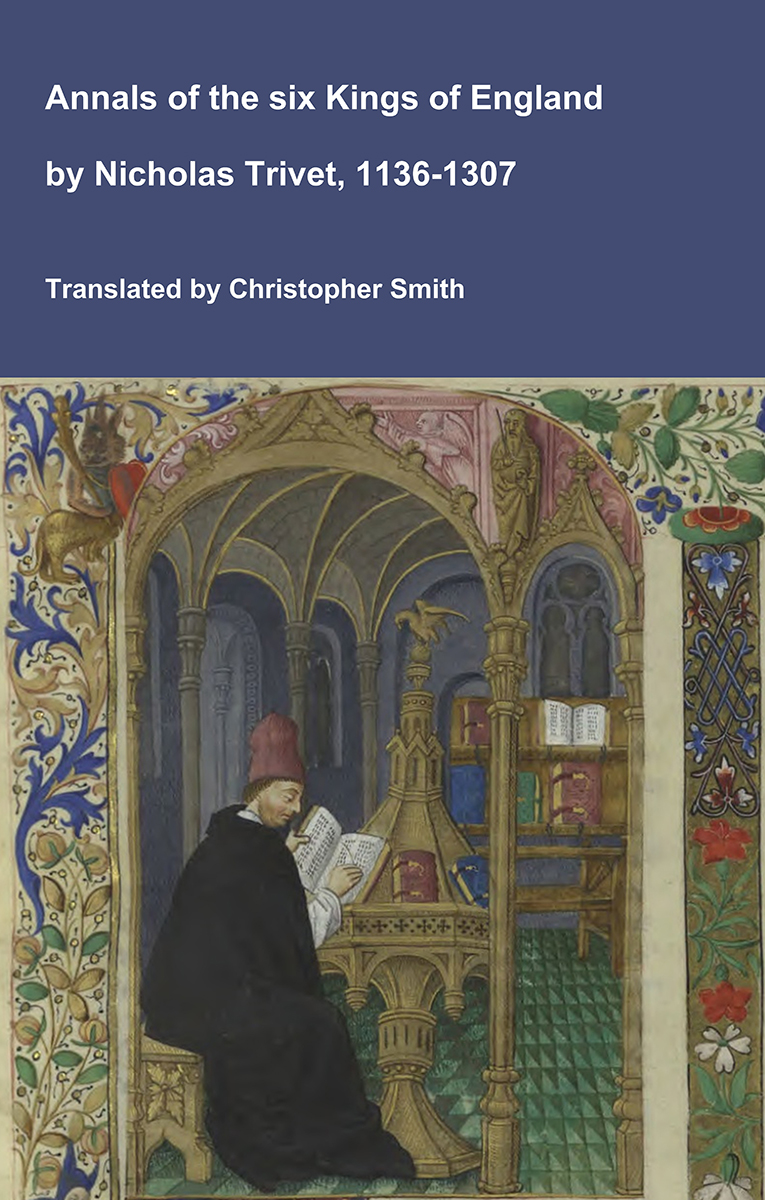
Annals of the six Kings of England by Nicholas Trivet
Translation of the Annals of the Six Kings of England by that traces the rise and rule of the Angevin aka Plantagenet dynasty from the mid-12th to early 14th century. Written by the Dominican scholar Nicholas Trivet, the work offers a vivid account of English history from the reign of King Stephen through to the death of King Edward I, blending political narrative with moral reflection. Covering the reigns of six monarchs—from Stephen to Edward I—the chronicle explores royal authority, rebellion, war, and the shifting balance between crown, church, and nobility. Trivet provides detailed insight into defining moments such as baronial conflicts, Anglo-French rivalry, and the consolidation of royal power under Edward I, whose reign he describes with particular immediacy. The Annals combines careful year-by-year reporting with thoughtful interpretation, presenting history not merely as a sequence of events but as a moral and political lesson. Ideal for readers interested in medieval history, kingship, and the origins of the English state, this chronicle remains a valuable and accessible window into the turbulent world of the Plantagenet kings.
Available at Amazon in eBook and Paperback format.
On 30th November 1586 [her former husband] Adrian Stokes [aged 67] died.
Kings Wessex: Great x 15 Grand Daughter of King Edmund "Ironside" I of England
Kings Gwynedd: Great x 12 Grand Daughter of Bleddyn ap Cynfyn King Gwynedd King Powys
Kings Seisyllwg: Great x 16 Grand Daughter of Hywel "Dda aka Good" King Seisyllwg King Deheubarth
Kings Powys: Great x 11 Grand Daughter of Maredudd ap Bleddyn King Powys
Kings Godwinson: Great x 14 Grand Daughter of King Harold II of England
Kings England: Grand Daughter of King Henry VII of England and Ireland
Kings Scotland: Great x 14 Grand Daughter of King Duncan I of Scotland
Kings Franks: Great x 21 Grand Daughter of Charles "Charlemagne aka Great" King of the Franks King Lombardy Holy Roman Emperor
Kings France: Great x 3 Grand Daughter of Charles "Beloved Mad" VI King France
Kings Duke Aquitaine: Great x 19 Grand Daughter of Ranulf I Duke Aquitaine
Great x 2 Grandfather: Robert Brandon 
Great x 1 Grandfather: William Brandon
Great x 2 Grandmother: Ada Calthorpe 
GrandFather: William Brandon 5 x Great Grand Son of King Edward I of England
Great x 4 Grandfather: John Wingfield 
Great x 3 Grandfather: Robert Wingfield 7 x Great Grand Son of King John of England
Great x 4 Grandmother: Margaret Hastings  6 x Great Grand Daughter of King John of England
Great x 2 Grandfather: Robert Wingfield 8 x Great Grand Son of King John of England
Great x 1 Grandmother: Elizabeth Wingfield 4 x Great Grand Daughter of King Edward I of England
Great x 3 Grandfather: Robert Goushill
Great x 2 Grandmother: Elizabeth Goushill 3 x Great Grand Daughter of King Edward I of England
Great x 4 Grandfather: Richard Fitzalan 9th Earl of Surrey 4th or 11th Earl of Arundel  2 x Great Grand Son of King Henry III of England
Great x 3 Grandmother: Elizabeth Fitzalan Duchess Norfolk 2 x Great Grand Daughter of King Edward I of England
Great x 4 Grandmother: Elizabeth Bohun Countess Arundel and Surrey  Great Grand Daughter of King Edward I of England
Father: Charles Brandon 1st Duke of Suffolk 6 x Great Grand Son of King Edward I of England
Great x 3 Grandfather: Ingram le Bruyn 
Great x 2 Grandfather: Morice Bruyn
Great x 4 Grandfather: Edmund de la Pole 
Great x 3 Grandmother: Elizabeth Pole
Great x 1 Grandfather: Henry Bruyn aka Darcy
GrandMother: Elizabeth Bruyn
Great x 4 Grandfather: Henry Darcy 
Great x 3 Grandfather: Robert Darcy
Great x 2 Grandfather: Robert Dracy
Great x 1 Grandmother: Elizabeth Darcy
Frances Brandon Duchess of Suffolk Grand Daughter of King Henry VII of England and Ireland
Great x 4 Grandfather: Tudur ap Goronwy Tudor
Great x 3 Grandfather: Maredudd Tudor 3 x Great Grand Son of King Edward I of England
Great x 4 Grandmother: Marged verch Thomas 2 x Great Grand Daughter of King Edward I of England
Great x 2 Grandfather: Owen Tudor 4 x Great Grand Son of King Edward I of England
Great x 1 Grandfather: Edmund Tudor 1st Earl Richmond 5 x Great Grand Son of King Edward I of England
Great x 4 Grandfather: King Charles V of France  5 x Great Grand Son of King Henry "Curtmantle" II of England
Great x 3 Grandfather: Charles "Beloved Mad" VI King France 4 x Great Grand Son of King Henry III of England
Great x 4 Grandmother: Joanna Bourbon Queen Consort France 3 x Great Grand Daughter of King Henry III of England
Great x 2 Grandmother: Catherine of Valois Queen Consort England 5 x Great Grand Daughter of King Henry III of England
Great x 4 Grandfather: Stephen "Magnificient Fop" Wittelsbach III Duke Bavaria  5 x Great Grand Son of King Henry "Curtmantle" II of England
Great x 3 Grandmother: Isabeau Wittelsbach Queen Consort France 6 x Great Grand Daughter of King Henry "Curtmantle" II of England
Great x 4 Grandmother: Taddea Visconti Duchess Bavaria
GrandFather: King Henry VII of England and Ireland  3 x Great Grand Son of King Edward III of England
Great x 4 Grandfather: John of Gaunt 1st Duke Lancaster Son of King Edward III of England
Great x 3 Grandfather: John Beaufort 1st Marquess Somerset and Dorset  Grand Son of King Edward III of England
Great x 4 Grandmother: Katherine Swynford aka Roet Duchess Lancaster 
Great x 2 Grandfather: John Beaufort 1st Duke of Somerset Great Grand Son of King Edward III of England
Great x 4 Grandfather: Thomas Holland 2nd Earl Kent Great Grand Son of King Edward I of England
Great x 3 Grandmother: Margaret Holland Duchess Clarence  2 x Great Grand Daughter of King Edward I of England
Great x 4 Grandmother: Alice Fitzalan Countess Kent 2 x Great Grand Daughter of King Henry III of England
Great x 1 Grandmother: Margaret Beaufort Countess Richmond 2 x Great Grand Daughter of King Edward III of England
Great x 4 Grandfather: Roger Beauchamp 2nd Baron Beauchamp Bletsoe  6 x Great Grand Son of King Henry I "Beauclerc" England
Great x 3 Grandfather: John Beauchamp 3rd Baron Beauchamp Bletsoe 7 x Great Grand Son of King Henry I "Beauclerc" England
Great x 2 Grandmother: Margaret Beauchamp Duchess Somerset 6 x Great Grand Daughter of King John of England
Great x 4 Grandfather: John Stourton  4 x Great Grand Son of King John of England
Great x 3 Grandmother: Edith Stourton Baroness Beauchamp Bletsoe 5 x Great Grand Daughter of King John of England
Mother: Mary Tudor Queen Consort France Daughter of King Henry VII of England and Ireland
Great x 4 Grandfather: Edmund of Langley 1st Duke of York  Son of King Edward III of England
Great x 3 Grandfather: Richard of Conisbrough 1st Earl Cambridge Grand Son of King Edward III of England
Great x 4 Grandmother: Isabella of Castile Duchess York  6 x Great Grand Daughter of King Henry "Curtmantle" II of England
Great x 2 Grandfather: Richard Plantagenet 3rd Duke of York Great Grand Son of King Edward III of England
Great x 4 Grandfather: Roger Mortimer 4th Earl March 3rd Earl of Ulster  Great Grand Son of King Edward III of England
Great x 3 Grandmother: Anne Mortimer 2 x Great Grand Daughter of King Edward III of England
Great x 4 Grandmother: Eleanor Holland Countess March and Ulster 2 x Great Grand Daughter of King Edward I of England
Great x 1 Grandfather: King Edward IV of England 2 x Great Grand Son of King Edward III of England
Great x 4 Grandfather: John Neville 3rd Baron Neville of Raby  4 x Great Grand Son of King Henry "Curtmantle" II of England
Great x 3 Grandfather: Ralph Neville 1st Earl of Westmoreland 5 x Great Grand Son of King Henry "Curtmantle" II of England
Great x 4 Grandmother: Maud Percy Baroness Neville Raby 5 x Great Grand Daughter of King Henry "Curtmantle" II of England
Great x 2 Grandmother: Cecily "Rose of Raby" Neville Duchess York Great Grand Daughter of King Edward III of England
Great x 4 Grandfather: John of Gaunt 1st Duke Lancaster Son of King Edward III of England
Great x 3 Grandmother: Joan Beaufort Countess of Westmoreland  Grand Daughter of King Edward III of England
Great x 4 Grandmother: Katherine Swynford aka Roet Duchess Lancaster
GrandMother: Elizabeth York Queen Consort England Daughter of King Edward IV of England
Great x 4 Grandfather: John Woodville 
Great x 3 Grandfather: Richard Woodville
Great x 2 Grandfather: Richard Woodville 1st Earl Rivers
Great x 4 Grandfather: Thomas Bittelsgate
Great x 3 Grandmother: Joan Bittelsgate
Great x 4 Grandmother: Joan Beauchamp 
Great x 1 Grandmother: Elizabeth Woodville Queen Consort England 6 x Great Grand Daughter of King Henry III of England
Great x 4 Grandfather: John Luxemburg Count St Pol  3 x Great Grand Son of King Henry III of England
Great x 3 Grandfather: Peter Luxemburg I Count Saint Pol 4 x Great Grand Son of King Henry III of England
Great x 4 Grandmother: Margaret Brienne
Great x 2 Grandmother: Jacquetta of Luxemburg Duchess Bedford 5 x Great Grand Daughter of King Henry III of England
Great x 4 Grandfather: Francesco Baux 1st Duke Andria 
Great x 3 Grandmother: Margherita Baux 5 x Great Grand Daughter of King John of England
Great x 4 Grandmother: Sueva Orsini 4 x Great Grand Daughter of King John of England