

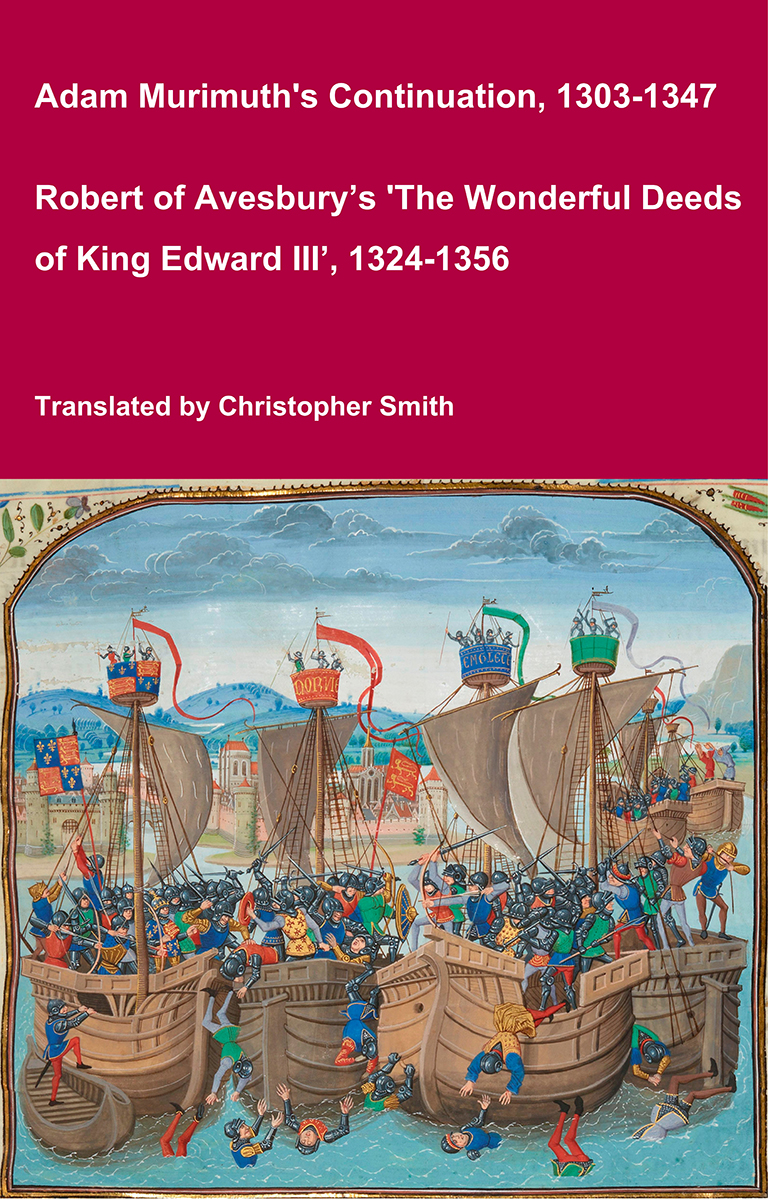
Adam Murimuth's Continuation and Robert of Avesbury’s 'The Wonderful Deeds of King Edward III'
This volume brings together two of the most important contemporary chronicles for the reign of Edward III and the opening phases of the Hundred Years’ War. Written in Latin by English clerical observers, these texts provide a vivid and authoritative window into the political, diplomatic, and military history of fourteenth-century England and its continental ambitions. Adam Murimuth Continuatio's Chronicarum continues an earlier chronicle into the mid-fourteenth century, offering concise but valuable notices on royal policy, foreign relations, and ecclesiastical affairs. Its annalistic structure makes it especially useful for establishing chronology and tracing the development of events year by year. Complementing it, Robert of Avesbury’s De gestis mirabilibus regis Edwardi tertii is a rich documentary chronicle preserving letters, treaties, and official records alongside narrative passages. It is an indispensable source for understanding Edward III’s claim to the French crown, the conduct of war, and the mechanisms of medieval diplomacy. Together, these works offer scholars, students, and enthusiasts a reliable and unembellished account of a transformative period in English and European history. Essential for anyone interested in medieval chronicles, the Hundred Years’ War, or the reign of Edward III.
Available at Amazon in eBook and Paperback format.
Paternal Family Tree: Anjou aka Plantagenet
In 1157 [her father] Almaric I King Jerusalem [aged 21] and [her step-mother] Agnes Courtenay Queen Jerusalem [aged 21] were married. She by marriage Queen Jerusalem. She the daughter of Joscelin Courtenay II Count Edessa. He the son of [her grandfather] Fulk "Young" King Jerusalem and [her grandmother] Melisende Queen of Jerusalem [aged 52]. They were third cousins.
In 1167 [her father] Almaric I King Jerusalem [aged 31] and [her mother] Maria Komnenos Queen Jerusalem [aged 13] were married. She by marriage Queen Jerusalem. He the son of [her grandfather] Fulk "Young" King Jerusalem and [her grandmother] Melisende Queen of Jerusalem.
In 1172 Isabella Anjou Queen Jerusalem was born to Almaric I King Jerusalem [aged 36] and Maria Komnenos Queen Jerusalem [aged 18].
On 11th July 1174 [her father] Almaric I King Jerusalem [aged 38] died. His son [her half-brother] Baldwin [aged 13] succeeded IV King Jerusalem.
On 16th March 1181 Henry Blois I Count Champagne [aged 53] died. His son [her future husband] Henry [aged 14] succeeded II Count Champagne.
In August 1186 [her nephew] Baldwin V King Jerusalem [aged 9] died. His mother [her half-sister] Sibylla [aged 26] succeeded Queen Jerusalem.
In August 1186 [her half-brother] Baldwin IV King Jerusalem [aged 25] died at Jerusalem [Map]. He was buried in the Church of the Holy Sepulchre [Map]. His nephew Baldwin [aged 9] succeeded V King Jerusalem.
In August 1186 [her brother-in-law] Guy I King Jerusalem [aged 36] and [her half-sister] Sibylla Anjou Queen Jerusalem [aged 26] were married. She the daughter of [her father] Almaric I King Jerusalem and [her step-mother] Agnes Courtenay Queen Jerusalem.
In 1190 Conrad of Montferrat King of Jerusalem [aged 44] and Isabella Anjou Queen Jerusalem [aged 18] were married; see  Ralph of Coggeshall. The difference in their ages was 26 years. She the daughter of Almaric I King Jerusalem and Maria Komnenos Queen Jerusalem [aged 36].
In 1190 [her half-sister] Sibylla Anjou Queen Jerusalem [aged 30] died. Her half sister Isabella [aged 18] succeeded Queen Jerusalem.
Adam Murimuth's Continuation and Robert of Avesbury’s 'The Wonderful Deeds of King Edward III'
This volume brings together two of the most important contemporary chronicles for the reign of Edward III and the opening phases of the Hundred Years’ War. Written in Latin by English clerical observers, these texts provide a vivid and authoritative window into the political, diplomatic, and military history of fourteenth-century England and its continental ambitions. Adam Murimuth Continuatio's Chronicarum continues an earlier chronicle into the mid-fourteenth century, offering concise but valuable notices on royal policy, foreign relations, and ecclesiastical affairs. Its annalistic structure makes it especially useful for establishing chronology and tracing the development of events year by year. Complementing it, Robert of Avesbury’s De gestis mirabilibus regis Edwardi tertii is a rich documentary chronicle preserving letters, treaties, and official records alongside narrative passages. It is an indispensable source for understanding Edward III’s claim to the French crown, the conduct of war, and the mechanisms of medieval diplomacy. Together, these works offer scholars, students, and enthusiasts a reliable and unembellished account of a transformative period in English and European history. Essential for anyone interested in medieval chronicles, the Hundred Years’ War, or the reign of Edward III.
Available at Amazon in eBook and Paperback format.
On 28th April 1192 [her husband] Conrad of Montferrat King of Jerusalem [aged 46] died.
On 6th May 1192 Henry of Champagne [aged 25] and Isabella Anjou Queen Jerusalem [aged 20] were married eight days after the assassination of her husband Conrad of Montferrat [deceased]. She the daughter of Almaric I King Jerusalem and Maria Komnenos Queen Jerusalem [aged 38]. He the son of Henry Blois I Count Champagne and Marie Capet Countess Champagne [aged 47]. They were half third cousin twice removed. He a great x 2 grandson of King William "Conqueror" I of England.
On 10th September 1197 [her husband] Henry Blois II Count Champagne [aged 31] died.
On 5th April 1205 Isabella Anjou Queen Jerusalem [aged 33] died.
Chronicum Anglicanum by Ralph Coggeshall. After these things had been done, King Philip wished to hand over that city [Acre], and the other cities which were to be taken, to the marquis of Montferrat1, and to establish him as king in the land of Jerusalem, since he had married the younger daughter of King Amalric, whose sister, namely the queen, had already died. But King Richard altogether opposed this plan, asserting that it would be more just to restore the kingdom, long since despoiled, to King Guy, rather than to substitute another while he was still living, since it was clear that Guy had not lost the kingdom through cowardice or sloth, but in hard battle, when, because of the number of the enemy and the fewness of his own forces, he had been captured by the Saracens together with the Lord's Cross. This, indeed, is recognised as having been the seed of an inexorable discord between the aforesaid princes. Yet this discord had first sprouted earlier, at the city of Messina in Sicily, when King Richard had taken that city by armed force, and slain many, while King Philip was staying there, on account of the insults and vexations which the army of the king of France was inflicting on his own army.
His itaque gestis, voluit rex Philippus urbem illam, et reliquas quas capturi erant urbes, marchisio de Monteferrato tradere, eumque in terra Hierosolymitana regem constituere, eo quod juniorem filiam regis Amalarii duxisset in uxorem, sorore ejus, regina scilicet, jam defuncta. Cujus voluntati rex Ricardus prorsus obstitit; asserens justius fore regi Guidoni, regno jampridem spoliato, regnum suum restituere, quam alium, illo adhuc vivente, substituere, cum constaret hunc non per ignaviam vel socordiam regnum amisisse, sed in gravi belli certamine, ob inimicorum numerositatem ac sui exercitus paucitatem, simul cum cruce Dominica a Sarracenis fuisse captum. Quod nimirum inexorabilis discordiæ inter prædictos principes seminarium ibidem fuisse dinoscitur. Cum tamen hæc discordia primo apud Messanam Siciliæ civitatem inter eosdem pullulaverat, cum rex Ricardus eamdem urbem armata manu cepit, plurimosque prostravit, rege Philippo in ea commorante, ob convitia et vexationes quæ exercitus regis Francorum exercitui suo inferebat.
Note 1. Conrad of Montferrat King of Jerusalem had married Isabella following the death of her sister [her half-sister] Sibylla Anjou Queen Jerusalem in 1190 and so became, jure uxoris i.e. by right of his wife, King of Jerusalem. King Richard's plan to reinstate Guy had no basis in the laws of succession since Guy was King by right of his wife who had died.
Chronicum Anglicanum by Ralph Coggeshall. The wife1 of the marquis King Richard gave to his nephew Henry, count of Troyes, together with the kingdom of Jerusalem, for she was the heiress of the whole kingdom, her sister the queen being now dead, with King Guy of Lusignan gladly consenting to this arrangement for the sake of establishing peace. But the island of Cyprus, which he had taken from the emperor, he granted to King Guy, having received his homage.
Uxorem vero marchisii dedit rex Ricardus Henrico nepoti suo, comiti Trecensium, cum regno Hierosolymitano, utpote hæredem totius regni, sorore ejus regina jam defuncta, rege Guidone de Lezinan hoc ipsum pro pacis stabilitate libenter annuente. Insulam autem Cypri, quam ab imperatore obtinuerat, regi Guidoni concessit, accepto ejus homagio.
Note 1. Isabella Anjou Queen Jerusalem and Henry of Champagne were married eight days after her husband Conrad's murder. He, Henry, was a son of Henry I, Count of Champagne, and Marie of France, one of two daughters of King Louis VII of France and Eleanor of Aquitaine.
Kings France: Great x 11 Grand Daughter of Charles "Charlemagne aka Great" King of the Franks King Lombardy Holy Roman Emperor
Great x 4 Grandfather: Fulcuich Count Mortagne au Perche 
Great x 3 Grandfather: Hugh de Perche Count Gâtinais
Great x 4 Grandmother: Melisende Viscountess Châteaudun
Great x 2 Grandfather: Geoffrey "Ferréol" Anjou 2nd Count Gâtinais
Great x 4 Grandfather: Albéric II Count Mâcon
Great x 3 Grandmother: Béatrice de Mâcon Countess Gâtinais
Great x 1 Grandfather: Fulk "Réchin" Anjou 4th Count Anjou 8 x Great Grand Son of Charles "Charlemagne aka Great" King of the Franks King Lombardy Holy Roman Emperor
Great x 4 Grandfather: Geoffrey "Greygown" Ingelger 1st Count Anjou
Great x 3 Grandfather: Fulk "Black" Ingelger III Count Anjou 6 x Great Grand Son of Charles "Charlemagne aka Great" King of the Franks King Lombardy Holy Roman Emperor
Great x 4 Grandmother: Adele Vermandois Countess Anjou 5 x Great Grand Daughter of Charles "Charlemagne aka Great" King of the Franks King Lombardy Holy Roman Emperor
Great x 2 Grandmother: Ermengarde Blanche Ingelger Duchess Burgundy 7 x Great Grand Daughter of Charles "Charlemagne aka Great" King of the Franks King Lombardy Holy Roman Emperor
Great x 3 Grandmother: Hildegarde Sundgau Countess Anjou
GrandFather: Fulk "Young" King Jerusalem 9 x Great Grand Son of Charles "Charlemagne aka Great" King of the Franks King Lombardy Holy Roman Emperor
Great x 4 Grandfather: William Reginarids
Great x 3 Grandfather: Aumary Reginarids
Great x 2 Grandfather: Simon Montfort
Great x 3 Grandmother: Bertrade Unknown
Great x 1 Grandmother: Bertrade Montfort Queen Consort France
Great x 4 Grandfather: Robert Normandy Archbishop of Rouen 
Great x 3 Grandfather: Richard Normandy 2nd Count Évreux
Great x 4 Grandmother: Herleva Countess Évreux
Great x 2 Grandmother: Agnès of Normandy
Great x 4 Grandfather: Ramon Borrell Count of Barcelona
Great x 3 Grandmother: Adelaide aka Godehildis Ramon
Great x 4 Grandmother: Ermesinde of Carcassonne
Father: Almaric I King Jerusalem 10 x Great Grand Son of Charles "Charlemagne aka Great" King of the Franks King Lombardy Holy Roman Emperor
Great x 2 Grandfather: Hugh I Count of Rethel
Great x 1 Grandfather: Baldwin II King Jerusalem
Great x 3 Grandfather: Guy I of Montlhéry
Great x 2 Grandmother: Melisende of Crécy
Great x 3 Grandmother: Hodierna of Gometz
GrandMother: Melisende Queen of Jerusalem
Isabella Anjou Queen Jerusalem 11 x Great Grand Daughter of Charles "Charlemagne aka Great" King of the Franks King Lombardy Holy Roman Emperor
Great x 3 Grandfather: Alexios I Komnenos
Great x 2 Grandfather: John II Komnenos
Great x 1 Grandfather: Andronikos Komnenos
GrandFather: John Doukas Komnenos
Mother: Maria Komnenos Queen Jerusalem