

Chronicle of Walter of Guisborough
A canon regular of the Augustinian Guisborough Priory, Yorkshire, formerly known as The Chronicle of Walter of Hemingburgh, describes the period from 1066 to 1346. Before 1274 the Chronicle is based on other works. Thereafter, the Chronicle is original, and a remarkable source for the events of the time. This book provides a translation of the Chronicle from that date. The Latin source for our translation is the 1849 work edited by Hans Claude Hamilton. Hamilton, in his preface, says: 'In the present work we behold perhaps one of the finest samples of our early chronicles, both as regards the value of the events recorded, and the correctness with which they are detailed; Nor will the pleasing style of composition be lightly passed over by those capable of seeing reflected from it the tokens of a vigorous and cultivated mind, and a favourable specimen of the learning and taste of the age in which it was framed.'
Available at Amazon in eBook and Paperback format.
Paternal Family Tree: Cowper
Around 1665 William Cowper 1st Earl Cowper was born to William Cowper 2nd Baronet [aged 26].
John Evelyn's Diary. 1st October 1705. Mr. Cowper [aged 40] made Lord Keeper. Observing how uncertain great officers are of continuing long in their places, he would not accept it, unless £2,000 a year were given him in reversion when he was put out, in consideration of his loss of practice. His predecessors, how little time soever they had the Seal, usually got £100,000 and made themselves Barons. A new Secretary of State. Lord Abington [aged 32], Lieutenant of the Tower, displaced, and General Churchill [aged 49], brother to the Duke of Marlborough [aged 55], put in. An indication of great unsteadiness somewhere, but thus the crafty Whig party (as called) begin to change the face of the Court, in opposition to the High Churchmen, which was another distinction of a party from the Low Churchmen. The Parliament chose one Mr. Smith, Speaker. There had never been so great an assembly of members on the first day of sitting, being more than 450. The votes both of the old, as well as the new, fell to those called Low Churchmen, contrary to all expectation.


In November 1705 [his father] William Cowper 2nd Baronet [aged 66] died. His son William [aged 40] succeeded 3rd Baronet Cowper of Ratling Court in Kent.

In 1706 William Cowper 1st Earl Cowper [aged 41] and Mary Clavering Countess Cowper [aged 21] were married. The difference in their ages was 20 years.
On 14th December 1706 William Cowper 1st Earl Cowper [aged 41] was created 1st Baron Cowper of Wingham in Kent. [his wife] Mary Clavering Countess Cowper [aged 21] by marriage Baroness Cowper of Wingham in Kent.
On 13th August 1709 [his son] William Clavering-Cowper 2nd Earl Cowper was born to William Cowper 1st Earl Cowper [aged 44] and [his wife] Mary Clavering Countess Cowper [aged 24]. He married 27th September 1732 Henrietta Nassau 2nd Countess Cowper, daughter of Henry Nassau 1st Earl Grantham and Henrietta Butler Countess Grantham, and had issue.
Around 1712 [his son] Reverend Spencer Cowper was born to William Cowper 1st Earl Cowper [aged 47] and [his wife] Mary Clavering Countess Cowper [aged 27].
The 1715 Battle of Preston was the final action of the 1715 Jacobite Rebellion. It commenced on 9th November 1715 when Jacobite cavalry entered Preston, Lancashire [Map]. Royalist troops arrived in number over the next few days surrounding Preston forcing the Jacocobite surrender. 1463 were taken prisoner of which 463 were English. The Scottish prisoners included:
George Seton 5th Earl of Winton [aged 38]. The only prisoner to plead not guilty, sentenced to death, escaped from the Tower of London [Map] on 4th August 1716 around nine in the evening. Travelled to France then to Rome.
On 24th February 1716 William Gordon 6th Viscount Kenmure [aged 44] was beheaded on Tower Hill [Map].
On 9th February 1716 William Maxwell 5th Earl Nithsale was sentenced to be executed on 24th February 1716. The night before his wife [aged 36] effected his escape from the Tower of London [Map] by exchanging his clothes with those of her maid. They travelled to Paris then to Rome where the court of James "Old Pretender" Stewart [aged 27] was.
James Radclyffe 3rd Earl Derwentwater [aged 26] was imprisoned in the Tower of London [Map]. He was examined by the Privy Council on 10th January 1716 and impeached on 19th January 1716. He pleaded guilty in the expectation of clemency. He was attainted and condemned to death. Attempts were made to procure his pardon. His wife Anna Maria Webb Countess Derwentwater [aged 24], her sister Mary Webb [aged 21] [Note. Assumed to be her sister Mary], their aunt Anne Brudenell Duchess Richmond [aged 45], Barbara Villiers 1st Duchess of Cleveland appealed to King George I [aged 55] in person without success.
On 24th February 1716 James Radclyffe 3rd Earl Derwentwater was beheaded on Tower Hill [Map]. Earl Derwentwater, Baronet Radclyffe of Derwentwater in Cumberland forfeit.
William Murray 2nd Lord Nairne was tried on 9th February 1716 for treason, found guilty, attainted, and condemned to death. He survived long enough to benefit from the Indemnity Act of 1717.
General Thomas Forster of Adderstone [aged 31] was attainted. He was imprisoned at Newgate Prison, London [Map] but escaped to France.
The trials and sentences were overseen by the Lord High Steward William Cowper 1st Earl Cowper [aged 50] for which he subsequently received his Earldom.


On 18th March 1718 William Cowper 1st Earl Cowper [aged 53] was created 1st Earl Cowper for having suppressed the Jacobite rebellion of 1715. [his wife] Mary Clavering Countess Cowper [aged 33] by marriage Countess Cowper.

Before 1723 Johnathan "The Elder" Richardson [aged 55]. Portrait of William Cowper 1st Earl Cowper [aged 57].
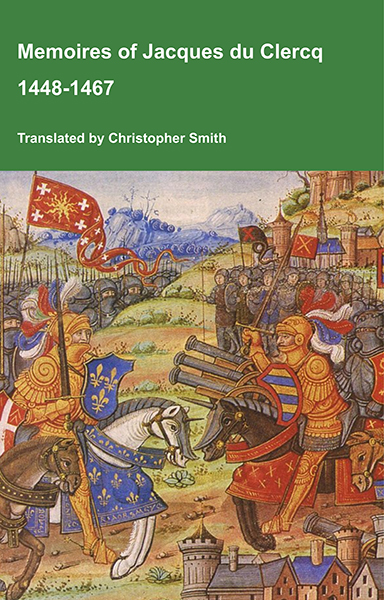
This is a translation of the 'Memoires of Jacques du Clercq', published in 1823 in two volumes, edited by Frederic, Baron de Reissenberg. In his introduction Reissenberg writes: 'Jacques du Clercq tells us that he was born in 1424, and that he was a licentiate in law and a counsellor to Philip the Good, Duke of Burgundy, in the castellany of Douai, Lille, and Orchies. It appears that he established his residence at Arras. In 1446, he married the daughter of Baldwin de la Lacherie, a gentleman who lived in Lille. We read in the fifth book of his Memoirs that his father, also named Jacques du Clercq, had married a lady of the Le Camelin family, from Compiègne. His ancestors, always attached to the counts of Flanders, had constantly served them, whether in their councils or in their armies.' The Memoires cover a period of nineteen years beginning in in 1448, ending in in 1467. It appears that the author had intended to extend the Memoirs beyond that date; no doubt illness or death prevented him from carrying out this plan. As Reissenberg writes the 'merit of this work lies in the simplicity of its narrative, in its tone of good faith, and in a certain air of frankness which naturally wins the reader’s confidence.' Du Clercq ranges from events of national and international importance, including events of the Wars of the Roses in England, to simple, everyday local events such as marriages, robberies, murders, trials and deaths, including that of his own father in Book 5; one of his last entries.
Available at Amazon in eBook and Paperback format.
On 10th October 1723 William Cowper 1st Earl Cowper [aged 58] died. His son William [aged 14] succeeded 2nd Earl Cowper, 2nd Baron Cowper of Wingham in Kent, 4th Baronet Cowper of Ratling Court in Kent.
On 5th February 1724 [his former wife] Mary Clavering Countess Cowper [aged 39] died.
Great x 1 Grandfather: William Cowper 1st Baronet
GrandFather: John Cowper
Father: William Cowper 2nd Baronet