

Jean de Waurin's Chronicle of England Volume 6 Books 3-6: The Wars of the Roses
Jean de Waurin was a French Chronicler, from the Artois region, who was born around 1400, and died around 1474. Waurin’s Chronicle of England, Volume 6, covering the period 1450 to 1471, from which we have selected and translated Chapters relating to the Wars of the Roses, provides a vivid, original, contemporary description of key events some of which he witnessed first-hand, some of which he was told by the key people involved with whom Waurin had a personal relationship.
Available at Amazon in eBook and Paperback format.
Paternal Family Tree: Ros
Maternal Family Tree: Emmeline Riddlesford 1223-1276
William Ros 3rd Baron Ros Helmsley and Margaret Neville were married. They were fourth cousin once removed. He a great x 5 grandson of King Henry "Curtmantle" II of England. She a great x 4 granddaughter of King Henry "Curtmantle" II of England.
Before 25th November 1316 [his father] William Ros 2nd Baron Ros Helmsley [aged 31] and [his mother] Margery Badlesmere Baroness Ros of Helmsley [aged 8] were married. She by marriage Baroness Ros Helmsley. The difference in their ages was 23 years.
On 19th May 1329 William Ros 3rd Baron Ros Helmsley was born to William Ros 2nd Baron Ros Helmsley [aged 44] and Margery Badlesmere Baroness Ros of Helmsley [aged 20].
On 7th June 1338 [his uncle] Giles Badlesmere 2nd Baron Badlesmere [aged 23] died. Baron Badlesmere abeyant between his sisters [his mother] Margery Badlesmere Baroness Ros of Helmsley [aged 29], [his aunt] Maud Badlesmere Countess of Oxford [aged 29], Elizabeth Badlesmere Countess Northampton [aged 25] and Margaret Badlesmere Baroness Tibetot [aged 23].
On 3rd February 1343 [his father] William Ros 2nd Baron Ros Helmsley [aged 58] died. He was buried at Kirkham Priory North Yorkshire [Map]. His son William [aged 13] succeeded 3rd Baron Ros Helmsley and inherited Belvoir Castle [Map]. Margaret Neville [aged 13] by marriage Baroness Ros Helmsley.
Around 1345 [his brother-in-law] John Welles 4th Baron Welles [aged 10] and [his sister] Maud Ros Baroness Welles were married. She by marriage Baroness Welles.
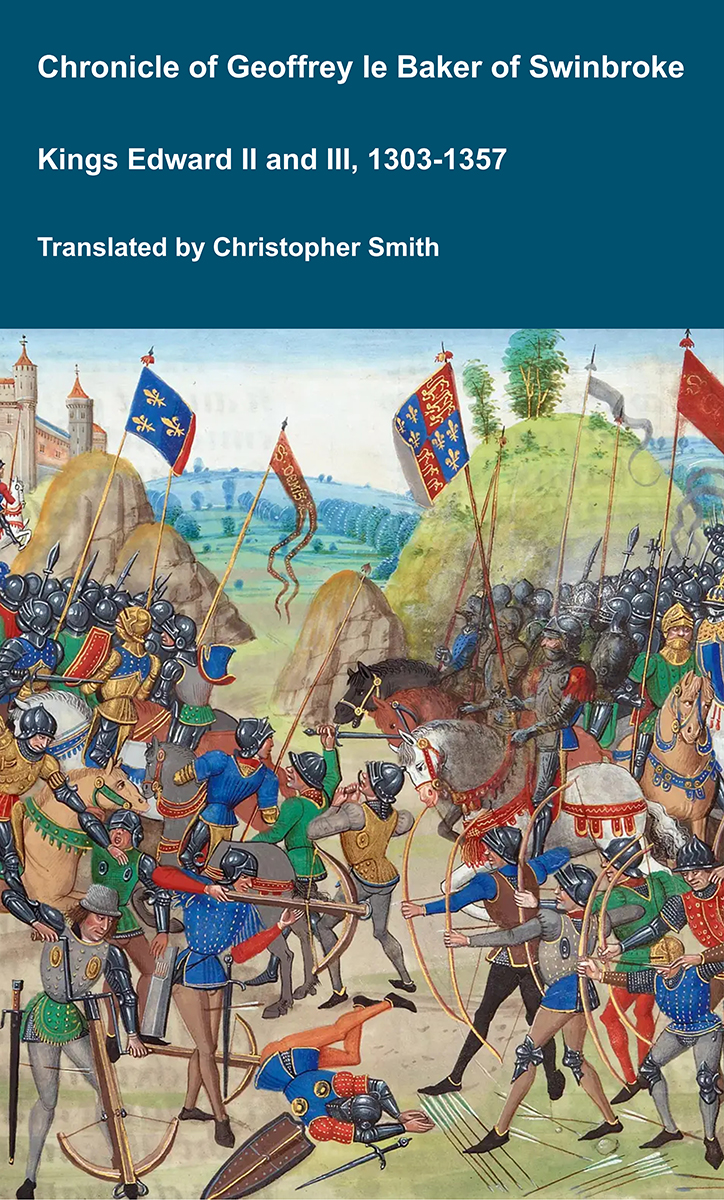 Chronicle of Geoffrey le Baker of Swinbroke. Finally, on the thirteenth day of the same month of July1 [1346], they arrived at the desired port. Upon landing, the king knighted his eldest son and created him Prince of Wales. Immediately, the prince in turn knighted2 the lords Mortimer [aged 17], Montagu [aged 18], and de Ros [aged 17], and others were likewise promoted to the order of knighthood. For the rest of that day and the whole night, the king lodged in the town of Hogue, and the next day, Tuesday, the army burned the town and proceeded inland through the region of the Cotentin Peninsula. That night, the king lodged at Marcellins, where he remained for five days, during which the entire countryside, including the town of Barfleur, was burned and laid waste along the whole coastline.
Tandem die tertio decimo eiusdem mensis Iulii, ad portum desideratum applicuerunt, ubi, nacti terram, in littore suum primogenitum fecit militem et eum principem Wallie constituebat. Statim princeps fecit milites dominos de Mortimer, de Monte acuto, et de Ros; et cum illis eciam fuerunt alii consimiliter ad ordinem promoti militarem. Per residuum diei et totam noctem rex in villa de Hogges ospitabatur, et in crastino, die Tovis, per exercitum villa combusta, deinde per patriam Constantin profectus, nocte sequenti in Marcelins rex hospitabatur, ibi per quinque dies commoratus, in quibus tota patria cum villa de Barbeflete combusta fuerat, vastata cum tota illa costa marina.
Note 1. The route of Edward's march in the Crécy campaign, across the north of France, from La Hougue to Calais, is here traced with great fullness, and there is no difficulty in identifying almost every place that is named. There is, however, a lack of dates, so that, were there no other means of checking the daily advance of the army, it would be hard, if not impossible, to make out the successive stages with perfect accuracy. Fortunately there is extant the journal of the king's kitchen, kept during the expedition, in which are recorded the names of the places where the king lodged, generally with accompanying dates. This document is quoted in 'Proofs of the early use of Gunpowder in the English Army,' by Mr. Joseph Hunter, printed in Archaeologia, 32: "The king landed at 'Hok,' or 'Hogges,' in Normandy, meaning the port of La Hogue, on Wednesday, the 12th July 1346, and the daily operations of his kitchen proceed at the same place till the Tuesday following, when they are transferred to Valognes. The day's stages of the King's march were now. Saint Come du Mount, Carenton, Pount Herbert, and Saint Lo. He then appears to have changed his purpose, and to have directed his march towards Caen, arriving there on Wednesday the 26th, the intermediate stages having been Sevance, Torteval, and Funtenay Paynel. He remained five days at Caen, and he left the place on the last day of July for Lisieux, at which place he arrived on the second of August, having passed through Treward and Leoperty. He was two days at Lisieux: on the 4th of August he was at Durenvile, on the 5th at Limburgh, the 7th at Oil de Boef, and the 8th at Pount Vadreel. The daily stages were now, Longvile, Frenose, Appone, Ferelaguillon, and Poissy, where he arrived on the 13th of August. He was then about 12 miles from Paris. He remained at Poissy till the 16th, on which day he had begun his march northward. The first day's march was to Grisy, the next to Anty, the next to Trussereux, then to Somerreux, Causeamyneux, and Asshen, where he arrived on the 21st of August. He spent the 22nd and 23rd at Asshen.
We then find him in this humble but authentic chronicle:
Thursday, August 24, 'sub foresta de Cressy.'
Friday, August 25, 'in foresta de Cressy.'
Saturday, August 26, 'adhuc sub foresta de Cressy.'
Sunday, August 27, 'in campis sub foresta de Cressy.'"
There is also a contemporary itinerary, copied in a hand of the 15th century, in the Cotton MS. Cleopatra D. 7. f. 179. From these two documents and Baker's route a perfect itinerary can be constructed.
There are extant also several letters written during the campaign, which enter more or less into details. These are the letters of Edward to sir Thomas Lucy (Coxe, The Black Prince, by Chandos Herald, Roxburghe Club, 1842, p. 351).
To the archbishop of Canterbury Lettenhove's Froissart 18.285.
To the archbishop of York Chronicle of Lanercost 342.
Bartholomew Burghersh to the archbishop of York; Adam Murimuth Continuation.
Bartholomew Burghersh to the archbishop of York; Adam Murimuth Continuation.
Letter of Thomas Bradwardine, chancellor of St. Paul's; Adam Murimuth Continuation.
Letter of Michael Northburgh; Murimuth 212, 367, Deeds of King Edward III by Robert of Avesbury.
Letter of Michael Northburgh; Deeds of King Edward III by Robert of Avesbury.
Letter of Richard Wynkeley, the king's confessor; Murimuth 215; Deeds of King Edward III by Robert of Avesbury.
I here give the stages as they appear in the Kitchen Journal (see also Brit. Mus., Add. MS. 25461, f. II); and also print the itinerary from the Cotton MS:
Kitchen Journal
12 July (Wednesday). Hok.
18 July (Tuesday). Valognes.
19 July (Wednesday). Saint Comb du Mont.
20 July (Thursday). Carentan.
21 July (Friday). Pount [Hébert].
22 July (Saturday). Saint Lo.
23 July (Sunday). Sevaunce.
24 July (Monday). Torteval.
25 July (7uesday). Funtenay Paynel.
26 July (Wednesday). Caen.
31 July (Monday). Treward.
1 August (Zuesday). Leoperty.
2 August (Wednesday). Lisieux.
4 August (Friday). Durenvile.
5 August (Saturday). Limburgh.
7 August (Monday). Oil de Boef.
8 August (Tuesday). Pount Vadreel.
9 August (Wednesday). Longville.
10 August (Thursday). Frenose.
11 August (Friday). Appone.
12 August (Saturday). Ferelaguillon.
13 August (Sunday). Poissy.
16 August (Wednesday). Grisy.
17 August (Thursday). Auty.
18 August (Friday). Trussereux.
19 August (Saturday). Somerreux.
20 August (Sunday). Canseamyneux.
21 August (Monday). Assheu.
24 August (Thursday). Sub foresta de Cressy.
25 August (Friday). In foresta de Cressy.
26 August (Saturday). Adhuc sub foresta de Cressy.
27 August (Sunday). Incampissub foresta de Cressy.
28 August (Monday). Valoles.
29 August (Twuesday). Mauntenay.
30 August (Wednesday). Saint Joce in Pountif.
31 August (Thursday). Chastelnoef.
2 September (Saturday). Vintevill.
3 September (Sunday). Vintevill.
4 September (Monday). Coram Calais.
Cotton MS. Cleopatra D. 7, f. 179
On comparing these two itineraries with that given in the text, it will be seen that there are certain discrepancies. In some instances these are no doubt due to mere blundering; but others may be accounted for as variations of three different statements written independently by persons marching with different battles of the army. Putting the three itineraries together, we can lay down the following route:
12 July, Wednesday. Landing at Saint-Vaast-de-la-Hougue. Baker has inadvertently dated this event the 13th July; but, as he speaks of the next day as Thursday, he is only wrong in the day of the month.
13 July, Thursday. Headquarters at Morsalines, only two or three miles from St. Vaast. The Kitchen Journal does not notice the removal. Halt of five days. The country wasted, and Barfleur burnt [on Friday, 14th July].
18 July, Tuesday. To Valognes, 9 miles S.W.
19 July, Wednesday. To Saint-Côme-du-Mont, just north of the river Douve, 14 miles S. by E. Cott. MS. fixes the halt at 'Caueny,' no doubt Coigny, 5 miles W. of Saint-Côme-du-Mont. Probably one of the battles lay there.
20 July, Thursday. Across the Douve to Carentan, only two or three miles.
21 July, Friday. The K. J. and Cott. MS. name Pont-Hébert, a town lying 11 miles S.E. of Carentan and about 4 miles N.W. of Saint-Lo, as the halting place for this day. Baker records the march to 'Serins,' Saint-Lo, and Torigni, and their destruction, and then gives Cormolain as the king's headquarters for the night. He has clearly compressed the events of two days into one. 'Serins' is probably a clerical error for Sevins, Sept-Vents or Sevans, the place which K. J. calls 'Sevance.' If 'Serins' were the correct reading, it might mean Ceérisy-la-Forêt or Cérisy-l'Abbaye, which however lies too much off the route.
22 July, Saturday. To Saint-Lo (K. J. and Cott. MS.)
23 July, Sunday. To Sept-Vents (K. J.) about 12 miles S.E. of Saint-Lo. Cormolain, mentioned by Baker and Cott MS., is not far from Sept-Vents, and may be reckoned as the halting-place of some part of the army.
24 July, Monday. To Torteval (K. J. and Cott. MS.), only about 5 miles E. of Cormolain. Baker makes this day's halt at 'Gerin,' a monastic cell, which may be identical with Cairon or le Quéron, a little S. of Fontenay-le-Pesnel.
25 July, Tuesday. To Fontenay-le-Pesnel (K. J.), 7 or 8 miles E. According to Cott. MS., only to Mauperthuis, just past Torteval.
26 July, Wednesday. To Caen; taken by assault. Halt of five days. Baker dates the capture of Caen on the day before, and makes the halt to last six days.
31 July, Monday. To 'Troward ' (Troarn), 8 miles E.; and Argences, 4 miles S. of Troarn.
I August, Tuesday. To Rumesnil, 9 miles E. K.J. fixes the stage at Leaupartie, which is quite close to Rumesnil; Cott MS. on the other hand, at Saint-Pierredu-Jonque on the left of the Dives, only about 5 miles E. by S. of Troarn.
2, 3 August, Wednesday and Thursday. To Lisieux, 9 miles E. by S. Halt of two days. Baker makes it three days.
4 August, Friday. To 'Lestintnoland' (Le Teil-Nollent), 14 miles E., or to Duranville (K. J.) adjoining Le Teil-Nollent.
5 August, Saturday. Through Brionne, 9 miles, to Le Neubourg, 9 miles further E. The latter place appears as 'Limburgh' in K.J. Cott. MS. makes a halt on both the 4th and 5th at Le Teil-Nollent.
6 August, Sunday. Apparently a halt.
7 August, Monday. To Elbeuf on the Seine, 11 miles N.E. 'Celebeef,' in Baker; 'Oil de Boef," in K. J. Cott. MS. makes the march to Elbeuf fall on Sunday, and continues a day in advance down to the 11th.
8 August, Tuesday. Passing Pont-de-l'Arche, to Léry, said to be on the Seine, but really on the Eure, 9 miles E. K. J. makes this stage halt at 'Pount Vadreel,' no doubt St-Cyr-de-Vaudreuil, a little S. of Léry.
9 August, Wednesday. Through Gaillon to Longueville, near Vernon. Longueville does not appear in the maps. Perhaps it was a suburb of Vernon; 17 miles S.E.
10 August, Thursday? Capture of the castle of Roche-blanche (not in the maps). This seems to be the 'chastel de la Roche,' of Cott. MS., there stated to have been captured on the 7th. Advance to Freneuse, 9 miles up the Seine, incorrectly called 'Frevile' by Baker.
11 August, Friday. Through Mantes, to Epone, 12 miles S.E.
12 August, Saturday. To Fresnes, 5 or 6 miles E. K. J. has 'Ferelaguillon,' which is no doubt a corruption of Fresnes-Ecquevilly.
13 August, Sunday. To Poissy, 6 miles E. According to Baker, the march to Fresnes was on Friday, and the arrival at Poissy on Saturday. Skirmish with a detachment from Amiens.
14, 15 August, Monday and Tuesday. Halt.
16 August, Wednesday. To Grisy, 14 miles N. Baker calls this place 'Gersile.'
17 August, Thursday. To Auteuil, 15 miles N.
18 August, Friday. To Troissereux, 10 miles N.W.
19 August, Saturday. To Sommereux, 15 miles N. In these last marches Baker still continues a day in advance, making the stage of Auteuil on Wednesday, and from thence to Sommereux on Thursday and Friday.
20 August, Sunday. Poissy taken. Then to Camps-en-Amienois (K. J. and Cott. MS.), 8 miles N. Baker refers the capture of Poissy alone to Sunday.
21, 22 August, Monday and Tuesday. To Airaines, 6 miles N. of Camps-enAmienois. Halt. K. J. has 'Assheu ' (Acheux) under date of the 21st; the king's kitchen must have been sent on far in advance.
23 August, Wednesday. To Acheux, 13 miles N.W.
24 August, Thursday. Passage of the Somme. Skirmish at Noyelle-sur-Mer, 8 miles N. Le Crotoy taken. Camp 'sub foresta de Cressy ' (K. J.).
25 August, Friday. Pass through the forest (Cott. MS.). 'In foresta' (K. J.). Attempt by the French to cross the river.
26 August, Saturday. In the open field before Crécy (Cott. MS.), about 8 miles N.E. of Noyelle. 'Adhuc sub foresta' (K. J.). The battle fought.
27 August, Sunday. On the field of battle. 'In campis sub foresta' (K. J.).
28 August, Monday. To 'Abbeville' (Cott. MS.) or 'Valoles' (K. J.), evidently Valloire-Abbaye, on the road to Maintenay.
29 August, Tuesday. To Maintenay, 8 or 9 miles N. of Crécy.
30 August, Wednesday. To Saint-Josse, 10. miles N.W.
31 August, 1 September, Thursday and Friday. To Neufchatel, 10 miles N. Halt. 2, 3 September (Saturday and Sunday). To Wissant (Cott. MS.), 18 miles N. K. J. says 'Vintevill,' i.e. Wimille, 10 miles N. Halt,
4 September (Monday). To Calais.
Note 2. Of the three here mentioned, Roger Mortimer was born about the year 1327, was restored to the earldom of March in April 1354, and died in 1360; William de Montacute, the young earl of Salisbury, was born in 1328, and died in 1397; and William de Roos was summoned to parliament in 1350, and died in Prussia in 1351 - see Chronicle of Henry Knighton.
On 3rd December 1351 William Ros 3rd Baron Ros Helmsley [aged 22] died. His brother Thomas [aged 16] succeeded 4th Baron Ros Helmsley and inherited Belvoir Castle [Map]. Beatrice Stafford Countess Desmond [aged 10] by marriage Baroness Ros Helmsley.
Chronicle of Henry Knighton. And upon this, Henry, Duke of Lancaster, traveled to Prussia with many of the higher nobles of the realm in his retinue. And when he arrived in Upper Germany, he was arrested along with many of his companions, and he paid a ransom for himself and his men of 3,000 gold écus. On this journey, Lord le Roos [aged 22] died [on 3rd December 1351].
Et super hoc Henricus dux Lancastriæ transivit versus le! Sprusiam cum multis viris in sua comitiva de majoribus regni. Et cum pervenisset in altam Almaniam arestatus est cum aliis multis de sociis suis, et fecit redemptionem pro se et suis de iij mille scutis auri In hoc itinere mortuus est dominus le Ros.
Kings Wessex: Great x 9 Grand Son of King Edmund "Ironside" I of England
Kings Gwynedd: Great x 10 Grand Son of Maredudd ab Owain King Deheubarth King Powys King Gwynedd
Kings Seisyllwg: Great x 12 Grand Son of Hywel "Dda aka Good" King Seisyllwg King Deheubarth
Kings Powys: Great x 10 Grand Son of Maredudd ab Owain King Deheubarth King Powys King Gwynedd
Kings England: Great x 5 Grand Son of King Henry "Curtmantle" II of England
Kings Scotland: Great x 4 Grand Son of King William I of Scotland
Kings France: Great x 10 Grand Son of Hugh I King of the Franks
Kings Duke Aquitaine: Great x 14 Grand Son of Ranulf I Duke Aquitaine
Great x 3 Grandfather: Robert Ros 
Great x 2 Grandfather: William Ros Grand Son of King William I of Scotland
Great x 4 Grandfather: King William I of Scotland  Grand Son of King David I of Scotland
Great x 3 Grandmother: Isabella Mac William Dunkeld Daughter of King William I of Scotland
Great x 4 Grandmother: Isabel d'Avenel Abenel
Great x 1 Grandfather: Robert Ros Great Grand Son of King William I of Scotland
Great x 4 Grandfather: Herbert Fitzherbert 
Great x 3 Grandfather: Piers Fitzherbert
Great x 2 Grandmother: Lucy Fitzpiers
GrandFather: William Ros 1st Baron Ros Helmsley 2 x Great Grand Son of King William I of Scotland
Great x 4 Grandfather: William Meschines Brito de Albini 8 x Great Grand Son of King Edward "Elder" of the Anglo Saxons
Great x 3 Grandfather: William de Albini 9 x Great Grand Son of King Edward "Elder" of the Anglo Saxons
Great x 4 Grandmother: Maud de Clare  8 x Great Grand Daughter of King Edward "Elder" of the Anglo Saxons
Great x 2 Grandfather: William de Albini 10 x Great Grand Son of King Edward "Elder" of the Anglo Saxons
Great x 4 Grandfather: William Trusbut
Great x 3 Grandmother: Agatha Trusbut
Great x 1 Grandmother: Isabel de Albini 11 x Great Grand Daughter of King Edward "Elder" of the Anglo Saxons
Father: William Ros 2nd Baron Ros Helmsley 3 x Great Grand Son of King William I of Scotland
Great x 2 Grandfather: Oliver Vaux 
Great x 1 Grandfather: John Vaux
GrandMother: Maud Vaux Baroness Ros
William Ros 3rd Baron Ros Helmsley 4 x Great Grand Son of King William I of Scotland
Great x 1 Grandfather: Gunselin Badlesmere 
GrandFather: Bartholomew Badlesmere 1st Baron Badlesmere
Great x 1 Grandmother: Joan Fitzbernard
Mother: Margery Badlesmere Baroness Ros of Helmsley 4 x Great Grand Daughter of King Henry "Curtmantle" II of England
Great x 4 Grandfather: Richard Clare 3rd Earl Hertford
Great x 3 Grandfather: Gilbert Clare 5th Earl Gloucester 4th Earl Hertford 2 x Great Grand Son of King Henry I "Beauclerc" England
Great x 4 Grandmother: Amice Fitzrobert Countess Hertford Great Grand Daughter of King Henry I "Beauclerc" England
Great x 2 Grandfather: Richard de Clare 6th Earl Gloucester 5th Earl Hertford 3 x Great Grand Son of King Henry I "Beauclerc" England
Great x 4 Grandfather: William Marshal 1st Earl Pembroke 
Great x 3 Grandmother: Isabel Marshal Countess Cornwall, Gloucester and Hertford 6 x Great Grand Daughter of Hugh I King of the Franks
Great x 4 Grandmother: Isabel Clare Countess Pembroke 5 x Great Grand Daughter of Hugh I King of the Franks
Great x 1 Grandfather: Thomas de Clare 4 x Great Grand Son of King Henry I "Beauclerc" England
Great x 4 Grandfather: Roger Lacy 6th Baron Pontefract 7th Baron Halton  9 x Great Grand Son of King Edward "Elder" of the Anglo Saxons
Great x 3 Grandfather: John Lacy Earl Lincoln 10 x Great Grand Son of King Edward "Elder" of the Anglo Saxons
Great x 4 Grandmother: Maud Clere Baroness Lacy Baroness Warkworth 
Great x 2 Grandmother: Maud Lacy Countess Gloucester and Hertford 4 x Great Grand Daughter of King Henry I "Beauclerc" England
Great x 4 Grandfather: Robert Quincy Earl Lincoln 6 x Great Grand Son of Hugh I King of the Franks
Great x 3 Grandmother: Margaret Quincy 3rd Countess Lincoln and Pembroke 3 x Great Grand Daughter of King Henry I "Beauclerc" England
Great x 4 Grandmother: Hawise Gernon 2nd Countess Lincoln 2 x Great Grand Daughter of King Henry I "Beauclerc" England
GrandMother: Margaret Clare Baroness Badlesmere 3 x Great Grand Daughter of King Henry "Curtmantle" II of England
Great x 4 Grandfather: Gerald Fitzgerald 1st Lord Offaly  4 x Great Grand Son of Maredudd ab Owain King Deheubarth King Powys King Gwynedd
Great x 3 Grandfather: Maurice Fitzgerald 2nd Lord Offaly 5 x Great Grand Son of Maredudd ab Owain King Deheubarth King Powys King Gwynedd
Great x 4 Grandmother: Eve Bermingham
Great x 2 Grandfather: Maurice Fitzgerald 4th Lord Offaly 6 x Great Grand Son of Maredudd ab Owain King Deheubarth King Powys King Gwynedd
Great x 3 Grandmother: Juliana Granville Baroness Offaly 
Great x 1 Grandmother: Juliana Fitzgerald 2 x Great Grand Daughter of King Henry "Curtmantle" II of England
Great x 4 Grandfather: William Longespée Earl Salisbury  Son of King Henry "Curtmantle" II of England
Great x 3 Grandfather: Stephen Longespée Grand Son of King Henry "Curtmantle" II of England
Great x 4 Grandmother: Ela of Salisbury 3rd Countess of Salisbury 6 x Great Grand Daughter of Hugh I King of the Franks
Great x 2 Grandmother: Emmeline Longespée Baroness Offaly Great Grand Daughter of King Henry "Curtmantle" II of England
Great x 4 Grandfather: Walter Riddlesford
Great x 3 Grandmother: Emmeline Riddlesford