

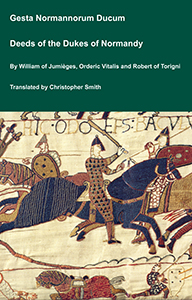
The Deeds of the Dukes of Normandy
The Gesta Normannorum Ducum [The Deeds of the Dukes of Normandy] is a landmark medieval chronicle tracing the rise and fall of the Norman dynasty from its early roots through the pivotal events surrounding the Norman Conquest of England. Originally penned in Latin by the monk William of Jumièges shortly before 1060 and later expanded at the behest of William the Conqueror, the work chronicles the deeds, politics, battles, and leadership of the Norman dukes, especially William’s own claim to the English throne. The narrative combines earlier historical sources with firsthand information and oral testimony to present an authoritative account of Normandy’s transformation from a Viking settlement into one of medieval Europe’s most powerful realms. William’s history emphasizes the legitimacy, military prowess, and governance of the Norman line, framing their expansion, including the conquest of England, as both divinely sanctioned and noble in purpose. Later chroniclers such as Orderic Vitalis and Robert of Torigni continued the history, extending the coverage into the 12th century, providing broader context on ducal rule and its impact. Today this classic work remains a foundational source for understanding Norman identity, medieval statesmanship, and the historical forces that reshaped England and Western Europe between 800AD and 1100AD.
Available at Amazon in eBook and Paperback format.
Oldenburg to Russell is in Armorials.
 Oglander Arms. Azure, a stork between three cross-croslets fitchée or. Source
 Oldenburg Arms. Barry or and gules. Source.
 Oldham Arms. Sable, a chevron or between three owls argent on a chief of the second three roses gules. Possibly an example of canting arms where owl represents owl-dam. Source.
 Onslow Arms. Argent, a fess gules, between six Cornish Choughs proper. Source.
 Paget Arms. Sable, on a cross engrailed between four eagles displayed argent, five lions passant guardant of the field. Source.
 Pakington Arms. Quarterley 1&4 Per chevron sable and argent, in chief three mullets or, in base as many garbs gules 2 a variation of the Washbourne Arms 3
  Harding Arms.
 Palmer Carlton Arms. Sable a chevron or three crecents argent. Source.
The History of William Marshal was commissioned by his son shortly after William’s death in 1219 to celebrate the Marshal’s remarkable life; it is an authentic, contemporary voice. The manuscript was discovered in 1861 by French historian Paul Meyer. Meyer published the manuscript in its original Anglo-French in 1891 in two books. This book is a line by line translation of the first of Meyer’s books; lines 1-10152. Book 1 of the History begins in 1139 and ends in 1194. It describes the events of the Anarchy, the role of William’s father John, John’s marriages, William’s childhood, his role as a hostage at the siege of Newbury, his injury and imprisonment in Poitou where he met Eleanor of Aquitaine and his life as a knight errant. It continues with the accusation against him of an improper relationship with Margaret, wife of Henry the Young King, his exile, and return, the death of Henry the Young King, the rebellion of Richard, the future King Richard I, war with France, the death of King Henry II, and the capture of King Richard, and the rebellion of John, the future King John. It ends with the release of King Richard and the death of John Marshal.
Available at Amazon in eBook and Paperback format.
 Parker Arms. Sable, a stag's head cabossed between two flaunches argent. Source.
 Paston Arms. Argent six fleurs de lis three two and one azure a chief indented or. Source.
On 27th June 1598 Bridget Paston died. Monument in Church of St Mary the Virgin, Tittleshall [Map]. Arched niche with kneeling effigy at prie-dieu which carries the inscription. Flanking pilasters with partly painted carved trophies surrounded by ribbon-work. Carved achievement in strapwork surround above and eight kneeling weepers below.
Armorials top left  Coke Arms and top right Paston Arms.
Above the monument an amorial Quarterly: Coke Arms, Crispin, Folkard and Pawe impaling Quarterly of Seventeen with 1 Paston Arms, 2 Peche 3 Leach 4 Somerton 5 Peyver 6 Walcot 7 Berry 8 Craven 9 Kerdeston 10 Wachesam or Sotherton 11 Hethersett 12 Charles 13 Tatshall 14 Hengrave 15 Gerbridge 16 Mautby 17 Basinges?.
Bridget Paston: she was born to John Paston. She a great x 4 granddaughter of King Edward III of England. On 13th August 1582 Edward Coke and she were married.


On 3rd September 1634 Edward Coke [aged 82] died. Monument in Church of St Mary the Virgin, Tittleshall [Map]. Simple sarcophagus on pedestal with lying effigy. Pair of flanking Tuscan columns supporting a full entablature with putti on frieze and broken segmental pediment. Carved and painted achievement in and above tympanum flanked by four reclining figures of the Virtues on pediment extrados.
Above. Quarterly of eight: Coke Arms, Crispin, Folkard, Sparham, Nerford, Yarmouth,  Knightley Arms and Pawe. The crest is broken. Farrer says it was: On a chapeau Azure, turned up Ermine, an ostrich Argent, holding in its mouth a horseshoe Or. The motto reads Prudens qui Patiens.
The effigy was carved by John Hargrave, the rest of the memorial was made by Nicholas Stone [aged 47].
Below the effigy are three shields. Left Coke Arms implaling Paston Arms. His first wife Bridget Paston. Middle Coke Arms. Right Coke Arms impaling  Cecil Arms; his second wife Elizabeth Cecil Countess Berkshire [aged 38].


In 1636 Lady Katherine Bertie died in childbirth. Memorial in the Church of St Michael, Oxnead [Map]. Bust carved by Nicholas Stone [aged 49]. Paston Arms and  Bertie Arms.
Lady Katherine Bertie: she was born to Robert Bertie 1st Earl Lindsey and Elizabeth Montagu Countess Lindsey. In 1631 William Paston 1st Baronet and she were married. She the daughter of Robert Bertie 1st Earl Lindsey and Elizabeth Montagu Countess Lindsey.


 Paulet Arms. Sable three swords pilewise points in base proper pomels and hilts or. Source.
On 22nd May 1653 unamed child was born to Charles Paulet 1st Duke Bolton [aged 23] and Christian Freschville [aged 19]. She died in childbirth. The child died seven days later on 29th May 1653. Both were buried at the St John the Baptist's Church, Staveley [Map]. Monument erected by her husband Charles Paulet 1st Duke Bolton the future Duke Bolton. Reclining figure with Chrisom Child.
Armorials...
Top Middle Paulet Arms differenced with a label argent three points impaled  Freschville Arms.
Top Left: His Arms, in sixths 1 Paulet Arms 2 Possibly  Seymour Arms although wings should be Or 3 Unknown Arms 4 Unknown Arms 5 Unknown Arms 6
  St John Arms with a label argent three points to reflect his status as son of the current owner of the Arms.
Top Right: Her Arms, in sixths 1 Freschville Arms 2 Unknown Arms 3 Unknown Arms 4 Unknown Arms 5 Unknown Arms 6  Harrington Arms.
Christian Freschville: On 13th December 1633 she was born to John Freschville 1st Baron Frescheville and Sarah Harrington. On 28th February 1652 Charles Paulet 1st Duke Bolton and she were married. He the son of John Paulet 5th Marquess Winchester and Jane Savage Marchioness Winchester.


 Perceval Arms. Argent, a chief indented gules three crosses pattee of the field. Source.
 Percy Arms. Or, a lion rampant azure. Source.
 Peyton Arms. Sable, a cross engrailed or a mullet in the first quarter argent.
Jean de Waurin's Chronicle of England Volume 6 Books 3-6: The Wars of the Roses
Jean de Waurin was a French Chronicler, from the Artois region, who was born around 1400, and died around 1474. Waurin’s Chronicle of England, Volume 6, covering the period 1450 to 1471, from which we have selected and translated Chapters relating to the Wars of the Roses, provides a vivid, original, contemporary description of key events some of which he witnessed first-hand, some of which he was told by the key people involved with whom Waurin had a personal relationship.
Available at Amazon in eBook and Paperback format.
On 19th March 1616 Henry Pierrepont [aged 70] died. Church of St Edmund, Holme Pierrepoint [Map]. Designed by John Smythson. Probably carved by Hugh Hall who also carved the monument to Thomas Smith originally at Wybynbury but since moved to Nantwich [Map]. Elizabethan Period. Armorials:
Top left  Cavendish Arms - he was married to Frances Cavendish [aged 67] daughter of William Cavendish and Bess of Hardwick.
Top right  Pierrepoint Arms.
Centre Bottom: Quartered 1&4 Pierrepoint Arms 2&3 Unknown Arms impaled Quartered 1&4 Cavendish Arms 2&3 Unknown Arms.
Frances Cavendish: On 18th June 1548 she was born to William Cavendish and Bess of Hardwick. Before 1584 Henry Pierrepont and she were married. She the daughter of William Cavendish and Bess of Hardwick Countess Shrewsbury and Waterford. They were sixth cousins. In January 1632 Frances Cavendish died.


 Pollard Arms. Argent, a chevron sable between three escallops gules.
 Ponsonby Arms. Gules, a chevron between three combs argent. Source.
 Ponthieu Arms. Azure, three bends or a bordure gules.

Effigy of Eleanor, Queen of Edward the First. ELEANOR, Queen of Edward the First, was the daughter of Ferdinand the Third, King of Castile, and only child of his second wifea, Joan, daughter and heiress of John Earl of Ponthieu. She was married to him at Bures, in Spain, in 1254, and accompanied him to the Holy Land, where she is said to have preserved his life by sucking the poison out of a wound inflicted on him by the hand of an assassin. She bore him four sons and nine daughters, and died in attending him on an expedition towards Scotland, 27th November, 1290, at the house of Richard Weston, at Herdby, or Harby [Map], in the parish of North Clifton on the Trent, five miles from Lincoln. Her bowels were burieda in Lincoln Cathedral [Map], and her body was conveyed for interment to the Abbey Church at Westminster. At every stage where it rested the King ordered a Cross to be placed. Fifteen are enumerated as having been erected in consequence. One at Herdby, whence the procession set out; and in the chapel of which place Edward also founded a chantry for her soul. The others at Lincoln, Newark [Map], Grantham [Map], Leicester [Map], Stamford [Map], Geddington [Map], Northampton, Stony Stratford [Map], Woburn, Dunstable [Map], St. Albans, Waltham, Cheapside (London), and at the village of Charing [Map], near the Minster where she was to be entombed. Herdby, Leicester, Woburn, and Cheap, are omitted by some authorities. These Crosses were adorned with statues of the Queen. Those at Geddington, Northampton, and Waltham are extant at this day. In gothic niches in the upper part have been female figures, very similar in style to that on her tomb; on the lower, shields charged with arms of England,  Castile and León Arms, and Ponthieu Arms. Edward caused a monument to be erected to her memory near that of his father in the Confessor's Chapel, in Westminster Abbey, on which is placed her recumbent image of copper; and round the verge of the tomb the following inscription, in uncial letters:
ICY GYST ALIANOR IADIS REYNE DE ANGLETERRE, FEMME AL RE EDEWERD FtZ LE RE. OVNTIF DEL ALME DE LI DEV PVR SA PITE EYT MERCI. AMEN.
Sandford informs us that on a tablet of wood, hanging near her monument by an iron chain, were the following verses in Latin:
Nobilis Hispani jacet hie soror inclita regis, [A Spanish noblewoman lies here, the sister of a famous king]
Eximii consors Aleanora thori, [A great companion of Aleanora?]
Edwardi primi Wallorum principis uxor, [The wife of Edward the First, Prince of Wales]
Cui pater Henricus tertius Anglus erat; [His father, Henry the Third, was an Englishman]
Hanc illi uxorem gnato petit; online princeps [He asks her to marry him;? leader]
Legati munus suscipit ipse bono: [He himself undertakes the office of ambassador in good faith]Alphonso fratri placuit felix Hymeneus;
Germanam Edwardo nec sine dote dedit, [Not given to Edward without a dowry]
Dos preciara fuit nec tali indigna marito, [The gift was precious and not unworthy of such a husband]
Pontivo princeps munere dives erat; [? was rich in the role of prince]
Feminaconsilio prudens, pia, proie beata, [A prudent, pious, blessed woman]
Auxit amicitiis, auxit honore virum: [Who increased friendships, increasing the honor of his husband]
Disce niori. [Learn more]
Note a. In a tomb bearing her effigy of brass gilt, similar to that in Westminster Abbey, but destroyed in the Civil wars. On it was the following inscription:
HIC * SVNT * SEPVLTA * VICERA * ALIANORE * QVONDAM * REGINE * VXORIS * REGIS * EDVARDI * FILII * REGIS * HENRICI * CVIVS * ANIME * PROPICTETVR * DEVS * AMEN * PATER * NOSTER *
[Here in this sepulchre are buried the viscera of Queen Eleanor wife of King Edward I son of King Henry whose soul we give to God Amen Our Father]
 Portman Arms. Or, a fleur-de-lis azure. Source.
 Portugal 1248 Arms.
  Portugal Arms a bordure gules charged with fourteen golden triple-towered castles. Source.
 Portugal 1385 Arms. Argent, in Cross azure each charged with five plates in saltire charged with ten golden triple-towered castles and four fleur de lys in cross vert, Source.
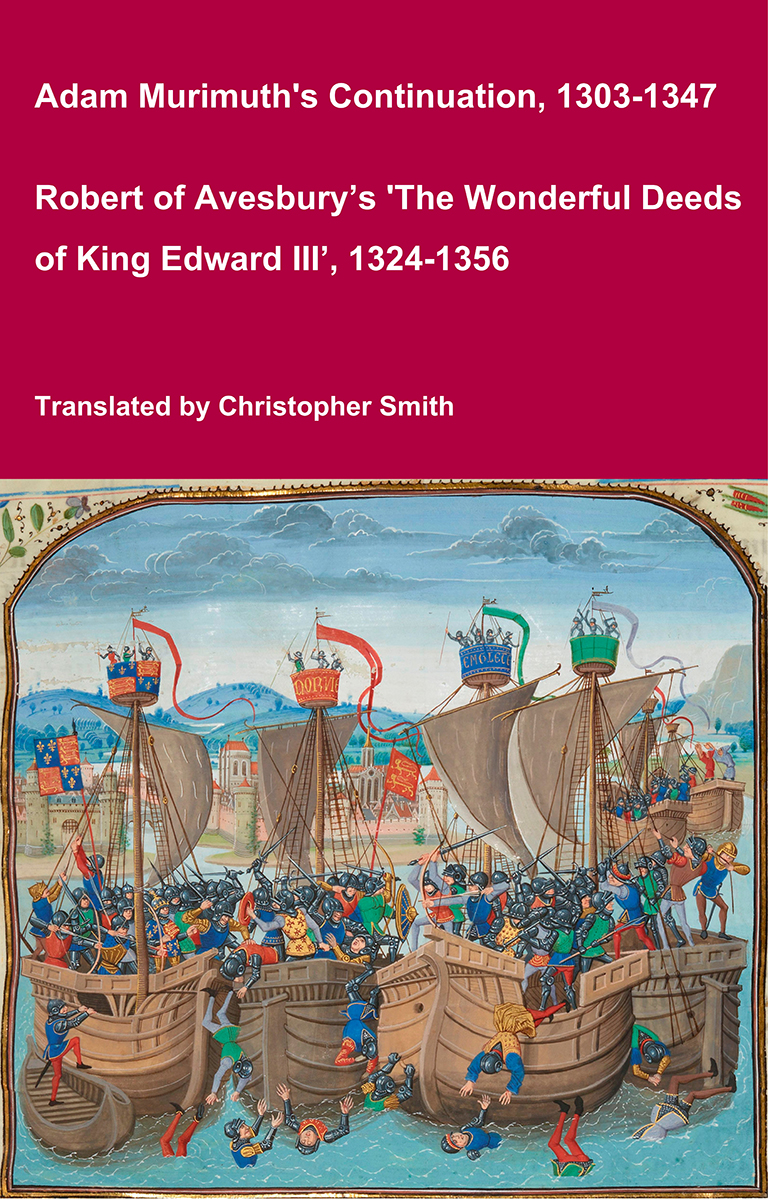
Adam Murimuth's Continuation and Robert of Avesbury’s 'The Wonderful Deeds of King Edward III'
This volume brings together two of the most important contemporary chronicles for the reign of Edward III and the opening phases of the Hundred Years’ War. Written in Latin by English clerical observers, these texts provide a vivid and authoritative window into the political, diplomatic, and military history of fourteenth-century England and its continental ambitions. Adam Murimuth Continuatio's Chronicarum continues an earlier chronicle into the mid-fourteenth century, offering concise but valuable notices on royal policy, foreign relations, and ecclesiastical affairs. Its annalistic structure makes it especially useful for establishing chronology and tracing the development of events year by year. Complementing it, Robert of Avesbury’s De gestis mirabilibus regis Edwardi tertii is a rich documentary chronicle preserving letters, treaties, and official records alongside narrative passages. It is an indispensable source for understanding Edward III’s claim to the French crown, the conduct of war, and the mechanisms of medieval diplomacy. Together, these works offer scholars, students, and enthusiasts a reliable and unembellished account of a transformative period in English and European history. Essential for anyone interested in medieval chronicles, the Hundred Years’ War, or the reign of Edward III.
Available at Amazon in eBook and Paperback format.
 Powys Arms. Or, a lion gules armed and langued azure. Source.
After 17th September 1563. Alabaster Monument to Henry Manners 2nd Earl of Rutland [deceased] and Margaret Neville Countess Rutland at St Mary the Virgin Church, Bottesford, Leicestershire [Map].
Monument an unusual Table Tomb with their effigies beneath surmounted by effigies of their children. The table may once have been raised in the same way as the one at St Lawrence's Church, Snarford [Map] to Thomas St Paul which may be by the same carver.


His arms showing quarterly: 1&4:  Manners Augmented Arms. 2nd: Top Row:
  Ros Arms,
  Roet Arms, Trusbutt [or Belvoir], Bottom Row: Todeni [Albini ancient],
  Daubeney Arms,
  Badlesmere Arms. 3rd Quarterly: 1
  Thomas Holland 2nd Earl Kent 1350 1397 Arms, 2
  Tiptoft Arms, 3
  Vaux Arms 4. Powys Arms aka Charlton.

Her arms. Quartered 1&4  Neville Arms, 2 Thomas Holland 2nd Earl Kent 1350 1397 Arms, 4 Neville Ancient Arms.

Peacock in Pride ie with its feathers displayed.


Detail of their children.


Detail of the corner of the pediment on which the arms are displayed decorated with fruit and detail of one of the legs of the table.


Detail of his armour, in his right hand a prayer-book, his left hand clutching his sword.

Detail of the Unicorn on which his feet rest and Lion on which her feet rest.

The Manners Peacock Crest.
 Become a Member via our Buy Me a Coffee page to read more.
After 1595. Elizabethan Period monument to John Manners 4th Earl of Rutland and Elizabeth Charlton Countess Rutland [aged 42] in the Chancel of St Mary the Virgin Church, Bottesford, Leicestershire [Map] sculpted by Gerard Johnson The Elder [aged 45].
Armorial above the monument showing top row: Manners Augmented Arms, Ros Arms, Roet Arms, Trusbutt [or Belvoir],
2nd Row:  Beauchamp Arms,
  Beaumont Arms,
  Berkeley Arms,
  Lisle Arms
3rd Row: Unknown, Thomas Holland 2nd Earl Kent 1350 1397 Arms, Tiptoft Arms, Powys Arms aka Charlton
4th Row: Badlesmere Arms, Vaux Arms, Todeni [Albini ancient] Arms, Daubeney Arms.


 Poynings Arms. Barry of six or and vert a bend gules. Source.
 Poyntz Arms. Barry of eight or and gules.
 Preston Arms. Or, a chief sable three crescents or.
NO IMAGE. Argent, a chevron sable in chief a label of three points gules. Source.
 Earl Roseberry Arms. Quarterly, 1&4 vert, three primroses within a double tressure flory counter-flory or (for Primrose); 2&3 argent, a lion rampant double queued sable (for Cressy). Source.
 Provence Arms. Paly or and gules. Source.
 Pulteney Arms. Argent, a fess dancetté gules in chief three leopard's faces sable. Source.
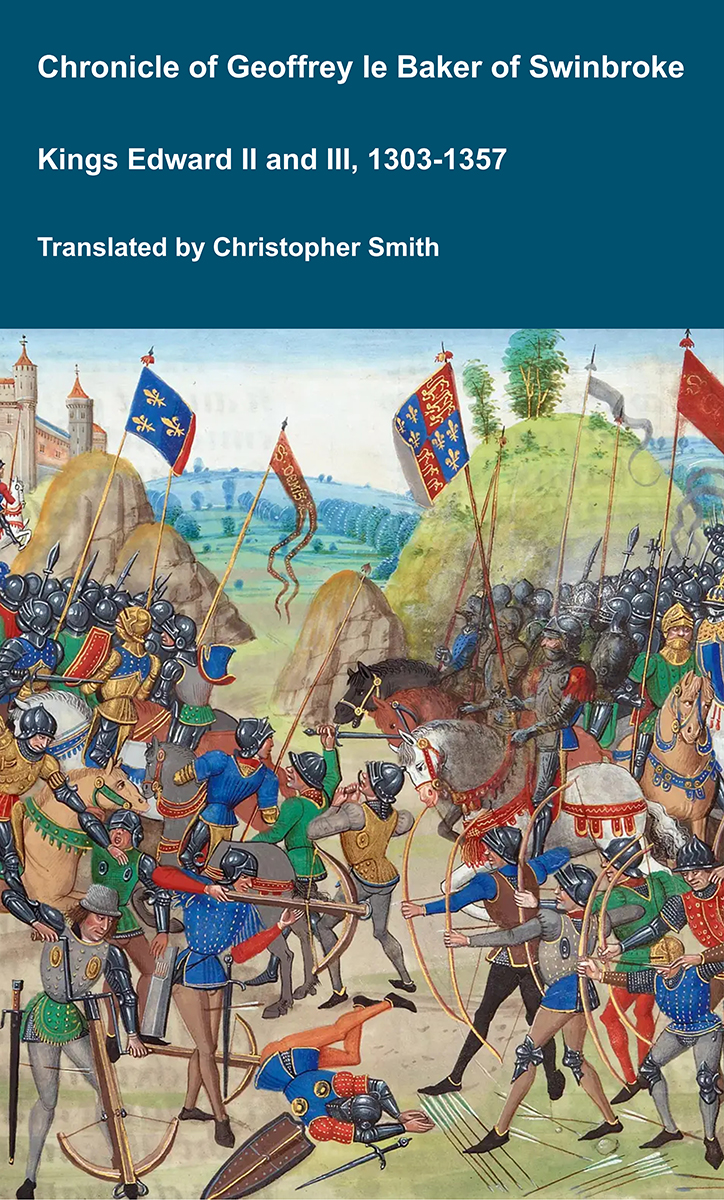
Chronicle of Geoffrey le Baker of Swinbroke
Baker was a secular clerk from Swinbroke, now Swinbrook, an Oxfordshire village two miles east of Burford. His Chronicle describes the events of the period 1303-1356: Gaveston, Bannockburn, Boroughbridge, the murder of King Edward II, the Scottish Wars, Sluys, Crécy, the Black Death, Winchelsea and Poitiers. To quote Herbert Bruce 'it possesses a vigorous and characteristic style, and its value for particular events between 1303 and 1356 has been recognised by its editor and by subsequent writers'. The book provides remarkable detail about the events it describes. Baker's text has been augmented with hundreds of notes, including extracts from other contemporary chronicles, such as the Annales Londonienses, Annales Paulini, Murimuth, Lanercost, Avesbury, Guisborough and Froissart to enrich the reader's understanding. The translation takes as its source the 'Chronicon Galfridi le Baker de Swynebroke' published in 1889, edited by Edward Maunde Thompson.
Available at Amazon in eBook and Paperback format.
 Pye Arms. Ermine, a bend lozengy gules. Source.
Around 1327. Lady Chapel of Hereford Cathedral [Map] Monument to Joan Plugenet of Kilpec, wife of Henry de Bohun, [1327], altar-tomb with effigy in wallrecess, plain altar-tomb with moulded top-edge enriched with Paterae and heads alternately, at head recumbent canopy with ogee cinque-foiled arch, crockets and finial; effigy of woman in wimple and veiled head-dress, tight sleeves and loose gown, head on cushion and feet on dog; all set in a 13th-century recess with moulded and segmental-pointed arch and label with head-stops and apex turned up to mitre with string-course of chapel; remains of black and red colour on effigy and arch, traces of painted figure and arch on back of recess and remains of decoration in spandrels of arch, including a diaper of fleur-de-lis and rosettes and two shields-of-arms (a) Plunkenet and (b) formerly Bohun but now obliterated.  Bohun Arms. Pye Arms.


 Robert Radclyffe 1st Earl of Sussex 1483 1542 Arms. Quartered 1 Quartered 1&4
  Radclyffe Arms 2&3
  Fitzwalter Arms 2 Unknown Arms 3
  Lucy Arms 4 Multon Arms.
 Redvers Arms. Or, a lion rampant azure. Source.
On 20th March 1619 Robert Rich 1st Earl Warwick [aged 59] died. His son Robert [aged 31] succeeded 2nd Earl Warwick, 4th Baron Rich of Leez. Frances Hatton Countess Warwick [aged 29] by marriage Countess Warwick.
He was buried at St Lawrence's Church, Snarford [Map]. Unusual head and shoulder portrait sculpture of deceased full face, with a profile of his wife Frances Wray Countess Warwick behind, set in a circular medallion. To either side are pelleted Pilasters supporting an entablature with scrolled Cartouche of arms and flanked by heraldic supporters. The whole is painted and gilded and beneath is a panel containing an inscribed poem. Above his Arms implaled with hers. His are quartered 1&4  Rich Arms 2&3 Baldry Arms (his mother), hers quartered 1&4 Wray 2&3 Unknown. the monument is perhaps the work of Epiphanius Evesham. Sculpted by Epiphanius Evesham.


 Ridgeway Arms. Sable, a pair of wings conjoined and elevated argent. Source.
 Riley Arms. Sable, on a pile or three crosses formy fitchy at the foot sable. Source.
 Robartes Arms. Azure, three estoiles and a chief wavy or. Source.
The History of William Marshal was commissioned by his son shortly after William’s death in 1219 to celebrate the Marshal’s remarkable life; it is an authentic, contemporary voice. The manuscript was discovered in 1861 by French historian Paul Meyer. Meyer published the manuscript in its original Anglo-French in 1891 in two books. This book is a line by line translation of the first of Meyer’s books; lines 1-10152. Book 1 of the History begins in 1139 and ends in 1194. It describes the events of the Anarchy, the role of William’s father John, John’s marriages, William’s childhood, his role as a hostage at the siege of Newbury, his injury and imprisonment in Poitou where he met Eleanor of Aquitaine and his life as a knight errant. It continues with the accusation against him of an improper relationship with Margaret, wife of Henry the Young King, his exile, and return, the death of Henry the Young King, the rebellion of Richard, the future King Richard I, war with France, the death of King Henry II, and the capture of King Richard, and the rebellion of John, the future King John. It ends with the release of King Richard and the death of John Marshal.
Available at Amazon in eBook and Paperback format.
 Robinson Arms. Vert, a chevron between three bucks at gaze or. Source.
After 20th May 1475. St Mary's Church, Ewelme [Map]. Monument to Alice Chaucer Duchess Suffolk [deceased]. Wrist Garter. The effigy was, apparently, viewed to determine how a lady should wear the garter at the re-commencement of Lady of the Garter appointments in 1901 after a gap of several hundred years. A particularly fine Cadaver Underneath the chest on which Alice's effigy lies. Full-length in a shroud. Chest with Angels with Rounded Wings holding Shields.
Detail of the South Side of the Monument to Alice Chaucer Duchess Suffolk.
1 Roet Arms impaled  Chaucer Modern Arms. Alice's paternal grandparents.
2  De La Pole Arms impaled
  Stafford Arms. Her third husbands parents Michael de la Pole 2nd Earl Suffolk and Katherine Stafford Countess Suffolk.
3  Montacute and Monthermer Arms impaled Francis? Possibly Alice's second husband's parents John Montagu 3rd Earl Salisbury and Maud Francis Countess of Salisbury.
4 De La Pole Arms quartered Chaucer Modern Arms.
5 Roet Arms quartered Chaucer Modern Arms.
8 De La Pole Arms impaled  England Henry IV Arms signifying Alice's son John's marriage to Elizabeth of York sister of King Edward IV of England.
Detail of the North Side of the monument to Alice Chaucer Duchess Suffolk. Arms from left to right ...
1 De La Pole Arms quartered Chaucer Modern Arms impaled Unknown.
2 De La Pole Arms impaled Chaucer Modern Arms. Her third husband William "Jackanapes" de la Pole 1st Duke of Suffolk.
3 De La Pole Arms quarted Chaucer Modern Arms. Alice's son John de la Pole 2nd Duke of Suffolk by her second husband William "Jackanapes" de la Pole 1st Duke of Suffolk.
5 Montacute and Monthermer Arms quartering impaled Chaucer. Alice's second husband Thomas Montagu 1st Count Perche 4th Earl Salisbury.
6 Roet Arms. Alice's paternal grandmother Philippa Roet.
7 England Henry IV Arms impaling Roet Arms probably signifying John of Gaunt 1st Duke Lancaster and Katherine Swynford aka Roet Duchess Lancaster, Katherine being the sister of Alice's paternal grandmother Philippa Roet who married Geoffrey Chaucer.
8 Roet Arms impaling Chaucer Modern Arms. Her paternal grandparents Geoffrey Chaucer and Philippa Roet.
Philippa Roet: Around 1346 she was born to Giles "Payne" Roet. Before 1367 Geoffrey Chaucer and she were married at St Mary de Castro Leicester, Leicestershire [Map]. Excerpta Historica Page 152. Philippa, his eldest daughter, is stated to have been the maid of honour to Philippa Queen of Edward the Third who by the name of "Philippa Pycard" obtained a grant of one hundred shillings per annum on the 20th January 1370, and married Geoffrey Chaucer, to whom, in consequence, it is supposed, of this connexion, the Duke of Lancaster granted the Castle of Dodington. Of John of Gaunt's connexion with Chaucer, however, no proof has been found; and the circumstance of the lady assigned to him for his wife being styled "Philippa Pycard," instead of Roelt, renders the assertion, that she was the sister of the Duchess of Lancaster, extremely doubtful. Around 1387 Philippa Roet died.


Become a Member via our Buy Me a Coffee page to read more.
After 17th September 1563. Alabaster Monument to Henry Manners 2nd Earl of Rutland [deceased] and Margaret Neville Countess Rutland at St Mary the Virgin Church, Bottesford, Leicestershire [Map].
Monument an unusual Table Tomb with their effigies beneath surmounted by effigies of their children. The table may once have been raised in the same way as the one at St Lawrence's Church, Snarford [Map] to Thomas St Paul which may be by the same carver.
His arms showing quarterly: 1&4: Manners Augmented Arms. 2nd: Top Row: Ros Arms, Roet Arms, Trusbutt [or Belvoir], Bottom Row: Todeni [Albini ancient], Daubeney Arms, Badlesmere Arms. 3rd Quarterly: 1 Thomas Holland 2nd Earl Kent 1350 1397 Arms, 2 Tiptoft Arms, 3 Vaux Arms 4. Powys Arms aka Charlton.
Her arms. Quartered 1&4 Neville Arms, 2 Thomas Holland 2nd Earl Kent 1350 1397 Arms, 4 Neville Ancient Arms.
Peacock in Pride ie with its feathers displayed.
Detail of their children.
Detail of the corner of the pediment on which the arms are displayed decorated with fruit and detail of one of the legs of the table.
Detail of his armour, in his right hand a prayer-book, his left hand clutching his sword.
Detail of the Unicorn on which his feet rest and Lion on which her feet rest.
The Manners Peacock Crest.
Become a Member via our Buy Me a Coffee page to read more.
After 1595. Elizabethan Period monument to John Manners 4th Earl of Rutland and Elizabeth Charlton Countess Rutland [aged 42] in the Chancel of St Mary the Virgin Church, Bottesford, Leicestershire [Map] sculpted by Gerard Johnson The Elder [aged 45].
Armorial above the monument showing top row: Manners Augmented Arms, Ros Arms, Roet Arms, Trusbutt [or Belvoir],
2nd Row: Beauchamp Arms, Beaumont Arms, Berkeley Arms, Lisle Arms
3rd Row: Unknown, Thomas Holland 2nd Earl Kent 1350 1397 Arms, Tiptoft Arms, Powys Arms aka Charlton
4th Row: Badlesmere Arms, Vaux Arms, Todeni [Albini ancient] Arms, Daubeney Arms.
 Rolle Arms. Or, a fess dancetté between three billets azure each charged with a lion rampant of the first three bezants. Source.
 Roper Arms. Per fess azure and or, a pale counter-changed and three buck's heads erased of the second. Source.
Ros Arms. Gules, three water bougets argent.
 George Villiers 1st Duke of Buckingham 1592 1628 Arms.George Villiers 1st Duke of Buckingham. Top Row: 1
  Villiers Arms differenced with a martlet 2
  Manners Arms 3 Ros Arms 4 Unknown 5 Unknown 6 Beauchamp Arms 7 Beaumont Arms 8 Berkeley Arms 9 Lisle Arms 10 Unknown 11
  Wake Arms 12 Villiers Arms differenced with a martlet. Source.


Adam Murimuth's Continuation and Robert of Avesbury’s 'The Wonderful Deeds of King Edward III'
This volume brings together two of the most important contemporary chronicles for the reign of Edward III and the opening phases of the Hundred Years’ War. Written in Latin by English clerical observers, these texts provide a vivid and authoritative window into the political, diplomatic, and military history of fourteenth-century England and its continental ambitions. Adam Murimuth Continuatio's Chronicarum continues an earlier chronicle into the mid-fourteenth century, offering concise but valuable notices on royal policy, foreign relations, and ecclesiastical affairs. Its annalistic structure makes it especially useful for establishing chronology and tracing the development of events year by year. Complementing it, Robert of Avesbury’s De gestis mirabilibus regis Edwardi tertii is a rich documentary chronicle preserving letters, treaties, and official records alongside narrative passages. It is an indispensable source for understanding Edward III’s claim to the French crown, the conduct of war, and the mechanisms of medieval diplomacy. Together, these works offer scholars, students, and enthusiasts a reliable and unembellished account of a transformative period in English and European history. Essential for anyone interested in medieval chronicles, the Hundred Years’ War, or the reign of Edward III.
Available at Amazon in eBook and Paperback format.
After 17th September 1563. Alabaster Monument to Henry Manners 2nd Earl of Rutland [deceased] and Margaret Neville Countess Rutland at St Mary the Virgin Church, Bottesford, Leicestershire [Map].
Monument an unusual Table Tomb with their effigies beneath surmounted by effigies of their children. The table may once have been raised in the same way as the one at St Lawrence's Church, Snarford [Map] to Thomas St Paul which may be by the same carver.
His arms showing quarterly: 1&4: Manners Augmented Arms. 2nd: Top Row: Ros Arms, Roet Arms, Trusbutt [or Belvoir], Bottom Row: Todeni [Albini ancient], Daubeney Arms, Badlesmere Arms. 3rd Quarterly: 1 Thomas Holland 2nd Earl Kent 1350 1397 Arms, 2 Tiptoft Arms, 3 Vaux Arms 4. Powys Arms aka Charlton.
Her arms. Quartered 1&4 Neville Arms, 2 Thomas Holland 2nd Earl Kent 1350 1397 Arms, 4 Neville Ancient Arms.
Peacock in Pride ie with its feathers displayed.
Detail of their children.
Detail of the corner of the pediment on which the arms are displayed decorated with fruit and detail of one of the legs of the table.
Detail of his armour, in his right hand a prayer-book, his left hand clutching his sword.
Detail of the Unicorn on which his feet rest and Lion on which her feet rest.
The Manners Peacock Crest.
Become a Member via our Buy Me a Coffee page to read more.
After 1595. Elizabethan Period monument to John Manners 4th Earl of Rutland and Elizabeth Charlton Countess Rutland [aged 42] in the Chancel of St Mary the Virgin Church, Bottesford, Leicestershire [Map] sculpted by Gerard Johnson The Elder [aged 45].
Armorial above the monument showing top row: Manners Augmented Arms, Ros Arms, Roet Arms, Trusbutt [or Belvoir],
2nd Row: Beauchamp Arms, Beaumont Arms, Berkeley Arms, Lisle Arms
3rd Row: Unknown, Thomas Holland 2nd Earl Kent 1350 1397 Arms, Tiptoft Arms, Powys Arms aka Charlton
4th Row: Badlesmere Arms, Vaux Arms, Todeni [Albini ancient] Arms, Daubeney Arms.
 Rous Arms. Sable, a fess dancetté or between three crescents argent. Source.
Bedford Chapel, St Michael's Church, Chenies. Monument to Francis Russell 2nd Earl Bedford and Margaret St John Countess Bedford.
The armorials on the visible south side being, left to right:
 Dudley Arms impaling
  Russell Arms. Ambrose Dudley 3rd Earl Warwick [aged 56] and Anne Russell Countess Warwick [aged 38].
Bourchier Arms impaling Russell Arms. William Bourchier 3rd Earl Bath [aged 28] and Elizabeth Russell Countess Bath
 Clifford Arms impaling Russell Arms. George Clifford 3rd Earl of Cumberland [aged 27] and Margaret Russell Countess Cumberland [aged 25].


 Thynne Arms. Quarterly 1&4
  Boteville Arms Bottevile; 2&3 Russell Arms Russel.


,_comte_d'Oldenbourg.svg)


#/media/File:Blazon_of_Palmer_Baronets_of_Carlton_(1660).svg)


#/media/File:PoleOfShuteArms.png)


.svg)
.svg)
.svg)
.svg)


