

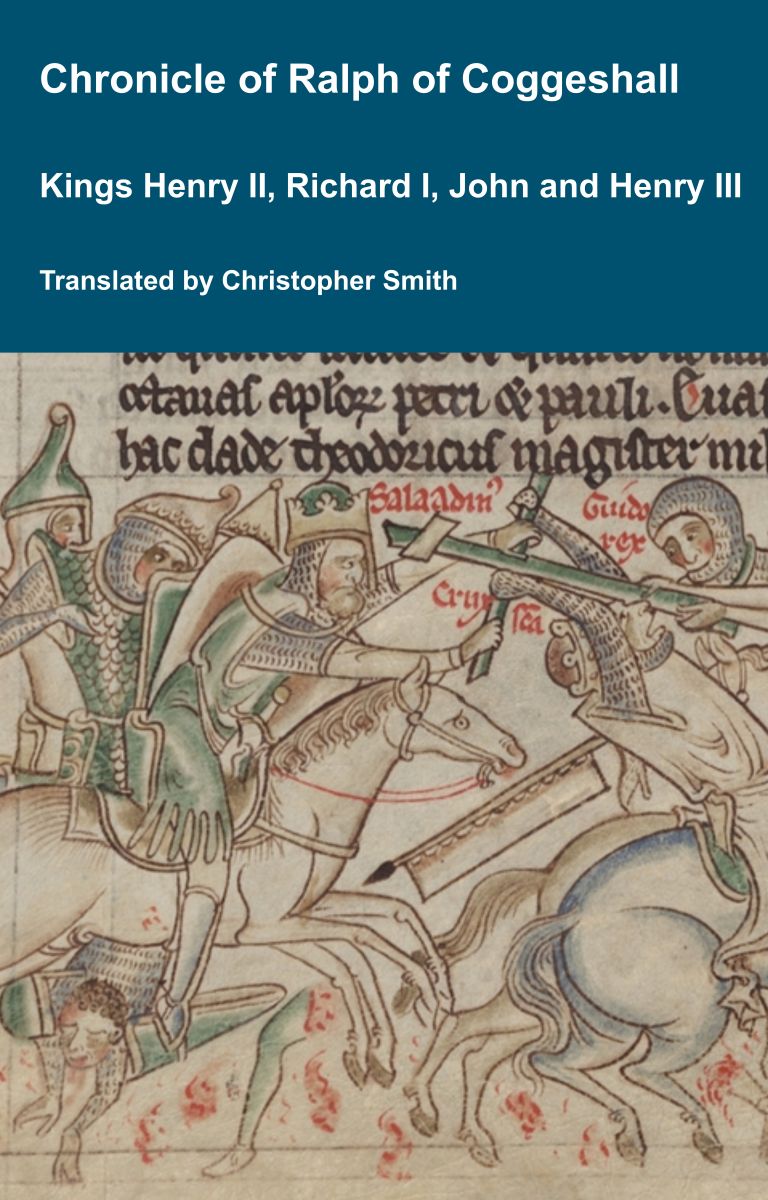
Chronicle of Abbot Ralph of Coggeshall
The Chronicle of Abbot Ralph of Coggeshall (Chronicon Anglicanum) is an indispensable medieval history that brings to life centuries of English and European affairs through the eyes of a learned Cistercian monk. Ralph of Coggeshall, abbot of the Abbey of Coggeshall in Essex in the early 13th century, continued and expanded his community’s chronicle, documenting events from the Norman Conquest of 1066 into the tumultuous reign of King Henry III. Blending eyewitness testimony, careful compilation, and the monastic commitment to record-keeping, this chronicle offers a rare narrative of political intrigue, royal power struggles, and social upheaval in England and beyond. Ralph’s work captures the reigns of pivotal figures such as Richard I and King John, providing invaluable insights into their characters, decisions, and the forces that shaped medieval rule. More than a simple annal, Chronicon Anglicanum conveys the texture of medieval life and governance, making it a rich source for scholars and readers fascinated by English history, monastic authorship, and the shaping of the medieval world.
Available at Amazon in eBook and Paperback format.
Duke York is in Dukedoms of England Alphabetically.
1385 Richard II Creates his Two Uncles as Dukes
1470 October 1470 King Henry VI Restored
1483 Disappearance of the Princes in the Tower
1491 Birth and Christening of Henry VIII
There have been eight creations of Duke York:
1st. 6th August 1385. Edmund of Langley 1st Duke of York. Merged with the Crown. 28th June 1461. Coronation of Edward IV.
2nd. May 1474. Richard of Shrewsbury 1st Duke of York. Extinct. August 1483. Disappearance of the Princes in the Tower.
3rd. 1494. King Henry VIII of England and Ireland. Merged with the Crown. 21st April 1509. Death of Henry VII.
4th. 5th January 1605. King Charles I of England, Scotland and Ireland. Merged with the Crown. 27th March 1625. Death of James I.
5th. 14th October 1633. King James II of England Scotland and Ireland. Merged with the Crown. 6th February 1685. Death and Burial of Charles II.
6th. 1892. King George V of the United Kingdom. Merged with the Crown. 20th January 1936.
7th. 1920. King George VI of the United Kingdom. Merged with the Crown. 11th December 1936. Abdication of King Edward VIII.
8th. 1986. Prince Andrew Windsor 1st Duke of York. Extant.
Duke York is also in Dukedoms of England Chronologically, Merged with the Crown Dukedoms of England.
Summary
6th August 1385. Edmund of Langley 1st Duke of York [aged 44] created. See Richard II Creates his Two Uncles as Dukes.
1st August 1402. Son Edward 2nd Duke of York 1st Duke Albemarle [aged 29] succeeded.
25th October 1415. Nephew Richard Plantagenet 3rd Duke of York [aged 4] succeeded. See Battle of Agincourt.
30th December 1460. Son King Edward IV of England [aged 18] succeeded. See Battle of Wakefield.
28th June 1461. King Edward IV of England merged with the crown. See Coronation of Edward IV.
On 6th August 1385 Edmund of Langley 1st Duke of York [aged 44] was created 1st Duke York by King Richard II of England [aged 18]. Isabella of Castile Duchess York [aged 30] by marriage Duchess York.
Thomas of Woodstock 1st Duke of Gloucester [aged 30] was created 1st Duke Albemarle, and around the same time, 1st Duke Gloucester. Eleanor Bohun Duchess Gloucester [aged 19] by marriage Duchess Albemarle and Duchess Gloucester.


On 4th November 1393 Edmund of Langley 1st Duke of York [aged 52] and Joan Holland Duchess York [aged 13] were married. She by marriage Duchess York. The difference in their ages was 38 years. She the daughter of Thomas Holland 2nd Earl Kent [aged 43] and Alice Fitzalan Countess Kent [aged 43]. He the son of King Edward III of England and Philippa of Hainaut Queen Consort England. They were half second cousin once removed. She a great x 2 granddaughter of King Edward I of England.
On 1st August 1402 Edmund of Langley 1st Duke of York [aged 61] died at King's Langley, Hertfordshire [Map]. His son Edward [aged 29] succeeded 2nd Duke York, 2nd Earl Cambridge and inherited his estates which included Conisbrough Castle [Map]. Philippa Mohun Duchess York [aged 35] by marriage Duchess York.
On 25th October 1415 King Henry V of England [aged 29] defeated a French army at the Battle of Agincourt.
The battle is described by three Chroniclers who were present:
Jean de Waurin: "1, the author of this work, know the truth of the matter, for in that assembly I was among the French".
Jean le Fevre de St Remy: "I who write this, seated on a horse among the baggage at the rear of the battle, along with the other priests who were present".
The anonymous author of the Gesta Henrici Quinti i.e. Deeds of Henry V: "while I was on the other side with the English".
Thomas Camoys 1st Baron Camoys [aged 64] commanded the Rearguard. Richard de Vere 11th Earl of Oxford [aged 30] commanded. Humphrey Lancaster 1st Duke Gloucester [aged 25] was wounded, and was protected by his brother King Henry V of England.
Edward 2nd Duke of York 1st Duke Albemarle [aged 42], commander of the Vanguard, was killed; the most senior English casualty. Duke Albemarle, Earl of Rutland and Earl Cork extinct. His nephew Richard [aged 4] succeeded 3rd Duke York and inherited his estates including Conisbrough Castle [Map].
John Fortescue [aged 35], Dafydd Gam Brecon [aged 35] and Edward Burnell [aged 44] and Roger Vaughan of Bredwardine [aged 38] were killed.
Michael de la Pole 3rd Earl Suffolk [aged 21] was killed. His brother William [aged 19] succeeded 4th Earl Suffolk, 4th Baron Pole.
In October 1429 Richard Plantagenet 3rd Duke of York [aged 18] and Cecily "Rose of Raby" Neville Duchess York [aged 14] were married. She by marriage Duchess York. She was the youngest sister of Richard's brother-in-arms Richard Neville Earl Salisbury [aged 29]. She the daughter of Ralph Neville 1st Earl of Westmoreland and Joan Beaufort Countess of Westmoreland [aged 50]. He the son of Richard of Conisbrough 1st Earl Cambridge and Anne Mortimer. They were second cousins. He a great grandson of King Edward III of England. She a great granddaughter of King Edward III of England.
On 30th December 1460 the Lancastrian army took their revenge for the defeats of the First Battle of St Albans and the Battle of Northampton at the Battle of Wakefield near Sandal Castle [Map]. The Lancastrian army was commanded by Henry Holland 3rd Duke Exeter [aged 30], Henry Beaufort 2nd or 3rd Duke of Somerset [aged 24] and Henry Percy 3rd Earl of Northumberland [aged 39], and included John Courtenay 7th or 15th Earl Devon [aged 25] and William Gascoigne XIII [aged 30], both knighted, and James Butler 1st Earl Wiltshire 5th Earl Ormonde [aged 40], John "Butcher" Clifford 9th Baron Clifford [aged 25], John Neville 1st Baron Neville of Raby [aged 50], Thomas Ros 9th Baron Ros Helmsley [aged 33], Henry Roos and Thomas St Leger [aged 20].
The Yorkist army was heavily defeated.
Richard Plantagenet 3rd Duke of York [aged 49] was killed. His son Edward [aged 18] succeeded 4th Duke York, 7th Earl March, 9th Earl of Ulster, 3rd Earl Cambridge, 9th Baron Mortimer of Wigmore.
Thomas Neville [aged 30], and Edward Bourchier were killed.
Father and son Thomas Harrington [aged 60] and John Harrington [aged 36] were killed, the former dying of his wounds the day after.
William Bonville 6th Baron Harington [aged 18] was killed. His daughter Cecily succeeded 7th Baroness Harington.
Thomas Parr [aged 53] fought in the Yorkist army.
Following the battle Richard Neville Earl Salisbury [aged 60] was beheaded by Thomas "Bastard of Exeter" Holland. William Bonville [aged 40] was executed.
Edmund York 1st Earl of Rutland [aged 17] was killed on Wakefield Bridge [Map] by John "Butcher" Clifford. Earl of Rutland extinct.
On 28th June 1461 King Edward IV of England [aged 19] was crowned IV King of England. Duke York, Earl March, Earl of Ulster, Earl Cambridge, Baron Mortimer of Wigmore merged with the Crown. Cardinal Thomas Bourchier [aged 43] was assisted by Archbishop William Booth [aged 73] at Westminster Abbey [Map].
Duke York is also in Dukedoms of England Chronologically, Extinct Dukedoms of England.
Summary
May 1474. Richard of Shrewsbury 1st Duke of York created.
August 1483. Richard of Shrewsbury 1st Duke of York extinct. See Disappearance of the Princes in the Tower.
In November 1470 King Edward IV of England [aged 28] was attainted. George York 1st Duke of Clarence [aged 21] was awarded the Duchy of York.

In May 1474 Richard of Shrewsbury 1st Duke of York was created 1st Duke York.
Around August 1483 the Princes in the Tower, brothers King Edward V of England [aged 12] and Richard of Shrewsbury 1st Duke of York [aged 9] disappeared from the Tower of London [Map].
King Edward V of England: Earl March and Earl Pembroke extinct.
Richard of Shrewsbury 1st Duke of York: Duke York, Duke Norfolk and Earl Norfolk, Earl Nottingham extinct.
Commines writes "Not long after, he received letters from the Duke of Gloucester, who had made himself king, styled himself Richard III, and barbarously murdered his two nephews".
Robert Ricart, Mayor of Bristol: "And this yere the two sonnes of King E. were put to scylence in the Towre of London." although it should be noted this was written in the margin.
Croyland Chronicle: "while a rumour was spread that the sons of king Edward before-named had died a violent death, but it was uncertain how."
Polydore Vergil: "And to rid himself of this altogether he decided to kill his nephews, for as long as they were safe he could by no means be free of danger."
Jean Molinet: "They were imprisoned for about five weeks; and by the captain of the tower, the Duke Richard secretly had them put to death and eliminated."
Mancini: "I have seen not a few people burst into tears and weep when his memory was brought up after he was removed from the sight of men, and it was already suspected that he had been eliminated. Whether he has indeed been removed, and by what manner of death, I have not yet discovered."
Robert Fabyan: "In which passe tyme the prynce, or of ryght kynge Edwarde the v., with his broder the duke of Yorke, were put under suer kepynge within the Tower, in suche wyse that they neuer came abrode after."
Duke York is also in Dukedoms of England Chronologically, Merged with the Crown Dukedoms of England.
Summary
1494. King Henry VIII of England and Ireland [aged 2] created.
21st April 1509. King Henry VIII of England and Ireland merged with the crown. See Death of Henry VII.
Chronicle of Edward Hall [1496-1548]. This yere was borne at Grenewiche [Map] lord Henry, second son to the King [aged 34], which was created duke of Yorke, and after Prince of Wales, and in conclusion succeeded his father in crown and dignity. Nowe let us return to the new found son of King Edward, conjured by men's policies from death to life.
And first to declare his lineage and beginning, you must understad that the Duchess of Burgoyne [aged 45] so nourished and brought up in the seditious and scelerate factions of false contryers and founders of discord could never cease nor be unquiet (like a viper that is ready to burst with superfluity of poison) except he should infest and unquiet the King of England, for no desert or displeasure by him to her committed, but only because he was propagate and descended of the house of Lancaster, ever being adverse and enemy to her line and lineage. For which only cause she compassed, imagined and invented how to cast a scorpion in his bosom, and to infect his whole realm with, a pestiferous discord. To the intent that he being vanquished and brought to confusion, both the boiling heat of her malicious heart might be fully satiated with his innocent blood, and also advance and prefer some darling of her faction to his Empire rule and dignity. And principally remembering that the Earl of Lincoln, which was by her set forth and al his company had small fortune and worse success in their progression and enterprise, contrary to her hope and expectation, she like a dog reverting to her olde vomit, began to devise and spin a new web, like a spider that daily weaves when his caul is torn. And as the devil provides venomous sauce to corrupt banckettes, so for her purpose she espied a certain young man of visage beautiful, of countenance demure, of with subtle crafty and pregnant, called Peter Warbreck. And for his dastard cowardness of the Englishmen, in derision called Perkin Warbreck [aged 17], according to the Dutch phrase, which change the name of Peter to Pekin, to younglings of no strength nor courage for their timorous hearts and pusillanimity. Which young man travelling many countries, could speak English and many other languages, and for his basenes of stock and birth was known of none almost, and only for the gain of his living from his childhood was of necessity, compelled to seek and frequent diverse realms and regions. Therefore the duches thinking to have gotten God by the foot, when she had the devil by the taile, and adjudging this young man to be a mete organ to convey her purpose, and one not unlike to be duke of Yorke, son to her brother King Edward, which was called Richard, kept him a certain space with her privately, and him with such diligence instructed, both of the secretes and common affaires of the realm of England, and of the lineage, descent and order of the House of Yorke, that he like a good scholar not forgetting his lesson could tell all that was taught him promptly without any difficulty or sign of any subornation and besides, he kept such a princely countenance, and so counterfeit a Majesty Royal, that all men in manner did firmly believe that he was extracted of the noble house and family of the Dukes of Yorke. For surely it was a gift given to that noble progeny as of nature in the root planted that all the sequel of that line and stock did study and devise how to be equivalent in honour and fame with their forefathers and noble predecessors.


In 1494 Henry VIII [aged 2] was created 1st Duke York.


On 21st April 1509 King Henry VII of England and Ireland [aged 52] died of tuberculosis at Richmond Palace [Map]. His son Henry VIII [aged 17] succeeded VIII King of England. Duke York and Earl Chester merged with the Crown.
Duke York is also in Dukedoms of England Chronologically, Merged with the Crown Dukedoms of England.
Summary
5th January 1605. King Charles I of England, Scotland and Ireland [aged 4] created. See New Years Honours.
27th March 1625. King Charles I of England, Scotland and Ireland merged with the crown. See Death of James I.
On 5th January 1605 King Charles I of England, Scotland and Ireland [aged 4] was created 1st Duke York and Knight of the Bath by his father King James I of England and Ireland and VI of Scotland [aged 38]
Francis Manners 6th Earl of Rutland [aged 27] and Thomas Somerset 1st Viscount Somerset [aged 26] was @@appointed Knight of the Bath.


On 27th March 1625 King James I of England and Ireland and VI of Scotland [aged 58] died at Theobalds House, Hertfordshire. His son Charles [aged 24] succeeded I King England Scotland and Ireland. Duke York merged with the Crown.
Duke York is also in Dukedoms of England Chronologically, Merged with the Crown Dukedoms of England.
Abbot John Whethamstede’s Chronicle of the Abbey of St Albans
Abbot John Whethamstede's Register aka Chronicle of his second term at the Abbey of St Albans, 1451-1461, is a remarkable text that describes his first-hand experience of the beginning of the Wars of the Roses including the First and Second Battles of St Albans, 1455 and 1461, respectively, their cause, and their consequences, not least on the Abbey itself. His text also includes Loveday, Blore Heath, Northampton, the Act of Accord, Wakefield, and Towton, and ends with the Coronation of King Edward IV. In addition to the events of the Wars of the Roses, Abbot John, or his scribes who wrote the Chronicle, include details in the life of the Abbey such as charters, letters, land exchanges, visits by legates, and disputes, which provide a rich insight into the day-to-day life of the Abbey, and the challenges faced by its Abbot.
Available at Amazon in eBook and Paperback format.
Summary
14th October 1633. King James II of England Scotland and Ireland created.
6th February 1685. King James II of England Scotland and Ireland merged with the crown. See Death and Burial of Charles II.
On 14th October 1633 James, Duke of York was born to King Charles I of England, Scotland and Ireland [aged 32] and Henrietta Maria Bourbon Queen Consort England [aged 23] at St James's Palace [Map]. He was created 1st Duke York at birth by his father. He married (1) 3rd September 1660 Anne Hyde Duchess of York, daughter of Edward Hyde 1st Earl Clarendon and Frances Aylesbury Countess Clarendon, and had issue (2) 20th September 1673 Mary of Modena Queen Consort England Scotland and Ireland and had issue.


On 3rd September 1660 James, Duke of York [aged 26] and Anne Hyde [aged 23] were married in secret. She by marriage Duchess York. She gave birth to their son Charles Stewart seven weeks later. She the daughter of Edward Hyde 1st Earl Clarendon [aged 51] and Frances Aylesbury Countess Clarendon [aged 43]. He the son of King Charles I of England, Scotland and Ireland and Henrietta Maria Bourbon Queen Consort England [aged 50].


On 6th February 1685 King Charles II of England Scotland and Ireland [aged 54] died around midday the morning at Whitehall Palace [Map] attended by Charles Scarburgh [aged 69]. His brother James [aged 51] succeeded II King England Scotland and Ireland. Duke York merged with the Crown. Mary of Modena Queen Consort England Scotland and Ireland [aged 26] by marriage Queen Consort England Scotland and Ireland. His brother King James II of England Scotland and Ireland, William Chiffinch [aged 83], Richard Mason [aged 52] and Archbishop William Sancroft [aged 68] were present.
The time of his death reported differtently by different contemporary sources: John Evelyn's Diary 'at halfe an houre after eleven in the morning', the Anonymous Letter to Reverend Roper: 'Yesterday noon', Ambassador Barillon's Account: 'and at noon, he died without any struggle or convulsion.' and Charl;es Scarburgh's Manuscript: 'He expired on February the Sixth soon after noon'.
According to Mark Bryant's book "Private Lives: Curious Facts about the Famous and Infamous' King Charles is supposed to have said the much repested phrase: "I am sorry, gentlemen, for being such a time a-dying." This doesn't appear to come from a contemporary source. Macaulay in his 'History of England', writing much later has "He apologised to those who had stood round him all night for the trouble which he had caused. He had been, he said, a most unconscionable time dying; but he hoped that they would excuse it." Perhaps the nearest we can find in a contemporary source is the Anonymous Letter to Reverend Roper: 'and beg the pardon of the standers by, and those that were employed about him, that he gave them so much trouble: that he hoped the work was almost over...'
Duke York is also in Dukedoms of England Chronologically, Merged with the Crown Dukedoms of England.
Summary
1892. King George V of the United Kingdom [aged 26] created.
20th January 1936. King Edward VIII of the United Kingdom [aged 41] merged with the crown.
In 1892 King George V of the United Kingdom [aged 26] was created 1st Duke York.



On 6th July 1893 King George V of the United Kingdom [aged 28] and Victoria Mary Teck Queen Consort England [aged 26] were married at Chapel Royal, St James's Palace. She by marriage Duchess York. He the son of King Edward VII of the United Kingdom [aged 51] and Alexandra of Denmark Queen Consort England [aged 48]. They were second cousin once removed. She a great granddaughter of King George III of Great Britain and Ireland.
The photograph by from left to right:
Alexandra Windsor Princess [aged 14]
Princess Alice of Battenburg [aged 8]
Victoria Eugénie Mountbatten Queen Consort Spain [aged 5]
Beatrice Windsor Duchess Galliera [aged 9]
King George V of the United Kingdom
Margaret "Daisy" Windsor [aged 11]
Victoria Mary Teck Queen Consort England
Maud Windsor Queen Consort Norway [aged 23]
Victoria Patricia "Patsy" Windsor [aged 7]
Princess Victoria Windsor [aged 25]
Helena Victoria Oldenburg [aged 23]
Victoria Melita Windsor [aged 16]

On 20th January 1936 King George V of the United Kingdom [aged 70] died. His son Edward [aged 41] succeeded VIII King of the United Kingdom. Duke York merged with the crown.
Duke York is also in Dukedoms of England Chronologically, Merged with the Crown Dukedoms of England.
Summary
1920. King George VI of the United Kingdom [aged 24] created.
11th December 1936. King George VI of the United Kingdom merged with the crown. See Abdication of King Edward VIII.

In 1920 King George VI of the United Kingdom [aged 24] was created 1st Duke York.
On 11th December 1936 King Edward VIII of the United Kingdom [aged 42] abdicated VIII King of the United Kingdom. King George VI of the United Kingdom [aged 40] succeeded VI King of the United Kingdom. Duke York merged with the Crown.
Duke York is also in Dukedoms of England Chronologically, Extant Dukedoms of England.
Summary
1986. Prince Andrew Windsor 1st Duke of York [aged 25] created.
In 1986 Prince Andrew Windsor 1st Duke of York [aged 25] was created 1st Duke York.