

William of Worcester's Chronicle of England
William of Worcester, born around 1415, and died around 1482 was secretary to John Fastolf, the renowned soldier of the Hundred Years War, during which time he collected documents, letters, and wrote a record of events. Following their return to England in 1440 William was witness to major events. Twice in his chronicle he uses the first person: 1. when writing about the murder of Thomas, 7th Baron Scales, in 1460, he writes '… and I saw him lying naked in the cemetery near the porch of the church of St. Mary Overie in Southwark …' and 2. describing King Edward IV's entry into London in 1461 he writes '… proclaimed that all the people themselves were to recognize and acknowledge Edward as king. I was present and heard this, and immediately went down with them into the city'. William’s Chronicle is rich in detail. It is the source of much information about the Wars of the Roses, including the term 'Diabolical Marriage' to describe the marriage of Queen Elizabeth Woodville’s brother John’s marriage to Katherine, Dowager Duchess of Norfolk, he aged twenty, she sixty-five or more, and the story about a paper crown being placed in mockery on the severed head of Richard, 3rd Duke of York.
Available at Amazon in eBook and Paperback format.
Chief is in Charges.
Chief. The Chief is the uppermost part of the arms occupying around one third of the arms.
 Acheson Arms. Argent, a double-headed eagle displayed sable, beaked and membered or, on a chief vert, two mullets or. Source.
 Kitson Arms. Sable three fishes hauriant in fess argent a chief or. Source.
 Clement Arms. Argent, two bendlets wavy sable on a chief gules three leopard's faces or a bordure compony or and azure. Source.
 Dormer Arms. Azure, ten billets or 4,3,2,1 issuant from a chief of the second a demi lion rampant sable langued gules.
 Babington Arms. Argent, ten torteau in chief a label three points azure. Source.
 Chichester Arms. Chequy or and gules, a chief vair. Source.
 Mortimer Arms. Barry or and azure, on a chief of the first two pallets between two base esquires of the second over all an inescutcheon argent. Source.
 Narborough Arms. Gules, a chief ermine. Source.
Henrici Quinti, Angliæ Regis, Gesta, is a first-hand account of the Agincourt Campaign, and subsequent events to his death in 1422. The author of the first part was a Chaplain in King Henry's retinue who was present from King Henry's departure at Southampton in 1415, at the siege of Harfleur, the battle of Agincourt, and the celebrations on King Henry's return to London. The second part, by another writer, relates the events that took place including the negotiations at Troye, Henry's marriage and his death in 1422.
Available at Amazon in eBook and Paperback format.
 Berkeley Arms. Gules a chevron between ten crosses pattee six in chief and four in base argent.
 Bacon Arms. Gules, on a chief argent two mullets pierced sable. Source.
 Turner Baronets Arms. Sable, a chevron ermine between three fers de moline or on a chief argent a lion passant gules. Source.
 Chaplin Arms. Ermine a chief azure three griffin's heads erased or.
 Clinton Arms. Argent, six cross crosslets fitchée sable three two and one on a chief azure two mullets or pierced gules. Source.
NO IMAGE. Argent, on a chief azure three mullets of the first.
 Saluzzo Arms. Argent, a chief azure. Source.
 Weston Arms. Ermine, on a chief azure five bezants.

Around 1577 George Gower [aged 37]. Portrait of Richard Drake [aged 42]. The heraldic escutcheon shows seven quarters as follows:
1:  Drake of Ash Arms. Drake of Ash in the parish of Musbury, Devon.
2: Argent, on a chief gules three cinquefoils of the first; Billet of Ash.
3: Gules, on a fess argent two mullets sable; Hamton of Rockbere and Ash.
4: Ermine, on a chief indented sable three crosslets fitchee or; Orwey of Orwey and Ash.
5: Barry of seven argent and sable.
6: Azure, six lions rampant argent crowned Gules, 3, 2, 1; Forde of Forde.
7: Argent, two chevrons sable (Esse/Ash of Ash); Esse or Ash of Ash.
 Chaucer Modern Arms. Argent, a chief gules overall a lion rampant double queued or.
 Manners Arms. Or, two fess azure a chief gules.
 St John Arms. Argent, a chief gules two estoiles or. Source.
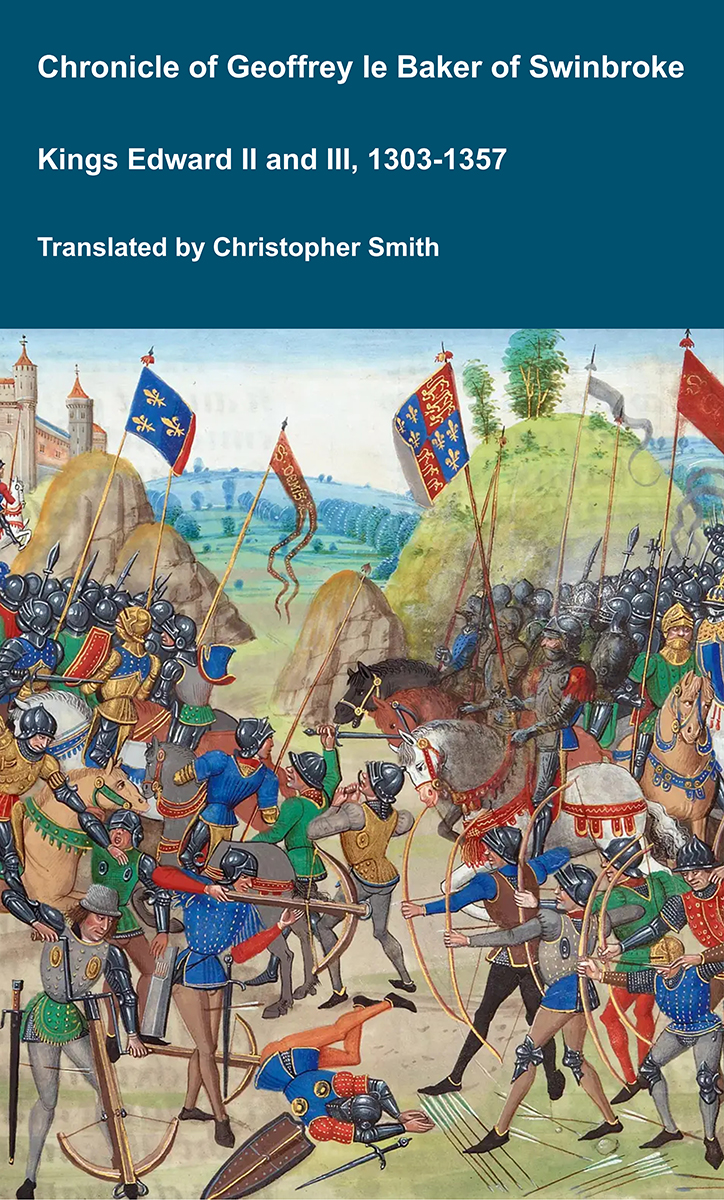
Chronicle of Geoffrey le Baker of Swinbroke
Baker was a secular clerk from Swinbroke, now Swinbrook, an Oxfordshire village two miles east of Burford. His Chronicle describes the events of the period 1303-1356: Gaveston, Bannockburn, Boroughbridge, the murder of King Edward II, the Scottish Wars, Sluys, Crécy, the Black Death, Winchelsea and Poitiers. To quote Herbert Bruce 'it possesses a vigorous and characteristic style, and its value for particular events between 1303 and 1356 has been recognised by its editor and by subsequent writers'. The book provides remarkable detail about the events it describes. Baker's text has been augmented with hundreds of notes, including extracts from other contemporary chronicles, such as the Annales Londonienses, Annales Paulini, Murimuth, Lanercost, Avesbury, Guisborough and Froissart to enrich the reader's understanding. The translation takes as its source the 'Chronicon Galfridi le Baker de Swynebroke' published in 1889, edited by Edward Maunde Thompson.
Available at Amazon in eBook and Paperback format.
 Worsley Arms. Argent, a chief gules. Source.
Around 1577 George Gower [aged 37]. Portrait of Richard Drake [aged 42]. The heraldic escutcheon shows seven quarters as follows:
1: Drake of Ash Arms. Drake of Ash in the parish of Musbury, Devon.
2: Argent, on a chief gules three cinquefoils of the first; Billet of Ash.
3: Gules, on a fess argent two mullets sable; Hamton of Rockbere and Ash.
4: Ermine, on a chief indented sable three crosslets fitchee or; Orwey of Orwey and Ash.
5: Barry of seven argent and sable.
6: Azure, six lions rampant argent crowned Gules, 3, 2, 1; Forde of Forde.
7: Argent, two chevrons sable (Esse/Ash of Ash); Esse or Ash of Ash.
 Butler Arms. Or, a chief indented azure. Source.
 Harsick Arms. Or, a chief indented sable.
 Lathom Arms. Or, on a chief indented azure three plates. Source.
 Perceval Arms. Argent, a chief indented gules three crosses pattee of the field. Source.
 St Leger Arms. Azure fretty argent, a chief or. Source.
 Preston Arms. Or, a chief sable three crescents or.


#/media/File%3AClement_OfIghtham_Arms_(Bordure_OrAndAzure).svg)


#/media/File:BaconArms.svg)


_arms#/media/File:Butler_arms.svg)
#/media/File:Butler_arms_(Earl_of_Carrick).svg)
