

Paternal Family Tree: Byron
In 1599 John Byron 1st Baron Byron was born to John Byron [aged 22] at Newstead, Nottinghamshire.
On 28th September 1623 [his father] John Byron [aged 46] died at Newstead, Nottinghamshire.
In or before 1624 Francis Bindlosse [aged 20] and [his future wife] Cecily West were married.
After 1629 John Byron 1st Baron Byron [aged 30] and Cecily West were married.
In February 1638 [his wife] Cecily West died.
On 23rd October 1642 the Battle of Edge Hill was fought at Edge Hill [Map]. The Royal army was commanded by King Charles I of England, Scotland and Ireland [aged 41] (with his son King Charles II of England Scotland and Ireland [aged 12] present), Prince Rupert Palatinate Simmern 1st Duke Cumberland [aged 22] and Richard Spencer [aged 49] commanded the army that included Prince Maurice of the Palatinate [aged 21], [his brother] Richard Byron 2nd Baron Byron [aged 36], Lucius Carey 2nd Viscount Falkland [aged 32], Charles Cavendish [aged 22], Henry Newton aka Puckering 3rd Baronet [aged 24], Spencer Compton 2nd Earl of Northampton [aged 41], Thomas Salusbury 2nd Baronet [aged 30], John Byron 1st Baron Byron [aged 43] and William Feilding 1st Earl Denbigh [aged 55].
George Stewart 9th Seigneur D'Aubigny [aged 24] was killed.
Of the Parliamentary army Basil Feilding 2nd Earl Denbigh [aged 34] and Robert Devereux 3rd Earl Essex [aged 51]. Oliver St John 5th Baron St John [aged 39] was wounded.
Samuel Sandes [aged 27] commanded a troop of horse.
Richard Sandes [aged 26] was killed.
Thomas Strickland [aged 20] was knighted on the field for his gallantry.
Henry Hunloke 1st Baronet [aged 24] was knighted by King Charles I of England, Scotland and Ireland.
William Dugdale [aged 37] witnessed the battle and subsequently surveyed the battlefield.
John Hinton [aged 38] was present.
Edward Verney [aged 52] was killed.
John Assheton [aged 29] was killed.
Robert Bertie 1st Earl Lindsey [aged 59] was killed. His son Montagu [aged 34] succeeded 2nd Earl Lindsey, 15th Baron Willoughby de Eresby.
William Pennyman 1st Baronet [aged 35] commanded a regiment, of which he served as Colonel, which he led for the King.
Edward Stradling 2nd Baronet [aged 42] fought for the King, was captured imprisoned for seven months, and died a month after his release.
John Byron's Account of the Battle of Roundway Down. Sir John Byrons [aged 44] Relation to the Secretary of the last Westerne Action [Battle of Roundway Down]. Between the Lord Willmott [aged 30] and Sir William Waller [aged 46]. On Thursday, July 13. 1643. With a List of both their Forces, and of their Losses. Printed at York by Stephen Bulkley, 1643. By speciall Command.
Sir
Upon the occasion of Lieutenant Colonell Butlers [aged 32] comming to Oxford, whom I shall desire your Honour to present to His Majesty, as one that carryed himselfe very bravely in this Action, and tooke three Corners of the Rebells, which we sent with the rest of the Colours to Oxford, I shall make bold summarily to relate to you the carriage of this Businesse, which deserves to be acknowledged with as much thankefulnesse to God as any thing that ever was done in this Kingdome. According to His Majesties Command, we appeared before the Devices on Thursday about three a Clocke in the Afternoone, with all our Horse, which were not above 17. or 1800. at the most, being much lessened in the long March, and many of them so tyred, that they were not able to come up; we shot off out Ordinance from an high Hill that overlookes the Town, to let them know, that we were there for their assistance; at the same time waller appeared with his whole Army upon an opposite Hill within lesse then two Miles of U; he made a very great show, divers of the Country People being called thither to that purpose. But really I beleeve his Horse were farre more then ours in number, and his Foot, beside the Country People 2500. all of them as compleatly armed as ever Troopes were. It was resolved that we should immediately march towards them, and my Lord Willmott very discreetly ordered it, That only his Brigade and mine should charge, (which both together made not above 1200. Horse,) and that the other Troopes (because they had lately taken an affright, and had been put to the worse by Wallers Men) should only stand as a Reserve, and not be imployed till it should please God to renue their Courage with our Successe: as we marcht towards the Rebells, they sent down some Troopes towards Us, which were gallantly encountered by Serjeant Major Paul Smith (who led our Forlorne Hope, consisting of 300. commanded Men) and forced them to turne their Backs. Sir Arthur Hasterigge seconded these with his Formidable Regiment of Lolsters, I meane his Curaffiers whom the Lieutenant Generall intermyned with his Brigade, and forced them to retreat, not so, but that they rallied themselves again and charged the second time, but with worse successe; for then my Brigade being drawn up to second my Lord Willmott, they all ran away that could, and from that time Sir Arthur Hasterigge appeared no more in the Battle; upon this Waller drew his whole Army down the Hill, and advanced with his own Brigade of Horse, with two Peeces of Cannon before it, and two great Bodyes of Foot on the left Flank of it, these it fell to my share to charge with my Brigade, my Lord Willmott in the meane time rallying his men together to second me if occasion should be. A d I marched towards them up the Hill, their Cannon pl [...]l'd upon me at a very neere distance, but with very small losse, killing but two in Colonell Sanayes Regiment; The Musketeers all this while playd upon our Flanke, and hurt and killed some; and another Regyment of their Horse was watching an opportunity to charge us either in the Reare or in the Flanke, but were hindered by Lord Craford. By this time we were come very near to Wallers Brigade, and the command I gave my men was, that not a Man should discharge a Pistoll till the Enemy had spent all his shot, which was punctually observed, so that first they gave us a Volly of their Carbins, then of their Pistolls, and then we fell in with them, and gave them ours in their teeth, yet they would not quit their ground but stood pushing for it a pretty space, till it pleased God, (I thinke) to put new Spirit into our tyr'd Horse as well as into our men, so that though it were up the Hill, and that a steepe one, we overbore them, and with that violence, that we forced them to fall fowle upon other Reserves of Horse that stood behind to second them, and so swept their whole Body of Horse out of the Field, and left their Foot naked, and pursued them neare three Miles over the Downes in Bristoll way till they came to a precipice, where their Feare made them so valiant that they gallop't downe as if it had been plain ground, and many of them brake both their own and their Horses necks. In my return from the chase, I tooke two peeces of their Cannon, and divers Waggons laden with Ammunition, and then rallied together our scattered Troopes, which were as much broken as the Enemy, by reason of their hot pursuit, in the meane time my Lord Willmott charg'd their Foot with the Horse he had with him, but could not breake them, and in the charge Dudley Smith was staine, and Lieutenant Colonell Weston [aged 33], hurt and many others, but when they saw my Horse rallyed together again before them, and the Lieutenant Generall continuing still in the Reare of them, and that the Cornish Foot began to sally out of the Town, they thought it not fit to stay any longer, they began first gently to march off, their Officers marching before them, amongst which (as I have been told since) Sir William Waller himselfe was, and Popham [aged 38]; With that I advanc'd toward them with those Troopes I had rallyed, and shot at them with the Cannon I had formerly taken, their Officers thought it not fit to stay any longer, but such as had Horses rid away as fast as they could, and too fast for Us to overtake them, and the rest blew up their Powder, and threw down their Arms and betooke themselves to their heeles, Our Horse fell in amongst them, and kill'd 600. of them, and hurt many more, and tooke 800. Prisoners, and all their Colours, and this was the successe of their great Conquererer.
The Victory on our side as intire as possiblely can be imagined, their Horse and Foot being totally routed, and all their Cannon being 7 Brasse Peeces taken, and all their Ammunition. Sir, I beseech you excuse this scribling from one that is,
July 14. 1643.
Sir,
Your Honours most humble Servant John Byron
On 20th September 1643 the First Battle of Newbury was fought at Newbury, Berkshire [Map] with King Charles I of England, Scotland and Ireland [aged 42] commanding the Royalist army and Robert Devereux 3rd Earl Essex [aged 52] commanding the victorious Parliamentary army. For King Charles I of England, Scotland and Ireland John Byron 1st Baron Byron [aged 44] fought with distinction.
Henry Bertie was killed.
Robert Dormer 1st Earl Carnarvon [aged 33] was killed. His son Charles [aged 10] succeeded 2nd Earl Carnarvon, 3rd Baron Dormer of Wyng in Buckinghamshire, 3rd Baronet Dormer of Wyng in Buckinghamshire.
William Villiers 2nd Viscount Grandison [aged 29] was killed. His brother John succeeded 3rd Viscount Grandison.
Edward Villiers [aged 23] fought.
Lucius Carey 2nd Viscount Falkland [aged 33] was killed. His son Lucius [aged 11] succeeded 3rd Viscount Falkland.
Richard Neville [aged 28] served under the Earl Carnarvon. Carnarvon was killed and Neville took up the command as a Colonel of Horse.
Major General Charles Fleetwood [aged 25] was wounded.


On 24th October 1643 John Byron 1st Baron Byron [aged 44] was created 1st Baron Byron of Rochdale in Lancashire.

In 1644 John Byron 1st Baron Byron [aged 45] and Eleanor Needham Baroness Byron [aged 17] were married. She by marriage Baroness Byron of Rochdale in Lancashire. The difference in their ages was 28 years.
In February 1645 John Owen [aged 45] was appointed Sergeant Major General of foot under the Governor of Chester, John Byron 1st Baron Byron [aged 46].
John Evelyn's Diary. 25th December 1651. The King [aged 21] and Duke [aged 18] received the Sacrament first by themselves, the Lords Byron [aged 52] and Wilmot [aged 39] holding the long towel all along the altar.


Before 1652. William Dobson. Portrait of John Byron 1st Baron Byron [aged 52].
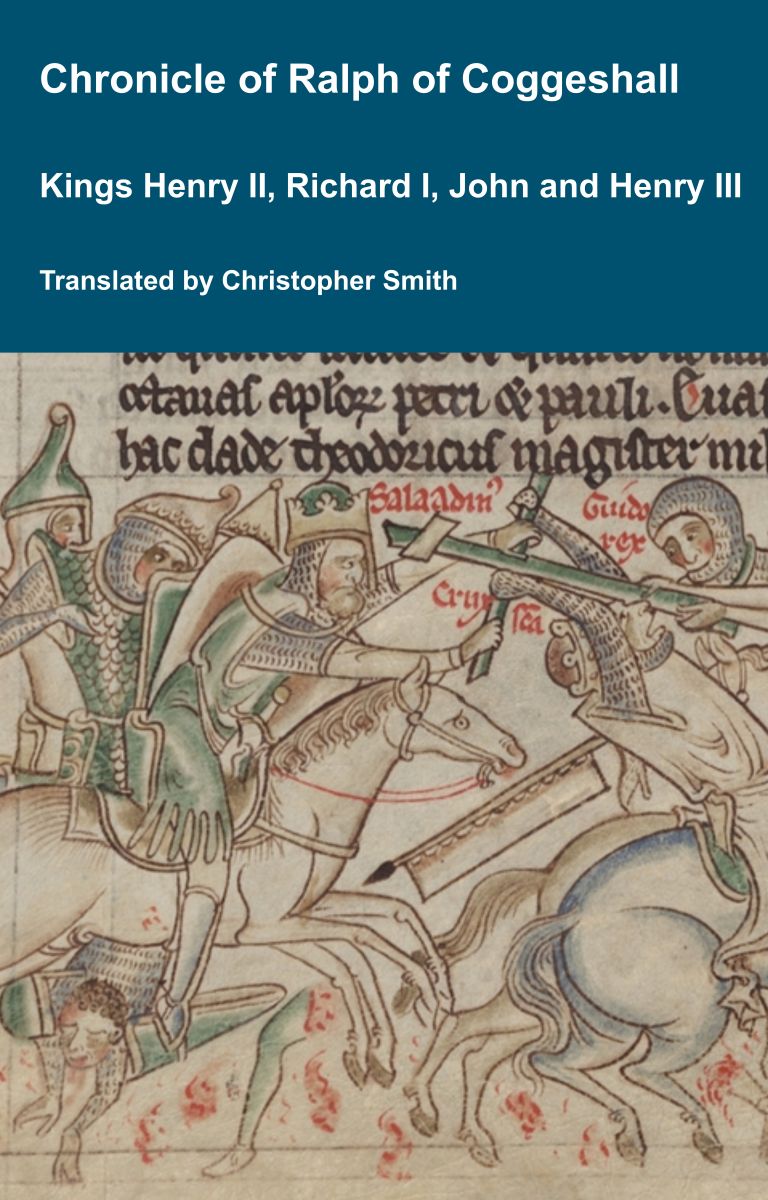
Chronicle of Abbot Ralph of Coggeshall
The Chronicle of Abbot Ralph of Coggeshall (Chronicon Anglicanum) is an indispensable medieval history that brings to life centuries of English and European affairs through the eyes of a learned Cistercian monk. Ralph of Coggeshall, abbot of the Abbey of Coggeshall in Essex in the early 13th century, continued and expanded his community’s chronicle, documenting events from the Norman Conquest of 1066 into the tumultuous reign of King Henry III. Blending eyewitness testimony, careful compilation, and the monastic commitment to record-keeping, this chronicle offers a rare narrative of political intrigue, royal power struggles, and social upheaval in England and beyond. Ralph’s work captures the reigns of pivotal figures such as Richard I and King John, providing invaluable insights into their characters, decisions, and the forces that shaped medieval rule. More than a simple annal, Chronicon Anglicanum conveys the texture of medieval life and governance, making it a rich source for scholars and readers fascinated by English history, monastic authorship, and the shaping of the medieval world.
Available at Amazon in eBook and Paperback format.
On 23rd August 1652 John Byron 1st Baron Byron [aged 53] died at Paris [Map]. His brother Richard [aged 46] succeeded 2nd Baron Byron of Rochdale in Lancashire.
On 26th January 1664 [his former wife] Eleanor Needham Baroness Byron [aged 37] died.
Samuel Pepys' Diary. 26th April 1667. Thence to Westminster Hall [Map] to hear our cause, but [it] did not come before them to-day, so went down and walked below in the Hall, and there met with Ned Pickering [aged 49], who tells me the ill newes of his nephew Gilbert [aged 15], who is turned a very rogue, and then I took a turn with Mr. Evelyn [aged 46], with whom I walked two hours, till almost one of the clock: talking of the badness of the Government, where nothing but wickedness, and wicked men and women command the King [aged 36]: that it is not in his nature to gainsay any thing that relates to his pleasures; that much of it arises from the sickliness of our Ministers of State, who cannot be about him as the idle companions are, and therefore he gives way to the young rogues; and then, from the negligence of the Clergy, that a Bishop shall never be seen about him, as the King of France [aged 28] hath always: that the King would fain have some of the same gang to be Lord Treasurer [aged 60], which would be yet worse, for now some delays are put to the getting gifts of the King, as that whore my Baroness Byron1, who had been, as he called it, the King's seventeenth whore abroad, did not leave him till she had got him to give her an order for £4000 worth of plate to be made for her; but by delays, thanks be to God! she died before she had it. He tells me mighty stories of the King of France, how great a Prince he is. He hath made a code to shorten the law; he hath put out all the ancient commanders of castles that were become hereditary; he hath made all the Fryers subject to the bishops, which before were only subject to Rome, and so were hardly the King's subjects, and that none shall become 'religieux' but at such an age, which he thinks will in a few, years ruin the Pope, and bring France into a patriarchate. He confirmed to me the business of the want of paper at the Council-table the other day, which I have observed; Wooly being to have found it, and did, being called, tell the King to his face the reason of it; and Mr. Evelyn tells me several of the menial servants of the Court lacking bread, that have not received a farthing wages since the King's coming in. He tells me the King of France hath his mistresses, but laughs at the foolery of our King, that makes his bastards Princes2, and loses his revenue upon them, and makes his mistresses his masters and the King of France did never grant Lavalliere [aged 22]3 any thing to bestow on others, and gives a little subsistence, but no more, to his bastards.
Note 1. Eleanor, daughter of Robert Needham, Viscount Kilmurrey, and widow of Peter Warburton, became in 1644 the second wife of John Byron, first Lord Byron. Died 1663. B.
Note 2. Louis made his own bastards dukes and Princes, and legitimatized them as much as he could, connecting them also by marriage with the real blood-royal. B.
Note 3. Louise Francoise de la Baume le Blanc de la Valliere had four children by Louis XIV., of whom only two survived - Marie Anne Bourbon, called Mademoiselle de Blois, born in 1666, afterwards married to the Prince de Conti [aged 6], and the Comte de Vermandois, born in 1667. In that year (the very year in which Evelyn was giving this account to Pepys), the Duchy of Vaujour and two baronies were created in favour of La Valliere, and her daughter, who, in the deed of creation, was legitimatized, and styled Princess. B.


Great x 4 Grandfather: Nicholas Byron 
Great x 3 Grandfather: Nicholas Byron
Great x 2 Grandfather: John Byron
Great x 1 Grandfather: John Byron
Grandfather: John Byron
Father: John Byron