Henry Wood 1st Baronet 1597-1671

In or before 1597 [his father] Thomas Wood [aged 31] and [his mother] Susanna Cranmer were married.

On or before 17th October 1597 Henry Wood 1st Baronet was born to Thomas Wood [aged 32] and Susanna Cranmer. He was baptised on 17th October 1597 at Hackney.

Around 1630 Henry Wood 1st Baronet [aged 32] and Anne Webb were married.

Around 1643 Henry Wood 1st Baronet [aged 45] was appointed Clerk of the Spicery.

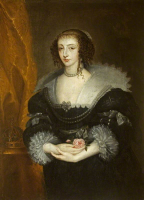
In 1644 Henry Wood 1st Baronet [aged 46] accompanied the Queen [aged 34], Henrietta Maria, to France, as Treasurer to her Household, an office he retained till his death.

On 16th April 1644 Henry Wood 1st Baronet [aged 46] was knighted at Oxford, Oxfordshire [Map].

Before 9th June 1648 [his wife] Anne Webb died at Paris [Map]. She was buried at Charenton on 9th June 1648.

In May 1649 [his father] Thomas Wood [aged 84] died.

On 15th June 1649 Henry Wood 1st Baronet [aged 51] was fined £273 for having been a Royalist.

In November 1651 Henry Wood 1st Baronet [aged 54] and Mary Gardiner [aged 24] were married at Paris [Map]. The difference in their ages was 29 years.

Annals of the six Kings of England by Nicholas Trivet

Translation of the Annals of the Six Kings of England by that traces the rise and rule of the Angevin aka Plantagenet dynasty from the mid-12th to early 14th century. Written by the Dominican scholar Nicholas Trivet, the work offers a vivid account of English history from the reign of King Stephen through to the death of King Edward I, blending political narrative with moral reflection. Covering the reigns of six monarchs—from Stephen to Edward I—the chronicle explores royal authority, rebellion, war, and the shifting balance between crown, church, and nobility. Trivet provides detailed insight into defining moments such as baronial conflicts, Anglo-French rivalry, and the consolidation of royal power under Edward I, whose reign he describes with particular immediacy. The Annals combines careful year-by-year reporting with thoughtful interpretation, presenting history not merely as a sequence of events but as a moral and political lesson. Ideal for readers interested in medieval history, kingship, and the origins of the English state, this chronicle remains a valuable and accessible window into the turbulent world of the Plantagenet kings.

Available at Amazon in eBook and Paperback format.

John Evelyn's Diary. 17th November 1651. I went to congratulate the marriage of [his wife] Mrs. Gardner [aged 24], maid of honor, lately married to that odd person, Sir Henry Wood [aged 54]: but riches do many things.

Around 1657 Henry Wood 1st Baronet [aged 59] was created 1st Baronet Wood.

There is no mention of this creation in Dugdale's Catalogue, but it is stated in the Family of Chester, of Chicheley, by R. E. Chester Waters (where there is a good account of the family of Wood), that Charles II created him a Baronet at the time when he had nothing but titles of honour to bestow. The date of his creation is unknown for his patent was never enrolled, but Sir Thomas Bond, the Comptroller of Queen Henrietta's Household, was made a Baronet 9 Oct. 1658, and it is not likely that the Queen's Treasurer, who had precedence of the Comptroller, would be passed over in the distribution of honours. Sir Henry's name does not occur in any list of Baronets which I have seen, but there is no doubt about his creation, for he is constantly styled Baronet in Royal Warrants after 1660, and is so described on his father's monument, and in his own will.

Around 1660 Henry Wood 1st Baronet [aged 62] was appointed Clerk of the Green Cloth.

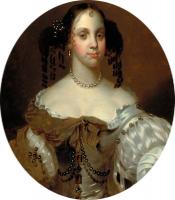
In 1661 Henry Wood 1st Baronet [aged 63] was in attendance on Queen Catharine [aged 22] on her voyage from Lisbon, and was subsequently a member of her Council.

In 1661 Henry Wood 1st Baronet [aged 63] was elected MP Hythe which seat he held until his death in 1671.

In or after 1661 Henry Wood 1st Baronet [aged 63] was appointed Clerk of the Green Cloth.

In or after 1661 Henry Wood 1st Baronet [aged 63] was appointed Clerk of the Green Cloth.

In 1663 [his daughter] Mary Wood Duchess Southampton was born to Henry Wood 1st Baronet [aged 65] and [his wife] Mary Gardiner [aged 35]. She married 1679 Charles Fitzroy 1st Duke Southampton 2nd Duke Cleveland, son of King Charles II of England Scotland and Ireland and Barbara Villiers 1st Duchess of Cleveland.

Samuel Pepys' Diary. 26th October 1663. Thence to Westminster Hall [Map] with Creed, and spent the morning walking there, where, it being Terme time, I met several persons, and talked with them, among others James Pearce Surgeon, who tells me that the Queen [aged 24] is in a way to be pretty well again, but that her delirium in her head continues still; that she talks idle, not by fits, but always, which in some lasts a week after so high a fever, in some more, and in some for ever; that this morning she talked mightily that she was brought to bed, and that she wondered that she should be delivered without pain and without spueing or being sicke, and that she was troubled that her boy was but an ugly boy. But the King [aged 33] being by, said, "No, it is a very pretty boy".-"Nay", says she, "if it be like you it is a fine boy indeed, and I would be very well pleased with it". The other day she talked mightily of Sir H. Wood's [aged 66] [his wife] lady's [aged 36] great belly, and said if she should miscarry he would never get another, and that she never saw such a man as this Sir H. Wood in her life, and seeing of Dr. Pridgeon, she said, "Nay, Doctor, you need not scratch your head, there is hair little enough already in the place". But methinks it was not handsome for the weaknesses of Princes to be talked of thus.

On 17th March 1665 [his wife] Mary Gardiner [aged 38] died of smallpox. On 1st April 1665 she was buried at Westminster Abbey [Map].

Samuel Pepys' Diary. 19th September 1666. Thence to White Hall, with Sir W. Batten [aged 65] and Sir W. Pen [aged 45], to Wilkes's; and there did hear the many profane stories of Sir Henry Wood [aged 68] damning the parsons for so much spending the wine at the sacrament, cursing that ever they took the cup to themselves, and then another story that he valued not all the world's curses, for two pence he shall get at any time the prayers of some poor body that is worth a 1000 of all their curses; Lord Norwich drawing a tooth at a health. Another time, he and Pinchbacke and Dr. Goffe, now a religious man, Pinchbacke did begin a frolick to drink out of a glass with a toad in it that he had taken up going out to shit, he did it without harm. Goffe, who knew sacke would kill the toad, called for sacke; and when he saw it dead, says he, "I will have a quick toad, and will not drink from a dead toad".1 By that means, no other being to be found, he escaped the health.

Note 1. "They swallow their own contradictions as easily as a hector can drink a frog in a glass of wine".-Benlivoglio and Urania, book v., p. 92, 3rd edit. B.

Memoires of Jacques du Clercq

This is a translation of the 'Memoires of Jacques du Clercq', published in 1823 in two volumes, edited by Frederic, Baron de Reissenberg. In his introduction Reissenberg writes: 'Jacques du Clercq tells us that he was born in 1424, and that he was a licentiate in law and a counsellor to Philip the Good, Duke of Burgundy, in the castellany of Douai, Lille, and Orchies. It appears that he established his residence at Arras. In 1446, he married the daughter of Baldwin de la Lacherie, a gentleman who lived in Lille. We read in the fifth book of his Memoirs that his father, also named Jacques du Clercq, had married a lady of the Le Camelin family, from Compiègne. His ancestors, always attached to the counts of Flanders, had constantly served them, whether in their councils or in their armies.' The Memoires cover a period of nineteen years beginning in in 1448, ending in in 1467. It appears that the author had intended to extend the Memoirs beyond that date; no doubt illness or death prevented him from carrying out this plan. As Reissenberg writes the 'merit of this work lies in the simplicity of its narrative, in its tone of good faith, and in a certain air of frankness which naturally wins the reader’s confidence.' Du Clercq ranges from events of national and international importance, including events of the Wars of the Roses in England, to simple, everyday local events such as marriages, robberies, murders, trials and deaths, including that of his own father in Book 5; one of his last entries.

Available at Amazon in eBook and Paperback format.

In 1671 [his brother] Bishop Thomas Wood [aged 64] was appointed Bishop of Lichfield.

On 25th May 1671 Henry Wood 1st Baronet [aged 73] died without male issue. Baronet Wood extinct. On 31st May 1671 he was buried at Ufford, Suffolk. His daughter Mary Wood Duchess Southampton [aged 8] was his heir. In view of the great wealth she was to inherit she was betrothed to Charles Fitzroy 1st Duke Southampton 2nd Duke Cleveland [aged 8], an illegitmate son of King Charles II of England Scotland and Ireland [aged 40] and Barbara Villiers 1st Duchess of Cleveland [aged 30]. On her father's death she went to live with Barbara Villiers 1st Duchess of Cleveland. They, Mary Wood Duchess Southampton and Charles Fitzroy 1st Duke Southampton 2nd Duke Cleveland married 1679 but she died a year later from smallpox.

Ancestors of Henry Wood 1st Baronet 1597-1671

Grandfather: Henry Wood

father: Thomas Wood

Henry Wood 1st Baronet

mother: Susanna Cranmer