

In January 1562 Richard Alington [aged 27] died of smallpox in Long Melford, Suffolk [Map].
Henry Machyn's Diary. January 1562. The (blank) day of (blank) master Recherd Alyngtun [aged 27], the sune of ser Gylles Alyngtun [aged 62] knyght of Cambryge-shyre, the wyche he ded of the smalle pokes.

On 9th February 1605 Filippo Emanuele Prince of Piedmont [aged 18] died of smallpox at Valladolid [Map]. His brother Victor [aged 17] succeeded Duke Savoy.
On 6th December 1618 Elizabeth Radclyffe Viscountess Haddington died of smallpox. She was buried at New Hall, Essex.
In 1620 Jane Okeover [aged 46] died of smallpox. The year also reported as 1622 when her former husband remarried and 1628.

On 25th September 1621 Mary Sidney Countess Pembroke [aged 59] died of smallpox at Herbert Townhouse Aldersgate Street. Her funeral was held at St Paul's Cathedral [Map]. She was buried at Salisbury Cathedral [Map].
Before 31st October 1642 Thomas Smyth [aged 33] died of smallpox. His body was buried in the Chancel of the Church of All Saints, Long Ashton [Map].
On 27th February 1643 Tobias Crispe [aged 43] died of smallpox. He was buried at St Mildred's Church, Bread Street.

On 3rd June 1643 Anne Sophia Herbert Countess Carnarvon died of smallpox.
On 24th June 1649 Henry Hastings [aged 19] died of smallpox.
Abbot John Whethamstede’s Chronicle of the Abbey of St Albans
Abbot John Whethamstede's Register aka Chronicle of his second term at the Abbey of St Albans, 1451-1461, is a remarkable text that describes his first-hand experience of the beginning of the Wars of the Roses including the First and Second Battles of St Albans, 1455 and 1461, respectively, their cause, and their consequences, not least on the Abbey itself. His text also includes Loveday, Blore Heath, Northampton, the Act of Accord, Wakefield, and Towton, and ends with the Coronation of King Edward IV. In addition to the events of the Wars of the Roses, Abbot John, or his scribes who wrote the Chronicle, include details in the life of the Abbey such as charters, letters, land exchanges, visits by legates, and disputes, which provide a rich insight into the day-to-day life of the Abbey, and the challenges faced by its Abbot.
Available at Amazon in eBook and Paperback format.
On 29th November 1649 John Leventhorpe 3rd Baronet [aged 20] died of smallpox unmarried at Chancery Lane [Map]. His brother Thomas [aged 13] succeeded 4th Baronet Leventhorpe of Shingey Hall in Hertfordshire.
In February 1655 George Brydges 6th Baron Chandos [aged 34] died of smallpox. His brother William [aged 34] succeeded 7th Baron Chandos of Sudeley.
On 7th December 1657 Johanna Saxe Gotha [aged 12] died of smallpox at Gotha.
On 31st December 1657 Johann Ernest Saxe Gotha [aged 16] died of smallpox at Gotha.
In 1659 Henry Lee 3rd Baronet [aged 21] died of smallpox. His brother Francis [aged 19] succeeded 4th Baronet Lee of Quarrendon in Buckinghamshire.
In 1660 Bassingbourne Gawdy [aged 22] died of smallpox.

On 10th August 1660 Esmé Stewart 2nd Duke Richmond 5th Duke Lennox [aged 11] died of smallpox at Paris [Map]. He was buried in on 04 Sep 1660 in the Richmond Vault, Westminster Abbey. His first cousin Charles [aged 21] succeeded 6th Duke Lennox, 3rd Duke Richmond, 4th Earl March. Elizabeth Rogers Duchess Richmond by marriage Duchess Richmond. His sister Mary [aged 9] succeeded 5th Baroness Clifton of Leighton Bromswold in Huntingdonshire.

On 13th September 1660 Henry Stewart 1st Duke Gloucester [aged 20] died of smallpox. Duke Gloucester and Earl Cambridge extinct. He was buried at Westminster Abbey [Map] in the same vault as Mary Queen of Scots.
On 24th December 1660 Mary Stewart Princess Orange [aged 29] died of smallpox. Her brother Henry Stewart 1st Duke Gloucester had also died of smallpox a few weeks before; she was buried in the same vault in the King Henry VII Chapel, Westminster Abbey [Map] on 2nd January 1661.


On 4th February 1661 Charles Villiers 2nd Earl Anglesey died of smallpox without legitimate issue. Earl Anglesey, Baron Villiers of Daventry extinct.
William of Worcester's Chronicle of England
William of Worcester, born around 1415, and died around 1482 was secretary to John Fastolf, the renowned soldier of the Hundred Years War, during which time he collected documents, letters, and wrote a record of events. Following their return to England in 1440 William was witness to major events. Twice in his chronicle he uses the first person: 1. when writing about the murder of Thomas, 7th Baron Scales, in 1460, he writes '… and I saw him lying naked in the cemetery near the porch of the church of St. Mary Overie in Southwark …' and 2. describing King Edward IV's entry into London in 1461 he writes '… proclaimed that all the people themselves were to recognize and acknowledge Edward as king. I was present and heard this, and immediately went down with them into the city'. William’s Chronicle is rich in detail. It is the source of much information about the Wars of the Roses, including the term 'Diabolical Marriage' to describe the marriage of Queen Elizabeth Woodville’s brother John’s marriage to Katherine, Dowager Duchess of Norfolk, he aged twenty, she sixty-five or more, and the story about a paper crown being placed in mockery on the severed head of Richard, 3rd Duke of York.
Available at Amazon in eBook and Paperback format.
On 5th May 1661 Charles Stewart died of smallpox at Whitehall Palace [Map].
On 17th December 1661 Charles Coote 1st Earl Mountrath [aged 51] died of smallpox. He was buried in Christ Church Cathedral, Dublin [Map]. Charles Coote 2nd Earl of Mountrath [aged 31] succeeded 2nd Earl Mountrath, 3rd Baronet Coote of Castle Cuffe.
On 17th March 1665 Mary Gardiner [aged 38] died of smallpox. On 1st April 1665 she was buried at Westminster Abbey [Map].
On 6th January 1668 Henry Caesar [aged 37] died of smallpox.
On 30th July 1671 Louis Guise Duke Guise [aged 20] died of smallpox.
In 1675 William Sarsfield died of smallpox.
On 2nd March 1675 Justinian Isham 2nd Baronet [aged 65] died of smallpox at Oxford, Oxfordshire [Map]. He was buried at Church of All Saints, Lamport. His son Thomas [aged 17] succeeded 3rd Baronet Isham of Lamport in Northamptonshire.
In 1676 William Brydges 7th Baron Chandos [aged 55] died of smallpox with no male issue. His third cousin James [aged 33] succeeded 8th Baron Chandos of Sudeley. Elizabeth Barnard Baroness Chandos [aged 33] by marriage Baroness Chandos of Sudeley.
On 19th November 1677 James Fox [aged 12] died of smallpox; some sources say smallpos. He is bured in the cloisters of Westminster Abbey [Map]. His mural monument is inscribed: "Here lies buried, near the ashes of Edward, John, and Stephen, three brothers, the most distinguished young man James Fox, the fifth son of the most honorable Sir Stephen Fox [aged 50], Knight, and Elizabeth his wife, a son most worthy of his parents, and parents worthy of their son. He showed the highest piety, even as a boy, towards God; a unique devotion towards his parents; old-fashioned simplicity among all; a head most dear to Venus and Apollo, a true Adonis and Hyacinth, and by the gifts of his mind and body, a beloved of God now, once of men. O parents, take pity on parents. O children, imitate this son! O descendants, mourn your loss. Cultivated in various kinds of literature, he flourished with an admirable contrast. Under the boy lay hidden another man; in the cradle of life and in death, a Hercules, while snatched away by the treachery of measles, he seemed to have flown from the fire and painful tunic to the heavens. On the 13th day before the Calends of December, in the year of our Lord 1677, aged 12 and a half."
Hic infra situs est, juxta Edwardi, Johannis, & Stephani, trium fratrum cineres, selectissimus Adolescentulus Jacobus Fox, honoratissimi Domini Steph. Fox Equiti Aurati & Elizabethae uxoris, filius natu quintus, parentes filio & filius parentibus quam dignissimus. Summa pietate, vel puer quoad Deum; singulari studio erga parentes, prisca simplicitate inter omnes, percarum Veneri & Apollini caput, indubitatus Adonis & Hyacinthus necnon per dotes animi & corporis, nunc Dei olim hominum amasius. O parentes miseremini parentum. O filii ex illo transcribite filium! O posteri vestrum deflete damnum. Vario literaturae genere excultus admirandi sua floruit Antithesis. Sub puero vir delituit alter in vitae cunabulis & in morte Hercules, dum morbillorum perfidia sublatus, videatur ex igne & tunicâ molestâ evolasse ad coelos. A. D. 13. Cal. Decemb. Anno Dom. 1677. aetatis 12. cum semisse.
On 12th December 1677 Charles Stewart died of smallpox.
In 1678 William Dummer [aged 21] died of smallpox.
Chronicle of a Bourgeois of Valenciennes
Récits d’un bourgeois de Valenciennes aka The Chronicle of a Bourgeois of Valenciennes is a vivid 14th-century vernacular chronicle written by an anonymous urban chronicler from Valenciennes in the County of Hainaut. It survives in a manuscript that describes local and regional history from about 1253 to 1366, blending chronology, narrative episodes, and eyewitness-style accounts of political, military, and social events in medieval France, Flanders, and the Low Countries. The work begins with a chronological framework of events affecting Valenciennes and its region under rulers such as King Philip VI of France and the shifting allegiances of local nobility. It includes accounts of conflicts, sieges, diplomatic manoeuvres, and the impact of broader struggles like the Hundred Years’ War on urban life in Hainaut. Written from the perspective of a burgher (bourgeois) rather than a monastery or royal court, the chronicle offers a rare lay viewpoint on high politics and warfare, reflecting how merchants, townspeople, and civic institutions experienced the turbulence of the 13th and 14th centuries. Its narrative style combines straightforward reporting of events with moral and civic observations, making it a valuable source for readers interested in medieval urban society, regional politics, and the lived experience of war and governance in pre-modern Europe.
Available at Amazon in eBook and Paperback format.
In 1680 Mary Wood Duchess Southampton [aged 17] died of smallpox. She was buried with her mother Mary Gardiner (who also died of smallpox) in Westminster Abbey [Map].
On 22nd June 1680 Elisabeth Saxe Coburg Altenburg [aged 1] died of smallpox at Gotha.
In 1681 Edward Turbeville [aged 33] died of smallpox.
In 1685 Anne Killigrew [aged 25] died of smallpox. She was buried at Savoy Chapel Royal [Map].
On 14th March 1685 Mary Evelyn [aged 20] died of smallpox.
On 9th July 1685 John Hussey [aged 26] died of smallpox.
On 27th August 1685 Elizabeth Evelyn [aged 17] died of smallpox.

Around 18th April 1686 Archbishop John Dolben [aged 61] died of smallpox. He had been returned from York to London when he came into contact with a person infected with small-pox. Becoming infected himself he died a few days later.
Around 1690 Henry Horatio O'Brien died of smallpox.
On 21st October 1690 Infanta Isabel Luísa of Portugal [aged 21] died of smallpox.
William of Worcester's Chronicle of England
William of Worcester, born around 1415, and died around 1482 was secretary to John Fastolf, the renowned soldier of the Hundred Years War, during which time he collected documents, letters, and wrote a record of events. Following their return to England in 1440 William was witness to major events. Twice in his chronicle he uses the first person: 1. when writing about the murder of Thomas, 7th Baron Scales, in 1460, he writes '… and I saw him lying naked in the cemetery near the porch of the church of St. Mary Overie in Southwark …' and 2. describing King Edward IV's entry into London in 1461 he writes '… proclaimed that all the people themselves were to recognize and acknowledge Edward as king. I was present and heard this, and immediately went down with them into the city'. William’s Chronicle is rich in detail. It is the source of much information about the Wars of the Roses, including the term 'Diabolical Marriage' to describe the marriage of Queen Elizabeth Woodville’s brother John’s marriage to Katherine, Dowager Duchess of Norfolk, he aged twenty, she sixty-five or more, and the story about a paper crown being placed in mockery on the severed head of Richard, 3rd Duke of York.
Available at Amazon in eBook and Paperback format.

On 6th August 1691 Mary Compton Countess Dorset and Middlesex [aged 22] died of smallpox.
On 26th November 1691 John Barrington 4th Baronet [aged 21] died of smallpox. His brother Charles [aged 20] succeeded 5th Baronet Barrington of Barrington Hall.
On 21st March 1693 Walter Chetwynd [aged 60] died of smallpox. He was buried at St Mary the Virgin Church, Ingestre [Map]. John Chetwynd of Boughton [aged 50] inherited Ingestre Hall, Staffordshire.
On 24th May 1694 Anthony Carey 5th Viscount Falkland [aged 38] died of smallpox. He was buried at Westminster Abbey [Map]. His second cousin Lucius [aged 6] succeeded 6th Viscount Falkland.
On 28th December 1694 Mary Stewart II Queen England Scotland and Ireland [aged 32] died of smallpox shortly after midnight at Kensington Palace. Her body lay in state at the Banqueting House, Whitehall Palace [Map].
On 5th March 1695 she was buried in Westminster Abbey [Map]. Archbishop Thomas Tenison [aged 58] preached the sermon.
She had reigned for five years. Her husband King William III of England, Scotland and Ireland [aged 44] continued to reign for a further eight years.


In November 1695 John Guise 2nd Baronet [aged 41] died of smallpox. He was buried in St John the Baptist's Church, Elmore. His son John [aged 18] succeeded 3rd Baronet Guise of Elmore in Gloucestershire.
On 25th February 1699 Robert Shirley [aged 25] died of smallpox.
On 30th July 1700 Prince William Duke Gloucester [aged 11] died of smallpox.
On 16th September 1700 Thomas Morgan [aged 36] died of smallpox. John Morgan of Tredegar [aged 29] inherited Tredegar House, Monmouthshire and estates worth £7000.
On 5th June 1701 Thomas Gee died of smallpox. Buried at St Matthew's Church, Hayfield [Map].
On 8th November 1702 John Evelyn of Nutfield [aged 25] died of smallpox.
On 20th February 1703 John Churchill [aged 17] died of smallpox.
On 21st November 1703 Karl Frederick Saxe Coburg Altenburg [aged 1] died of smallpox (possibly) at Gotha.
On 29th November 1703 Sophie Saxe Coburg Altenburg [aged 6] died of smallpox at Gotha.
On 28th March 1704 Edward Ward 8th Baron Dudley 3rd Baron Ward [aged 20] died of smallpox. His son Edward succeeded 4th Baron Ward of Birmingham, 9th Baron Dudley posthumously.
Jean de Waurin's Chronicle of England Volume 6 Books 3-6: The Wars of the Roses
Jean de Waurin was a French Chronicler, from the Artois region, who was born around 1400, and died around 1474. Waurin’s Chronicle of England, Volume 6, covering the period 1450 to 1471, from which we have selected and translated Chapters relating to the Wars of the Roses, provides a vivid, original, contemporary description of key events some of which he witnessed first-hand, some of which he was told by the key people involved with whom Waurin had a personal relationship.
Available at Amazon in eBook and Paperback format.
On 27th February 1705 Christian Saxe Coburg Altenburg was born to Frederick Saxe Coburg Altenburg II Duke Saxe Gotha Altenburg [aged 28] and Magdalena Augusta Anhalt-Zerbst Duchess Saxe Gotha Altenburg at Gotha. He died of smallpox on 5th March 1705 at Gotha.
In 1710 Margaret Brownlow [aged 23] died of smallpox. Her estate of £40,000 was divided between her four sisters: Jane Brownlow Duchess Ancaster and Kesteven, Elizabeth Brownlow Countess Exeter [aged 29], Alicia Brownlow Baroness Guildford [aged 26] and Eleanor Brownlow Viscountess Tyconnel [aged 19].


On 16th June 1710 William Ashburnham 2nd Baron Ashburnham [aged 31] died of smallpox at Ashburnham. His brother John [aged 23] succeeded 3rd Baron Ashburnham of Ashburnham in Sussex.
In July 1710 Catherine Taylor died of smallpox.
On 27th November 1710 Robert Lovett [aged 43] died of smallpox.
In 1711 Joseph I Holy Roman Emperor [aged 32] died of smallpox. His brother Charles [aged 25] succeeded VI Holy Roman Emperor.
In 1711 William Henry Osborne [aged 21] died of smallpox in Utrecht.
On 14th April 1711 Louis "Le Grand Dauphin" Bourbon Duke Burgundy [aged 49] died of smallpox. Louis Bourbon Duke Burgundy [aged 28] was appointed Duke Burgundy and Dauphin.
On 17th May 1711 William Henry Granville 3rd Earl of Bath [aged 19] died of smallpox. Earl Bath, Baron Granville of Kilkhampton and Biddeford extinct.

On 20th March 1711 Cloberley Bromley [aged 25] died of smallpox. The House of Commons, on behalf of his father, the Speaker, William Bromley [aged 47] adjourbed until the 26th of March.
On 22nd February 1712 John Reade 3rd Baronet [aged 21] died of smallpox unmarried at Rome in exile having become a Jacobite. He was buried on 11th June 1712 in the Brocket Chapel at St Etheldreda's Church, Hatfield [Map]; see monument here [Map]. Baronet Reade of Brocket Hall in Hertfordshire extinct.
William of Worcester's Chronicle of England
William of Worcester, born around 1415, and died around 1482 was secretary to John Fastolf, the renowned soldier of the Hundred Years War, during which time he collected documents, letters, and wrote a record of events. Following their return to England in 1440 William was witness to major events. Twice in his chronicle he uses the first person: 1. when writing about the murder of Thomas, 7th Baron Scales, in 1460, he writes '… and I saw him lying naked in the cemetery near the porch of the church of St. Mary Overie in Southwark …' and 2. describing King Edward IV's entry into London in 1461 he writes '… proclaimed that all the people themselves were to recognize and acknowledge Edward as king. I was present and heard this, and immediately went down with them into the city'. William’s Chronicle is rich in detail. It is the source of much information about the Wars of the Roses, including the term 'Diabolical Marriage' to describe the marriage of Queen Elizabeth Woodville’s brother John’s marriage to Katherine, Dowager Duchess of Norfolk, he aged twenty, she sixty-five or more, and the story about a paper crown being placed in mockery on the severed head of Richard, 3rd Duke of York.
Available at Amazon in eBook and Paperback format.
In 1713 William Pierrepont [aged 21] died of smallpox. He was buried at the Church of St Edmund, Holme Pierrepoint [Map].
On 22nd March 1713 Robert Petre 7th Baron Petre [aged 24] died of smallpox. His son Robert succeeded 8th Baron Petre.
On or before 27th March 1713, the date he was buried at Westminster Abbey, Richard Maulever 5th Baronet [aged 24] died of smallpox. He was unmarried. Baronet Maulever of Allerton in Yorkshire extinct.
On 1st December 1713 Richard Lowther 2nd Viscount Lonsdale [aged 19] died of smallpox. His brother Henry [aged 19] succeeded 3rd Viscount Lonsdale in Westmoreland.
On 17th April 1714 Baptist Noel 3rd Earl Gainsborough [aged 30] died of smallpox. His son Baptist [aged 6] succeeded 4th Earl Gainsborough, 7th Viscount Campden, 7th Baron Hicks of Ilmington in Warwickshire.
On 5th July 1714 Robert Shirley [aged 21] died of smallpox. Monument in Holy Trinity Church Staunton Harold, Leicestershire [Map]. Elbow Reclining Figure. Powdered Wig. Heeled Shoes. Possibly by John Michael Rysbrack [aged 20].
Robert Shirley: On 28th December 1692 he was born to Robert Shirley and Anne Ferrers.
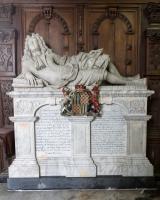
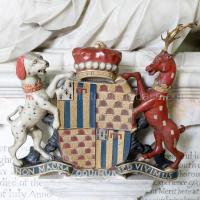
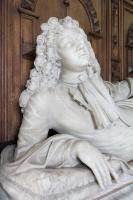
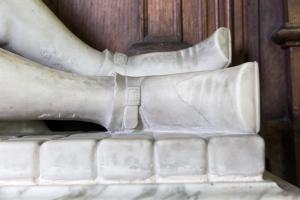
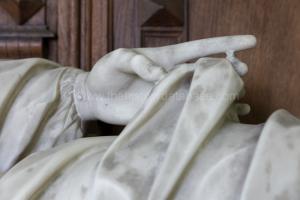
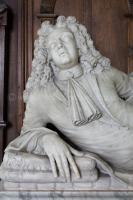
On 30th January 1719 John Egerton [aged 14] died of smallpox at Eton College [Map]. He was buried at St Peter and St Paul Church, Little Gaddesden on 5th February 1719.
In 1721 Helen Froggatt [aged 22] died of smallpox during an epidemic at Kinder.
In 1721 Elizabeth Booth died of smallpox.
On 21st May 1721 Francis Gee [aged 17] died of smallpox. He was buried at St Matthew's Church, Hayfield [Map].
On 23rd May 1721 Essex Finch [aged 34] died of smallpox.
Annals of the six Kings of England by Nicholas Trivet
Translation of the Annals of the Six Kings of England by that traces the rise and rule of the Angevin aka Plantagenet dynasty from the mid-12th to early 14th century. Written by the Dominican scholar Nicholas Trivet, the work offers a vivid account of English history from the reign of King Stephen through to the death of King Edward I, blending political narrative with moral reflection. Covering the reigns of six monarchs—from Stephen to Edward I—the chronicle explores royal authority, rebellion, war, and the shifting balance between crown, church, and nobility. Trivet provides detailed insight into defining moments such as baronial conflicts, Anglo-French rivalry, and the consolidation of royal power under Edward I, whose reign he describes with particular immediacy. The Annals combines careful year-by-year reporting with thoughtful interpretation, presenting history not merely as a sequence of events but as a moral and political lesson. Ideal for readers interested in medieval history, kingship, and the origins of the English state, this chronicle remains a valuable and accessible window into the turbulent world of the Plantagenet kings.
Available at Amazon in eBook and Paperback format.
On 4th July 1721 Percy Seymour [aged 25] died of smallpox.
Before 19th August 1721 John Booth of Kinder died of smallpox. He was buried at St Matthew's Church, Hayfield [Map]. His son Thomas Booth [aged 2] inherited Booth Farm, Kinder [Map].
On 21st September 1721 John Froggat [aged 19] died of smallpox.
Before 24th July 1722 Robert Nightingale 4th Baronet died of smallpox unmarried. His brother Edward [aged 64] de jure 5th Baronet Nightingale of Newport Pond in Essex.
On 4th June 1723 Léopold Clement Charles Lorraine [aged 16] died of smallpox.


On 31st August 1724 Louis I King Spain [aged 17] died of smallpox. He was buried at the El Escorial Palace. Philippe V King Spain [aged 40] returned to the Spanish throne.


On 23rd May 1731 John Chaplin 2nd Baronet [aged 20] died of smallpox. Baronet Chaplin of the Inner Temple in London extinct.
In 1732 Elizabeth Tenison died of smallpox.
On 13th May 1737 William Wodehouse [aged 31] died of smallpox without issue. He was buried in St James'.
In 23rd February 1738 Edmund Quincy [aged 56] died of smallpox.
On 1st July 1741 Mary Fairfax Viscountess Fairfax died of smallpox.
On 2nd July 1742 Robert Petre 8th Baron Petre [aged 29] died of smallpox at Ingatestone Hall, Essex. His son Robert succeeded 9th Baron Petre.

The True Chronicles of Jean le Bel Volume 1 Chapters 1-60 1307-1342
The True Chronicles of Jean le Bel offer one of the most vivid and immediate accounts of 14th-century Europe, written by a knight who lived through the events he describes, and experienced some of them first hand. Covering the early decades of the Hundred Years’ War, this remarkable chronicle follows the campaigns of Edward III of England, the politics of France and the Low Countries, and the shifting alliances that shaped medieval warfare. Unlike later historians, Jean le Bel writes with a strong sense of eyewitness authenticity, drawing on personal experience and the testimony of fellow soldiers. His narrative captures not only battles and sieges, but also the realities of military life, diplomacy, and the ideals of chivalry that governed noble society. A key source for Jean Froissart, Le Bel’s chronicle stands on its own as a compelling and insightful work, at once historical record and literary achievement. This translation builds on the 1905 edition published in French by Jules Viard, adding extensive translations from other sources Rymer's Fœdera, the Chronicles of Adam Murimuth, William Nangis, Walter of Guisborough, a Bourgeois of Valenciennes, Geoffrey le Baker of Swinbroke and Richard Lescot to enrich the original text and Viard's notes.
Available at Amazon in eBook and Paperback format.
In 1746 Elizabeth Fazakerley died of smallpox.
On 1st April 1750 Francis Scott [aged 29] died of smallpox. He was buried at Buccleuch Crypt, St Nicholas Church, Dalkeith.
On 24th August 1751 James Aston 5th Baronet [aged 28] died of smallpox without male issue. His fourth cousin once removed Philip [aged 40] succeeded 6th Baronet Aston of Tixall.
In 1752 Margaret Cecil died of smallpox at Earl of Egmont's House Pall Mall.
On 23rd December 1753 Thomas Gresley 5th Baronet [aged 30] died of smallpox. His brother Nigel [aged 26] succeeded 6th Baronet Gresley of Drakelow in Derbyshire. Elizabeth Wynn Lady Gresley by marriage Lady Gresley of Drakelow in Derbyshire.
On 6th June 1759 Bluett Wallop [aged 33] died of smallpox.
On 31st January 1760 Mary Radclyffe [aged 46] died of smallpox in Brussels [Map].

On 23rd December 1762 Maria Johanna Gabriela of Austria [aged 12] died of smallpox.
On 10th May 1774 Louis XV King France [aged 64] died of smallpox. His grandson Louis [aged 19] succeeded XVI King France: Capet Valois Bourbon.


On 20th April 1848 Katherine Isabella Manners [aged 39] died of smallpox at 47 Eaton Place, Kensington.
William of Worcester's Chronicle of England
William of Worcester, born around 1415, and died around 1482 was secretary to John Fastolf, the renowned soldier of the Hundred Years War, during which time he collected documents, letters, and wrote a record of events. Following their return to England in 1440 William was witness to major events. Twice in his chronicle he uses the first person: 1. when writing about the murder of Thomas, 7th Baron Scales, in 1460, he writes '… and I saw him lying naked in the cemetery near the porch of the church of St. Mary Overie in Southwark …' and 2. describing King Edward IV's entry into London in 1461 he writes '… proclaimed that all the people themselves were to recognize and acknowledge Edward as king. I was present and heard this, and immediately went down with them into the city'. William’s Chronicle is rich in detail. It is the source of much information about the Wars of the Roses, including the term 'Diabolical Marriage' to describe the marriage of Queen Elizabeth Woodville’s brother John’s marriage to Katherine, Dowager Duchess of Norfolk, he aged twenty, she sixty-five or more, and the story about a paper crown being placed in mockery on the severed head of Richard, 3rd Duke of York.
Available at Amazon in eBook and Paperback format.
On 3rd March 1883 Frances Grey [aged 3] died of smallpox.