

On 18th October 1697 Canaletto was born. His given name was Giovanni Antonio Canal. He came to be known as Canaletto meaning Little Canal or Canal Junior.

Around 1735. Canaletto [aged 37]. The Interior of the King Henry VII Chapel, Westminster Abbey [Map].

Around 1745. Canaletto [aged 47]. Old Somerset House [Map].
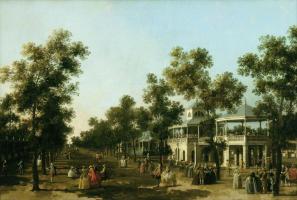
Around 1746. Canaletto [aged 48]. The Grand Walk at Vauxhall Gardens.

Around 1746. Canaletto [aged 48]. The City of Westminster from River Thames near the York Water Gate, York House [Map] with Westminster Bridge [Map] under construction.

Around 1747. Canaletto [aged 49]. View across the River Thames to Westminster Abbey [Map] and Westminster Hall [Map].

Around 1747. Canaletto [aged 49]. Westminster Bridge [Map], with the Lord Mayor's Procession on the Thames.

Around 1748. Canaletto [aged 50]. Warwick Castle [Map].

Around 1749. Canaletto [aged 51]. View of Whitehall, Old Horse Guards and Banqueting House, Whitehall Palace [Map].
Jean de Waurin's Chronicle of England Volume 6 Books 3-6: The Wars of the Roses
Jean de Waurin was a French Chronicler, from the Artois region, who was born around 1400, and died around 1474. Waurin’s Chronicle of England, Volume 6, covering the period 1450 to 1471, from which we have selected and translated Chapters relating to the Wars of the Roses, provides a vivid, original, contemporary description of key events some of which he witnessed first-hand, some of which he was told by the key people involved with whom Waurin had a personal relationship.
Available at Amazon in eBook and Paperback format.
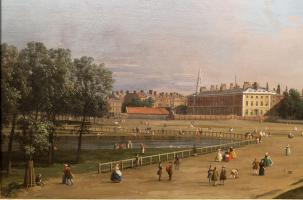
Around 1749. Canaletto [aged 51]. View of St James' Park [Map].

1749. Canaletto [aged 51]. Westminster Abbey [Map] with a procession of Knights of the Bath. St Margaret's Church, Westminster [Map] adjacent with the flag.

Around 1749. Canaletto [aged 51]. View of Whitehall, New Horse Guards.

Around 1750. Canaletto [aged 52]. Alnwick Castle, Northumberland [Map].

Around 1750. Canaletto [aged 52]. Westminster from near the Terrace of Somerset House [Map] In the distance the Banqueting House, Whitehall Palace [Map], Westminster Abbey [Map] and Westminster Bridge [Map].

Around 1750. Canaletto [aged 52]. The City from near the Terrace of Somerset House [Map] with St Paul's Cathedral [Map].

Around 1751. Canaletto [aged 53]. Royal Hospital Chelsea, Rotunda Ranelagh Gardens Chelsea and Ranelagh House.

Around 1752. Canaletto [aged 54]. Greenwich Hospital [Map] from the North Bank of the Thames.

Around 1752. Canaletto [aged 54]. Warwick Castle [Map] East Front from the Courtyard.

1754. Canaletto [aged 56]. Walton on Thames Bridge [Map]. Commissioned by Thomas Hollis [aged 33].
Thomas Hollis: On 14th April 1720 he was born. In 1757 Thomas Hollis was elected Fellow of the Royal Society. On 1st January 1774 he died.
The History of William Marshal was commissioned by his son shortly after William’s death in 1219 to celebrate the Marshal’s remarkable life; it is an authentic, contemporary voice. The manuscript was discovered in 1861 by French historian Paul Meyer. Meyer published the manuscript in its original Anglo-French in 1891 in two books. This book is a line by line translation of the first of Meyer’s books; lines 1-10152. Book 1 of the History begins in 1139 and ends in 1194. It describes the events of the Anarchy, the role of William’s father John, John’s marriages, William’s childhood, his role as a hostage at the siege of Newbury, his injury and imprisonment in Poitou where he met Eleanor of Aquitaine and his life as a knight errant. It continues with the accusation against him of an improper relationship with Margaret, wife of Henry the Young King, his exile, and return, the death of Henry the Young King, the rebellion of Richard, the future King Richard I, war with France, the death of King Henry II, and the capture of King Richard, and the rebellion of John, the future King John. It ends with the release of King Richard and the death of John Marshal.
Available at Amazon in eBook and Paperback format.

1754. Canaletto [aged 56]. Walton on Thames Bridge [Map].

Around 1754. Canaletto [aged 56]. View across the River Thames to Eton College [Map] with the new Eton College Chapel [Map] visible in white stone and the original Tudor buildings in red brick.

Around 1754. Canaletto [aged 56]. View of the interior of the Rotunda Ranelagh Gardens Chelsea.

Around 1754. Canaletto [aged 56]. St Paul's Cathedral [Map].

Around 1763. Canaletto [aged 65]. Northumberland House looking towards Strand [Map]. Note the Percy Lion; crest of the Duke Northumberland. And the statue of King Charles I of England, Scotland and Ireland which remains in situ on the corner of what is now the south-east corner of Trafalgar Square.
On 19th April 1768 Canaletto [aged 70] died.
