

Cowdray House is in Cowdray Midhurst.
Before 1493 David Owen [aged 33] and Mary Bohun [aged 24] were married. by which Owen came into possession of Cowdray House [Map] when Mary inherited it from her father John Bohun of Midhurst [aged 46].
Around 1493 Ann Owen was born to David Owen [aged 34] and Mary Bohun [aged 25] in Cowdray House [Map]. She married before 1515 Arthur Hopton and had issue.
Before 26th April 1494 John Bohun of Midhurst [aged 48] died. His daughter and her husband David Owen [aged 35] inherited Cowdray House [Map].
Around 1500 Henry Owen was born to David Owen [aged 41] and Mary Bohun [aged 32] in Cowdray House [Map].
Around 1520 David Owen [aged 61] began construction of Cowdray House [Map] on the site of the former manor house that he had inherited from his wife Mary Bohun.

In 1529 Henry Owen [aged 29] sold Cowdray House [Map] to William Fitzwilliam 1st Earl of Southampton [aged 39].
In 1533 Henry VIII [aged 41] granted William Fitzwilliam 1st Earl of Southampton [aged 43] to inpark 600 acres of meadow, pasture and wood and build fortifications at Cowdray House [Map].


In November 1538 Margaret York aka Pole Countess of Salisbury [aged 65] was imprisoned in Cowdray House [Map] until Sep 1539.
In July 1539 Henry VIII [aged 48] visited Cowdray House [Map].
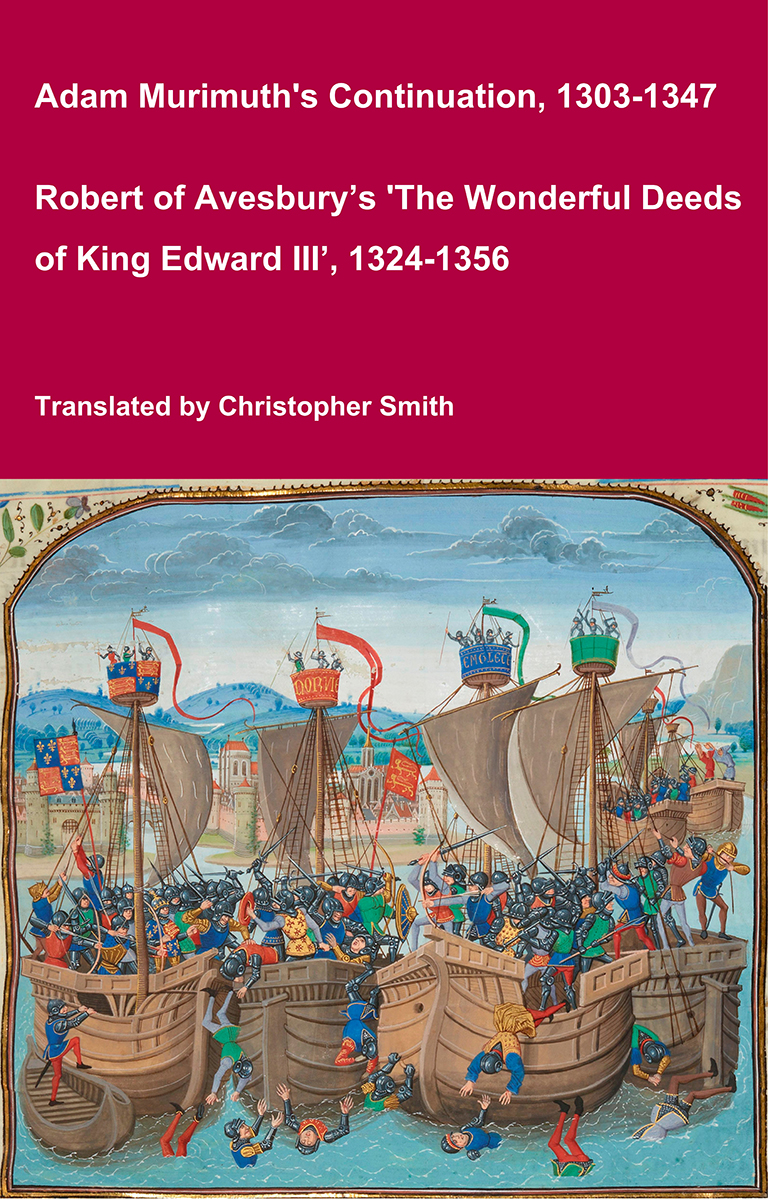
Adam Murimuth's Continuation and Robert of Avesbury’s 'The Wonderful Deeds of King Edward III'
This volume brings together two of the most important contemporary chronicles for the reign of Edward III and the opening phases of the Hundred Years’ War. Written in Latin by English clerical observers, these texts provide a vivid and authoritative window into the political, diplomatic, and military history of fourteenth-century England and its continental ambitions. Adam Murimuth Continuatio's Chronicarum continues an earlier chronicle into the mid-fourteenth century, offering concise but valuable notices on royal policy, foreign relations, and ecclesiastical affairs. Its annalistic structure makes it especially useful for establishing chronology and tracing the development of events year by year. Complementing it, Robert of Avesbury’s De gestis mirabilibus regis Edwardi tertii is a rich documentary chronicle preserving letters, treaties, and official records alongside narrative passages. It is an indispensable source for understanding Edward III’s claim to the French crown, the conduct of war, and the mechanisms of medieval diplomacy. Together, these works offer scholars, students, and enthusiasts a reliable and unembellished account of a transformative period in English and European history. Essential for anyone interested in medieval chronicles, the Hundred Years’ War, or the reign of Edward III.
Available at Amazon in eBook and Paperback format.
In July 1539 Henry VIII [aged 48] visited Cowdray House [Map].
On 15th October 1542 William Fitzwilliam 1st Earl of Southampton [aged 52] died at Newcastle upon Tyne, Northumberland [Map]. Earl of Southampton extinct. Anthony Browne [aged 42] inherited Cowdray House [Map].
In August 1545 Henry VIII [aged 54] visited Cowdray House [Map].

On 6th May 1548 Anthony Browne [aged 48] died at Byfleet, Surrey. He was buried at Senlac Hill Hastings. Anthony Browne 1st Viscount Montagu [aged 19] inherited Cowdray House [Map].
In October 1551 Mary of Guise Queen Consort Scotland [aged 35] stayed the night in Cowdray House [Map].
In July 1552 King Edward VI of England and Ireland [aged 14] visited Cowdray House [Map].


On 22nd July 1552 twins Anthony Browne and Mary Browne Countess Southampton were born to Anthony Browne 1st Viscount Montagu [aged 23] and Jane Radclyffe at Cowdray House [Map]. Their mother died in childbirth although Henry Machen's diary reports her death in 1553.


On 6th October 1573 Henry Wriothesley 3rd Earl of Southampton was born to Henry Wriothesley 2nd Earl of Southampton [aged 28] and Mary Browne Countess Southampton [aged 21] at Cowdray House [Map]. He married 30th August 1598 his third cousin once removed Elizabeth Vernon Countess Southampton and had issue.


On 15th August 1591 Queen Elizabeth I of England and Ireland [aged 57] arrived at Cowdray House [Map] the home of Anthony Browne 1st Viscount Montagu [aged 62] and Magdalen Dacre Viscountess Montague [aged 53]. She was welcomed by a breakfast for some 300 guests. George Browne [aged 36] was knighted. Henry Browne organised the hunting. Elizabeth stayed until the 21 Aug 1591.


On 19th October 1592 Anthony Maria Browne 2nd Viscount Montagu [aged 18] inherited Cowdray House [Map]. During his tenure Guy Fawkes was briefly employed as a footman and, as a consequence, Anthony Maria Browne 2nd Viscount Montagu was briefly imprisoned for complicity in the Gunpowder Plot.

In 1770 Anthony Joseph Browne 7th Viscount Montagu [aged 40] commissioned Capability Brown [aged 53] to landscape Cowdray House [Map].
On 24th September 1793, during restoration work, a fire started in the carpenter's workshop in the North Gallery of Cowdray House [Map] resulting in the destruction of the house and its contents bar three paintings.
Henrici Quinti, Angliæ Regis, Gesta, is a first-hand account of the Agincourt Campaign, and subsequent events to his death in 1422. The author of the first part was a Chaplain in King Henry's retinue who was present from King Henry's departure at Southampton in 1415, at the siege of Harfleur, the battle of Agincourt, and the celebrations on King Henry's return to London. The second part, by another writer, relates the events that took place including the negotiations at Troye, Henry's marriage and his death in 1422.
Available at Amazon in eBook and Paperback format.
In 1843 Cowdray House [Map] was sold to George Perceval 6th Earl Egmont [aged 48] at Shelley, Kirkburton.
In 1908 Augustus Perceval 8th Earl Egmont [aged 52] sold Cowdray House [Map] to Weetman Dickinson Pearson 1st Viscount Cowdray [aged 51].
John Bohun constructed a fortified manor house at Cowdray House [Map] naming it Coudreye which means Hazel Woods in Norman French.
The River Rother rises at Empshott, Hampshire [Map] from where it flows through Liss, Hampshire [Map], Sheet, Hampshire [Map], past Rogate [Map], Trotton [Map], Chithurst [Map], Iping [Map], Stedham [Map], Easebourne Midhurst [Map] and Cowdray House [Map], South Ambersham [Map], Selham [Map], Coultershaw Bridge [Map], Lower Fittleworth [Map] after which it joins the River Arun one km before Pulborough [Map].