Memoires of Jacques du Clercq

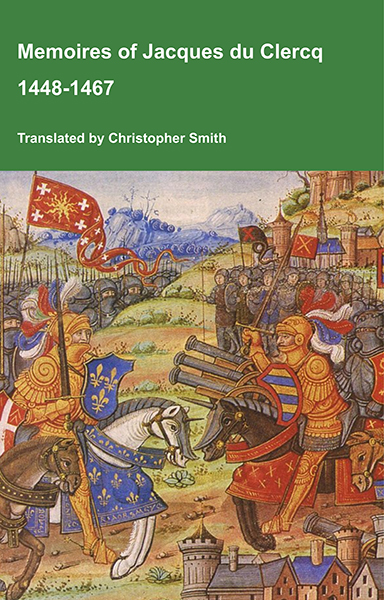
This is a translation of the 'Memoires of Jacques du Clercq', published in 1823 in two volumes, edited by Frederic, Baron de Reissenberg. In his introduction Reissenberg writes: 'Jacques du Clercq tells us that he was born in 1424, and that he was a licentiate in law and a counsellor to Philip the Good, Duke of Burgundy, in the castellany of Douai, Lille, and Orchies. It appears that he established his residence at Arras. In 1446, he married the daughter of Baldwin de la Lacherie, a gentleman who lived in Lille. We read in the fifth book of his Memoirs that his father, also named Jacques du Clercq, had married a lady of the Le Camelin family, from Compiègne. His ancestors, always attached to the counts of Flanders, had constantly served them, whether in their councils or in their armies.' The Memoires cover a period of nineteen years beginning in in 1448, ending in in 1467. It appears that the author had intended to extend the Memoirs beyond that date; no doubt illness or death prevented him from carrying out this plan. As Reissenberg writes the 'merit of this work lies in the simplicity of its narrative, in its tone of good faith, and in a certain air of frankness which naturally wins the reader’s confidence.' Du Clercq ranges from events of national and international importance, including events of the Wars of the Roses in England, to simple, everyday local events such as marriages, robberies, murders, trials and deaths, including that of his own father in Book 5; one of his last entries.

Available at Amazon in eBook and Paperback format.

Bishop Wulfwy -1067

In 1053 Bishop Wulfwy was elected Bishop of Dorchester.

Anglo-Saxon Chronicle. 15th April 1053. In this year was the king [aged 50] at Winchester, Hampshire [Map], at Easter; and Earl Godwin [aged 52] with him, and Earl Harold [aged 31] his son, and Tosty [aged 27]. On the day after Easter sat he with the king at table; when he suddenly sunk beneath against the foot-rail, deprived of speech and of all his strength. He was brought into the king's chamber; and they supposed that it would pass over: but it was not so. He continued thus speechless and helpless till the Thursday; when he resigned his life, on the seventeenth before the calends of May; and he was buried at Winchester in the old minster. Earl Harold, his son, took to the earldom that his father had before, and to all that his father possessed; whilst Earl Elgar took to the earldom that Harold had before. The Welshmen this year slew a great many of the warders of the English people at Westbury, Wiltshire [Map]. This year there was no archbishop in this land: but Bishop Stigand held the see of Canterbury at Christ church, and Kinsey that of York. Leofwine and Wulfwy went over sea, and had themselves consecrated bishops there. Wulfwy took to the bishopric which Ulf had whilst he was living and in exile.

Anglo-Saxon Chronicle. 1067. This year came the king [aged 39] back again to England on St. Nicholas's day; and the same day was burned the church of Christ at Canterbury [Map]. Bishop Wulfwy also died, and is buried at his see in Dorchester [Map].

Chronicon ex Chronicis by Florence and John of Worcester. 1067. Wulfwi, bishop of Dorchester, died at Winchester, but was buried at Dorchester [Map].

In 1067 Bishop Wulfwy died.

Charter S1478 Agreement between Wulfwig, Leofric and Godgifu. Agreement between Bishop Wulfwig, and Earl Leofric and Godgifu, his wife, concerning the endowment of a monastery at Stowe St Mary, Lincs [Map].