

Merionethshire, North West Wales is in North-West Wales aka Gwynedd.
The River Dovey rises nears Pennant, Gwynedd [Map] from where it flows past Dinas Mawddwy, Gwynedd [Map], Aberangell [Map], Cemmaes, Montgomeryshire [Map], Machynlleth [Map] to Aberdyfi [Map] where it joins the Irish Sea.
The River Dovey rises nears Pennant, Gwynedd [Map] from where it flows past Dinas Mawddwy, Gwynedd [Map], Aberangell [Map], Cemmaes, Montgomeryshire [Map], Machynlleth [Map] to Aberdyfi [Map] where it joins the Irish Sea.
The River Dee rises at Lake Bala [Map] from where it flows under Pont Fawr, Denbighshire [Map], past Crogen, Denbighshire [Map], Cynwyd, Denbighshire [Map], Corwen, Denbighshire [Map], Carrog, Denbighshire [Map], Llangollen [Map], under the Pontcysyllte Aqueduct [Map], under Overton Bridge [Map], and Bangor-on-Dee Bridge [Map], past Holt Castle [Map] to Chester, Cheshire [Map] after which it flows past Queensferry, Flintshire [Map] and Flint Castle [Map] before joining the Irish Sea.
The Itinerary of Archbishop Baldwin through Wales: Book 2 Chapter 5. Approaching to the river Devi,135 which divides North and South Wales, the bishop of St. David's, and Rhys the son of Gruffydd, who with a liberality peculiarly praiseworthy in so illustrious a prince, had accompanied us from the castle of Aberteivi, throughout all Cardiganshire, to this place, returned home. Having crossed the river in a boat, and quitted the diocese of St. David's, we entered the land of the sons of Conan, or Merionyth, the first province of Venedotia on that side of the country, and belonging to the bishopric of Bangor.136 We slept that night at Towyn [Map]. Early next morning, Gruffydd son of Conan137 came to meet us, humbly and devoutly asking pardon for having so long delayed his attention to the archbishop. On the same day, we ferried over the bifurcate river Maw,138 where Malgo, son of Rhys, who had attached himself to the archbishop, as a companion to the king's court, discovered a ford near the sea. That night we lay at Llanvair,139 that is the church of St. Mary, in the province of Ardudwy.140 This territory of Conan, and particularly Merionyth, is the rudest and roughest district of all Wales; the ridges of its mountains are very high and narrow, terminating in sharp peaks, and so irregularly jumbled together, that if the shepherds conversing or disputing with each other from their summits, should agree to meet, they could scarcely effect their purpose in the course of the whole day. The lances of this country are very long; for as South Wales excels in the use of the bow, so North Wales is distinguished for its skill in the lance; insomuch that an iron coat of mail will not resist the stroke of a lance thrown at a small distance. The next morning, the youngest son of Conan, named Meredyth, met us at the passage of a bridge, attended by his people, where many persons were signed with the cross; amongst whom was a fine young man of his suite, and one of his intimate friends; and Meredyth, observing that the cloak, on which the cross was to be sewed, appeared of too thin and of too common a texture, with a flood of tears, threw him down his own.
Note 135. This river is now called Dovey.
Note 136. From Llanbadarn our travellers directed their course towards the sea-coast, and ferrying over the river Dovey, which separates North from South Wales, proceeded to Towyn, in Merionethshire, where they passed the night. [Venedotia is the Latin name for Gwynedd.]
Note 137. The province of Merionyth was at this period occupied by David, the son of Owen Gwynedd, who had seized it forcibly from its rightful inheritor. This Gruffydd - who must not be confused with his great-grandfather, the famous Gruffydd ap Conan, prince of Gwynedd - was son to Conan ap Owen Gwynedd; he died A.D. 1200, and was buried in a monk's cowl, in the abbey of Conway.
Note 138. The epithet "bifurcus," ascribed by Giraldus to the river Maw, alludes to its two branches, which unite their streams a little way below Llaneltid bridge, and form an aestuary, which flows down to the sea at Barmouth [Map] or Aber Maw. The ford at this place, discovered by Malgo, no longer exists.
Note 139. Llanfair [Map] is a small village, about a mile and a half from Harlech, with a very simple church, placed in a retired spot, backed by precipitous mountains. Here the archbishop and Giraldus slept, on their journey from Towyn to Nevyn.
Note 140. Ardudwy was a comot of the cantref Dunodic, in Merionethshire, and according to Leland, "Streccith from half Trait Mawr to Abermaw on the shore XII myles." The bridge here alluded to, was probably over the river Artro, which forms a small aestuary near the village of Llanbedr.
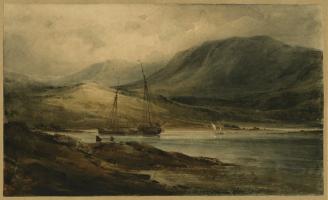
Before 1842. John Sell Cotman [aged 59]. Barmouth Estuary [Map].
Archaeologia Cambrensis 1869 Page 118-147 Cromlechs in North Wales. There are other cromlechs in this part of Merioneth, which, together with the curious remains at Carnedd Hengwm [Map], must be reserved for some future notice.
In January 1283 King Edward I surrounded Dafydd's [aged 44] base of Snowdonia with a massive army. Dafydd initially operated from Dolwyddelan [Map]. Dafydd moved down to Castell y Bere [Map]. In April, Castell y Bere was besieged by over 3,000 men, and the small Welsh garrisonsurrendered on 25th April 1283. Dafydd escaped the siege and moved north to Dolbadarn Castle [Map]. In May 1283, he was forced to move again, this time to the mountains above the Welsh royal home in Abergwyngregyn.
Castles built by the Welsh for the Welsh include Dolbadarn Castle [Map], Dolforwyn Castle [Map], Dolwyddelan Castle [Map], Dryslwyn Castle [Map], Ewloe Castle [Map], Castell Dinas Brân [Map], Castell y Bere [Map], Carreg Cennen Castle [Map] and Arnold Arnaullt Castle [Map].
The Itinerary of Archbishop Baldwin through Wales: Book 2 Chapter 5. Approaching to the river Devi,135 which divides North and South Wales, the bishop of St. David's, and Rhys the son of Gruffydd, who with a liberality peculiarly praiseworthy in so illustrious a prince, had accompanied us from the castle of Aberteivi, throughout all Cardiganshire, to this place, returned home. Having crossed the river in a boat, and quitted the diocese of St. David's, we entered the land of the sons of Conan, or Merionyth, the first province of Venedotia on that side of the country, and belonging to the bishopric of Bangor.136 We slept that night at Towyn [Map]. Early next morning, Gruffydd son of Conan137 came to meet us, humbly and devoutly asking pardon for having so long delayed his attention to the archbishop. On the same day, we ferried over the bifurcate river Maw,138 where Malgo, son of Rhys, who had attached himself to the archbishop, as a companion to the king's court, discovered a ford near the sea. That night we lay at Llanvair,139 that is the church of St. Mary, in the province of Ardudwy.140 This territory of Conan, and particularly Merionyth, is the rudest and roughest district of all Wales; the ridges of its mountains are very high and narrow, terminating in sharp peaks, and so irregularly jumbled together, that if the shepherds conversing or disputing with each other from their summits, should agree to meet, they could scarcely effect their purpose in the course of the whole day. The lances of this country are very long; for as South Wales excels in the use of the bow, so North Wales is distinguished for its skill in the lance; insomuch that an iron coat of mail will not resist the stroke of a lance thrown at a small distance. The next morning, the youngest son of Conan, named Meredyth, met us at the passage of a bridge, attended by his people, where many persons were signed with the cross; amongst whom was a fine young man of his suite, and one of his intimate friends; and Meredyth, observing that the cloak, on which the cross was to be sewed, appeared of too thin and of too common a texture, with a flood of tears, threw him down his own.
Note 135. This river is now called Dovey.
Note 136. From Llanbadarn our travellers directed their course towards the sea-coast, and ferrying over the river Dovey, which separates North from South Wales, proceeded to Towyn, in Merionethshire, where they passed the night. [Venedotia is the Latin name for Gwynedd.]
Note 137. The province of Merionyth was at this period occupied by David, the son of Owen Gwynedd, who had seized it forcibly from its rightful inheritor. This Gruffydd - who must not be confused with his great-grandfather, the famous Gruffydd ap Conan, prince of Gwynedd - was son to Conan ap Owen Gwynedd; he died A.D. 1200, and was buried in a monk's cowl, in the abbey of Conway.
Note 138. The epithet "bifurcus," ascribed by Giraldus to the river Maw, alludes to its two branches, which unite their streams a little way below Llaneltid bridge, and form an aestuary, which flows down to the sea at Barmouth [Map] or Aber Maw. The ford at this place, discovered by Malgo, no longer exists.
Note 139. Llanfair [Map] is a small village, about a mile and a half from Harlech, with a very simple church, placed in a retired spot, backed by precipitous mountains. Here the archbishop and Giraldus slept, on their journey from Towyn to Nevyn.
Note 140. Ardudwy was a comot of the cantref Dunodic, in Merionethshire, and according to Leland, "Streccith from half Trait Mawr to Abermaw on the shore XII myles." The bridge here alluded to, was probably over the river Artro, which forms a small aestuary near the village of Llanbedr.
This is a translation of the 'Memoires of Jacques du Clercq', published in 1823 in two volumes, edited by Frederic, Baron de Reissenberg. In his introduction Reissenberg writes: 'Jacques du Clercq tells us that he was born in 1424, and that he was a licentiate in law and a counsellor to Philip the Good, Duke of Burgundy, in the castellany of Douai, Lille, and Orchies. It appears that he established his residence at Arras. In 1446, he married the daughter of Baldwin de la Lacherie, a gentleman who lived in Lille. We read in the fifth book of his Memoirs that his father, also named Jacques du Clercq, had married a lady of the Le Camelin family, from Compiègne. His ancestors, always attached to the counts of Flanders, had constantly served them, whether in their councils or in their armies.' The Memoires cover a period of nineteen years beginning in in 1448, ending in in 1467. It appears that the author had intended to extend the Memoirs beyond that date; no doubt illness or death prevented him from carrying out this plan. As Reissenberg writes the 'merit of this work lies in the simplicity of its narrative, in its tone of good faith, and in a certain air of frankness which naturally wins the reader’s confidence.' Du Clercq ranges from events of national and international importance, including events of the Wars of the Roses in England, to simple, everyday local events such as marriages, robberies, murders, trials and deaths, including that of his own father in Book 5; one of his last entries.
Available at Amazon in eBook and Paperback format.
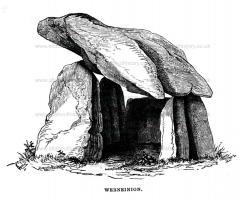
Archaeologia Cambrensis 1869 Page 118-147 Cromlechs in North Wales. In the parish of Llanfair, on a small farm called Gwern Einion, is another cromlech [Gwern Einion Burial Mound [Map]], of larger proportions than those already mentioned. It is, for a Welsh cromlech, in a tolerably perfect condition, and was lately used as a pigsty. There is a large quantity of stones heaped up around it, which may, perhaps, have been the remains of the carn; but this is not quite certain, as the place might have been considered convenient to receive the stones when cleared off the land. (Cut No. 6.)
Archaeologia Cambrensis 1869 Page 118-147 Cromlechs in North Wales. Not far from this spot is a remarkably fine maenhir [Gwern Einion Standing Stone [Map]], built in the middle of a high wall; over which it towers, and presents a conspicuous mark against the setting sun. This stone, local authorities say, was originally dedicated to the sun; and when it was judged expedient to burn a human victim in honour of that luminary, the unfortunate sufferer was secured by iron chains to the stone. The lower part of the stone is now embedded in the wall, so it is not easy to make out the traces of the fire; which otherwise would, no doubt, be discovered, and believed by the peasants of the district. There is little doubt that many other monuments of the same character have once existed in this district, as here and there fragments of them may be found in the stone walls which divide the enclosures. There is also reason to suppose that most of the stones of which the carns were formed have found their way to the same destination, for the builders of these walls have ascertained by experience that the stones taken from such early remains, are much more suitable for their purpose than any others they can find. Whether this is exactly the case in this part of Merioneth, was not ascertained by personal inquiry; but such, at least, is the acknowledged fact in the higher lands of Denbighshire.
On 18th June 1715 Sarah Harvey Viscountess Bulkeley [aged 78] was buried at Llanfor Church.
The Itinerary of Archbishop Baldwin through Wales: Book 2 Chapter 5. Approaching to the river Devi,135 which divides North and South Wales, the bishop of St. David's, and Rhys the son of Gruffydd, who with a liberality peculiarly praiseworthy in so illustrious a prince, had accompanied us from the castle of Aberteivi, throughout all Cardiganshire, to this place, returned home. Having crossed the river in a boat, and quitted the diocese of St. David's, we entered the land of the sons of Conan, or Merionyth, the first province of Venedotia on that side of the country, and belonging to the bishopric of Bangor.136 We slept that night at Towyn [Map]. Early next morning, Gruffydd son of Conan137 came to meet us, humbly and devoutly asking pardon for having so long delayed his attention to the archbishop. On the same day, we ferried over the bifurcate river Maw,138 where Malgo, son of Rhys, who had attached himself to the archbishop, as a companion to the king's court, discovered a ford near the sea. That night we lay at Llanvair,139 that is the church of St. Mary, in the province of Ardudwy.140 This territory of Conan, and particularly Merionyth, is the rudest and roughest district of all Wales; the ridges of its mountains are very high and narrow, terminating in sharp peaks, and so irregularly jumbled together, that if the shepherds conversing or disputing with each other from their summits, should agree to meet, they could scarcely effect their purpose in the course of the whole day. The lances of this country are very long; for as South Wales excels in the use of the bow, so North Wales is distinguished for its skill in the lance; insomuch that an iron coat of mail will not resist the stroke of a lance thrown at a small distance. The next morning, the youngest son of Conan, named Meredyth, met us at the passage of a bridge, attended by his people, where many persons were signed with the cross; amongst whom was a fine young man of his suite, and one of his intimate friends; and Meredyth, observing that the cloak, on which the cross was to be sewed, appeared of too thin and of too common a texture, with a flood of tears, threw him down his own.
Note 135. This river is now called Dovey.
Note 136. From Llanbadarn our travellers directed their course towards the sea-coast, and ferrying over the river Dovey, which separates North from South Wales, proceeded to Towyn, in Merionethshire, where they passed the night. [Venedotia is the Latin name for Gwynedd.]
Note 137. The province of Merionyth was at this period occupied by David, the son of Owen Gwynedd, who had seized it forcibly from its rightful inheritor. This Gruffydd - who must not be confused with his great-grandfather, the famous Gruffydd ap Conan, prince of Gwynedd - was son to Conan ap Owen Gwynedd; he died A.D. 1200, and was buried in a monk's cowl, in the abbey of Conway.
Note 138. The epithet "bifurcus," ascribed by Giraldus to the river Maw, alludes to its two branches, which unite their streams a little way below Llaneltid bridge, and form an aestuary, which flows down to the sea at Barmouth [Map] or Aber Maw. The ford at this place, discovered by Malgo, no longer exists.
Note 139. Llanfair [Map] is a small village, about a mile and a half from Harlech, with a very simple church, placed in a retired spot, backed by precipitous mountains. Here the archbishop and Giraldus slept, on their journey from Towyn to Nevyn.
Note 140. Ardudwy was a comot of the cantref Dunodic, in Merionethshire, and according to Leland, "Streccith from half Trait Mawr to Abermaw on the shore XII myles." The bridge here alluded to, was probably over the river Artro, which forms a small aestuary near the village of Llanbedr.