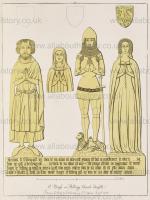
Engravings of Sepulchral Brasses Volume 1. Plate XV. Sir Simon Felbrigge And His Lady Margaret, at Felbrigge, 1413.
Blomefield's Norf. viii.116. Gough's Sepulch. Monum. ii. 138, Anstis's Order of the Garter, ii. 167.
The monument now given is, after the Lynn brasses, the most interesting of the kind that our county can boast. It was placed by Sir Simon Felbrigge in his life time, and under his own direction, upon the death of Margaret his first wife, by whose side it was evidently his intention to be buried; though he afterwards changed his mind, and was buried in the church of the Friars Preachers, in Norwich (the present St. Andrew's Hall), in 1442. The knight, in complete plate armour, has his "shoulder pieces, or emerases, or gonfanons,"1 charged with a plain cross of St. George; round his left leg is the garter with the motto, the first example of it in Norfolk; his right arm supports a banner or pennon, charged with the arms borne by Richard II. in the latter part of his reign. In a shield above the canopy, on the knight's side, the same arms are repeated, as they are on the opposite side also, but impaling quarterly, 1 and 4, the arms of the Empire, a spread eagle with two heads crowned; 2 and 3, the kingdom of Bohemia, a lion rampant, quëue fourchée, being the arms of Anne, Richard's queen. The second and.third quarters are now blank in the plate, but are thus given by Anstis and Blomefield. Suspended from the middle pinnacle is Felbrigge, Or, a lion saliant gules,3 impaling a spread eagle, the arms of his lady: below, on each side, is a fetterlock, his badge, used by Edward IV. also, and the house of York. His supporters are not here, but are said to have been two lions, and his crest a plume of ostrich feathers ermine, issuing from a coronet. On the corbel, between the arches of the canopy, is a white hart lodged, which should have been gorged with a coronet and chain or; the device or badge, and also the supporter of Richard II.
Sir Simon was son of Roger de Felbrigge (vid. sup. 1380), and was a very distinguished knight in the reign of Richard II. To this king, in 1395, he was appointed standard-bearer (an office formerly granted to none but persons of tried courage and known military talents, and endowed with great personal strength), in memory of which the royal standard is represented on the monument. In the first year of Henry V. he received the robes of the Order of the Garter; and in the register of the Garter, 14, he is styled ordinis mawime senew. He died 1443. His first wife was Margaret, daughter of Primislaus, Duke of Teschen, and nephew to Winceslaus V. King of Bohemia, and consequently a near kinswoman of Anne, queen of Richard II. and one of her maids of honour. She died in 1413, and her figure is represented on the stone with his at Felbrigge. His second wife was Katharine, daughter of Ansketil Malory, Esq. of Winwick, and relict of Ralph Grene, of Draiton: she died in 1459, and was buried by her husband at Norwich.
[To the preceding account of this distinguished person it may be added that he furnished twelve men at arms and thirty-six foot archers, and possibly served in the expedition to France under Henry V. in 1415, and at Agincourt. He made his will at Felbrigge in September 1431, which was proved in February 1443-4, whereby he gave certain manors to his daughter Alana, wife of Sir Thomas Wanton, with remainder, failing the heirs of her body, to the right heirs of the body of Sir John Felbrigge, remainder to Richard Felbrigge, remainder to John, brother of the said Richard Felbrigge. He mentioned also his wife Katharine, whom he made one of his executors, and his daughter Anne a nun at Brusyard. 'Katharine Lady Felbrigge, his widow, made her will in February 1459, and ordered her body to be buried with her husband. Testamenta Vetusta, and Harl. MS.10. N.]
Note 1. Palettes—S. R. M.
Note 2. This is one of the few existing memorials of the remarkable change in the royal Arms by the addition of the bearing attributed to Edward the Confessor, introduced by Richard II. which appears never to have been satisfactorily explained, and may deserve some more detailed notice. Froissart relates that he was informed hy a person attached to the court, that the king in his Irish expedition in 1394, with a view to conciliate that country, adopted the bearing of the Confessor: but according to Walsingham, this alteration in the arms commenced about 1398. By some the change has heen attributed to a pious motive, for the Confessor was Richard's Patron Saint, as were likewise the Baptist and King Edmund; and the heralds having assigned arms to Edmund, as well as the Confessor, we might expect, if this were the true explanation, to find both patrons similarly honoured. The MS. Chronicle of Melros imputes it to a different motive, namely, the pride and exultation of Richard, on having triumphed over his foes; as if the bearings of his ancestors were no longer good enough for him; but it were more reasonable to suppose, that he sought to honor the saint, by whose protection the triumph had been attained. These assumed bearings appear neither on the seals, nor the tomb of Richard: they were specially granted, as honorable augmentations of arms, to certain of his favourites or relations, with some armorial difference to each; but in all, as here in the royal arms, were borne impaling their paternal coats. They were granted, perhaps as early as 1396, to Thomas Mowbray, Duke of Norfolk; and afterwards to Thomas Holland, Duke of Surrey, and John Holland, Duke of Exeter, On the brass in Westminster Abbey, of Robert Waldeby, Archbishop of Dublin, who died 1397, and was in Ireland at the period of Richard's expedition,—being also, like Sir Simon Felbrigge, an attached and favoured servant of that king,—the royal arms are again found thus singularly impaled: in wardrobe accounts nearly of the same time, 22 Ric. II. occur entries of robes emdroidered with the arms of the Confessor, and of England, nunc partitis, which seems to imply that it was then a change of recent adoption. See Sandford, and Anstis, Reg. ii, 175, where will be found various memorials of Sir Simon Felbrigge. A.W.
Note 3. Hugh Bigod, Earl of Norfolk, who married Maud Marshal, bore on one side of his seal a representation of himself in complete armour, on horseback, and on the other side a lion saliant: the field was party per pale or and vert, and the lion gules: so that the Felbrigges, as descended from him, varied only (as was customary) the field, but retained the lion.
Note 4. Drawn by John Sell Cotman [aged 33] in 1816.
Click to read more ...