

Maternal Family Tree: Margaret Norwich Countess Suffolk 1286-1368
Simon Felbrigge was born to Roger Felbrigge and Elizabeth Scales.
In 1360 [his father] Roger Felbrigge [aged 25] and [his mother] Elizabeth Scales [aged 20] were married.
Around 1380 [his father] Roger Felbrigge [aged 45] died.
Around 1386 Simon Felbrigge and Margaret of Teschen [aged 19] were married. She one of the maids of honour of Queen Anne of Bohemia.
In 1398 Simon Felbrigge was appointed 91st Knight of the Garter by King Richard II of England [aged 30].
Around 1409 [his daughter] Elizabeth Felbrigge was born to Simon Felbrigge. She married before 1438 Miles Stapleton of Ightham in Norfolk.
In 1416 [his wife] Margaret of Teschen [aged 49] died.
Before 1438 [his son-in-law] Miles Stapleton of Ightham in Norfolk [aged 27] and [his daughter] Elizabeth Felbrigge [aged 28] were married.
Before 1438 [his daughter] Elizabeth Felbrigge [aged 28] died.
On 3rd December 1442 Simon Felbrigge died.
William of Worcester's Chronicle of England
William of Worcester, born around 1415, and died around 1482 was secretary to John Fastolf, the renowned soldier of the Hundred Years War, during which time he collected documents, letters, and wrote a record of events. Following their return to England in 1440 William was witness to major events. Twice in his chronicle he uses the first person: 1. when writing about the murder of Thomas, 7th Baron Scales, in 1460, he writes '… and I saw him lying naked in the cemetery near the porch of the church of St. Mary Overie in Southwark …' and 2. describing King Edward IV's entry into London in 1461 he writes '… proclaimed that all the people themselves were to recognize and acknowledge Edward as king. I was present and heard this, and immediately went down with them into the city'. William’s Chronicle is rich in detail. It is the source of much information about the Wars of the Roses, including the term 'Diabolical Marriage' to describe the marriage of Queen Elizabeth Woodville’s brother John’s marriage to Katherine, Dowager Duchess of Norfolk, he aged twenty, she sixty-five or more, and the story about a paper crown being placed in mockery on the severed head of Richard, 3rd Duke of York.
Available at Amazon in eBook and Paperback format.
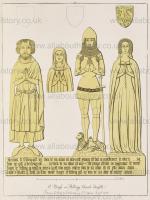
Engravings of Sepulchral Brasses Volume 1. Sir Simon de Felbrigge And Lady, 1351. Sir Roger de Felbrigge And Lady, Felbrigge, Circa 1380.
Blomefield's Norf. viii. 108.
Sir Simon de Felbrigge, son of Sir Roger Bigod, was lord of Felbrigge in the ninth of Edward I. and twenty-second of Edward III. He married Alice, daughter of Sir George de Thorp, and died probably in 1351; for in 1852 we find Sir Roger his son lord, who, three years after, is said to have been in the wars of France. His wife was Elizabeth, daughter of Robert Lord Scales. He died, and was buried in Prussia (misread Paris by Blomefield), as the inscription testifies, in what year is very uncertain; but I have said about 1380, though the eleventh of Richard II. is the first year in which I find his son acting as lord. The dresses of the knight and his lady, almost the counterparts of those of Sir William and Cecilia Kerdeston, point to ten years later, when this stone may have been placed by Sir Simon as a memorial of two generations—his father and his grandfather.
[Though here called Sir Simon de Felbrigge, his effigy shows him to have been a Merchant, which agrees with the inscription, where no title is attributed to him. His son, Sir Roger Felbrigge, was a distinguished soldier, and died in Prussia. N.]
Note. Drawn by John Sell Cotman [aged 32] in May 1815.
Roger Felbrigge: Around 1335 he was born. In 1360 he and Elizabeth Scales were married. Around 1380 he died.

Engravings of Sepulchral Brasses Volume 1. Plate XV. Sir Simon Felbrigge And His Lady Margaret, at Felbrigge, 1413.
Blomefield's Norf. viii.116. Gough's Sepulch. Monum. ii. 138, Anstis's Order of the Garter, ii. 167.
The monument now given is, after the Lynn brasses, the most interesting of the kind that our county can boast. It was placed by Sir Simon Felbrigge in his life time, and under his own direction, upon the death of Margaret his first wife, by whose side it was evidently his intention to be buried; though he afterwards changed his mind, and was buried in the church of the Friars Preachers, in Norwich (the present St. Andrew's Hall), in 1442. The knight, in complete plate armour, has his "shoulder pieces, or emerases, or gonfanons,"1 charged with a plain cross of St. George; round his left leg is the garter with the motto, the first example of it in Norfolk; his right arm supports a banner or pennon, charged with the arms borne by Richard II. in the latter part of his reign. In a shield above the canopy, on the knight's side, the same arms are repeated, as they are on the opposite side also, but impaling quarterly, 1 and 4, the arms of the Empire, a spread eagle with two heads crowned; 2 and 3, the kingdom of Bohemia, a lion rampant, quëue fourchée, being the arms of Anne, Richard's queen. The second and.third quarters are now blank in the plate, but are thus given by Anstis and Blomefield. Suspended from the middle pinnacle is Felbrigge, Or, a lion saliant gules,3 impaling a spread eagle, the arms of his lady: below, on each side, is a fetterlock, his badge, used by Edward IV. also, and the house of York. His supporters are not here, but are said to have been two lions, and his crest a plume of ostrich feathers ermine, issuing from a coronet. On the corbel, between the arches of the canopy, is a white hart lodged, which should have been gorged with a coronet and chain or; the device or badge, and also the supporter of Richard II.
Sir Simon was son of Roger de Felbrigge (vid. sup. 1380), and was a very distinguished knight in the reign of Richard II. To this king, in 1395, he was appointed standard-bearer (an office formerly granted to none but persons of tried courage and known military talents, and endowed with great personal strength), in memory of which the royal standard is represented on the monument. In the first year of Henry V. he received the robes of the Order of the Garter; and in the register of the Garter, 14, he is styled ordinis mawime senew. He died 1443. His first wife was Margaret, daughter of Primislaus, Duke of Teschen, and nephew to Winceslaus V. King of Bohemia, and consequently a near kinswoman of Anne, queen of Richard II. and one of her maids of honour. She died in 1413, and her figure is represented on the stone with his at Felbrigge. His second wife was Katharine, daughter of Ansketil Malory, Esq. of Winwick, and relict of Ralph Grene, of Draiton: she died in 1459, and was buried by her husband at Norwich.
[To the preceding account of this distinguished person it may be added that he furnished twelve men at arms and thirty-six foot archers, and possibly served in the expedition to France under Henry V. in 1415, and at Agincourt. He made his will at Felbrigge in September 1431, which was proved in February 1443-4, whereby he gave certain manors to his daughter Alana, wife of Sir Thomas Wanton, with remainder, failing the heirs of her body, to the right heirs of the body of Sir John Felbrigge, remainder to Richard Felbrigge, remainder to John, brother of the said Richard Felbrigge. He mentioned also his wife Katharine, whom he made one of his executors, and his daughter Anne a nun at Brusyard. 'Katharine Lady Felbrigge, his widow, made her will in February 1459, and ordered her body to be buried with her husband. Testamenta Vetusta, and Harl. MS.10. N.]
Note 1. Palettes—S. R. M.
Note 2. This is one of the few existing memorials of the remarkable change in the royal Arms by the addition of the bearing attributed to Edward the Confessor, introduced by Richard II. which appears never to have been satisfactorily explained, and may deserve some more detailed notice. Froissart relates that he was informed hy a person attached to the court, that the king in his Irish expedition in 1394, with a view to conciliate that country, adopted the bearing of the Confessor: but according to Walsingham, this alteration in the arms commenced about 1398. By some the change has heen attributed to a pious motive, for the Confessor was Richard's Patron Saint, as were likewise the Baptist and King Edmund; and the heralds having assigned arms to Edmund, as well as the Confessor, we might expect, if this were the true explanation, to find both patrons similarly honoured. The MS. Chronicle of Melros imputes it to a different motive, namely, the pride and exultation of Richard, on having triumphed over his foes; as if the bearings of his ancestors were no longer good enough for him; but it were more reasonable to suppose, that he sought to honor the saint, by whose protection the triumph had been attained. These assumed bearings appear neither on the seals, nor the tomb of Richard: they were specially granted, as honorable augmentations of arms, to certain of his favourites or relations, with some armorial difference to each; but in all, as here in the royal arms, were borne impaling their paternal coats. They were granted, perhaps as early as 1396, to Thomas Mowbray, Duke of Norfolk; and afterwards to Thomas Holland, Duke of Surrey, and John Holland, Duke of Exeter, On the brass in Westminster Abbey, of Robert Waldeby, Archbishop of Dublin, who died 1397, and was in Ireland at the period of Richard's expedition,—being also, like Sir Simon Felbrigge, an attached and favoured servant of that king,—the royal arms are again found thus singularly impaled: in wardrobe accounts nearly of the same time, 22 Ric. II. occur entries of robes emdroidered with the arms of the Confessor, and of England, nunc partitis, which seems to imply that it was then a change of recent adoption. See Sandford, and Anstis, Reg. ii, 175, where will be found various memorials of Sir Simon Felbrigge. A.W.
Note 3. Hugh Bigod, Earl of Norfolk, who married Maud Marshal, bore on one side of his seal a representation of himself in complete armour, on horseback, and on the other side a lion saliant: the field was party per pale or and vert, and the lion gules: so that the Felbrigges, as descended from him, varied only (as was customary) the field, but retained the lion.
Note 4. Drawn by John Sell Cotman [aged 33] in 1816.
 Westminster Chronicle. At that time the king gave in marriage, at his own expense, certain women of the lady queen’s country to noble men1. For this king, in the beginning of his reign, was so liberal that if anyone rightly asked anything of him, he immediately granted it to him. Indeed, sometimes he anticipated the wishes of those asking, and often used to confer more than had been requested. Yet he gave away his possessions so lavishly that almost everything belonging to his Crown he distributed piecemeal to various persons asking for this and that, together with other profits belonging to the king’s treasury. Thus, after giving away his own resources to others, he was compelled by necessity to oppress the commons. Therefore the poor complain bitterly about this, saying that they cannot long sustain such a burden. Would that the king might arrange to relieve them in some measure, and indeed, as I think, he would gain no small advantage from it.
Quo in tempore rex quasdam mulieres dominæ reginæ compatriotas viris nobilibus suis sumptibus nuptui tradidit. Erat namque rex iste in sui primordio tam liberalis ut si quis ab eo quiequid rite petiisset illico sibi concederet. Immo quandoque petentium voluntates ipse prævenit et ultra petita sæpe conferre solebat ; verum tamen tam profuse est sua largitus quod omnia quæ suæ coronæ pertinuerunt diversis personis hæc et illa postulantibus particulatim cum aliis emolumentis fisco regis pertinentibus fère distribuit; sic enim suis aliis erogatis communitatem de necessitate opprimere est compulsus, Unde pauperes super hoc graviter conqueruntur, asserentes se tale onus diu sustinere non posse. Utinam rex disponeret eosdem in aliquo alleviare et profecto commodum inde non modicum, ut æstimo, reportaret.
Note 1. For example, Simon Felbrigge, died 1442, King Richard II’s standard-bearer, and in 1398 Knight Garter, married Margaret who, as the inscription on the brass over his grave in Black Friars Priory, Norwich, states, was 'of the nation and noble blood of Bohemia and once maid of honour to the most noble Lady Anne, formerly Queen of England.' And Nicholas Sarnesfield, died 1397, who married a Margaret, also one of the Queen's maids of honour. And Robert de Vere, who was, or soon would be, Duke of Ireland, who married Agnes de Launcecrona, Lady of the Bedchamber to Queen Anne, having divorced his first wife Philippa, first cousin to King Richard, who he had married ten years before, causing a scandal, as described by Walsingham, St Albans Chronicle: The Chronica Maiora: "It happened in these days that Robert de Vere, puffed up by the honours which the king was bestowing on him, continually repudiated his wife, a young noblewoman both noble and beautiful, born of Isabella, daughter of the illustrious King Edward [the Third], and married another woman, who had come from Bohemia with Queen Anne, as is said, the daughter of a certain saddler, altogether low-born and ugly. Because of this, a great occasion for scandals crept in. Her name, in the common tongue, was 'Launcecrona.' In all these matters the king himself favoured him, unwilling to distress him in anything, or rather, as is said, unable in any way to oppose his wishes, because, hindered by the sorceries of a certain friar who was with the said Robert, the king was in no way able to discern or pursue what was good and honourable. The nobles were therefore indignant, but especially the duke of Gloucester, the uncle of the aforesaid young woman [Philippa]. Although he was not at that time able to avenge such great injuries inflicted upon his niece, nevertheless he kept all these things in his heart until the time of future retribution. The duke of Ireland, however, was not unaware of the aforesaid matters. For that reason he resolved to take precautions for himself, and considered removing from the midst the duke of Gloucester, together with all those who favoured him."
Kings Wessex: Great x 16 Grand Son of King Alfred "The Great" of Wessex
Kings England: Great x 8 Grand Son of King Henry I "Beauclerc" England
Kings France: Great x 12 Grand Son of Hugh I King of the Franks
Kings Duke Aquitaine: Great x 16 Grand Son of Ranulf I Duke Aquitaine
Father: Roger Felbrigge
Simon Felbrigge 8 x Great Grandson of King Henry I "Beauclerc" England
Great x 2 Grandfather: Roger Scales 1st Baron Scales
Great x 1 Grandfather: Roger Scales 2nd Baron Scales
Great x 2 Grandmother: Isabella Unknown Baroness Scales
Grandfather: Robert Scales 3rd Baron Scales 6 x Great Grandson of King Henry I "Beauclerc" England
Great x 4 Grandfather: Robert Courtenay 1st Baron Okehampton  6 x Great Grandson of Hugh I King of the Franks
Great x 3 Grandfather: John Courtenay 2nd Baron Okehampton 3 x Great Grandson of King Henry I "Beauclerc" England
Great x 4 Grandmother: Mary Vernon Redvers Baroness Okehampton  2 x Great Granddaughter of King Henry I "Beauclerc" England
Great x 2 Grandfather: Hugh Courtenay 3rd Baron Okehampton 4 x Great Grandson of King Henry I "Beauclerc" England
Great x 4 Grandfather: Hugh de Vere 4th Earl of Oxford 
Great x 3 Grandmother: Isabel Vere Baroness Okehampton 7 x Great Granddaughter of Hugh I King of the Franks
Great x 4 Grandmother: Hawise Quincy Countess Oxford 6 x Great Granddaughter of Hugh I King of the Franks
Great x 1 Grandmother: Egeline or Eleanor Courtenay Baroness Scales 5 x Great Granddaughter of King Henry I "Beauclerc" England
Great x 4 Grandfather: Hugh Despencer 
Great x 3 Grandfather: Hugh Despencer
Great x 2 Grandmother: Eleanor Despencer Baroness Okehampton 4 x Great Granddaughter of King Henry I "Beauclerc" England
Great x 4 Grandfather: Philip Basset  2 x Great Grandson of King Henry I "Beauclerc" England
Great x 3 Grandmother: Aline Basset 3 x Great Granddaughter of King Henry I "Beauclerc" England
Great x 4 Grandmother: Hawise Reginar 10 x Great Granddaughter of King Edward "Elder" of the Anglo Saxons
Mother: Elizabeth Scales 7 x Great Granddaughter of King Henry I "Beauclerc" England
Great x 2 Grandfather: Robert Ufford 1st Baron Ufford 
Great x 1 Grandfather: Robert Ufford 1st Earl Suffolk
Great x 3 Grandfather: Robert Valoignes 
Great x 2 Grandmother: Cecily Valoignes Baroness Ufford
Grandmother: Catherine Ufford Baroness Scales
Great x 2 Grandfather: Walter Norwich
Great x 1 Grandmother: Margaret Norwich Countess Suffolk