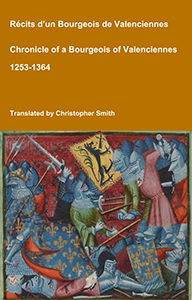
Chronicle of a Bourgeois of Valenciennes

Récits d’un bourgeois de Valenciennes aka The Chronicle of a Bourgeois of Valenciennes is a vivid 14th-century vernacular chronicle written by an anonymous urban chronicler from Valenciennes in the County of Hainaut. It survives in a manuscript that describes local and regional history from about 1253 to 1366, blending chronology, narrative episodes, and eyewitness-style accounts of political, military, and social events in medieval France, Flanders, and the Low Countries. The work begins with a chronological framework of events affecting Valenciennes and its region under rulers such as King Philip VI of France and the shifting allegiances of local nobility. It includes accounts of conflicts, sieges, diplomatic manoeuvres, and the impact of broader struggles like the Hundred Years’ War on urban life in Hainaut. Written from the perspective of a burgher (bourgeois) rather than a monastery or royal court, the chronicle offers a rare lay viewpoint on high politics and warfare, reflecting how merchants, townspeople, and civic institutions experienced the turbulence of the 13th and 14th centuries. Its narrative style combines straightforward reporting of events with moral and civic observations, making it a valuable source for readers interested in medieval urban society, regional politics, and the lived experience of war and governance in pre-modern Europe.

Available at Amazon in eBook and Paperback format.

River Coquet

River Coquet

River Coquet is in North Sea.

737. Church of St Lawrence, Warkworth [Map] is next to the River Coquet 2.5km from where the river joins the sea at Amber. A wooden church is mentioned in 737AD when Ceolwulf King Northumbria gave Wercewode aka Warkworth, including the church, to the Abbot of Lindisfarne Abbey [Map].

Around 1135 Brinkburn Priory, Northumberland [Map] was founded as an Augustinian priory by William Bertram, Baron of Mitford next to the River Coquet.

Around 1150. The date of the first construction of Warkworth Castle, Northumberland [Map] is somewhat vague being founded by either Henry Dunkeld 3rd Earl Huntingdon 1st Earl of Northumbria [aged 36] or King Henry "Curtmantle" II of England [aged 16] on a motte on a natural mound at the narrowest point of a loop of the River Coquet.

Around 1375. Warkworth Bridge, Northumberland [Map], constructed in the late 14th Century, spans the River Coquet at the bottom of the hill in Warkworth, Northumberland [Map] on which is located Warkworth Castle, Northumberland [Map]. The bridge is a mile from where the River Coquet flows into the North Sea. The bridge measures 43m long between land piers, with an overall length of 61m, by 3.5m wide between the parapet walls. The bridge, built of squared and coursed sandstone, has two segmental ribbed arches, each with a span of 18.4m. Documentary evidence records that John Cook of Newcastle, who died in 1378-9, left 20 marks towards the building of Warkworth Bridge on the condition it was built within two years.