

Theobalds House, Hertfordshire is in Theobalds Park, Hertfordshire.

On 2nd July 1575 Elizabeth Vere Countess Derby was born to Edward de Vere 17th Earl of Oxford [aged 25] and Anne Cecil Countess of Oxford [aged 18] at Theobalds House, Hertfordshire. She married 26th January 1595 her fifth cousin William Stanley 6th Earl of Derby, son of Henry Stanley 4th Earl of Derby and Margaret Clifford Countess Derby, and had issue.
On 6th April 1584 Bridget Vere Baroness Norreys Rycote was born to Edward de Vere 17th Earl of Oxford [aged 33] and Anne Cecil Countess of Oxford [aged 27] at Theobalds House, Hertfordshire. She married 1. 28th April 1599 her fifth cousin once removed Francis Norreys 1st Earl Berkshire, son of William Norreys and Elizabeth Morrison Countess Lincoln, and had issue 2. before 1631 her second cousin twice removed Hugh Pollard 2nd Baronet, son of Lewis Pollard 1st Baronet and Margaret Berkeley, and had issue.
Diary of Anne Clifford. 24th March 1603. About 10 o'clock King James was proclaimed in Cheapside by all the Council with great joy and triumph.1 I went to see and hear. This peaceable coming-in of the King was unexpected of all sorts of people. Within two or three days we returned to Clerkenwell again. A little after this Queen Elizabeth's corpse came by night in a barge from Richmond to Whitehall, my Mother [aged 42] and a great company of ladies attending it, where it continued a great while standing in the Drawing Chamber, where it was watched all night by several lords and ladies, my Mother sitting up with it two or three nights, but my Lady would not give me leave to watch, by reason I was held too young. At this time we used to go very much to Whitehall, and walked much in the garden which was frequented by lords and ladies, my Mother being all full of hopes, every man expecting mountains and finding molehills, excepting Sir R. Cecil [aged 39] and the house of the Howards, who hated my Mother and did not much love my Aunt Warwick [aged 55]. About this time my Lord Southampton [aged 29] was enlarged of his imprisonment out of the Tower. When the corpse of Queen Elizabeth had continued at Whitehall as the Council had thought fit, it was carried with great solemnity to Westminster,2 the lords and ladies going on foot to attend it, my Mother and my Aunt of Warwick being mourners, but I was not allowed to be one, because I was not high enough, which did much trouble me then, but yet I stood in the church at Westminster to see the solemnities performed. A little after this my Lady and a great deal of other company as Mrs Eliz. Bridges [aged 25], Lady Newtin, and her daughter Lady Finch [aged 43] [?], went down with my Aunt Warwick to North Hall, and from thence we all went to Tibbalds to see the King who used my Mother and aunt very graciously, but we all saw a great change between the fashion of the Court as it is now and of that in the Queen's time, for we were all lousy by sitting in the chamber of Sir Thomas Erskine [aged 37]. As the King came out of Scotland, when he lay at York, there was a strife between my Father [aged 44] and Lord Burleigh3 (who was the President,) who should carry the sword, but it was adjudged on my Father's side because it was an office by inheritance and so it lineally descended to me. From Tibbalds the King went to Charterhouse, where Lord T. Howard [aged 41] was created Earl of Suffolk, and Lord Mountjoy [aged 40] Earl of Devonshire, and restored Lords Southampton and Essex [aged 12], who stood attainted, likewise he created many barons, among which my uncle Russell [aged 43] was made Lord Russell of Thorney, [sic] and for knights they were innumerable. All this spring I had my health very well. My Father used to come to us sometimes at Clerkenwell but not often, for he had at this time as it were wholly left my Mother, yet the house was kept still at his charge.
Note 1. The first time that King sent to the Lords in England, he gave command that the Earls of Northumberland [aged 38], Cumberland, Lord Thomas Howard, and Lord Mountjoy should be added to the Council.
Note 2. Queen Elizabeth's funeral was on Thursday, April the 8th.
Note 3. A dispute between George Earl of Cumberland, and the Lord Burleigh.


On 7th May 1603 during his journey south King James I of England and Ireland and VI of Scotland [aged 36] stayed at Theobalds House, Hertfordshire as a guest of William Cecil 1st Baron Burghley.
King James I of England and Ireland and VI of Scotland knighted:
Gervase Helwys [aged 41]
John Leventhorpe 1st Baronet [aged 43]
Michael Stanhope [aged 54].
Thomas Bishopp 1st Baronet [aged 50].


Letters of the Court of James I 1613. 15th July 1613. London. Reverend Thomas Lorkin to Thomas Puckering 1st Baronet [aged 21].
Since my last letters, the king hath signed the book for the prince's household, and *** first entry thereupon on Friday last. The same day were sworn unto him all such officers as have been thought fit to be about him for the present. In the bed-chamber - Sir Robert Carey [aged 30], Sir James Fullerton [aged 50], Robert Carr of Ancram [aged 35], were sworn gentlemen, whereof the last came in by my Lord of Rochester's [aged 26] means. Sir David Murray was not only rejected, but taxed openly at the council-table, for having suggested none of the best counsels to the late prince deceased. Into the same place were sworn, as grooms, Mr. Kirk, Mr. Gray (who was formerly his highness's page), and Pitcairne, who, till then, supplied the office of carver. This man is likewise one of my Lord of Rochester's creatures. In the privy-chamber were sworn gentlemen-ushers, Sir William Irwin and Mr. Heydon, to the prejudice of Sir Robert Darcy, who is left out for a wrangler, notwithstanding his continual attendance since his last master's death ***. In quality of gentlemen were sworn into the same place, Sir Arthur Mainwaring [aged 33], Sir Edward Vemey [aged 23], Sir Edward Lewis, Mr. Clare, and Mr. Dallington. The grooms are taken out of the gentlemen-waiters to the prince, while he was Duke of York, without the addition of any, unless it be Trotter, who is either already come in, or like to obtain the like condition very soon. Mr. Young and Mr. Alexander are sworn gentlemen-ushers of the presence. For carvers, cup-bearers, and sewers, I have not yet learned certainly who they be; but I hear there is little alteration. Ramsay is the first equerry, and Sir Thomas Howard [aged 28] master of the horse. The great officers rest still in expectation. Sir David Foulis, it seems, promiseth himself the best assurance; for he executes his place still, though more by permission and sufferance than any commission he hath received to that purpose. D. Ramsay and **** have been great suitors, but with as bad success as may be.
The court is at Theobalds, where his majesty [aged 47] hath been much afflicted with a flux and griping of the belly. He is much amended; and, if the occasion of this sickness alter, not his purpose, begins his progress in [Wiltshire], and so to Salisbury, Wiltshire, next Saturday. The queen [aged 38], likewise, returns to the Bath, Somerset [Map] the Saturday following.
The chief subject of our French news is the compounding of the quarrel between the Dukes of Savoy [aged 51] and Mantua; whereof to write aught to you, who live so near them, were to send owls to Athens.
There hath lately fallen out a great difference between the Duke de Rohan and Monsieur de Plessis (both men of principal mark of them of the Religion, though in a several kind); but what is the cause of their quarrel I yet know not. The chief church there is not a little troubled at it, insomuch that the deputies-general have sent Monsieur Durand, one of the ministers of Paris, down into those parts, to clear the matter, and to mediate a friendly peace between both. The Duke of Lennox [aged 38] hath received there a very honourable entertainment. He was expected in the condition of ambassador; but on his arrival took no other quality than of a private person, which gives many occasion to think, that his first commission was countermanded upon the Duke of Savoy's late ambassage hither. These are but conjectures.
I wish your return into these quarters as soon as the season of the year will permit you; it was your purpose when I left you, and I trust you still keep that resolution. The knowledge of that state is chiefly necessary, and the use of that language. I am sure you understand these things better than myself, and therefore dare not [presume] to advise you. Only my desire is the more earnestly led hereunto by an opinion I have of being able to do you there some pleasing service, and of putting into your hands the commodity of advantaging yourself [into] his highnesses favour, than either your friends or money are like to do in haste. I have heard that you have formerly had some inward acquaintance with Sir Robert Carr of Ancram. It will not be unworthy your entertaining still.


In 1615 Richard Newport 1st Baron Newport [aged 27] was knighted at Theobalds House, Hertfordshire.
Letters of John Chamberlain Volume 2.252. 252. To Sir Dudley Carleton [aged 43]. [S. P. Dom., Jac. I, lxxxix, 21.] London, November 14, 1616.
My very goode Lord: Beeing last night at Master Secretaries [aged 53] I understoode that Dieston was to be dispatcht this day towards you, who must not come empty though I wrote so lately. There supped divers of your goode frends, Sir Walter Raleigh [aged 62], Sir Henry Savile, Sir Maurice Barklay, Sir ... Seymor, Sir Harry Nevill, Sir Robert Killegree with I know not how many Ladies and gentlewomen of that race and alliance. The absence of the court geves Master Secretarie leave and leysure to entertain his frends as Sir Henry Savile was there likewise the night before: the King went to Tiballs on Monday and so towards Roiston and Newmarket. The Quene continues at Somerset House till his return. The Lord Cooke [aged 64] is now quite of the hookes, and order geven to send him a supersedeas from executing his place. The common speach is that fowre Ps have overthrown and put him down, that is Pride, Prohibitions, Premunire, and Prerogative. Sir Henry Montague is generally nominated to the place, by reason that the citie is written unto to choose Sir Harry Yelverton [aged 50] for theyre Recorder which is terminus diminutinus [diminutive term] to his office of sollicitor, but yet must be accepted to serve turns. Yet perhaps yt may be that yf yt come to light in time that the late Recorder [aged 53]1 hath maried his maide1 (as is bruited) and geven her such earnest as cannot be long concealed, yt may hinder his preferment.
Note 1. Henry Montagu, future Earl of Mancheser, married three times. His second wife Anne Wincot died in November 1614 so at the time of the letter he was a widower. He next married in 1620 to Margaret Crouch Countess Manchester [aged 11].


On 19th July 1619 Richard Lumley 1st Viscount Lumley [aged 30] was knighted by King James I of England and Ireland and VI of Scotland [aged 53] at Theobalds House, Hertfordshire.
On 1st December 1623 John Strode of Parnham [aged 62] was knighted at Theobalds House, Hertfordshire.
On 27th March 1625 King James I of England and Ireland and VI of Scotland [aged 58] died at Theobalds House, Hertfordshire. His son Charles [aged 24] succeeded I King England Scotland and Ireland. Duke York merged with the Crown.


On 9th December 1628 George Grimes [aged 23] was knighted at Theobalds House, Hertfordshire.
John Evelyn's Diary. 15th April 1643. To Hatfield [Map], and near the town of Hertford I went to see Sir J. Harrison's [aged 53] house new built. Returning to London, I called to see his Majesty's house and gardens at Theobald's, since demolished by the rebels.
In 1887 Valerie Susan Langdon Lady Meux [aged 34] purchased the remains of Temple Bar - it had been demolished nine years earlier - and had it erected at Theobalds House, Hertfordshire.


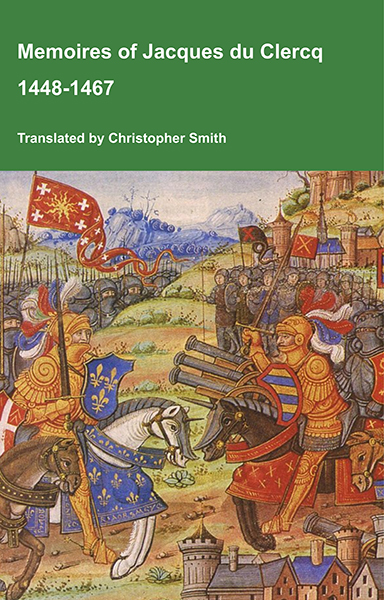
This is a translation of the 'Memoires of Jacques du Clercq', published in 1823 in two volumes, edited by Frederic, Baron de Reissenberg. In his introduction Reissenberg writes: 'Jacques du Clercq tells us that he was born in 1424, and that he was a licentiate in law and a counsellor to Philip the Good, Duke of Burgundy, in the castellany of Douai, Lille, and Orchies. It appears that he established his residence at Arras. In 1446, he married the daughter of Baldwin de la Lacherie, a gentleman who lived in Lille. We read in the fifth book of his Memoirs that his father, also named Jacques du Clercq, had married a lady of the Le Camelin family, from Compiègne. His ancestors, always attached to the counts of Flanders, had constantly served them, whether in their councils or in their armies.' The Memoires cover a period of nineteen years beginning in in 1448, ending in in 1467. It appears that the author had intended to extend the Memoirs beyond that date; no doubt illness or death prevented him from carrying out this plan. As Reissenberg writes the 'merit of this work lies in the simplicity of its narrative, in its tone of good faith, and in a certain air of frankness which naturally wins the reader’s confidence.' Du Clercq ranges from events of national and international importance, including events of the Wars of the Roses in England, to simple, everyday local events such as marriages, robberies, murders, trials and deaths, including that of his own father in Book 5; one of his last entries.
Available at Amazon in eBook and Paperback format.
On 20th December 1910 Valerie Susan Langdon Lady Meux [aged 58] died. She left her estate, including Theobalds House, Hertfordshire, and a substantial interest in the Meux Brewery to Hedworth Lambton aka Meux [aged 54] on condition that he change his surname to Meux, which he duly did. She excluded her mother-in-law's family, the Brudenell-Bruces, from her will probably because they had shunned her socially.