

Paternal Family Tree: Kerr
On 31st March 1586 [his father] Thomas Kerr of Ferniehirst [aged 56] died.
Around 1587 Robert Carr 1st Earl Somerset was born to Thomas Kerr of Ferniehirst at Wrington, Somerset.
Around 1601 Thomas Overbury [aged 20] met Robert Carr 1st Earl Somerset [aged 14] and the two became close friends returning to London together.
In 1603 Robert Devereux 3rd Earl Essex [aged 11] and [his future wife] Frances Howard Countess Essex and Somerset [aged 12] were married. They were separated after the wedding given their young age. Essex went on a European tour from 1607 to 1609. When he returned she avoided him having fallen for Robert Carr 1st Earl Somerset [aged 16] whilst her husband was away. He was ill with smallpox. She sought an annulment with her father Robert Devereux 2nd Earl Essex and uncle Henry Howard 1st Earl of Northampton [aged 62] acting for her. She maintained the marriage had not been consummated and was examined by ten matrons and two midwives who found her hymen intact. It was widely rumoured at the time that Sir Thomas Monson's [aged 38] daughter was a substitute, which is possible because she had requested to be veiled during the examination "for modesty's sake". He maintained he was capable with other women, but was unable to consummate his marriage blaming her. She the daughter of [his future father-in-law] Thomas Howard 1st Earl Suffolk [aged 41] and [his future mother-in-law] Catherine Knyvet Countess Suffolk [aged 39]. He the son of Robert Devereux 2nd Earl Essex and Frances Walsingham Countess Essex [aged 36]. They were fourth cousins.


In 1604 Robert Devereux 3rd Earl Essex [aged 12] was restored 3rd Earl Essex, 4th Viscount Hereford, 13th Baron Ferrers of Chartley, 10th Baron Bourchier although it isn't clear whether the latter three titles were forfeit when his father was executed in 1601. [his future wife] Frances Howard Countess Essex and Somerset [aged 13] by marriage Countess Essex.
Before June 1607 Robert Carr 1st Earl Somerset [aged 20] broke his leg at a tilting match bringing him to the attention to King James I of England and Ireland and VI of Scotland [aged 40].


In June 1607 Robert Carr 1st Earl Somerset [aged 20] was knighted by King James I of England and Ireland and VI of Scotland [aged 40].
In 1611 Robert Carr 1st Earl Somerset [aged 24] was appointed 407th Knight of the Garter by King James I of England and Ireland and VI of Scotland [aged 44].
On 24th March 1611 Robert Carr 1st Earl Somerset [aged 24] was created 1st Viscount Rochester and admitted to the Privy Council. Robert Carr 1st Earl Somerset was now the Kings [aged 44] favourite.
On 22nd April 1613, before Robert Carr 1st Earl Somerset [aged 26] and [his future wife] Frances Howard Countess Essex and Somerset [aged 22] were married, the Howard family sought to undermine Thomas Overbury's [aged 32] influence over Robert Carr 1st Earl Somerset. King James I of England and Ireland and VI of Scotland [aged 46] offered Thomas Overbury an ambassadorship, possibly on the Howard's advice, which Overbury declined to James' annoyance who put Overbury in the Tower of London [Map].
In May 1613 Thomas Killigrew [aged 1] was caught talking to Thomas Overbury, a prisoner in the Tower of London [Map], and sent to the Fleet Prison [Map] for a short time. He was later accused of involvement in Overbury's murder, because he had supplied white powder to his patron, the Earl of Somerset [aged 26], but exonerated.


Letters of the Court of James I 1613. 24th June 1613. London. Reverend Thomas Lorkin to Thomas Puckering 1st Baronet [aged 21].
If these letters did not assure you to the contrary, you might judge me dead; at least that some strange accident hath befallen me, who have kept so deep silence so long a time; for to imagine that either I could forget or neglect your so infinite merits towards me, were a censure too hard and rigorous once to enter into the conceit of so generous a disposition. None of these therefore have been the occasion, but only a mere necessity, first of drawing forth my journey into a longer tract than ever I propounded to myself, and then of making a farther abode in France, than at the beginning I intended, thereby to accommodate certain businesses of your brother [Note. brother-in-law] Newton's [aged 33]1, which began through my absence to grow into some untowardly disorder. But now that I am safely arrived here, I shall promise to dedicate myself wholly to your affairs, and will hope to improve my industry and diligence such as you shall find no fault to complain that ever you reposed in me that trust which you have done. Touching your design in the prince's' service, I had already communicated it with Mr. Newton, who giveth small encouragement of proceeding farther in it, at least till his highpess grow near upon the point of his creation [as Prince of Wales], which is yet likely to hold us in expectance three years longer.
There hath been already some contestation had between your brother and Mr. Murray2, the prince's tutor, touching the place of secretaryship, this man making it, as your brother formerly did, the chief end of his hopes; so that at length Mr. Newton hath been content to relinquish his right thereunto, upon condition to be made his highnesses Teceiver»general, which is like to be no less beneficial than the former. The mastership of his highness's horse hath divers competitors. Sir Thomas Howard is the most importunate suitor; and Ramsey, who is first escuyer to the prince, thinks it great wrong if he do not enjoy it. In the bedchamber, you know there are already two, Sir Robert Carey and Sir James Fullerton [aged 50]: David Murray sues to be the third, hoping by that means to recover himself of what he is so much cast behind in, having made a very weak and uncertain estate unto himself, notwithstanding all his former service. But he is like to meet with difficulty enough before be obtain it, notwithstanding all the furtherance he finds from Mr. Murray, his kinsman.
Among the grooms, Sandilands began the suit first, and had procured the king's grant for his present entrance into that charge: but this giving occasion to Gibb and Ramsey to do the like, their importunity hath been a means to revoke and cross that which the other made sure reckoning to have before fully effected for himself.
The first day of this next month the prince begins to keep house at Richmond, where Sir Arthur Mainwaring [aged 33] and Sir Edward Varnam [aged 23] (so I think they call him, for I am a bad treasurer-up of names) are like to exercise their former places, though they both sue to exchange them with being gentlemen of the privy-chamber. Mr. Alexander likewise shall be pat again into the possession of his. So shall Mr. Peter Newton and his fellow Shaw also. Few others shall be admitted above stairs at this present; and for them below, the first clerks in every office shall execute their proper charge as before.
The great places of the court are not yet disposed of. The manifest faction which is between the family of the Howards on the one side, and the Earl of Southampton [aged 39] and Viscount Rochester [aged 26] on the other, is supposed to be the cause thereof. For the treasurership, the general voice confers it still upon Northampton [aged 73], as it did that of the secretaryship upon Sir Harry Neville; though, for this latter, I suppose his hopes quite dashed; for merely depending upon my Lord Rochester, he wants not opposition; and then, besides, Overbury [aged 32] being fallen into disgrace3, he is thereby deprived of his best instrument. The most likely man to carry it, in the judgment of those who are not altogether unacquainted with those businesses, is Sir Charles Cornwallis, late treasurer to the prince deceased, who is reported very sufficient for foreign affairs: and with him it is thought shall be joined Sir Thomas Luke, though in a far meaner condition than were their predecessors, by reason of the lord treasurer's present greatness.
There hath lately come forth a proclamation against one Cotton, a west-country gentleman and a great recusant, charging him with high treason against the king and State, for having published a very scandalous and railing book against his majesty; and promising a very large reward to whosoever could apprehend him and bring him in. At the very self-same time, this Cotton being to cross the Thames, and inquiring of the watermen what news, they, not knowing the man, told him what was newly happened concerning himself. Whereupon being landed, he muffled himself in his cloak, thinking thereby to pass unknown to any of his acquaintance that he might haply meet. But he had not passed thence many paces, when one Maine, a follower sometimes of the late Lord of Devonshire, and a sure friend of his meeting him in the street and discovering well what he was, [warned] him likewise of danger, with protestation nevertheless not to make any benefit of the discovery of his friend, but wishing him to provide for his own safety. Thereupon Cotton demanding his opinion what he thought fittest to be done, he advised him to submit himself to the king's mercy: whose counsel he followed, and presently went and surrendered himself into my Lord of South* ampton's hands, and so rests at his majesty's mercy.
Your brother Newton, Mr. Southcot, and one Mr. Wood, have all, jointly together, lately obtained letters-patents for the putting in practice of an invention of the said Wood's, who by steeping all kind of com and grain in a certain liquor, undertakes thereby to render it more fruitful with five shillings' cost, than would ever have been before done with forty. They are now very busy in projecting a course for the [spread]ing of it throughout the realm, and hope to reap no small profit and advantage by it. When that is settled, your brother meaneth to make a journey to Durham4, whither Sir Thomas Grantham and his lady purpose to accompany him. He despatches away before great store of provision by sea, both of wine, beer, and divers other commodities, and means to be at the charge of a very honourable entertainment. Only Mrs. Newton stays behind, being hindered by a very happy occasion, finding herself quick with child.
Sir Thomas Mildmay5 keeps Whitehall close, not daring to venture abroad, for Sir John Wentworth's debt. He intends [to sell] Moulsham away shortly, and so to procure his own liberty.
About four or five days since, the Duke of Savoy's [aged 51] ambassador took his leave, who hath been here honoured with a very royal entertainment. The occasion of his ambassage, I suppose, is well enough known unto you, namely, to treat of a second motion of marriage between our prince and one of the daughters of Savoy. His offers are very great, and such as none other cometh near to. His wars upon the Duke of Mantua do, in a manner, furnish the whole subject to the Frenchmen's discourse. To write anything of them, I hold it needless; for, being much nearer, you cannot but understand those things likewise, much better than myself. Only I shall, in a word or two, inform you in how doubtful a deliberation the state of France stands, touching those affairs. The Prince of Conde [aged 24] and the Duke of Bouillon press both very earnestly for the relief of the Mantuan against the Savoyard. The Duke d'Espemon, on the contrary, travaileth all he may to overthrow and hinder it. And not long since, this point being debated in open council. Monsieur le Prince, in the heat of his contestation with the said duke, spared not to tell him that there was now carried so much respect to the affairs of Spain, as in the mean time they quite forgot that natural affection which they owed unto France, threatening therewithal that, in case they continued to reject the wholesome counsel which he gave in a matter of that importance, he would go and make his protestations to the Court of Parliament. It is that which keeps the adverse part somewhat in bridle, though yet the queen seems rather inclined to authorize the advice of the others than his. For, as touching the little aid which the Chevalier de Guise hath lately carried over, it is rather by permission than any commission from the queen, and is wholly composed of mere voluntaries.
The Duke de Vendome having lately retired himself from court to a certain house of his, not far from Paris upon a discontentment taken in the behalf and favour of the Prince of Conde, and there threatening never to return again so long as the regency of this queen lasteth; the queen, being advertised thereof presently, sent and confined him to his house. But the said duke, not able to brook any such confinement, contrary to the queen's injunction, made a journey into Bretagne, and there put himself into a very strong castle, named Ansenis. Whereupon, the queen presently despatched Monsieur de la Yarenne towards him, to command him to return; and, in case of his refusal, threatened to deprive him of his goyemment. The duke thereto made a very humble and submissive answer, yet no way disposes himself to obey her commandment Hereupon, the queen hath renewed it a second time by letters; but these are thought will as little avail as the former. And yet, nevertheless, the Prince of Conde, employing himself very earnestly in favour of the said duke, it is not like that there will be any rigorous proceeding against him, as is threatened.
Note 1. Adam Newton, Esq. He is styled by Dr. Thomas Smith, "Vitre quorandam eruditise et illost. virorim," printed in 4to., in 1707, vir elegantissimi ingenii."
Note 2. This appears to refer to Mr. Thomas Murray, who was tutor to the Duke of York, Charles I [aged 12].
Note 3. He had ventored to remonstrate with the favourite respecting his intimacy with the [his future wife] Countess of Essex [aged 23].
Note 4. See the letter of Letter August 12. Mr. Newton was, as we have stated, Dean of Durham, though a layman: such an appointment being allowable at this period.
Note 5. Knighted by King James I., at his majesty's arrival at Whitehall from Scotland, July 23, 1603, and created a baronet, Jane 29, 1611.


The Deeds of the Dukes of Normandy
The Gesta Normannorum Ducum [The Deeds of the Dukes of Normandy] is a landmark medieval chronicle tracing the rise and fall of the Norman dynasty from its early roots through the pivotal events surrounding the Norman Conquest of England. Originally penned in Latin by the monk William of Jumièges shortly before 1060 and later expanded at the behest of William the Conqueror, the work chronicles the deeds, politics, battles, and leadership of the Norman dukes, especially William’s own claim to the English throne. The narrative combines earlier historical sources with firsthand information and oral testimony to present an authoritative account of Normandy’s transformation from a Viking settlement into one of medieval Europe’s most powerful realms. William’s history emphasizes the legitimacy, military prowess, and governance of the Norman line, framing their expansion, including the conquest of England, as both divinely sanctioned and noble in purpose. Later chroniclers such as Orderic Vitalis and Robert of Torigni continued the history, extending the coverage into the 12th century, providing broader context on ducal rule and its impact. Today this classic work remains a foundational source for understanding Norman identity, medieval statesmanship, and the historical forces that reshaped England and Western Europe between 800AD and 1100AD.
Available at Amazon in eBook and Paperback format.
Letters of the Court of James I 1613. 8th July 1613. London. Reverend Thomas Lorkin to Thomas Puckering 1st Baronet [aged 21].
Painters and poets may lie by privilege; but such as undertake to make relation of things that pass, should tell naught but truth. Pardon me, therefore, if I must now revoke what in my last letters I writ for certain, touching the swearing of Sir David Murray and Sir Robert Carr [aged 35] in his highness's bedchamber. I received it very confidently from Sir John Harrington's [aged 73] mouth. But I have found since, by my inquiry, that they only procured the king's warrant, which met with afterwards that opposition from the lords, as it rests yet doubtful whether and when it shall take effect. The prince's household is not yet settled; yesterday the council sat about it, and the opinion was that the king would then sign the book.
My Lord Stanhope's [aged 64]1 son [aged 20] is lately fallen lunatic; and the little hope that is conceived of his recovery makes divers of your friends think that it was your hard fortune to be no more forward in embracing those offers which were formerly made you out of that house.
You have heard long since, I suppose, of the great difference between my Lord of Essex [aged 22] and his [his future wife] lady [aged 23], who hath most earnestly sued for a divorce, pretending the only cause to be of her husband's insufficiency; who confesseth it towards her, though he esteems himself well enough provided for any other. It was expected that a nullity of marriage should have been pronounced by my Lord of Canterbury [aged 50] at the end of last term, but the sentence is deferred to the term following; which, if it be given in favour of her, it is generally believed that a match shall be concluded between my Lord of Rochester [aged 26] and her: thereby to reconcile him and the house of Howard together, who are now far enough asunder.
The news of the great entertainment at the Palatine's I court is but newly arrived here. It consists chiefly in matter of good cheer, after the fashion of the country. They talk of I know not how many hundred tables which should be every day prepared; but you will easily proportion them out yourself, when you shall hear of the number of mouths, which were no fewer, every meal, than 6000. The same messenger brings tidings that her grace is with child, and that there wants not the concurrence of all sach tokens and probabilities as are usually observed in women in that state and condition.
The Duke of Lennox [aged 38]2 arrived in Paris on Saturday last, as we are informed here, having made that the way of his return home from Heidelberg. He pretends the occasion of his stay there to be, the seeking to obtain the command of the company of horse which our Prince Charles had, when he was but Duke of York. But, though made an absolute refusal of it before his coming, he having employed himself in that business by commission from our king, the true cause of his stay is thought to be a treaty of marriage between Prince Charles and Madame Christine, which, having been long time negociated by Sir Thomas Edraondes, is thought shall receive its final conclusion from him.
Sir Thomas Waller [deceased], governor of Dover Castle, is lately dead. His place is already disposed of; but I cannot say certainly how. Sir Thomas Somerset [aged 34]3 inquires very kindly after you, and you shall do well to omit no good means of entertaining his good opinion still.
Note 1. John, created an English baron by the title of Lord Stanhope of Harrington, May 4, 1605. He died March 9, 1621, leaving issue one daughter only. [Note. He left issue Charles Stanhope 2nd Baron Stanhope, Elizabeth Stanhope Lady Talmash and Catherine Stanhope Countess Leinster]
Note 2. Lodovick Stuart. He was high chamberlain and admiral of Scotland, and in 1601 was Bent by James ambassador to the court of France. In October, 1613, he was created Baron Setrington and Earl of Richmond. He filled the offices of master of the hoasehold, first gentleman of the bedchamber, was invested with the garter, and appointed commissioner to the parliament; and, in 1623, was further advanced to the dignities of the Earl of Newcastle and Duke of Richmond. Though twice married, the Duke of Lennox died without issue, in February. 1624.
Note 3. Third son of Edward, Earl of Worcester [aged 63]. He was afterwards created Viscount Somerset of Cassel (Cashel) in Ireland.


Letters of the Court of James I 1613. 15th July 1613. London. Reverend Thomas Lorkin to Thomas Puckering 1st Baronet [aged 21].
Since my last letters, the king hath signed the book for the prince's household, and *** first entry thereupon on Friday last. The same day were sworn unto him all such officers as have been thought fit to be about him for the present. In the bed-chamber - Sir Robert Carey [aged 30], Sir James Fullerton [aged 50], Robert Carr of Ancram [aged 35], were sworn gentlemen, whereof the last came in by my Lord of Rochester's [aged 26] means. Sir David Murray was not only rejected, but taxed openly at the council-table, for having suggested none of the best counsels to the late prince deceased. Into the same place were sworn, as grooms, Mr. Kirk, Mr. Gray (who was formerly his highness's page), and Pitcairne, who, till then, supplied the office of carver. This man is likewise one of my Lord of Rochester's creatures. In the privy-chamber were sworn gentlemen-ushers, Sir William Irwin and Mr. Heydon, to the prejudice of Sir Robert Darcy, who is left out for a wrangler, notwithstanding his continual attendance since his last master's death ***. In quality of gentlemen were sworn into the same place, Sir Arthur Mainwaring [aged 33], Sir Edward Vemey [aged 23], Sir Edward Lewis, Mr. Clare, and Mr. Dallington. The grooms are taken out of the gentlemen-waiters to the prince, while he was Duke of York, without the addition of any, unless it be Trotter, who is either already come in, or like to obtain the like condition very soon. Mr. Young and Mr. Alexander are sworn gentlemen-ushers of the presence. For carvers, cup-bearers, and sewers, I have not yet learned certainly who they be; but I hear there is little alteration. Ramsay is the first equerry, and Sir Thomas Howard [aged 28] master of the horse. The great officers rest still in expectation. Sir David Foulis, it seems, promiseth himself the best assurance; for he executes his place still, though more by permission and sufferance than any commission he hath received to that purpose. D. Ramsay and **** have been great suitors, but with as bad success as may be.
The court is at Theobalds, where his majesty [aged 47] hath been much afflicted with a flux and griping of the belly. He is much amended; and, if the occasion of this sickness alter, not his purpose, begins his progress in [Wiltshire], and so to Salisbury, Wiltshire, next Saturday. The queen [aged 38], likewise, returns to the Bath, Somerset [Map] the Saturday following.
The chief subject of our French news is the compounding of the quarrel between the Dukes of Savoy [aged 51] and Mantua; whereof to write aught to you, who live so near them, were to send owls to Athens.
There hath lately fallen out a great difference between the Duke de Rohan and Monsieur de Plessis (both men of principal mark of them of the Religion, though in a several kind); but what is the cause of their quarrel I yet know not. The chief church there is not a little troubled at it, insomuch that the deputies-general have sent Monsieur Durand, one of the ministers of Paris, down into those parts, to clear the matter, and to mediate a friendly peace between both. The Duke of Lennox [aged 38] hath received there a very honourable entertainment. He was expected in the condition of ambassador; but on his arrival took no other quality than of a private person, which gives many occasion to think, that his first commission was countermanded upon the Duke of Savoy's late ambassage hither. These are but conjectures.
I wish your return into these quarters as soon as the season of the year will permit you; it was your purpose when I left you, and I trust you still keep that resolution. The knowledge of that state is chiefly necessary, and the use of that language. I am sure you understand these things better than myself, and therefore dare not [presume] to advise you. Only my desire is the more earnestly led hereunto by an opinion I have of being able to do you there some pleasing service, and of putting into your hands the commodity of advantaging yourself [into] his highnesses favour, than either your friends or money are like to do in haste. I have heard that you have formerly had some inward acquaintance with Sir Robert Carr of Ancram. It will not be unworthy your entertaining still.


After 1st October 1615 Gervase Helwys [aged 54], Thomas Monson 1st Baronet [aged 50], the gaoler Richard Weston, widow of a London doctor Mrs Anne Turner, and an apothecary James Franklin were tried for the murder of Thomas Overbury at the Guildhall [Map] by Edward Coke [aged 63] and Francis Bacon 1st Viscount St Alban [aged 54]. It was ruled that "poisons" had been "administered" in the form of "jellies" and "tarts" by Weston, Turner and Franklin at the direction of [his wife] Frances Howard Countess Essex and Somerset [aged 25]. Frances Howard Countess Essex and Somerset admitted her guilt. Her husband Robert Carr 1st Earl Somerset [aged 28] maintained his innocence despite King James I of England and Ireland and VI of Scotland [aged 49] urging him to admit his guilt to avoid James being implicated. Frances Howard Countess Essex and Somerset and Robert Carr 1st Earl Somerset were found guilty and sentenced to death. King James I of England and Ireland and VI of Scotland commuted their sentence to life imprisonment. They, along with Monson, were subsequently pardoned.
The evidence for Gervase Helwys appeared to indicated he had attempted to undermine the plot to poison Thomas Overbury.


Letters of the Court of James I 1613. 29th August 1613. London. Reverend Thomas Lorkin to Thomas Puckering 1st Baronet [aged 21].
Yoa may please to remember how, in some of my former letters, I made mention of my Lord of Essex's [aged 22] case, which was to rest in dependance till next term. But the king showed himself so affectionate in it, as the commissioners have been forced (to give his majesty satisfaction) to yield a more speedy hearing of it, which was done (though with little effect) upon last Wednesday. But it is believed generally that unless the commission be changed, the nullities which his majesty desireth will never be pronounced. For the Archbishop of Canterbury [aged 50] and the Bishop of London [aged 54], together with Dr. Bennet, and Dr. Edwards, who are like to have the greatest sway in deciding this controversy, are directly against it; insomuch as my Lord of Canterbury, being with his majesty at Windsor for some three or four days before the hearing, fell down upon his knees twice or thrice, to entreat his majesty that he might be dispensed with from being on the commission; which he would esteem a greater favour that all that he had received from him in being raised from a private condition, and in so short a space, to the highest dignity ecclesiastical. At the last hearing, my Lord of Rochester [aged 26] stayed here in town, as is supposed, to hear the success, and rode presently past unto the king, [to acquaint] his majesty thereof, and showeth himself so passionate in this business only in favour [of the [his future wife] countess [aged 23],] with whom a new match would be presently concluded, if the old one were now abolished.
Sir Thomas Overbury [aged 32] is like to run a short course, being sick unto death1. The lieutenant of the Tower, and the physicians that were there about him, have subscribed their hands, that they hold him a man past all recovery.
Mr. Albert Morton [aged 29], secretary of Sir Henry Wotton, is to be sent presently ambassador to the Duke of Savoy [aged 51], and there [remain], which gives occasion of conjecture here that the old treaty of marriage is now [on foot] again; and that that other of France is like to fall to the ground. But in these [conjectures] haply it would be fit to be more sparing.
I received news lately from a gentleman, that heard it from Sir Ralph Winwood's [aged 50] own mouth, that the States are resolved to make war upon the King of Denmark, if either our king will join them, or otherwise be [persuaded] to stand by a neuter. Their quarrel is, for that the King of Denmark hath imposed a grievous tax upon all merchandize that pass the Sound, and he hath in effect blocked up that passage: for it is held that of every three ships that pass, one falls by this means to his share, which is a thing intolerable.
The differences between them of the Religion in France are grown so violent as the deputies'-general have petitioned the queen, in the name of all the provinces, for liberty to hold a general assembly for [consideration] and pacification of them. But they find this request to be nothing pleasing, nor without great difficulty to be obtained, out of a jealousy the States hath that they may grow to new complaints and demands, after the example of the last assembly.
There hath been lately a proposition of marriage between the daughter of M. D'Ancre, and M. De Villeroy's grand-child, who is the heir of his house; there having been a former intention of matching her with the young Duke D'Elboeuf, which gives occasion of great jealousy and suspicion to M. De Guise and his faction, fearing by this news that M. De Yilleroy will be disjoined from them.
Note 1. He died on the 15th of September following, from poison, which Rochester and his countess had caused to be administered in his food.
On 25th September 1613 Robert Devereux 3rd Earl Essex [aged 22] and [his future wife] Frances Howard Countess Essex and Somerset [aged 23] marriage annulled by King James I of England and Ireland and VI of Scotland [aged 47]. She married Robert Carr 1st Earl Somerset [aged 26] three months later.
On 3rd November 1613 Robert Carr 1st Earl Somerset [aged 26] was created 1st Earl Somerset.
Life and Letters of Henry Wotton. 223. To Sir Edmund Bacon [aged 43]. Letter to B., p. 135, no date; dated in Reliquiae, 3rd ed., p. 427. Rochester created Earl of Somerset, &c. (London, Nov. 5, 1613.)
Now I begin; but why not before? That question shall be answered by the next carrier, or by a special messenger the next week, at which time you shall have an account of all that hath passed, and some prognostication also upon the future; for my pen is grown bold and eager with rest, as dogs that are tied up.
At the present all my care is to let you know that I have received your last, with the enclosed: which although I well understand myself, yet I have not had time since the deciphering to acquaint the party with it. which shall be done as soon as I have sealed this, and sent it to the carrier's.
I thought now to have said no more; but lest it lose the grace of freshness, I pray let me tell you, that yesterday morning the Viscount Rochester [aged 26] was very solemnly in the banqueting-hall. in the sight of many great ones and small ones, created Earl of Somerset; and in the afternoon, for a farther honouring and signalizing of the day, my Lord Cook (brought in by the said Earl) was sworn a Privy Councillor, to counterpoise the difference of the profit between the Common Pleas and the King's Bench1.
I will turn over the leaf though I die for it, to remember the heartiest love of my soul to that good niece, to that sweet niece, to whom I have much to say by the next opportunity. Our dear Saviour keep you both in His continual love.
Your faithfullest servant,
Henry Wotton.
Touching the project of our house, believe it, sir, I boil in it, and am ready to begin again, that I may tell you how busy I have been in the matter; but let this also be put over till the following week, which is likely to fall heavy upon you.
Written on the day of our great preservation, for which our God be ever glorified.
Note 1. Sir Edward Coke [aged 61], Chief Justice of the Common Pleas in 1606, was now by Bacon's advice, and against his own will, appointed to the Chief Justiceship of the King's Bench, a more honourable, but less lucrative position. (Gardiner. ii, pp. 207, 208.)
On 23rd December 1613 Robert Carr 1st Earl Somerset [aged 26] was appointed Treasurer of Scotland.
On 26th December 1613 Robert Carr 1st Earl Somerset [aged 26] and Frances Howard Countess Essex and Somerset [aged 23] were married. She by marriage Countess Somerset. She the daughter of Thomas Howard 1st Earl Suffolk [aged 52] and Catherine Knyvet Countess Suffolk [aged 49].
Her marriage with her first husband Robert Devereux 3rd Earl Essex [aged 22] had been annulled on the grounds of his impotence three months before causing something of a scandal.
In 1614 [his brother-in-law] Thomas Howard 1st Earl Berkshire [aged 26] and Elizabeth Cecil Countess Berkshire [aged 18] were married. She the daughter of William Cecil 2nd Earl Exeter [aged 48] and Elizabeth Drury Countess Exeter [aged 35]. He the son of [his father-in-law] Thomas Howard 1st Earl Suffolk [aged 52] and [his mother-in-law] Catherine Knyvet Countess Suffolk [aged 50]. They were fourth cousins.
In August 1614 George Villiers 1st Duke of Buckingham [aged 21] caught the eye of King James I of England and Ireland and VI of Scotland [aged 48] at hunt at Apethorpe, Northamptonshire. Opponents of the king's favourite Robert Carr, Earl of Somerset [aged 27], saw an opportunity to displace Somerset and began promoting Villiers. Money was raised to purchase Villiers a new wardrobe.


On 9th December 1615 [his daughter] Anne Carr Countess of Bedford was born to Robert Carr 1st Earl Somerset [aged 28] and [his wife] Frances Howard Countess Essex and Somerset [aged 25]. She married 11th July 1637 William Russell 1st Duke Bedford, son of Francis Russell 4th Earl Bedford and Catherine Brydges Countess Bedford, and had issue.
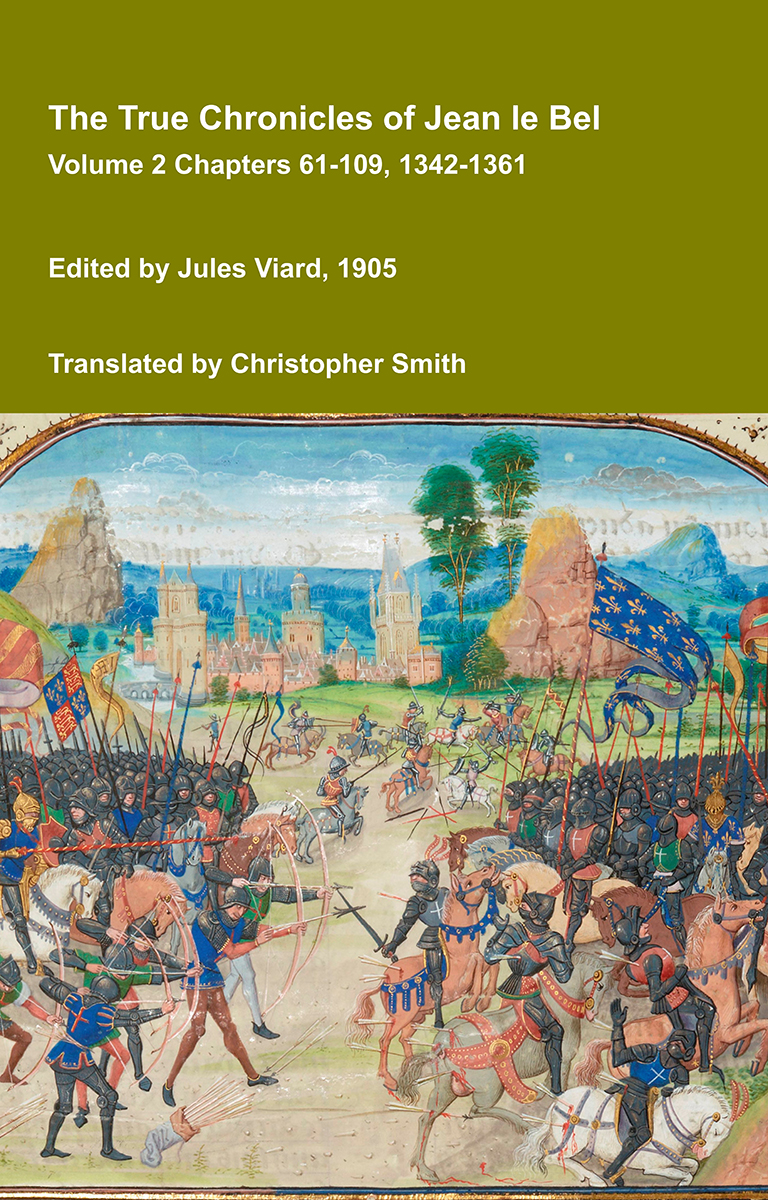
The True Chronicles of Jean le Bel Volume 2 Chapters 61-109 1342-1361
The Chronicle of Jean le Bel, Volume 2 continues one of the most important fourteenth-century accounts of the early Hundred Years’ War. Written by the Liège chronicler Jean le Bel, this vivid narrative follows the fortunes of Edward III, Jean II of France, the Black Prince, the great nobles of France and England, and the soldiers, captains and companies who shaped the conflict. This volume covers some of the most dramatic events of the period, including the battles of Crécy and Poitiers, the siege and capture of Calais, the captivity of King John, the rise of the Jacquerie, the turmoil in Paris under Étienne Marcel and Charles of Navarre, the devastation caused by the free companies, Edward III’s great campaign of 1359–1360, and the negotiations leading to the Treaty of Brétigny. Jean le Bel’s chronicle is especially valuable for its lively detail, its interest in chivalry, warfare, politics and reputation, and its influence on later chroniclers, most famously Froissart. This English translation presents the text in clear, readable British English while preserving the force and character of the original narrative. The translation includes extensive notes to help the reader better understand Jean le Bel's text. Volume 2 also includes translated appendices drawn from royal and administrative records, many from the English Record Office, which illuminate Edward III’s campaigns in Brittany, the siege and occupation of Calais, naval preparations, military finance, appointments, safe conducts and related affairs.
Available at Amazon in eBook and Paperback format.
In 1616 William Knollys 1st Earl Banbury [aged 72] was created 1st Viscount Wallingford. [his sister-in-law] Elizabeth Howard Countess Banbury [aged 33] by marriage Viscountess Wallingford.


Diary of Anne Clifford. 25th May 1616. Upon the 25th my Lord of Somerset [aged 29] was arraigned and condemned in the same place and stood much upon his innocency.
Letters of John Chamberlain Volume 2.243. 243. To Sir Dudley Carleton [aged 43]. [S. P. Dom., Jac. I, lxxxvii, 51.] London, June 8, 1616.
My very goode Lord: When I wrote last I left the earle of Somerset [aged 29] pleading for his life, but that he saide for himself was so litle that he was found guilty by all his peeres: which did so litle appall him that when he was asked what he could say why sentence shold not be pronounced, he stoode still upon his innocence, and could hardly be brought to refer himself to the Kinges mercie: upon which termes he stands still, and having leave to write to the King, hath only required that his judgement of hanging shold be chaunged to heading, and that his daughter might have such of his lands as the King doth not resume and reserve in his owne handes. The [his sister-in-law] Lady Knolles [aged 33] and some other frends have had accesse to the [his wife] Lady [aged 26] divers times since her conviction, and caried her younge daughter to her twise or thrise; but I heare not of any that comes at him. He hath ben much urged and fayre offered to confesse the offence both before his arraignment and since, but he stands firme in denial: though by all circumstances and most pregnant, (yea almost infallible) probabilities he be more faulty and fowle then any of the companie, which makes the King marvayle that all the rest that have gon before having so franckly confessed the matter after theyre condemnation, he only shold continue so confident. Whether this or any other reason be the cause of stay of execution I know not, but they live yet and for ought I can learne so are like to do many a day. Sir Thomas Mounsons [aged 51] arraignment which shold have ben yesterday, was then put of again till the Tewsday after the terme, which procrastination from time to time makes the world thincke we shall heare no more of this busines, the rather for that the Lord Cooke [aged 64] of late is fallen (I know not how) into disfavor, so far foorth that the King hath ben very bitter to him, both in privat and publike, as upon Thursday last when all the Judges were called before the King at Whitehall, to geve a reason of theyre proceeding in the exchecquer chamber to argue a case of commendams contrarie to his commaundment by expresse message, and sending a letter subscribed by them all, not so respectively and reverently written as might become them, they all stoode upon the very words and termes of law and statutes and upon the strictnes of theyre oath: but the heaviest burthen lighted on him, wherin he behaved and caried himself so well and confidently, that the matter goes on, and they argue yt again this day, contrarie to the expectation and hope of all the bishops. But the worst is that the Lord Chauncellor [aged 76], the atturny [aged 55] and sollicitor [aged 49] prosecute him implacablie, and have won so much ground upon him, that there is a commission graunted to the Lord Archbishop, the Lord Knollis [aged 72], Sir Thomas Lake [aged 48] and Sir Fulke Grivell to call him before them and examine him upon articles and points touching the premunire: and withall, the whole course of his life is like to be ript up and looked into which yf yt be severely followed many men feare yt may be his utter overthrow. But he holdes up his head, and geves no way, which makes his frends thincke he will passe over this storme and tempest well enough. Our goode frend [aged 53] stands only firme to him in what he may, which many marvayle at, and sticke not to say he is corrupted, which I thincke is as far from the one as the other: but howsoever, I could wish he shold not presume so much on the strength of his shoulders, as to thincke he alone were able to beare up the ruines of a building that is falling: and to say truth in many such cases I observe he hath more courage then needs, not weighing his owne strength, nor that yt is soma d'altri homeri [the burden of other men], for I perceve he hath litle appoggio [support, baking] to the maine piller [aged 23] that now stands upright.
In 1621 [his brother-in-law] Thomas Howard 1st Earl Berkshire [aged 33] was created 1st Viscount Andover in Hampshire, 1st Baron Howard of Charlton in Wiltshire. Elizabeth Cecil Countess Berkshire [aged 25] by marriage Baroness Howard of Charlton in Wiltshire.
Letters of John Chamberlain Volume 2.315. [19th January 1622] The Marquis Buckingam [aged 29] hath contracted with the Lord [aged 78] and [his sister-in-law] Lady Wallingford [aged 39] for their house neere White-hall, for some monie, and the making of Sir [his brother-in-law] Thomas Howard baron of Charleton and Vicount Andover [aged 34], and some thincke the deliverie of the Lord of Somerset [aged 35] and his [his wife] Lady [aged 31] out of the Towre was part of the bargain. I heare they came out severally on Thursday in the evening and lay that night at Northampton House. Then they are to go to Master Gibbes by Otelands, and so to Grayes a house of the Lord of Wallingfords in Oxfordshire where they are to continue.
In 1626 William Knollys 1st Earl Banbury [aged 82] was created 1st Earl Banbury. [his sister-in-law] Elizabeth Howard Countess Banbury [aged 43] by marriage Countess Banbury.
On 7th February 1626 [his brother-in-law] Thomas Howard 1st Earl Berkshire [aged 38] was created 1st Earl Berkshire. Elizabeth Cecil Countess Berkshire [aged 30] by marriage Countess Berkshire.

On 28th May 1626 [his father-in-law] Thomas Howard 1st Earl Suffolk [aged 64] died at Charing Cross [Map]. He was buried at Waldon Priory and Abbey [Map]. His son [his brother-in-law] Theophilus [aged 43] succeeded 2nd Earl Suffolk. Elizabeth Home Countess Suffolk [aged 27] by marriage Countess Suffolk.

Around 1628 John Hoskins [aged 38] (copy from original). Portrait of Robert Carr 1st Earl Somerset [aged 41].
On 25th May 1632 William Knollys 1st Earl Banbury [aged 88] died. His son Edward [aged 5] de jure 2nd Earl Banbury, 2nd Viscount Wallingford, 2nd Baron Knollys. Parliament disallowed the succession on the basis that Edward had been born when William was some eighty-two years old and Edward was, in fact, the son of Edward Vaux 4th Baron Vaux Harrowden [aged 43] whom Edward's [his sister-in-law] mother [aged 49] subsequently married around a month after William's death.
Chronicle of a Bourgeois of Valenciennes
Récits d’un bourgeois de Valenciennes aka The Chronicle of a Bourgeois of Valenciennes is a vivid 14th-century vernacular chronicle written by an anonymous urban chronicler from Valenciennes in the County of Hainaut. It survives in a manuscript that describes local and regional history from about 1253 to 1366, blending chronology, narrative episodes, and eyewitness-style accounts of political, military, and social events in medieval France, Flanders, and the Low Countries. The work begins with a chronological framework of events affecting Valenciennes and its region under rulers such as King Philip VI of France and the shifting allegiances of local nobility. It includes accounts of conflicts, sieges, diplomatic manoeuvres, and the impact of broader struggles like the Hundred Years’ War on urban life in Hainaut. Written from the perspective of a burgher (bourgeois) rather than a monastery or royal court, the chronicle offers a rare lay viewpoint on high politics and warfare, reflecting how merchants, townspeople, and civic institutions experienced the turbulence of the 13th and 14th centuries. Its narrative style combines straightforward reporting of events with moral and civic observations, making it a valuable source for readers interested in medieval urban society, regional politics, and the lived experience of war and governance in pre-modern Europe.
Available at Amazon in eBook and Paperback format.
Around 30th June 1632 Edward Vaux 4th Baron Vaux Harrowden [aged 43] and [his sister-in-law] Elizabeth Howard Countess Banbury [aged 49] were married some five weeks after the death of her first husband William Knollys 1st Earl Banbury [deceased] on 25th May 1632. They, Edward and Elizabeth, when teenagers, had been subject to marriage negotiations which broke down as a consequence of the Gunpowder Plot and she had married William Knollys 1st Earl Banbury some thirty-nine years her senior. She the daughter of [his father-in-law] Thomas Howard 1st Earl Suffolk and [his mother-in-law] Catherine Knyvet Countess Suffolk [aged 68]. They were fifth cousin once removed.
On 23rd August 1632 [his wife] Frances Howard Countess Essex and Somerset [aged 42] died.
On 11th July 1637 [his son-in-law] William Russell 1st Duke Bedford [aged 20] and Anne Carr Countess of Bedford [aged 21] were married. She the daughter of Robert Carr 1st Earl Somerset [aged 50] and Frances Howard Countess Essex and Somerset. He the son of Francis Russell 4th Earl Bedford [aged 44] and Catherine Brydges Countess Bedford [aged 57].


On 17th July 1645 Robert Carr 1st Earl Somerset [aged 58] died without male issue. Earl Somerset, Viscount Rochester extinct.
Diary of Isabella Twysden 1645. the 15 July 1645 the earle of Summerset died.
Kings Wessex: Great x 18 Grand Son of King Edmund "Ironside" I of England
Kings Gwynedd: Great x 14 Grand Son of Owain "Great" King Gwynedd
Kings Seisyllwg: Great x 20 Grand Son of Hywel "Dda aka Good" King Seisyllwg King Deheubarth
Kings Powys: Great x 15 Grand Son of Maredudd ap Bleddyn King Powys
Kings England: Great x 13 Grand Son of King John of England
Kings Scotland: Great x 7 Grand Son of King Robert III of Scotland
Kings France: Great x 19 Grand Son of Hugh I King of the Franks
Kings Duke Aquitaine: Great x 23 Grand Son of Ranulf I Duke Aquitaine
Great x 3 Grandfather: Andrew Kerr
Great x 2 Grandfather: Thomas Kerr of Smailholm later of Ferniehurst
Great x 1 Grandfather: Andrew Kerr of Ferniehirst
Grandfather: John Kerr 10th of Ferniehirst
Father: Thomas Kerr of Ferniehirst 6 x Great Grandson of King Robert III of Scotland
Great x 4 Grandfather: Andrew Kerr
Great x 3 Grandfather: Walter Kerr Lord of Cessford
Great x 2 Grandfather: Robert Kerr of Calverton 3 x Great Grandson of King Robert III of Scotland
Great x 4 Grandfather: John Hay 1st Lord Hay of Yester  Great Grandson of King Robert III of Scotland
Great x 3 Grandmother: Isabel Hay Lady Kerr 2 x Great Granddaughter of King Robert III of Scotland
Great x 4 Grandmother: Elizabeth Cunningham of Belton
Great x 1 Grandfather: Andrew Kerr of Cessford 4 x Great Grandson of King Robert III of Scotland
Grandmother: Catherine Ker 5 x Great Granddaughter of King Robert III of Scotland
Great x 4 Grandfather: Robert Crichton 1st Lord Crichton of Sanquhar
Great x 3 Grandfather: Robert Crichton 3 x Great Grandson of King Robert II of Scotland
Great x 4 Grandmother: Christian Erskine 2 x Great Granddaughter of King Robert II of Scotland
Great x 2 Grandfather: Robert Crichton 2nd Lord Crichton of Sanquhar 4 x Great Grandson of King Robert II of Scotland
Great x 4 Grandfather: John Stewart 1st Earl Lennox  9 x Great Grandson of King David I of Scotland
Great x 3 Grandmother: Marion Stewart 10 x Great Granddaughter of King David I of Scotland
Great x 4 Grandmother: Margaret Montgomerie Countess Lennox
Great x 1 Grandmother: Agnes Crichton 5 x Great Granddaughter of King Robert II of Scotland
Great x 4 Grandfather: John Maxwell  9 x Great Grandson of King David I of Scotland
Great x 3 Grandfather: John Maxwell 10 x Great Grandson of King David I of Scotland
Great x 2 Grandmother: Marion Margaret Maxwell 11 x Great Granddaughter of King David I of Scotland
Robert Carr 1st Earl Somerset  7 x Great Grandson of King Robert III of Scotland