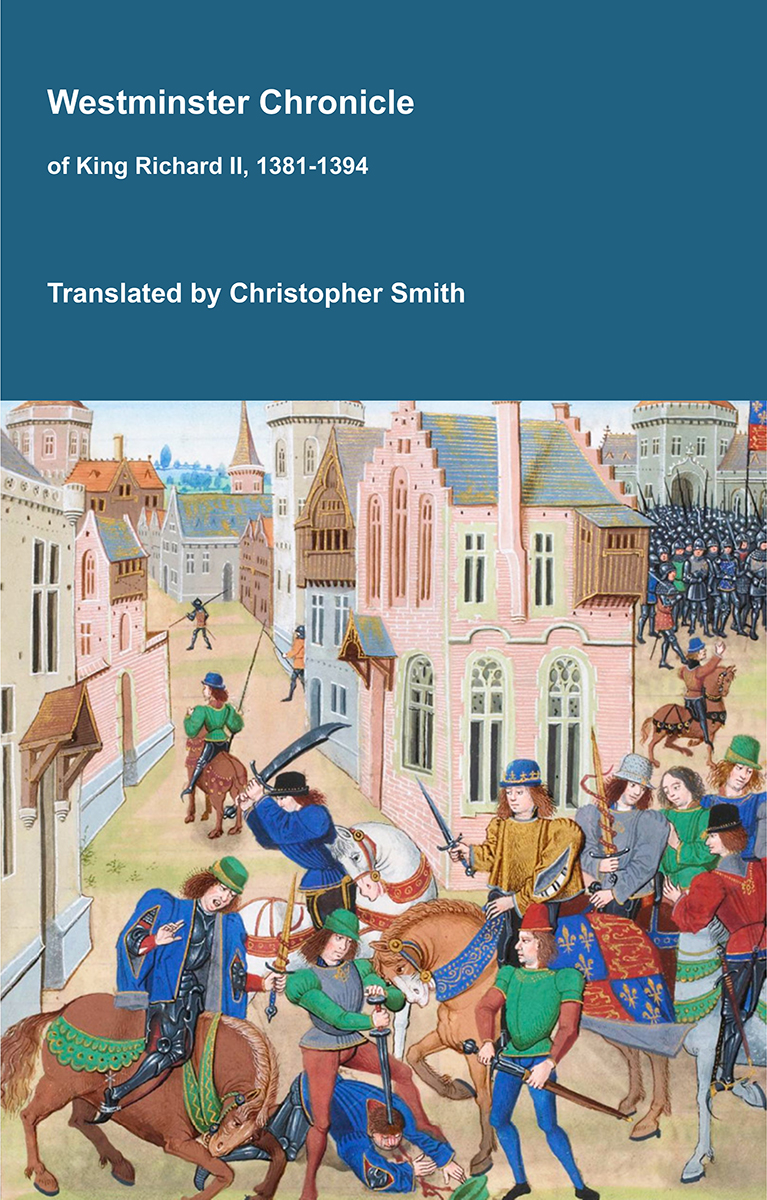
Westminster Chronicle of King Richard II, 1381-1394

The Westminster Chronicle is one of the most vivid and important narrative sources for the reign of Richard II. Written by an anonymous chronicler closely connected with Westminster Abbey, it covers the years 1381 to 1394, from the Peasants’ Revolt to the political tensions, court ceremonies, diplomatic negotiations, royal progresses, and public crises of Richard’s later reign. Rich in detail the chronicle records major events such as the conflicts between the King and Lords Appellant, King and the City of London, negotiations with France and Scotland, the death and funeral of Queen Anne of Bohemia, the illness of Charles VI of France, and the changing fortunes of leading nobles including John of Gaunt, Thomas of Gloucester, Robert de Vere, and the Earl of Arundel. The Chronicle offers readers a remarkable window into late fourteenth-century England, combining political observation, courtly spectacle, urban drama, ecclesiastical affairs, and moral judgement. It is an essential source for anyone interested in medieval monarchy, London, Westminster, and the troubled reign of Richard II.

Available at Amazon in eBook and Paperback format.

St Mary's Church, Boyton, Heytesbury Hundred, Wiltshire, South-West England, British Isles [Map]

St Mary's Church, Boyton is in Boyton, Wiltshire [Map], Churches in Wiltshire.

After 1262. St Mary's Church, Boyton [Map]. Monument to Alexander Giffard. Believed to represent Alexander Giffard; possibly his father Hugh Giffard. Early Medieval Period effigy. Alexander fought on the Seventh Crusade and may possibly have died at the Battle of Mansoura in 1250. The effigy notable for the Otter at his feet, biting his sword, and for the Giffard Arms on the shield with a label five points indicating the son, possibly grandson, of the current owner of the arms. The Otter may actually be a badly carved lion! Right Leg over Left.

Hugh Giffard: Around 1195 he was born to Walter Giffard at Warminster, Wiltshire [Map]. Before 18th March 1217 he and Sibyl Cormeilles were married. Around 1246 he died at Warminster, Wiltshire [Map].

Wiltshire Archaeological Magazine 1854 V1 Pages 233-238. Beneath the Easternmost of the Arches dividing the Chapel from the Nave [Map] is an altar tomb, the one side being composed of slightly pointed Arches, the other of a series of triangles; upon the tomb reposes the effigy of a Knight clad in chain armour, the legs crossed, and the feet resting upon an animal, which, may be eithera wild cat or a lion.—Upon his left arm is the triangular shield of the 13th century; his right arm extending across his breast grasps the long straight sword, which doubtless in its reality had cloven many an infidel's crest. The figure is of a man in full vigour, of ordinary size, and good proportion. His shield carries the arms of Giffard, gules, three-lions. passant or; in chief, a label of five points azure; upon each point, two Fleur-de-lis of the second. This beyond all doubt is the effigy of Alexander Giffard, the Crusader mentioned in Matthew Paris, as we shall hereafter show.