Annals of Kings Richard II and Henry IV 1393-1406

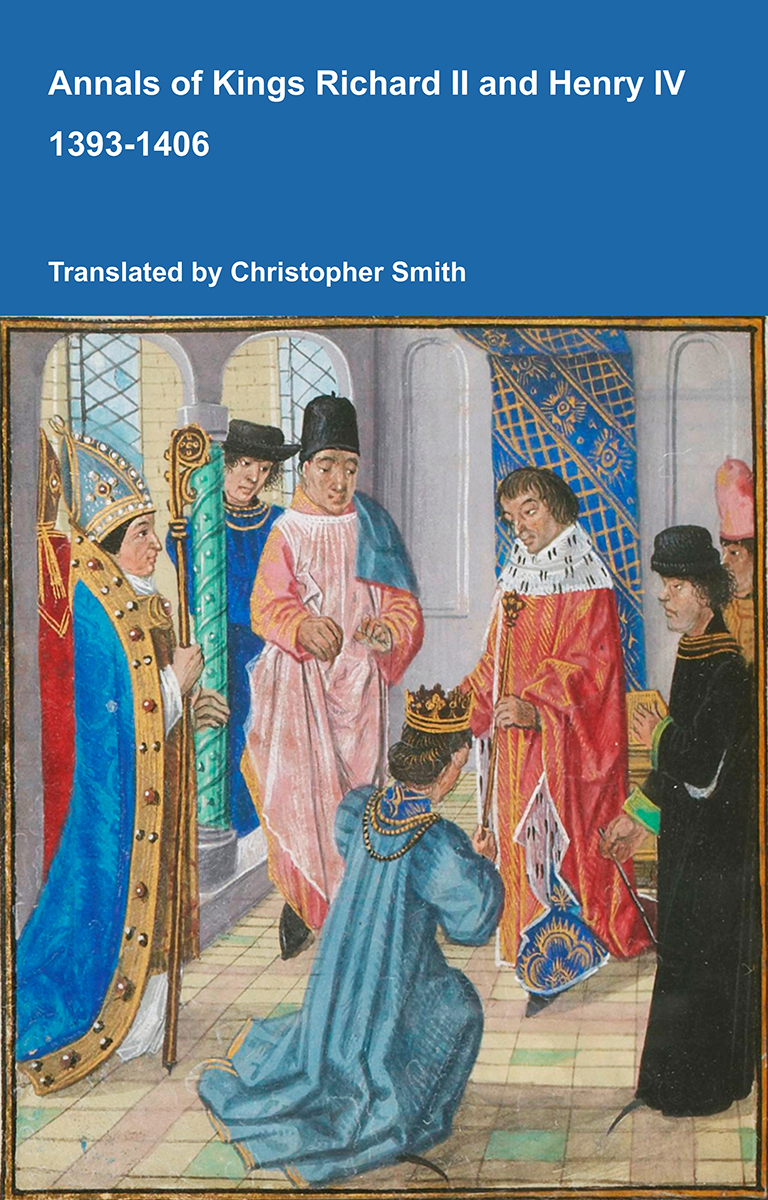
The Annals of Kings Richard II and Henry IV offers a vivid contemporary account of one of the most turbulent periods in late medieval England. Covering the reigns of Richard II and Henry IV, the chronicle records royal ceremonies, political conflict, rebellion, war, taxation, religious controversy, executions, popular unrest and remarkable portents. Its pages include a detailed description of Richard II’s coronation, the fall and deposition of the king, Henry IV’s seizure of the throne, the Percy rebellion, the execution of Archbishop Richard Scrope, the campaigns of Owain Glyndŵr, and England’s relations with Scotland, France, Portugal and Scandinavia. Alongside affairs of state, the annalist preserves reports of miracles, eclipses, prophecies, supernatural events and the experiences of ordinary townspeople, clergy, soldiers and travellers. Written from a monastic perspective, the work combines political observation with moral judgement, presenting victories and disasters as evidence of divine favour or punishment. At once a historical record and a reflection of medieval belief, the Annals provides an invaluable window into the challenges, ceremonies and conflicts of England at the turn of the fifteenth century.

Available at Amazon in eBook and Paperback format.

North Kesteven, Lincolnshire, North-Central England, British Isles

North Kesteven is in Kesteven.

Boothby Graffoe, North Kesteven, Lincolnshire, North-Central England, British Isles

Somerton Castle, Lincolnshire, Boothby Graffoe, North Kesteven, North-Central England, British Isles [Map]

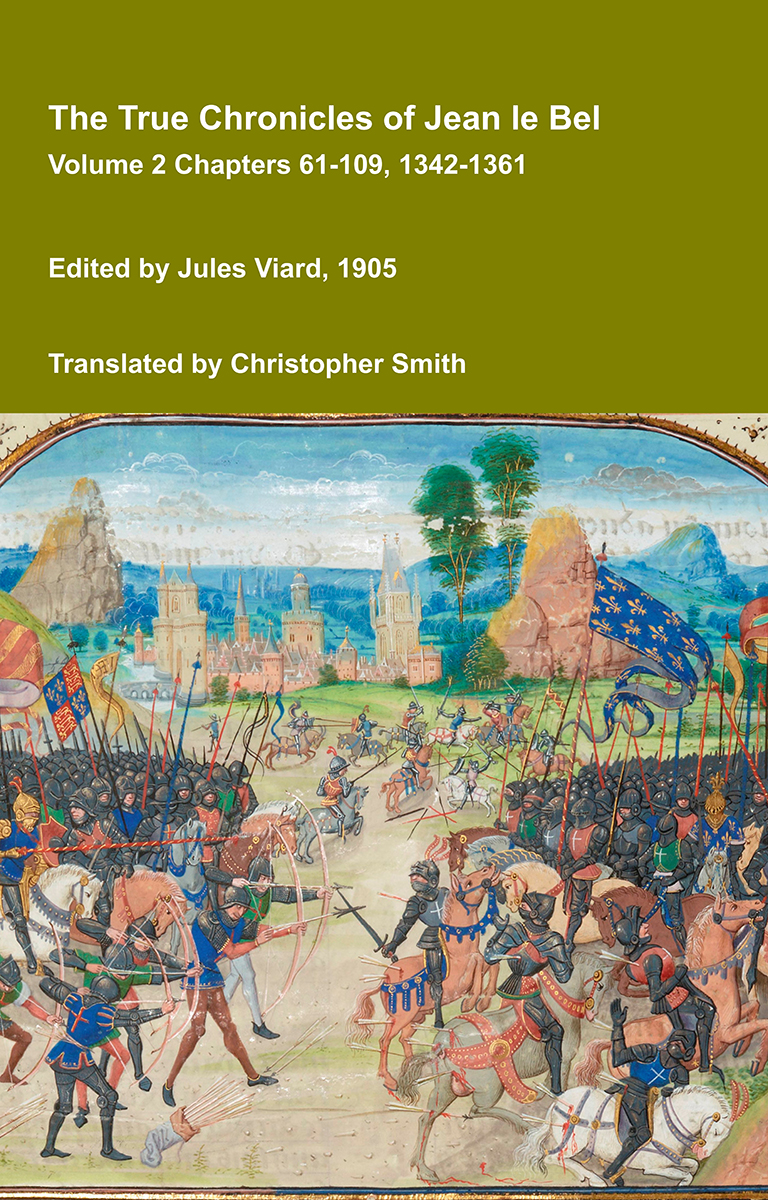
Chronicle of Jean le Bel Volume 2. Now it should be known that, when the Duke of Lancaster left England to come to Calais to those foreign lords, as you have heard, the noble King Edward made the greatest preparations to come into France and accomplish his intention that anyone had ever seen. He had all his prisoners, the highest barons of France, dispersed and placed them in his strongest castles, with large garrisons inside them. He sent King Jean back to a stronger castle1, restricted him from the greater part of his recreations, and had him guarded more closely than before.

Or est à sçavoir que quant le duc de Lancaste parti d'Angleterre pour venir à Kalays à ces seigneurs estrangiers, comme vous avez ouy, le noble roy Edowart fist le plus grand appareil de venir en France pour accomplir son intencion que nul eust jamais veu, et fist departir tous ses prisonniers, les plus haults barons de France, et les mit en ses plus fors chasteaulx, et grosses garnisons dedens, et renvoya le roy Jehan en ung plus fort chastel, et le restraindi de la plus grande partie de ses deduis, et le fist garder plus estroittement que devant.

Note 1. As early as 26th July 1359, Edward III was already making arrangements to have Jean le Bon transferred from Hertford Castle [Map] to Somerton Castle, and, on 14th August 1359, an order was given to the Treasury to release the sum needed to conduct him from London to Somerton [Map] under good escort; Rymer 3.438–439 and 3.442.

1`. Dès le 26 juillet 1359, Édouard II prenait déjà ses dispositions pour faire transférer Jean le Bon du château de Hertford au château de Somerton, et, le 14 août, ordre fut donné au Trésor de délivrer la somme nécessaire pour le conduire de Londres à Somerton sous bonne escorte, (Rymer opcit, t. I, p. 438, 439 et 442.)

Click to read more ...

Branston, North Kesteven, Lincolnshire, North-Central England, British Isles

Coleby, North Kesteven, Lincolnshire, North-Central England, British Isles

On 14th July 1841 Ellen Fenton [aged 96] died at Coleby, North Kesteven.

All Saints, Coleby, North Kesteven, Lincolnshire, North-Central England, British Isles [Map]

All Saints, Coleby [Map]

Monument to Mary Lister d.1734. Coleby Hall was built by the Listers in 1628. Kelly's Directory 1919 states "The Listers of Coleby filled the office of High Sheriff of Lincolnshire in the years 1624, 1625, 1644, 1669 and 1696, and Thomas Lister was in 1651 and 1653 a member of Cromwell's Council of State".

Great Hale, North Kesteven, Lincolnshire, North-Central England, British Isles [Map]

The South Forty Foot Drain aka Black Sluice is a man-made drain starting at Guthram Gowt [Map] that drains a large area of the Lincolnshire fen-land known as the Black Sluice Area aka Lindsey Level. The drain, or an early version of it was first constructed around 1635 when the Earl of Lindsey agreed with the Commissioners of Sewers for Lincolnshire to carry out drainage works which would make 150 km2 of land available for agricultural use. The South Forty Foot Drain drains the area bounded by Great Hale, North Kesteven [Map], Bourne, South Kesteven [Map], Pinchbeck [Map] and Boston [Map].

Harmston, North Kesteven, Lincolnshire, North-Central England, British Isles [Map]

Leadenham, North Kesteven, Lincolnshire, North-Central England, British Isles [Map]

Nocton, North Kesteven, Lincolnshire, North-Central England, British Isles

Around 1168 Thomas Darcy was born in Nocton, North Kesteven.

Around 1192 Norman Darcy was born to Thomas Darcy [aged 24] in Nocton, North Kesteven.

Around 1206 Thomas Darcy [aged 38] died in Nocton, North Kesteven.

Around 1213 Philip Darcy was born to Norman Darcy [aged 21] in Nocton, North Kesteven.

In 1236 Norman Darcy was born to Philip Darcy [aged 23] in Nocton, North Kesteven.

Around 16th October 1254 Norman Darcy [aged 62] died in Nocton, North Kesteven.

In May 1264 Philip Darcy [aged 51] died in Nocton, North Kesteven.

On 6th January 1296 Norman Darcy [aged 60] died in Nocton, North Kesteven.

On 2nd December 1680 William Ellis [aged 71] died. He was buried at Nocton, North Kesteven where he has a monument attributed to William Stanton [aged 41].

William Ellis: In 1609 he was born.

Stragglethorpe, North Kesteven, Lincolnshire, North-Central England, British Isles