

See Painters.
On 18th October 1697 Canaletto was born. His given name was Giovanni Antonio Canal. He came to be known as Canaletto meaning Little Canal or Canal Junior.

Around 1735. Canaletto [aged 37]. The Interior of the King Henry VII Chapel, Westminster Abbey [Map].

Around 1745. Canaletto [aged 47]. Old Somerset House [Map].
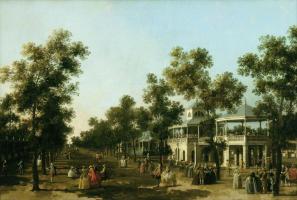
Around 1746. Canaletto [aged 48]. The Grand Walk at Vauxhall Gardens.

Around 1746. Canaletto [aged 48]. The City of Westminster from River Thames near the York Water Gate, York House [Map] with Westminster Bridge [Map] under construction.

Around 1747. Canaletto [aged 49]. View across the River Thames to Westminster Abbey [Map] and Westminster Hall [Map].

Around 1747. Canaletto [aged 49]. Westminster Bridge [Map], with the Lord Mayor's Procession on the Thames.

Around 1748. Canaletto [aged 50]. Warwick Castle [Map].

Around 1749. Canaletto [aged 51]. View of Whitehall, Old Horse Guards and Banqueting House, Whitehall Palace [Map].
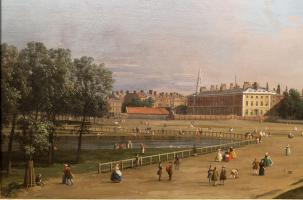
Around 1749. Canaletto [aged 51]. View of St James' Park [Map].
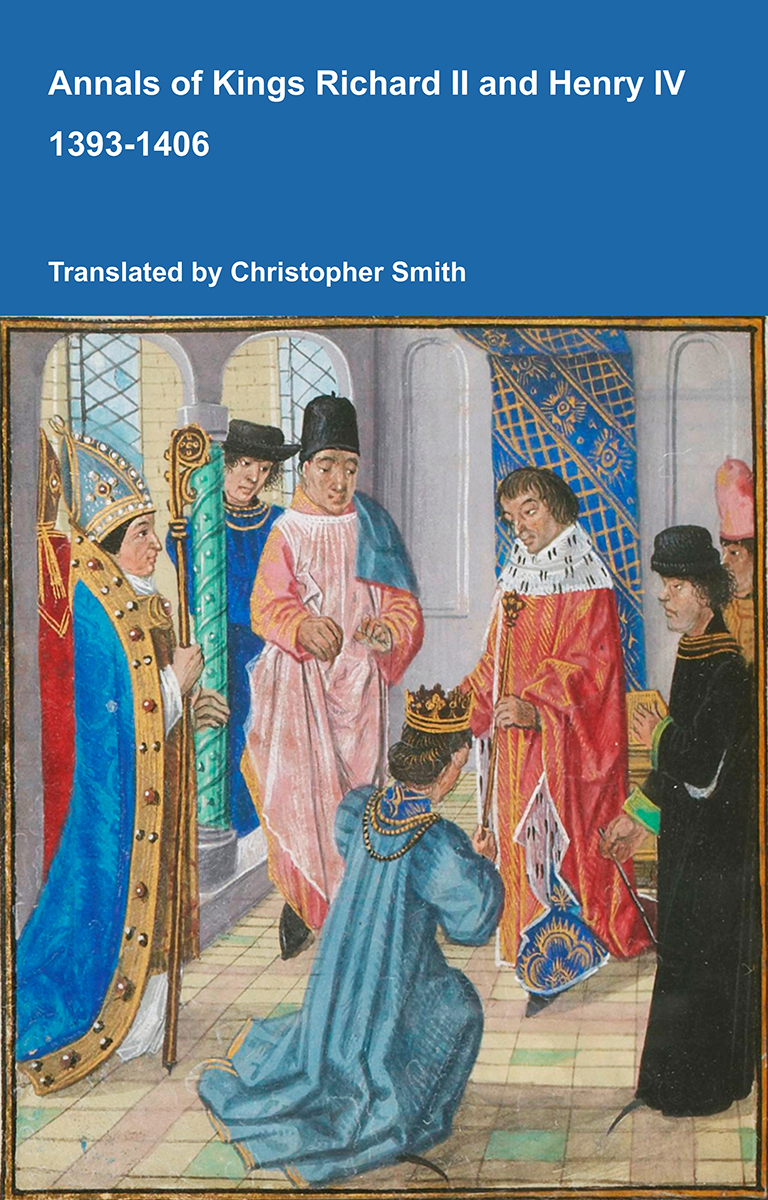
Annals of Kings Richard II and Henry IV 1393-1406
The Annals of Kings Richard II and Henry IV offers a vivid contemporary account of one of the most turbulent periods in late medieval England. Covering the reigns of Richard II and Henry IV, the chronicle records royal ceremonies, political conflict, rebellion, war, taxation, religious controversy, executions, popular unrest and remarkable portents. Its pages include a detailed description of Richard II’s coronation, the fall and deposition of the king, Henry IV’s seizure of the throne, the Percy rebellion, the execution of Archbishop Richard Scrope, the campaigns of Owain Glyndŵr, and England’s relations with Scotland, France, Portugal and Scandinavia. Alongside affairs of state, the annalist preserves reports of miracles, eclipses, prophecies, supernatural events and the experiences of ordinary townspeople, clergy, soldiers and travellers. Written from a monastic perspective, the work combines political observation with moral judgement, presenting victories and disasters as evidence of divine favour or punishment. At once a historical record and a reflection of medieval belief, the Annals provides an invaluable window into the challenges, ceremonies and conflicts of England at the turn of the fifteenth century.
Available at Amazon in eBook and Paperback format.

1749. Canaletto [aged 51]. Westminster Abbey [Map] with a procession of Knights of the Bath. St Margaret's Church, Westminster [Map] adjacent with the flag.

Around 1749. Canaletto [aged 51]. View of Whitehall, New Horse Guards.

Around 1750. Canaletto [aged 52]. Alnwick Castle, Northumberland [Map].

Around 1750. Canaletto [aged 52]. Westminster from near the Terrace of Somerset House [Map] In the distance the Banqueting House, Whitehall Palace [Map], Westminster Abbey [Map] and Westminster Bridge [Map].

Around 1750. Canaletto [aged 52]. The City from near the Terrace of Somerset House [Map] with St Paul's Cathedral [Map].

Around 1751. Canaletto [aged 53]. Royal Hospital Chelsea, Rotunda Ranelagh Gardens Chelsea and Ranelagh House.

Around 1752. Canaletto [aged 54]. Greenwich Hospital [Map] from the North Bank of the Thames.

Around 1752. Canaletto [aged 54]. Warwick Castle [Map] East Front from the Courtyard.

1754. Canaletto [aged 56]. Walton on Thames Bridge [Map]. Commissioned by Thomas Hollis [aged 33].
Thomas Hollis: On 14th April 1720 he was born. In 1757 Thomas Hollis was elected Fellow of the Royal Society. On 1st January 1774 he died.

1754. Canaletto [aged 56]. Walton on Thames Bridge [Map].
Chronicle of Walter of Guisborough
A canon regular of the Augustinian Guisborough Priory, Yorkshire, formerly known as The Chronicle of Walter of Hemingburgh, describes the period from 1066 to 1346. Before 1274 the Chronicle is based on other works. Thereafter, the Chronicle is original, and a remarkable source for the events of the time. This book provides a translation of the Chronicle from that date. The Latin source for our translation is the 1849 work edited by Hans Claude Hamilton. Hamilton, in his preface, says: 'In the present work we behold perhaps one of the finest samples of our early chronicles, both as regards the value of the events recorded, and the correctness with which they are detailed; Nor will the pleasing style of composition be lightly passed over by those capable of seeing reflected from it the tokens of a vigorous and cultivated mind, and a favourable specimen of the learning and taste of the age in which it was framed.'
Available at Amazon in eBook and Paperback format.

Around 1754. Canaletto [aged 56]. View across the River Thames to Eton College [Map] with the new Eton College Chapel [Map] visible in white stone and the original Tudor buildings in red brick.

Around 1754. Canaletto [aged 56]. View of the interior of the Rotunda Ranelagh Gardens Chelsea.

Around 1754. Canaletto [aged 56]. St Paul's Cathedral [Map].

Around 1763. Canaletto [aged 65]. Northumberland House looking towards Strand [Map]. Note the Percy Lion; crest of the Duke Northumberland. And the statue of King Charles I of England, Scotland and Ireland which remains in situ on the corner of what is now the south-east corner of Trafalgar Square.
On 19th April 1768 Canaletto [aged 70] died.
