

Jean de Waurin's Chronicle of England Volume 6 Books 3-6: The Wars of the Roses
Jean de Waurin was a French Chronicler, from the Artois region, who was born around 1400, and died around 1474. Waurin’s Chronicle of England, Volume 6, covering the period 1450 to 1471, from which we have selected and translated Chapters relating to the Wars of the Roses, provides a vivid, original, contemporary description of key events some of which he witnessed first-hand, some of which he was told by the key people involved with whom Waurin had a personal relationship.
Available at Amazon in eBook and Paperback format.
Paternal Family Tree: Douglas
James Douglas 2nd Earl Douglas and Isabella Stewart Countess Douglas were married. She by marriage Countess Douglas. She the daughter of King Robert II of Scotland and Elizabeth Mure Queen Consort Scotland. He the son of William Douglas 1st Earl Douglas and Margaret Mar Countess Douglas 11th Countess Mar. They were half third cousin once removed. She a great x 4 granddaughter of King John of England.
In 1357 [his father] William Douglas 1st Earl Douglas [aged 34] and [his mother] Margaret Mar Countess Douglas 11th Countess Mar were married. She the daughter of [his grandfather] Domhnall Mar II Earl of Mar and [his grandmother] Isabella Stewart.
In 1358 James Douglas 2nd Earl Douglas was born to William Douglas 1st Earl Douglas [aged 35] and Margaret Mar Countess Douglas 11th Countess Mar.
On 26th January 1358 [his father] William Douglas 1st Earl Douglas [aged 35] was created 1st Earl Douglas. [his mother] Margaret Mar Countess Douglas 11th Countess Mar by marriage Countess Douglas.
In 1377 [his uncle] Thomas Mar 10th Earl of Mar [aged 47] died. His sister [his mother] Margaret succeeded 11th Countess Mar.
Around 1378 [his illegitimate son] Archibald "Black Archibald" Douglas 1st Lord Cavers was born illegitimately to James Douglas 2nd Earl Douglas [aged 20] and Mistress Unknown.
In 1384 [his father] William Douglas 1st Earl Douglas [aged 61] died. His son James [aged 26] succeeded 2nd Earl Douglas.
Before 27th October 1387 [his son-in-law] William Dacre 5th Baron Dacre Gilsland, Baron Multon of Gilsand [aged 30] and [his illegitimate daughter] Joan Douglas Baroness Dacre Gilsland were married. She the illegitmate daughter of James Douglas 2nd Earl Douglas [aged 29] and Mistress Unknown. He the son of Hugh Dacre 4th Baron Dacre of Gilsland, Baron Multon of Gilsand and Elizabeth Maxwell Countess Atholl.
Froissart Book 13. Before 5th August 1388. When these three Scottish earls who were chief captains had made their enterprise in the bishopric of Durham and had sore overrun the country, then they returned to Newcastle and there rested and tarried two days, and every day they scrimmished. The earl of Northumberland's two sons were two young lusty knights and were ever foremost at the barriers to scrimmish. There were many proper feats of arms done and achieved: there was fighting hand to hand: among other there fought hand to hand the earl Douglas [aged 30] and sir Henry Percy [aged 46], and by force of arms the earl Douglas won the pennon of sir Henry Percy's, wherewith he was sore displeased and so were all the Englishmen. And the earl Douglas said to sir Henry Percy: 'Sir, I shall bear this token of your prowess into Scotland and shall set it on high on my castle of Dalkeith, that it may be seen far off.' 'Sir,' quoth sir Henry, 'ye may be sure ye shall not pass the bounds of this country till ye be met withal in such wise that ye shall make none avaunt thereof.' 'Well, sir.' quoth the earl Douglas, 'come this night to my lodging and seek for your pennon: I shall set it before my lodging and see if ye will come to take it away.' So then it was late, and the Scots withdrew to their lodgings and refreshed them with such as they had. They had flesh enough: they made that night good watch, for they thought surely to be awaked for the words they had spoken, but they were not, for sir Henry Percy was counselled not so to do.


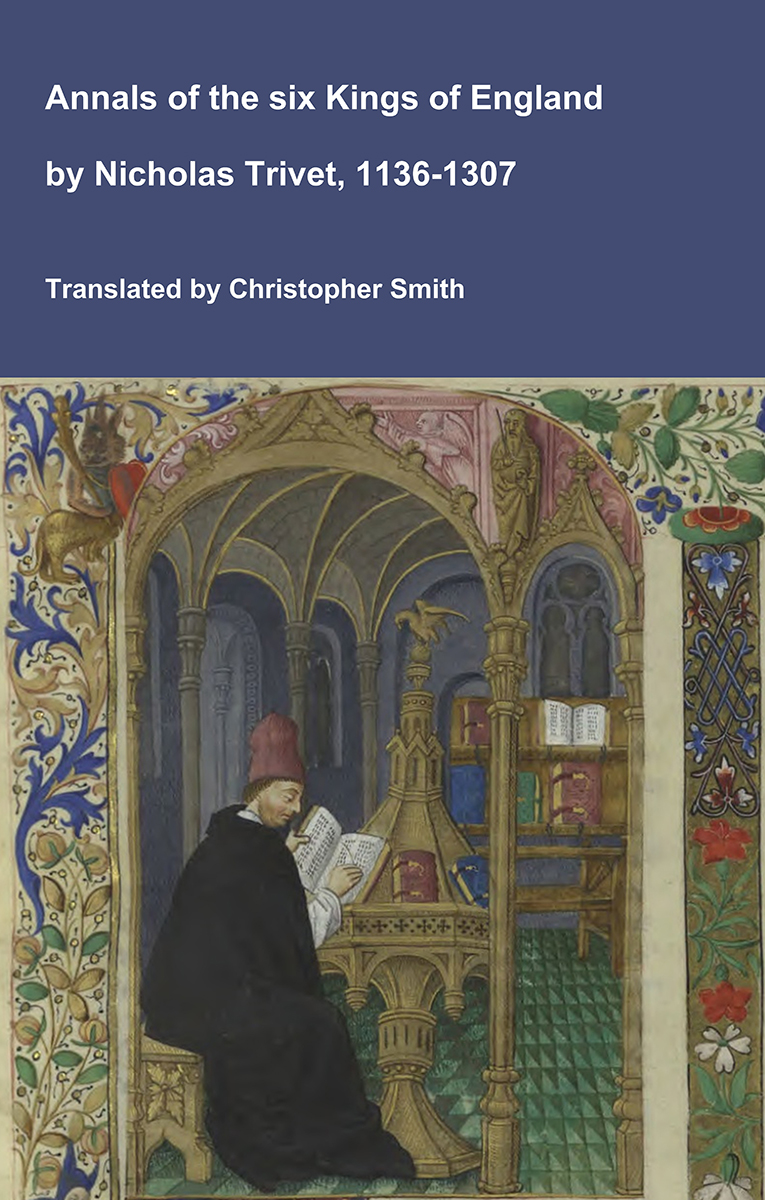
Annals of the six Kings of England by Nicholas Trivet
Translation of the Annals of the Six Kings of England by that traces the rise and rule of the Angevin aka Plantagenet dynasty from the mid-12th to early 14th century. Written by the Dominican scholar Nicholas Trivet, the work offers a vivid account of English history from the reign of King Stephen through to the death of King Edward I, blending political narrative with moral reflection. Covering the reigns of six monarchs—from Stephen to Edward I—the chronicle explores royal authority, rebellion, war, and the shifting balance between crown, church, and nobility. Trivet provides detailed insight into defining moments such as baronial conflicts, Anglo-French rivalry, and the consolidation of royal power under Edward I, whose reign he describes with particular immediacy. The Annals combines careful year-by-year reporting with thoughtful interpretation, presenting history not merely as a sequence of events but as a moral and political lesson. Ideal for readers interested in medieval history, kingship, and the origins of the English state, this chronicle remains a valuable and accessible window into the turbulent world of the Plantagenet kings.
Available at Amazon in eBook and Paperback format.
Froissart Book 13. Before 5th August 1388. Now let us speak of the earl Douglas [aged 30] and other, for they had more to do than they that went by Carlisle, Cumberland [Map]. When the earls of Douglas, of Moray [aged 46], of March, and Dunbar [aged 50]1 departed from the great host, they took their way thinking to pass the water and to enter into the bishopric of Durham, and to ride to the town and then to return, brenning and exiling the country and so to come to Newcastle [Map] and to lodge there in the town in the despite of all the Englishmen. And as they determined, so they did assay to put it in use, for they rode a great pace under covert without doing of any pillage by the way or assaulting of any castle, tower or house, but so came into the lord Percy's land and passed the river of Tyne without any let a three leagues above Newcastle not far from Brancepeth, and at last entered into the bishopric of Durham, where they found a good country. Then they began to make war, to slay people and to bren villages and to do many sore displeasures.
Note 1. George, earl of March and Dunbar: the text gives Mare, but there was at this time no earl of Mar.
On either 5th August 1388 or 19th August 1388 a Scottish army commanded by John Swinton defeated an English army commanded by Henry "Hotspur" Percy [aged 24] during the Battle of Otterburn at Otterburn [Map]. Henry "Hotspur" Percy and his brother Ralph Percy [aged 29] were captured as was Matthew Redman [aged 60]. The English suffered 1000 killed, 2000 captured. The Scottish 100 killed, 200 captured.
On the Scottish side James Douglas 2nd Earl Douglas [aged 30] was killed. His sister Isabel [aged 28] succeeded Countess Mar.
John Dunbar 1st Earl of Moray [aged 46] fought.
Froissart Book 13. Battle of Otterburn. KNIGHTS and squires were of good courage on both parties to fight valiantly: cowards there had no place, but hardiness reigned with goodly feats of arms, for knights and squires were so joined together at hand strokes, that archers had no place of nother party. There the Scots shewed great hardiness and fought merrily with great desire of honour: the Englishmen were three to one: howbeit, I say not but Englishmen did nobly acquit themselves, for ever the Englishmen had rather been slain or taken in the place than to fly. Thus, as I have said, the banners of Douglas and Percy and their men were met each other, envious who should win the honour of that journey. At the beginning the Englishmen were so strong that they reculed back their enemies: then the earl Douglas, who was of great heart and high of enterprise, seeing his men recule back, then to recover the place and to shew knightly valour he took his axe in both his hands, and entered so into the press that he made himself way in such wise, that none durst approach near him, and he was so well armed that he bare well off such strokes as he received1. Thus he went ever forward like a hardy Hector, willing alone to conquer the field and to discomfit his enemies: but at last he was encountered with three spears all at once, the one strake him on the shoulder, the other on the breast and the stroke glinted down to his belly, and the third strake him in the thigh, and sore hurt with all three strokes, so that he was borne perforce to the earth and after that he could not be again relieved. Some of his knights and squires followed him, but not all, for it was night, and no light but by the shining of the moon. The Englishmen knew well they had borne one down to the earth, but they wist not who it was; for if they had known that it had been the earl Douglas, they had been thereof so joyful and so proud that the victory had been theirs. Nor also the Scots knew not of that adventure till the end of the battle; for if they had known it, they should have been so sore despaired and discouraged that they would have fled away. Thus as the earl Douglas was felled to the earth, he was stricken into the head with an axe, and another stroke through the thigh: the Englishmen passed forth and took no heed of him: they thought none otherwise but that they had slain a man of arms. On the other part the earl George de la March and of Dunbar fought right valiantly and gave the Englishmen much ado, and cried, 'Follow Douglas,' and set on the sons of Percy: also earl John of Moray with his banner and men fought valiantly and set fiercely on the Englishmen, and gave them so much to do that they wist not to whom to attend.
Note 1. 'No man was so well armed that he did not fear the great strokes which he gave.'
After 5th August 1388 James Douglas 2nd Earl Douglas [deceased] was buried at Melrose Abbey, Melrose.
[his illegitimate daughter] Joan Douglas Baroness Dacre Gilsland was born illegitimately to James Douglas 2nd Earl Douglas and Mistress Unknown.
[his illegitimate son] William Douglas 1st Lord Drumlanrig was born illegitimately to James Douglas 2nd Earl Douglas and Mistress Unknown.
Kings Wessex: Great x 10 Grand Son of King Edmund "Ironside" I of England
Kings Scotland: Great x 7 Grand Son of King David I of Scotland
Kings France: Great x 11 Grand Son of Hugh I King of the Franks
Kings Duke Aquitaine: Great x 15 Grand Son of Ranulf I Duke Aquitaine
Great x 4 Grandfather: William Douglas 1st Lord Douglas
Great x 3 Grandfather: Archibald Douglas
Great x 4 Grandmother: Margaret Kerdal
Great x 2 Grandfather: William "Longleg" Douglas
Great x 4 Grandfather: John Crawford
Great x 3 Grandmother: Margaret Crawford
Great x 1 Grandfather: William "Hardy" Douglas 2nd Lord Douglas
Great x 2 Grandmother: Constance Battail Battail
GrandFather: Archibald Douglas
Great x 1 Grandmother: Eleanor Louvain Baroness Douglas 
Father: William Douglas 1st Earl Douglas 
Great x 1 Grandfather: Alexander Lindsay Crawford
GrandMother: Beatrice Crawford
James Douglas 2nd Earl Douglas 7 x Great Grand Son of King David I of Scotland
GrandFather: Domhnall Mar II Earl of Mar
Mother: Margaret Mar Countess Douglas 11th Countess Mar 6 x Great Grand Daughter of King David I of Scotland
Great x 4 Grandfather: Walter Stewart 3rd High Steward 
Great x 3 Grandfather: Alexander Stewart 4th High Steward 2 x Great Grand Son of King David I of Scotland
Great x 4 Grandmother: Bethóc Angus Great Grand Daughter of King David I of Scotland
Great x 2 Grandfather: John Stewart of Bonkyll 3 x Great Grand Son of King David I of Scotland
Great x 1 Grandfather: Alexander Stewart 4 x Great Grand Son of King David I of Scotland
Great x 3 Grandfather: Alexander de Bonkyl Bonkyl
Great x 2 Grandmother: Margaret Bonkyl
GrandMother: Isabella Stewart 5 x Great Grand Daughter of King David I of Scotland
Great x 2 Grandfather: Alexander Fitzjames
Great x 1 Grandmother: Jean Fitzjames