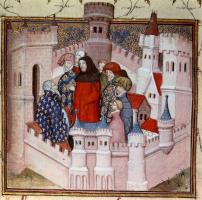
 Westminster Chronicle. On the twelfth day of November the king held a parliament at Westminster, in which, according to the usual custom, subsidies were requested to be granted to the lord king, chiefly for the defence of the realm. At last, after much deliberation on this matter, two tenths were granted to him by the clergy, and two fifteenths by the lay people, on this condition, that the lord king should cross into France with a strong hand in the following year. Otherwise, he was to have only half of all that had been granted. After he went into Scotland, as will be described below, he took all that had been granted to him, the condition being set aside. In this parliament, however, nothing useful was done for the advantage of the realm, because the temporal lords, whose duty it is to speak for the estate and advantage of the realm, were always at that time at odds with one another, and, when it had ended, they departed in discord. During the parliament the Scots deceitfully took the castle of Berwick [Map]. And although the earl of Northumberland [aged 43]1, keeper of the aforesaid castle, was then in London for the parliament, as he had been commanded by the king, he could not be excused, for the temporal lords, and especially the duke of Lancaster, judged that he ought justly to recover the aforesaid castle solely at his own expense, because it had been lost through his fault. And unless it were recovered within the appointed time, they decreed that he and all his goods, movable and immovable, should be subject to the king’s will. For the aforesaid earl received annually from the king five hundred marks for the custody of the said castle. Seeing that he could have no other aid from the king, he quickly girded himself for the journey and came to Berwick. There he found his paid soldiers daily making heavy assaults upon the enemy garrison in the castle and inflicting daily losses, but because of the strength of the place they were by no means able to prevail against them. The aforesaid earl, considering that the recovery of the said castle would be wholly impossible for him without a greater force of men and arms, therefore, after taking counsel on this matter, in order to avoid a greater evil, and as the better course, bought it from the Scots for two thousand marks. This condition was added that the Scots might freely return into Scotland with their possessions. And this was done.
Duodecimo die Novembris tenuit rex parliamentum apud Westmonasterium in quo more solito petuntur subsidia domino regi concedi pro defensione regni præcipue. Tandem post magnam super hoc deliberationem concessæ sunt sibi a clerico duæ decimæ, ac duæ quintædecimæ a populo laicali, eo pacto quod dominus rex manu robusta transiret in Franciam anno sequenti, alias non haberet nisi medietatem omnium concessorum. Posteaquam transivit in Scotiam, prout inferius deseribetur, accepit omnia sibi concessa conditione rejecta. In isto vero parliamento pro commodo regni nihil utile fuit actum quia domini temporales quibus competit loqui pro statu et commodo regni adinvicem adversantes semper eo tempore discordes fuere ac co finito in discordia recesserunt. Durante parliamento Scoti dolose ceperunt castrum de Berewyk et licet comes Northumberland, custos castri prædicti, erat tunc Londoniæ causa parliamenti, prout a rege habuit in mandatis, non potuit excusari quod domini temporales et præcipue dux Lancastriæ decernebant ipsum juste debere prædictum castrum suis propriis expensis tantummodo recuperare, quia propter sui defectum illud erat amissum. Et nisi fuerit infra dictum tempus recuperatum decreverunt illum et omnia bona ‘sua mobilia et immobilia subjacere regiæ voluntati. Accepit namque comes prædictus pro custodia dicti castri annuatim a rege quingentas marcas ; qui videns à rege aliud subsidium non posse habere celer accinxit se ad iter et venit Berewycum; ubi invenit suos stipendiarios graves insultus indies hostibus castellanis et damna quotidiana inferre, sed propter fortitudinem loci contra eos minime prævaluerunt. Præfatus vero comes considerans quod dicti castri recuperatio sine majori potentia virorum [et] armorum fuisset omnino sibi impossibilis, unde super hoc librato consilio ad evitandum majus malum et pro meliori emit illud a Scotis duobus millibus marcarum. Sub ista conditione adjecta quod Scoti possent libecre in Scotiam cum qu redire. Quod et factum est.
Note 1. Henry Percy, 1341-1408, created Earl of Northumberland in 1377. He married in 1381 Maud Lucy and had issue. He rebelled against King Henry IV and was killed at the Battle of Bramham Moor, his head spiked on London Bridge. His son Henry "Hotspur" Percy, also in rebellion against King Henry IV, was killed in 1403 at the Battle of Shrewsbury. Hotspur's son Henry, 2nd Earl of Northumberland, was killed in 1455 at the First Battle of St Albans. His son, Henry, 3rd Earl, was killed at the 1461 Battle of Towton.
Click to read more ...