

Earl Cornwall is in Earldoms of England Alphabetically.
There have been six creations of Earl Cornwall:
1st. 1072. Brian Penthièvre 1st Earl Cornwall. Extinct. 1084.
2nd. 1072. Robert Mortain Count Mortain 1st Earl Cornwall. Forfeit. 28th September 1106. Battle of Tinchebray.
3rd. 1141. Reginald de Dunstanville Fitzroy 1st Earl Cornwall. Extinct. 1st July 1175.
4th. 1225. Richard of Cornwall 1st Earl Cornwall. Extinct. 25th September 1300.
5th. 6th August 1307. Piers Gaveston 1st Earl Cornwall. Extinct. 19th June 1312. Capture, Trial and Execution of Piers Gaveston.
6th. 1330. John of Eltham 1st Earl Cornwall. Extinct. 30th September 1336.
Summary
1072. 1st. Brian Penthièvre 1st Earl Cornwall [aged 32] created.
1084. 1st. Brian Penthièvre 1st Earl Cornwall extinct.
In 1072 Brian Penthièvre 1st Earl Cornwall [aged 32] was created 1st Earl Cornwall.
After 1084 Brian Penthièvre 1st Earl Cornwall [deceased] died. Earl Cornwall extinct. He may have resigned the title before this date when he returned to live in Brittany.
Summary
1072. 1st. Robert Mortain Count Mortain 1st Earl Cornwall [aged 41] created.
1090. 2nd. Son William Mortain Count Mortain 2nd Earl Cornwall [aged 6] succeeded.
28th September 1106. 2nd. William Mortain Count Mortain 2nd Earl Cornwall forfeit. See Battle of Tinchebray.
In 1072 Robert Mortain Count Mortain 1st Earl Cornwall [aged 41] was created 1st Earl Cornwall.
In 1090 Robert Mortain Count Mortain 1st Earl Cornwall [aged 59] died. His son William [aged 6] succeeded Count Mortain Mortagne, 2nd Earl Cornwall.
Before 1106 William Mortain Count Mortain 2nd Earl Cornwall [aged 22] forfeit 2nd Earl Cornwall for having attacked the Normandy castles of King Henry I "Beauclerc" England [aged 37].
On 28th September 1106 King Henry I "Beauclerc" England [aged 38] defeated his older brother Robert Curthose III Duke Normandy [aged 55] at the Battle of Tinchebray at Tinchebray, Orne.
William Warenne 2nd Earl of Surrey and Robert Beaumont 1st Earl of Leicester Count Meulan [aged 66]. Elias I Count Maine commanded the reserve. The following fought for Henry:
Alan Canhiart IV Duke Brittany [aged 43].
Raoul Tosny [aged 26].
William "Pincerna aka Butler" D'Aubigny [aged 42].
Robert Grandesmil [aged 28], and.
William Normandy I Count Évreux.
Robert Curthose III Duke Normandy was captured and spent the next twenty-eight years in prison; never released.
William Mortain Count Mortain 2nd Earl Cornwall [aged 22] was also captured. He spent the next thirty or more years in prison before becoming a monk. Earl Cornwall forfeit.
King Edgar Ætheling II of England [aged 55] was captured and subsequently released; Henry had married to Edgar's niece Edith aka Matilda Dunkeld Queen Consort England [aged 26] in 1100.
Robert II Belleme 2nd Count Ponthieu 3rd Earl of Shrewsbury [aged 50] escaped.
Robert Stuteville was captured.
Summary
1141. 1st. Reginald de Dunstanville Fitzroy 1st Earl Cornwall [aged 31] created.
1st July 1175. 1st. Reginald de Dunstanville Fitzroy 1st Earl Cornwall extinct.
In 1141 Reginald de Dunstanville Fitzroy 1st Earl Cornwall [aged 31] was created 1st Earl Cornwall.
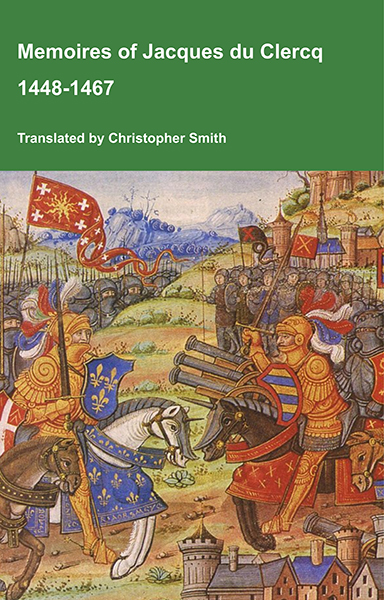
This is a translation of the 'Memoires of Jacques du Clercq', published in 1823 in two volumes, edited by Frederic, Baron de Reissenberg. In his introduction Reissenberg writes: 'Jacques du Clercq tells us that he was born in 1424, and that he was a licentiate in law and a counsellor to Philip the Good, Duke of Burgundy, in the castellany of Douai, Lille, and Orchies. It appears that he established his residence at Arras. In 1446, he married the daughter of Baldwin de la Lacherie, a gentleman who lived in Lille. We read in the fifth book of his Memoirs that his father, also named Jacques du Clercq, had married a lady of the Le Camelin family, from Compiègne. His ancestors, always attached to the counts of Flanders, had constantly served them, whether in their councils or in their armies.' The Memoires cover a period of nineteen years beginning in in 1448, ending in in 1467. It appears that the author had intended to extend the Memoirs beyond that date; no doubt illness or death prevented him from carrying out this plan. As Reissenberg writes the 'merit of this work lies in the simplicity of its narrative, in its tone of good faith, and in a certain air of frankness which naturally wins the reader’s confidence.' Du Clercq ranges from events of national and international importance, including events of the Wars of the Roses in England, to simple, everyday local events such as marriages, robberies, murders, trials and deaths, including that of his own father in Book 5; one of his last entries.
Available at Amazon in eBook and Paperback format.
On 1st July 1175 Reginald de Dunstanville Fitzroy 1st Earl Cornwall [aged 65] died at Chertsey, Surrey. He was buried at Reading Abbey, Berkshire [Map]. Earl Cornwall extinct. His son appears to have predeceaseed him by months.
Summary
1225. 1st. Richard of Cornwall 1st Earl Cornwall [aged 15] created.
2nd April 1272. 2nd. Son Edmund "Almain" 2nd Earl Cornwall [aged 22] succeeded.
25th September 1300. 2nd. Edmund "Almain" 2nd Earl Cornwall extinct.
In 1225 Richard of Cornwall 1st Earl Cornwall [aged 15] was created 1st Earl Cornwall.
On 30th March 1231 Richard of Cornwall 1st Earl Cornwall [aged 22] and Isabel Marshal Countess Cornwall, Gloucester and Hertford [aged 30] were married at Fawley, Lambourn. She by marriage Countess Cornwall. She the daughter of William Marshal 1st Earl Pembroke and Isabel Clare Countess Pembroke. He the son of King John of England and Isabella of Angoulême Queen Consort England [aged 43]. They were fifth cousins.
On 23rd November 1243 Richard of Cornwall 1st Earl Cornwall [aged 34] and Sanchia Provence Queen Consort Germany [aged 15] were married at Westminster Abbey [Map]. She by marriage Countess Cornwall. She the daughter of Raymond IV Count Provence [aged 45] and Beatrice Savoy Countess Provence [aged 45]. He the son of King John of England and Isabella of Angoulême Queen Consort England [aged 55]. They were fourth cousins.
On 16th June 1269 Richard of Cornwall 1st Earl Cornwall [aged 60] and Beatrice Falkenburg Countess Cornwall were married at Kaiserslautern [Map]. She by marriage Countess Cornwall. He the son of King John of England and Isabella of Angoulême Queen Consort England.
On 2nd April 1272 Richard of Cornwall 1st Earl Cornwall [aged 63] died at Berkhamsted Castle, Hertfordshire [Map]. He was buried at Hailes Abbey [Map]. His son Edmund [aged 22] succeeded 2nd Earl Cornwall.
On 6th October 1272 Edmund "Almain" 2nd Earl Cornwall [aged 22] and Margaret Clare Countess Cornwall [aged 22] were married at the Ruislip [Map]. She by marriage Countess Cornwall. She the daughter of Richard de Clare 6th Earl Gloucester 5th Earl Hertford and Maud Lacy Countess Gloucester and Hertford [aged 49]. He the son of Richard of Cornwall 1st Earl Cornwall and Sanchia Provence Queen Consort Germany. They were half fourth cousin once removed. He a grandson of King John of England. She a great x 4 granddaughter of King Henry I "Beauclerc" England.
On 25th September 1300 Edmund "Almain" 2nd Earl Cornwall [aged 50] died. Earl Cornwall extinct. He was buried, heart and flesh, at Ashridge, Hertfordshire [Map]. His bones were interred at Hailes Abbey [Map] during a service attended by King Edward I of England [aged 61].
Summary
6th August 1307. 1st. Piers Gaveston 1st Earl Cornwall [aged 23] created. See Return of Piers Gaveston.
19th June 1312. 1st. Piers Gaveston 1st Earl Cornwall extinct. See Capture, Trial and Execution of Piers Gaveston.
On 6th August 1307 Piers Gaveston 1st Earl Cornwall [aged 23] was created 1st Earl Cornwall by King Edward II of England [aged 23]; Earl Cornwall usually reserved for the heir. The earldom gave Gaveston substantial landholdings over great parts of England, to the value of £4,000 a year. These possessions consisted of most of Cornwall, as well as parts of Devonshire in the south-west, land in Berkshire and Oxfordshire centred on the honour of Wallingford, most of the eastern part of Lincolnshire, and the honour of Knaresborough in Yorkshire, with the territories that belonged to it.
Chronicle of Walter of Guisborough
A canon regular of the Augustinian Guisborough Priory, Yorkshire, formerly known as The Chronicle of Walter of Hemingburgh, describes the period from 1066 to 1346. Before 1274 the Chronicle is based on other works. Thereafter, the Chronicle is original, and a remarkable source for the events of the time. This book provides a translation of the Chronicle from that date. The Latin source for our translation is the 1849 work edited by Hans Claude Hamilton. Hamilton, in his preface, says: 'In the present work we behold perhaps one of the finest samples of our early chronicles, both as regards the value of the events recorded, and the correctness with which they are detailed; Nor will the pleasing style of composition be lightly passed over by those capable of seeing reflected from it the tokens of a vigorous and cultivated mind, and a favourable specimen of the learning and taste of the age in which it was framed.'
Available at Amazon in eBook and Paperback format.
On 5th August 1309 Piers Gaveston 1st Earl Cornwall [aged 25] was restored 1st Earl Cornwall.
On 19th June 1312 Piers Gaveston 1st Earl Cornwall [aged 28] was taken to Blacklow Hill, Warwickshire [Map] where he was beheaded. Earl Cornwall extinct. Blacklow Hill, Warwickshire [Map] being outside of the lands of Guy Beauchamp 10th Earl of Warwick [aged 40]. Gaveston's body was left where it lay eventually being recovered by Dominican friars who took it to King's Langley Priory, Hertfordshire [Map].
Summary
1330. 1st. John of Eltham 1st Earl Cornwall [aged 13] created.
30th September 1336. 1st. John of Eltham 1st Earl Cornwall extinct.
In 1330 John of Eltham 1st Earl Cornwall [aged 13] was created 1st Earl Cornwall.
On 30th September 1336 John of Eltham 1st Earl Cornwall [aged 20] died at Perth [Map]. Earl Cornwall extinct. He was buried at the east side of the doorway to the Chapel of St Edmund, Westminster Abbey [Map]. His monument comprises a head of the statue encircled by a coronet of large and small leaves, remarkable for being the earliest specimen of the kind. The details of plate-armour, surcoat, gorget, coroneted helmet, with other accessories, give great antiquarian interest to this work. It was formerly surmounted by a canopy, of which, however, no traces are now visible.