

Bishop of Worcester is in Bishop, Worcester Cathedral [Map].
Around 744 Bishop Mildred was appointed Bishop of Worcester.
Around 800 Bishop Denebeorht was consecrated Bishop of Worcester.
In 957 Archbishop Dunstan [aged 48] was appointed Bishop of Worcester.
Anglo-Saxon Chronicle. 959. This year died King Edwy, on the calends of October; and Edgar [aged 16] his brother took to the government of the West-Saxons, Mercians, and Northumbrians. He was then sixteen years old. It was in this year he sent after St. Dunstan [aged 50], and gave him the bishopric of Worcester; and afterwards the bishopric of London. In his days it prosper'd well; and God him gave, that he dwelt in peace the while that he lived. Whate'er he did, whate'er he plan'd, he earn'd his thrift. He also rear'd God's glory wide, and God's law lov'd, with peace to man, above the kings that went before in man's remembrance. God so him sped, that kings and earls to all his claims submissive bow'd; and to his will without a blow he wielded all as pleased himself. Esteem'd he was both far and wide in distant lands; because he prized the name of God, and God's law traced, God's glory rear'd, both far and wide, on every side. Wisely he sought in council oft his people's good, before his God, before the world. One misdeed he did, too much however, that foreign tastes he loved too much; and heathen modes into this land he brought too fast; outlandish men hither enticed; and to this earth attracted crowds of vicious men. But God him grant, that his good deeds be weightier far than his misdeeds, to his soul's redemption on the judgment-day.
In 992 Archbishop Ealdwulf was elected Archbishop of York and Bishop of Worcester.
In 1033 Bishop Brihtheah was appointed Bishop of Worcester.
Chronicon ex Chronicis by Florence and John of Worcester. 1033. Leofsy, bishop of the Hwiccas, a devout and humble man, died at the episcopal vill of Rempsey, on Tuesday, the fourteenth of the calends of September [19th August], and, as we may be allowed to hope, ascended to the heavenly realms: his body was buried with honour in the church of St. Mary [Map], at Worcester. Brihteag, abbot of Pershore, sister's son of Wulfstan, archbishop of York, was raised to the vacant see.
In 1038 Bishop Lyfing was appointed Bishop of Worcester.
Chronicon ex Chronicis by Florence and John of Worcester. 1040. Harold [aged 24], king of England, died at London, and was buried at Westminster. After his funeral, the nobles of almost the whole of England sent envoys to Hardicanute [aged 22] at Bruges, where he was staying with his mother [aged 55], and, thinking it was for the best, invited him to come to England and ascend the throne. Thereupon, he fitted out fifty ships, and embarking Danish troops, before midsummer sailed over to England, where he was received with universal joy, and shortly afterwards crowned; but during his government he did nothing worthy his royal power. For as soon as he began to reign, calling to mind the injuries which both he and his mother had suffered at the hands of his predecessor, and reputed brother, king Harold, he despatched to London, Ælfric, archbishop of York, and earl Godwin [aged 39], with Stor, the master of his household, Edric, his steward, Thrond, captain of his guards, and other men of high rank, with orders to dig up the body of Harold and throw it into a sewer; and when it was thrown there, he caused it to be dragged out and cast into the river Thames. Shortly afterwards, it was picked up by a fisherman, and being immediately brought to the Danes, was honourably buried by them in a cemetery they possessed at London.60 After this, he ordered that eight marks should be paid to every rower in his fleet, and twelve to each steersman, to be levied from the whole of England; a tax so burthensome, that scarcely any one would pay it, and he became thoroughly detested by those who at first were most anxious for his coming. Besides, he was greatly incensed against earl Godwin, and Living, bishop of Worcester, for the death of his brother Alfred, of which they were accused by Ælfric, archbishop of York, and some others. In consequence, he took the bishopric of Worcester from Living and gave it to Ælfric; but the following year, he ejected Ælfric and graciously restored Living, who had made his peace with him.
Note 60. The cemetery of St Clement-Danes, where the Northmen had a settlement on the bank of the Thames, outside the walls of London. The Saxon Chronicle is silent as to Harold's corpse being thrown into the Thames and fished up, but Henry of Huntingdon gives the same account as our author.
In 1041 Bishop Lyfing was restored to the see of Worcester.
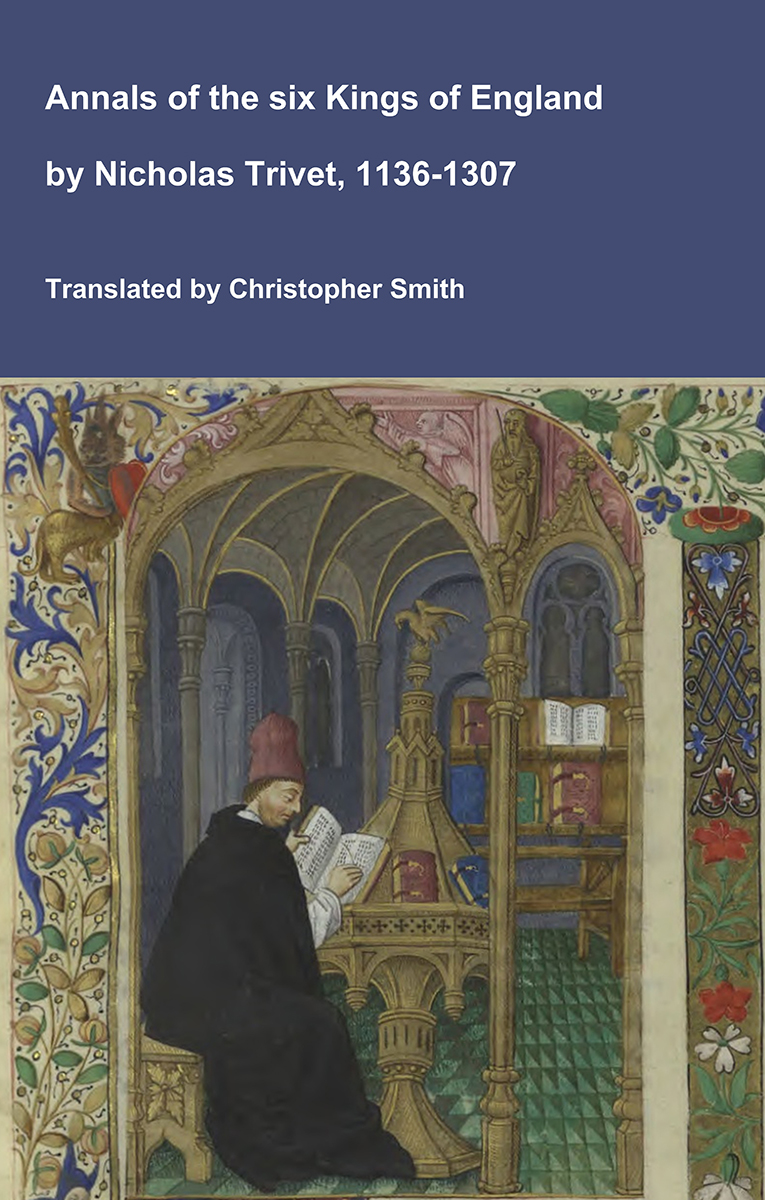
Annals of the six Kings of England by Nicholas Trivet
Translation of the Annals of the Six Kings of England by that traces the rise and rule of the Angevin aka Plantagenet dynasty from the mid-12th to early 14th century. Written by the Dominican scholar Nicholas Trivet, the work offers a vivid account of English history from the reign of King Stephen through to the death of King Edward I, blending political narrative with moral reflection. Covering the reigns of six monarchs—from Stephen to Edward I—the chronicle explores royal authority, rebellion, war, and the shifting balance between crown, church, and nobility. Trivet provides detailed insight into defining moments such as baronial conflicts, Anglo-French rivalry, and the consolidation of royal power under Edward I, whose reign he describes with particular immediacy. The Annals combines careful year-by-year reporting with thoughtful interpretation, presenting history not merely as a sequence of events but as a moral and political lesson. Ideal for readers interested in medieval history, kingship, and the origins of the English state, this chronicle remains a valuable and accessible window into the turbulent world of the Plantagenet kings.
Available at Amazon in eBook and Paperback format.
In 1047 Archbishop Stigand was appointed Bishop of Worcester.
In 1062 Bishop Wulfstan [aged 54] was appointed Bishop of Worcester.
Flowers of History. 1073. Gregory, who is also called Hildebrand, held a synod, and anathematized those guilty of simony. Some priests who had taken wives he removed from their holy office, by a new example, and as it seemed to many an inconsiderate prejudice, in contradiction to the opinions of the ancient fathers. The blessed Wolstan [aged 65], who had been unjustly deposed by archbishop Lanfranc [aged 68], was restored to his diocese, in consequence of a miracle. After he had fixed his pastoral staff on the tomb of the blessed Edward, no one except himself could draw it out again.
Chronicon ex Chronicis by Florence and John of Worcester. 1125. Simon, the queen's chancellor, and Sigefred, abbot of Glastonbury, both men of distinguished worth and piety, were chosen bishops while they were in Normandy; Simon being appointed to the see of Worcester, and Sigefred to the see of Chichester. Hugh, a man of great prudence, archdeacon successively to Samson and Theowulf, bishops of Worcester, died on the twelfth of the calends of April [21st March). After Easter [29th March], the bishops-elect, Simon and Sigefred, with the archbishops William [aged 55] and Thurstan [aged 55], and a cardinal of Rome named John, came to England,
Chronicon ex Chronicis by Florence and John of Worcester. 1125. Simon, the bishop-elect of Worcester, went to Canterbury in company with Godfrey, bishop of Bath, and, having been ordained priest by the archbishop on Saturday in Whitsunweek [23rd May]1, was on the following day consecrated with great pomp bishop of the holy mother church of Worcester. John, archdeacon of Canterbury, receiving consecration as bishop of Rochester at the same time. Richard, bishop of Hereford, David of Bangor, Godfrey of Bath, and Sigefred of Chichester assisted at the consecration.
Note 1. A repetition of a former entry.
In 1163 Bishop Roger Fitzrobert was appointed Bishop of Worcester.
On 10th August 1180 Archbishop Baldwin of Forde [aged 55] was appointed Bishop of Worcester.
On 4th December 1193 Bishop Henry de Sully was elected Bishop of Worcester.
On 3rd April 1216 Bishop Sylvester was elected Bishop of Worcester.
On 3rd July 1216 Bishop Sylvester was consecrated as Bishop of Worcester.
On 8th September 1216 Bishop Sylvester was enthroned as Bishop of Worcester.
Henrici Quinti, Angliæ Regis, Gesta, is a first-hand account of the Agincourt Campaign, and subsequent events to his death in 1422. The author of the first part was a Chaplain in King Henry's retinue who was present from King Henry's departure at Southampton in 1415, at the siege of Harfleur, the battle of Agincourt, and the celebrations on King Henry's return to London. The second part, by another writer, relates the events that took place including the negotiations at Troye, Henry's marriage and his death in 1422.
Available at Amazon in eBook and Paperback format.
Around 25th August 1218 Bishop William de Blois was elected Bishop of Worcester.
On 7th October 1218 Bishop William de Blois was consecrated Bishop of Worcester.
On 30th August 1236 Bishop Walter de Cantelupe [aged 45] was elected Bishop of Worcester.
On 3rd May 1237 Bishop Walter de Cantelupe [aged 46] was consecrated Bishop of Worcester.
On 19th September 1266 Bishop Nicholas Ely was consecrated Bishop of Worcester.
On 26th September 1266 Bishop Nicholas Ely was enthroned Bishop of Worcester at Worcester Cathedral [Map].
Around 20th May 1268 Godfrey Giffard Bishop of Worcester [aged 33] was appointed Bishop of Worcester.
On 13th November 1307 Archbishop Walter Reynolds was elected Bishop of Worcester.
On 13th October 1308 Archbishop Walter Reynolds was consecrated Bishop of Worcester.
On 7th October 1313 Bishop Walter of Maidstone was consecrated Bishop of Worcester.

The True Chronicles of Jean le Bel Volume 1 Chapters 1-60 1307-1342
The True Chronicles of Jean le Bel offer one of the most vivid and immediate accounts of 14th-century Europe, written by a knight who lived through the events he describes, and experienced some of them first hand. Covering the early decades of the Hundred Years’ War, this remarkable chronicle follows the campaigns of Edward III of England, the politics of France and the Low Countries, and the shifting alliances that shaped medieval warfare. Unlike later historians, Jean le Bel writes with a strong sense of eyewitness authenticity, drawing on personal experience and the testimony of fellow soldiers. His narrative captures not only battles and sieges, but also the realities of military life, diplomacy, and the ideals of chivalry that governed noble society. A key source for Jean Froissart, Le Bel’s chronicle stands on its own as a compelling and insightful work, at once historical record and literary achievement. This translation builds on the 1905 edition published in French by Jules Viard, adding extensive translations from other sources Rymer's Fœdera, the Chronicles of Adam Murimuth, William Nangis, Walter of Guisborough, a Bourgeois of Valenciennes, Geoffrey le Baker of Swinbroke and Richard Lescot to enrich the original text and Viard's notes.
Available at Amazon in eBook and Paperback format.
On 31st March 1317 Bishop Thomas Cobham [aged 49] was appointed Bishop of Worcester.
On 22nd May 1317 Bishop Thomas Cobham [aged 49] was consecrated Bishop of Worcester.
On 25th September 1327 Bishop Adam Orleton was translated to Bishop of Worcester.
In 1333 Bishop Simon Montagu was appointed Bishop of Worcester.
On 4th September 1349 Cardinal John of Thoresby was translated to Bishop of Worcester.
On 15th June 1395 Bishop Robert Tideman of Winchcombe was translated to Bishop of Worcester.
On 19th May 1401 Bishop Richard Clifford was elected Bishop of Worcester.
On 9th October 1401 Bishop Richard Clifford was consecrated as Bishop of Worcester.
On 15th May 1434 Cardinal Thomas Bourchier [aged 16] was appointed Bishop of Worcester.
On 15th July 1476 Bishop John Alcock [aged 46] was translated to Bishop of Worcester.
William of Worcester's Chronicle of England
William of Worcester, born around 1415, and died around 1482 was secretary to John Fastolf, the renowned soldier of the Hundred Years War, during which time he collected documents, letters, and wrote a record of events. Following their return to England in 1440 William was witness to major events. Twice in his chronicle he uses the first person: 1. when writing about the murder of Thomas, 7th Baron Scales, in 1460, he writes '… and I saw him lying naked in the cemetery near the porch of the church of St. Mary Overie in Southwark …' and 2. describing King Edward IV's entry into London in 1461 he writes '… proclaimed that all the people themselves were to recognize and acknowledge Edward as king. I was present and heard this, and immediately went down with them into the city'. William’s Chronicle is rich in detail. It is the source of much information about the Wars of the Roses, including the term 'Diabolical Marriage' to describe the marriage of Queen Elizabeth Woodville’s brother John’s marriage to Katherine, Dowager Duchess of Norfolk, he aged twenty, she sixty-five or more, and the story about a paper crown being placed in mockery on the severed head of Richard, 3rd Duke of York.
Available at Amazon in eBook and Paperback format.
On 16th October 1486 Bishop Robert Morton [aged 51] was appointed Bishop of Worcester.
On 28th January 1487 Bishop Robert Morton [aged 52] was consecrated Bishop of Worcester. He was the last Bishop of Worcester before the Reformation.
On 30th August 1497 Giovanni de Gigli was elected Bishop of Worcester.
On 10th September 1497 Giovanni de Gigli was consecrated Bishop of Worcester.
In 1535 Bishop Hugh Latimer [aged 48] was appointed Bishop of Worcester.

In 1539 John Bell was appointed Bishop of Worcester. On 17th August 1539 he he was consecrated by Archbishop Thomas Cranmer [aged 49].
In 1544 Bishop Richard Pate was appointed Bishop of Worcester having been appointed by the Pope in 1541.
In 1559 five new Bishops were consecrated including:
Archbishop Edwin Sandes [aged 40] was consecrated Bishop of Worcester.
Bishop William Barlow [aged 61] was consecrated Bishop of Chichester.
Archbishop Edmund Grindal [aged 40] was consecrated Bishop of London.
In 1559 Archbishop Edwin Sandes [aged 40] was consecrated Bishop of Worcester.
On 26th January 1571 Bishop Nicholas Bullingham [aged 51] was translated to Bishop of Worcester.

On 10th February 1593 Bishop Richard Fletcher [aged 48] was translated to Bishop of Worcester.
Henrici Quinti, Angliæ Regis, Gesta, is a first-hand account of the Agincourt Campaign, and subsequent events to his death in 1422. The author of the first part was a Chaplain in King Henry's retinue who was present from King Henry's departure at Southampton in 1415, at the siege of Harfleur, the battle of Agincourt, and the celebrations on King Henry's return to London. The second part, by another writer, relates the events that took place including the negotiations at Troye, Henry's marriage and his death in 1422.
Available at Amazon in eBook and Paperback format.
In 1660 Bishop George Morley [aged 61] was consecrated Bishop of Worcester.
On 23rd May 1660 Bishop John Gauden was elected Bishop of Worcester.

On 30th November 1662 Bishop John Earle [aged 61] was consecrated Bishop of Worcester.
John Evelyn's Diary. 30th November 1662. St. Andrew's day. Invited by the Dean of Westminster [aged 61] to his consecration dinner and ceremony, on his being made Bishop of Worcester. Dr. Bolton preached in the Abbey Church [Map]; then followed the consecration by the Bishops of London [aged 64], Chichester [aged 70], Winchester [aged 64], Salisbury [aged 70], etc. After this, was one of the most plentiful and magnificent dinners that in my life I ever saw; it cost near £600 as I was informed. Here were the judges, nobility, clergy, and gentlemen innumerable, this Bishop being universally beloved for his sweet and gentle disposition. He was author of those Characters which go under the name of Blount. He translated his late Majesty's [aged 32] "Icon" into Latin, was Clerk of his Closet, Chaplain, Dean of Westminster, and yet a most humble, meek, and cheerful man, an excellent scholar, and rare preacher. I had the honor to be loved by him. He married me at Paris, during his Majesty's and the Church's exile. When I took leave of him, he brought me to the cloisters in his episcopal habit. I then went to prayers at Whitehall [Map], where I passed that evening.
In 1671 Bishop Walter Blandford [aged 55] was appointed Bishop of Worcester.
In 1675 Bishop James Fleetwood [aged 71] was appointed Bishop of Worcester.
John Evelyn's Diary. 24th March 1676. Dr. Brideoake [aged 63], Bishop of Chichester, preached a mean discourse for a Bishop. I also heard Dr. Fleetwood [aged 72], Bishop of Worcester, on Matt. xxvi. 38, of the sorrows of Christ, a deadly sorrow caused by our sins; he was no great preacher.
In 1689 Bishop Edward Stillingfleet [aged 53] was appointed Bishop of Worcester.


In 1717 Bishop John Hough [aged 65] was appointed Bishop of Worcester.
In 1743 Bishop Isaac Maddox [aged 45] was translated to Bishop of Worcester.
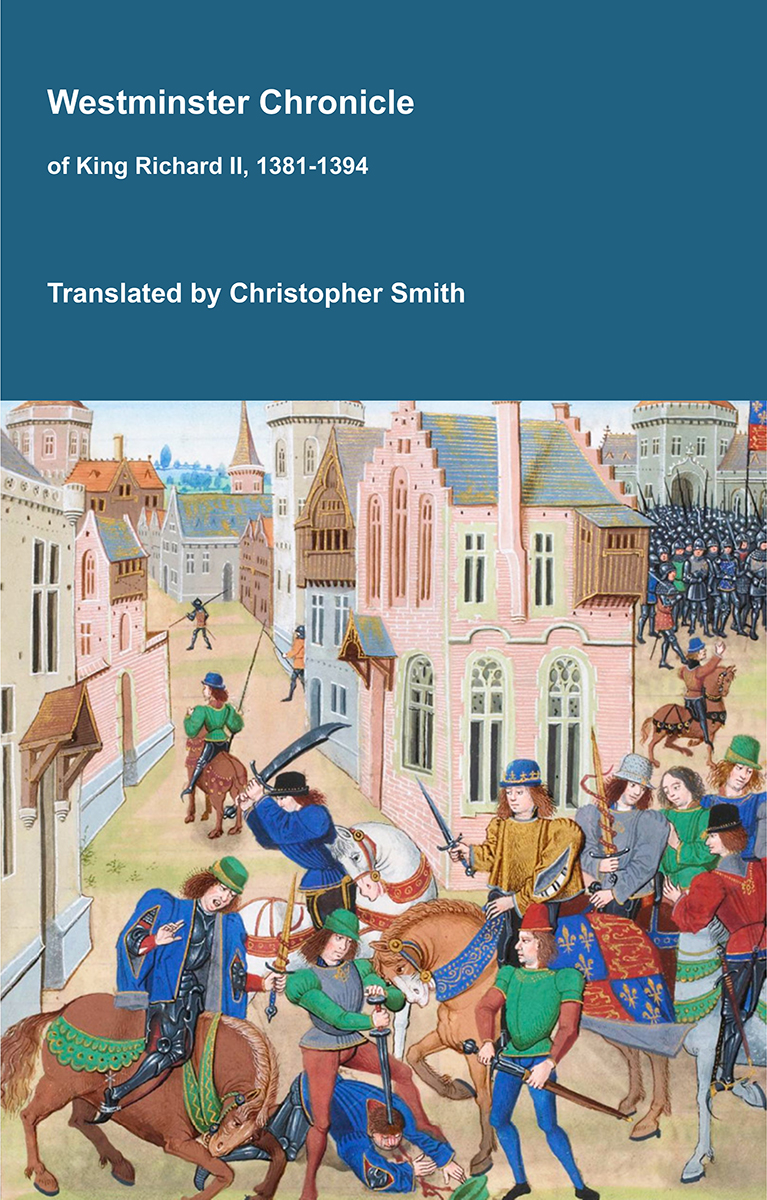
Westminster Chronicle of King Richard II, 1381-1394
The Westminster Chronicle is one of the most vivid and important narrative sources for the reign of Richard II. Written by an anonymous chronicler closely connected with Westminster Abbey, it covers the years 1381 to 1394, from the Peasants’ Revolt to the political tensions, court ceremonies, diplomatic negotiations, royal progresses, and public crises of Richard’s later reign. Rich in detail the chronicle records major events such as the conflicts between the King and Lords Appellant, King and the City of London, negotiations with France and Scotland, the death and funeral of Queen Anne of Bohemia, the illness of Charles VI of France, and the changing fortunes of leading nobles including John of Gaunt, Thomas of Gloucester, Robert de Vere, and the Earl of Arundel. The Chronicle offers readers a remarkable window into late fourteenth-century England, combining political observation, courtly spectacle, urban drama, ecclesiastical affairs, and moral judgement. It is an essential source for anyone interested in medieval monarchy, London, Westminster, and the troubled reign of Richard II.
Available at Amazon in eBook and Paperback format.

In 1774 Bishop Brownlow North [aged 32] was appointed Bishop of Worcester.
In 1808 Bishop Folliott Cornewall [aged 53] was translated to Bishop of Worcester.
In 1831 James Lloyd 1st Baronet [aged 68] was appointed Bishop of Worcester.