

Picardy is in France.
1156 Henry II travels to Normandy
1433 John Duke of Bedford marries Jacquetta Luxemburg
In 1340 Enguerrand de Coucy 1st Earl Bedford 1st Count Soissons was born to Enguerrand 6th Lord de Coucy and Catherine Habsburg at Picardy. He married 1. 27th July 1365 Isabella Countess Bedford and Soissons, daughter of King Edward III of England and Philippa of Hainaut Queen Consort England, and had issue 2. after 1380 Isabelle of Lorraine, daughter of John Metz I Duke Lorraine and Sophie Württemberg Duchess Lorraine, and had issue.
In June 1520 Henry VIII hosted Field of the Cloth of Gold at Balinghem.
Thomas Grey 2nd Marquess Dorset carried the Sword of State.
Bishop John Stokesley attended as Henry VIII's chaplain.
Edmund Braye 1st Baron Braye, Gruffydd ap Rhys ap Thomas Deheubarth, Anthony Poyntz, William Coffin, William "Great" Courtenay, Robert Radclyffe 1st Earl of Sussex, William Paston, William Denys, Richard Cecil, William Parr 1st Baron Parr of Horton, Ralph Neville 4th Earl of Westmoreland, John Mordaunt 1st Baron Mordaunt, Henry Guildford, Marmaduke Constable, William Compton, William Blount 4th Baron Mountjoy, Thomas Cheney, Henry Willoughby, John Rodney, John Marney 2nd Baron Marney, William Sidney, John de Vere 14th Earl of Oxford, John de Vere 15th Earl of Oxford, Edmund Walsingham, William Skeffington and Thomas West 8th Baron De La Warr 5th Baron West attended.
William Carey jousted.
William Sandys 1st Baron Sandys of the Vyne organised.
Jane Parker Viscountess Rochford attended.
Thomas Brooke 8th Baron Cobham, Robert Willoughby 2nd Baron Willoughby 10th Baron Latimer, Anthony Wingfield, William Scott, Thomas Wriothesley, Bishop Thomas Ruthall, Margaret Dymoke aka Mistress Coffin and Edward Chamberlayne were present.


In January 1244 Baldwin Guines III Count Guînes died at Bourbourg.
On 20th March 1916 Sydney James Drever Joicey was killed in action at Calonne whilst serving as Captain Adjutant of the 10th Northumberland Fusiliers.
In 1054 Baldwin "The Good" V Count Flanders fought against Henry "Black Pious" Salian III Holy Roman Emperor at the Battle of Lille after Baldwin "The Good" V Count Flanders had seized Cambrai.
On 25th November 1314 King John Balliol I of Scotland died at Château de Hélicourt.
In April 1366 Marie de Coucy Countess Soissons was born to Enguerrand de Coucy 1st Earl Bedford 1st Count Soissons and Isabella Countess Bedford and Soissons at Coucy Castle. She married November 1384 Henry of Bar, son of Robert of Bar 1st Duke of Bar and Marie Valois Duchess Bar, and had issue.
Chronicle of Edward Hall [1496-1548]. 25th May 1522. On Sunday the twenty-fifth day of May, the Lord Marques of Dorset, the Bishop of Chichester, and the Lord de la Warr, with other noble men, at the water of Graveling, received the Emperor in the name of the King of England, and so the Emperor embraced them, and he having in his company many noble men, came toward Calice, where at the Turnpike in the lordship of Marke, he was received of Sir Edward Guildford Marshall of Calais, with fifty men of arms richly be seen, and also a hundred archers on horseback, then in passing forward toward Calais, the ordnance shot terribly, and into Calais he was received with procession, and then by the lord Barne deputy there, and the counsel of the town then was he received by the Mayor and Aldermen of the town, and then of the Mayor and Merchants of the Staple, and so conveyed to the Exchequer, and there lodged.


On 25th April 1472 Archbishop George Neville was imprisoned at Hammes Castle.
Warkworth's Chronicle [1461-1474]. 25th April 1472. Also this yere, or a lytelle before, George the ArcheBishop of Yorke, and brother to the Earl of Warwick, was withe Kynge Edwarde at Wynsoure, and huntede, and hade there ryghte good chere, and supposid he hade stonde in grete favour with the Kynge: for the Kynge seid to the sayde Archebyschope that he wuld come for to hunte and disporte withe him in his manere at Moore; whereof he was ryghte glade, and toke his leve and went home to make purvyaunce therfore; and fett oute of Londone, and dyverse other places, alle his plate and othere stuffe that he hade hyde after Barnet felde and Teukysbury feld; and also borowede more stuff of other menne, and purveyde for the Kynge for two or iij. dayes for mete and drynke and logynge, and arayed as rychely and as plesauntly as he coude. And the day afore the Kynge schulde have comyne to the ArcheBishop, to the seid manere of Moore, whiche the saide Archebisshoppe hade purchasshed and byllede1 it ryghte comodiusly and plesauntly, the Kynge send a gentylman to the seide Archebisshoppe, and commaundyd him to come to Wyndsoure to him; and asone as he came he was arested and apeched of hye treysone, that he schuld helpe the Earl of Oxenforde; and anone ryght he was put to warde. And forthewithe Sere William of Parre, knyghte, and Thomas Vaghan, squyre, withe othere many dyverse gentilmenne and yomen, were sent to the seide manere of Moore; and ther by the Kynges comawndement seysede the seid manere into the Kynges handes, and alle the good that was therin, whiche was worthe xx. Ml. or more, and alle other lordschippes and landes that the seid Bishop hade withein England, and alle his stuff and rychesse withein alle his lordschippes; and sent the same bisschoppe overe the see to Caleis, and from thens to the castelle of Hammys, and ther he was kepte presonere many a day; and the Kynge alle that seasone toke the prophete of the ArcheBishopryche, &c. And anone after the Kynge brake the seyd Archebysschoppes mytere, in the whiche were fulle many ryche stones and preciouse, and made therof a croune for him self. And alle his other juels, plate, and stuff, the Kynge gaff it to his eldest sonne and heyre Prynce Edward: for the sayd Archebisshoppe hade be Chaunselere of Englond many dayes, and he and his brotheres hade the reule of the lande, and hade gaderyde grete rychesse many yeres, whiche in one day was lost; and alle be the hye jugement of ryghtwisnes (as many manne seide be hym) for his grete covetousenes, and had no pyte of Kynge Harry menne, and was cause of many mannys undoynge for Kynge Edwardys sake, if he mighte gete any good by hym. Wherefore suche goodes as were gaderide with synne, were loste with sorwe. And also menne supposid for cause he was duble to Kynge Herry, and kepte hym in Londone, where he wulde a be at Westmynstere, he hade a lettere send frome Kynge Edward to kepe hym oute of sanctuary, and he hade his charture send hym; where he had be a trewe manne to Kynge Herry, as the comons of Londone were, Kynge Edward hade not comene into Londone afore Barnet felde, &c.
Note 1. Hade purchased and byllede. Moor Park in Hertfordshire, now the seat of the Marquess of Westminster. Clutterbuck (History of Hertfordshire, i. 191) states that the Archbishop had license to inclose 600 acres of pasture and land in Rickmersworth and Watford for a park, and to embattle the site of the manor of Moor in Rickmersworth; and quotes for authority Pat. 9. H. VI. m. 10; but George Neville was then unborn, and on further inquiry we find that the grant was made five years earlier, to Henry (Beaufort) Bishop of Winchester: "Quod Henr' Ep'us Winton' et alii possint kernell' manerium suam de More in Rickmansworth, ac imparcare sexcent, acras terræ, & c. ac liber' warrenn [That Bishop Henry of Winchester and others may enclose their manor of More in Rickmansworth, and impark six hundred acres of land, etc., and have free warren there].' ib'm " 2 Pat. 4 Hen. VI. m. 10.-J.G.N.
In 1474 William Beaumont 2nd Viscount Beaumont was imprisoned at Hammes Castle.
In 1483 John Dynham 1st Baron Dynham was captured at Hammes Castle.
Anglo-Saxon Chronicle. 1067. This summer the child Edgar departed, with his mother Agatha, and his two sisters, Margaret and Christina, and Merle-Sweyne, and many good men with them; and came to Scotland under the protection of King Malcolm, who entertained them all. Then began King Malcolm to yearn after the child's sister, Margaret, to wife; but he and all his men long refused; and she also herself was averse, and said that she would neither have him nor any one else, if the Supreme Power would grant, that she in her maidenhood might please the mighty Lord with a carnal heart, in this short life, in pure continence. The king, however, earnestly urged her brother, until he answered Yea. And indeed he durst not otherwise; for they were come into his kingdom. So that then it was fulfilled, as God had long ere foreshowed; and else it could not be; as he himself saith in his gospel: that "not even a sparrow on the ground may fall, without his foreshowing." The prescient Creator wist long before what he of her would have done; for that she should increase the glory of God in this land, lead the king aright from the path of error, bend him and his people together to a better way, and suppress the bad customs which the nation formerly followed: all which she afterwards did. The king therefore received her, though it was against her will, and was pleased with her manners, and thanked God, who in his might had given him such a match. He wisely bethought himself, as he was a prudent man, and turned himself to God, and renounced all impurity; accordingly, as the apostle Paul, the teacher of all the gentries, saith: "Salvabitur vir infidelis per mulierem fidelem; sic et mulier infidelis per virum fidelem," etc.: that is in our language, "Full oft the unbelieving husband is sanctified and healed through the believing wife, and so belike the wife through the believing husband." This queen aforesaid performed afterwards many useful deeds in this land to the glory of God, and also in her royal estate she well conducted herself, as her nature was. Of a faithful and noble kin was she sprung. Her father was Edward Etheling, son of King Edmund. Edmund was the son of Ethelred; Ethelred the son of Edgar; Edgar the son of Edred; and so forth in that royal line: and her maternal kindred goeth to the Emperor Henry, who had the sovereignty over Rome. This year went out Githa, Harold's mother, and the wives of many good men with her, to the Flat-Holm, and there abode some time; and so departed thence over sea to St. Omer's.
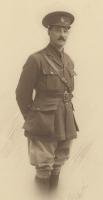
On 7th October 1915 Captain Charles Noel Ridley died at St Omer having been mortally wounded on 29 Sep 1915. He was survived by his wife Daphne Bewicke and their three daughters. "The History of the Northumberland (Hussars) Yeomanry, 1819 – 1919 with Supplement to 1923" Edited by Howard Pease M.A., F.S.A. Printed by Constable & Co. Ltd. London 1924. On page 114 of the volume there is the following reference: September 30th [1915] – Most unfortunately Captain C.N. Ridley was killed, and about fourteen other ranks were wounded, whilst burying about forty men just behind "Gun Trench". He was buried at Longuenesse Souvenir Cemetery, St Omer, France.
Daphne Bewicke: On 10th February 1887 she was born to Calverley Bewicke of Close House, Northumberland in Torquay, Devon. In September 1907 Captain Charles Noel Ridley and she were married. In 1918 Hall Grant Pringle and she were married in Brampton, Cumberland. On 23rd April 1947 she died in Whitby, Yorkshire.
On 22nd April 1433 John Duke Bedford and Jacquetta Luxemburg were married at Thérouanne. She by marriage Duchess Bedford. The difference in their ages was 25 years. She the daughter of Peter Luxembourg I Count Saint Pol and Margherita Baux. He the son of King Henry IV of England and Mary Bohun.
The marriage caused a rift with Philip "Good" Duke Burgundy, John's late wife's brother, who regarded the marriage, some five months after his sister's death, an insult to her memory. There was no issue from the marriage with John dying a year and a half later.
Chronicle of Gregory. 22nd April 1433. And the same year the Duke of Bedforde, and Regyant of Fraunce, weddyde the dukys1 daughter of Syn Powle the XXij2 day at Tyruyn3.
Note 1. He was Count Saint Pol rather than Duke.
Note 2. of April.
Note 3. Thérouanne.
On 16th August 1513 Henry VIII fought at Thérouanne during the Battle of the Spurs.
Henry's army included George Talbot 4th Earl of Shrewsbury (commanded), Thomas Grey 2nd Marquess Dorset, Thomas Brooke 8th Baron Cobham, Henry Bourchier 2nd Earl Essex 3rd Count of Eu, John de Vere 15th Earl of Oxford and Anthony Wingfield. John "Tilbury Jack" Arundell, William Compton, John Hussey 1st Baron Hussey of Sleaford and William Hussey was knighted by King Henry VII of England and Ireland. Thomas West 8th Baron De La Warr 5th Baron West and Andrew Windsor 1st Baron Windsor was created Knight Banneret.
Louis I d'Orléans Duc de Longueville 1480-1516 was captured.
Arthur Hopton was knighted for his bravery.
On 15th September 1915 Edward Hugh Hastings Abney-Hastings died of enteric fever whilst on active service. he was buried at the Wimereux Communal Cemetery Plot III. O. 1.
17th September 1915. Leicester Daily Post.
Lieutenant Edward Hastings, of the Black Watch, whose serious illness from enteric we reported a few days ago, has, we regret to announce, passed away, his death having taken place in a hospital near Boulogne, on Wednesday. His mother, Lady Maude Hastings, of the Manor House, Ashby, left for France last Friday, on receipt of an intimation that the attack, which was at first thought to be slight, had become serious, and her ladyship learned on arrival that there was little hope of her son's recovery. It is understood that the deceased officer, who was only 20 years of age, will be buried in France. Lieut. Hastings was granted a commission when the war began. He was the second son of Lady Hastings and the late Hon. Paulyn Hastings, and nephew of the Earl of Loudoun. Yesterday the flag, with the Maunch, was hanging half-mast
On 10th January 1156 King Henry "Curtmantle" II of England crossed from Dover, Kent to Wissant. Richard "The Loyal" Lucy was appointed Regent in Henry's absence. Eleanor of Aquitaine Queen Consort Franks and England was placed in the care of Archbishop Theobald of Bec and Bishop John of Salisbury. Her party included her sister Petronilla Poitiers.
Quentovic was a Frankish port that no longer exists. Archaeological discoveries led by David Hill in the 1980s found that the actual location of Quentovic was east of Étaples, in what is now the commune of La Calotterie.
Bede. They proceeded by sea to Marseilles, and thence by land to Arles, and having there delivered to John, archbishop of that city, Pope Vitalian's letters of recommendation, were by him detained till Ebrin, the king's mayor of the palace, sent them a pass to go where they pleased. Having received the same, Theodore repaired to Agilbert, bishop of Paris, of whom we have spoken above, and was by him kindly received, and long entertained. But Hadrian went first to Emme, and then to Faro, bishops of Sens and Meaux, and lived with them a considerable time; for the hard winter had obliged them to rest wherever they could. King Egbert, being informed by messengers that the bishop they had asked of the Roman prelate was in the kingdom of France, sent thither his prefect, Redfrid, to conduct him; who, being arrived there, with Ebrin's leave, conveyed him to the port of Quentavic; where, being indisposed, he made some stay, and as soon as he began to recover, sailed over into Britain. But Ebrin detained Hadrian, suspecting that he went on some message from the emperor to the kings of Britain, to the prejudice of the kingdom, of which he at that time took especial care; however, when he found that he really had no such commission, he discharged him, and permitted him to follow Theodore. As soon as he came, he received from him the monastery of St. Peter the apostle, where the archbishops of Canterbury are usually buried, as I have said before; for at his departure, the apostolic lord had ordered that he should provide for him in his diocese, and give him a suitable place to live in with his followers.