

Deal, Kent is in Kent.
See: Deal Castle [Map], Goodwin Sands [Map].
On 3rd July 1495 Perkin Warbreck [aged 21] landed at Deal, Kent [Map]. He was driven off by supporters of the Crown and travelled to Ireland.
In 1587 Charles Fotherby [aged 38] was appointed Vicar of Deal, Kent [Map].
Samuel Pepys' Diary. 30th April 1660. All the morning getting instructions ready for the Squadron of ships that are going to-day to the Streights, among others Captain Teddiman, Curtis, and Captain Robert Blake to be commander of the whole Squadron. After dinner to ninepins, W. Howe and I against Mr. Creed and the Captain. We lost 5s. apiece to them. After that W. Howe, Mr. Sheply and I got my Lord's leave to go to see Captain Sparling. So we took boat and first went on shore, it being very pleasant in the fields; but a very pitiful town Deal, Kent [Map] is. We went to Fuller's (the famous place for ale), but they have none but what was in the vat. After that to Poole's, a tavern in the town, where we drank, and so to boat again, and went to the Assistance, where we were treated very civilly by the Captain, and he did give us such music upon the harp by a fellow that he keeps on board that I never expect to hear the like again, yet he is a drunken simple fellow to look on as any I ever saw. After that on board the Nazeby, where we found my Lord at supper, so I sat down and very pleasant my Lord was with Mr. Creed and Sheply, who he puzzled about finding out the meaning of the three notes which my Lord had cut over the chrystal of his watch. After supper some musique. Then Mr. Sheply, W. Howe and I up to the Lieutenant's cabin, where we drank, and I and W. Howe were very merry, and among other frolics he pulls out the spigot of the little vessel of ale that was there in the cabin and drew some into his mounteere, and after he had drank, I endeavouring to dash it in his face, he got my velvet studying cap and drew some into mine too, that we made ourselves a great deal of mirth, but spoiled my clothes with the ale that we dashed up and down. After that to bed very late with drink enough in my head.
Samuel Pepys' Diary. 1st May 1660. This morning I was told how the people of Deal, Kent [Map] have set up two or three Maypoles, and have hung up their flags upon the top of them, and do resolve to be very merry to-day. It being a very pleasant day, I wished myself in Hide Park [Map]. This day I do count myself to have had full two years of perfect cure for the stone, for which God of heaven be blessed. This day Captain Parker came on board, and without his expectation I had a commission for him for the Nonsuch frigate ["The Nonsuch" was a fourth-rate of thirty-two guns, built at Deptford, Kent [Map] in 1646 by Peter Pett, jun. The captain was John Parker.] (he being now in the Cheriton), for which he gave me a French pistole. Captain H. Cuttance has commission for the Cheriton. After dinner to nine-pins, and won something. The rest of the afternoon in my cabin writing and piping. While we were at supper we heard a great noise upon the Quarter Deck, so we all rose instantly, and found it was to save the coxon of the Cheriton, who, dropping overboard, could not be saved, but was drowned. To-day I put on my suit that was altered from the great skirts to little ones. To-day I hear they were very merry at Deal, Kent [Map], setting up the King's [aged 29] flag upon one of their maypoles, and drinking his health upon their knees in the streets, and firing the guns, which the soldiers of the Castle threatened; but durst not oppose.
Samuel Pepys' Diary. 5th May 1660. All the morning very busy writing letters to London, and a packet to Mr Downing [aged 35], to acquaint him with what had been done lately in the fleet. And this I did by my Lord's command, who, I thank him, did of himself think of doing it, to do me a kindness, for he writ a letter himself to him, thanking him for his kindness to me. All the afternoon at ninepins, at night after supper good musique, my Lord, Mr. North, I and W. Howe. After that to bed. This evening came Dr. Clarges [aged 42] to Deal, Kent [Map], going to the King; where the towns-people strewed the streets with herbes against his coming, for joy of his going. Never was there so general a content as there is now. I cannot but remember that our parson did, in his prayer to-night, pray for the long life and happiness of our King and dread Soveraign, that may last as long as the sun and moon endureth.
Samuel Pepys' Diary. 10th May 1660. This morning came on board Mr. Pinkney and his son, going to the King with a petition finely writ by Mr. Whore, for to be the King's [aged 29] embroiderer; for whom and Mr. Saunderson [aged 74] I got a ship. This morning come my Lord Winchelsea and a great deal of company, and dined here. In the afternoon, while my Lord and we were at musique in the great cabin below, comes in a messenger to tell us that Mr. Edward Montagu [aged 12], [Sir Edward Montagu's eldest son, afterwards second Earl of Sandwich, called by Pepys "The child".] my Lord's son, was come to Deal, Kent [Map], who afterwards came on board with Mr. Pickering [aged 42] with him. The child was sick in the evening. At night, while my Lord was at supper, in comes my Lord Lauderdale and Sir John Greenville, who supped here, and so went away. After they were gone, my Lord called me into his cabin, and told me how he was commanded to set sail presently for the King1, and was very glad thereof, and so put me to writing of letters and other work that night till it was very late, he going to bed. I got him afterwards to sign things in bed. After I had done some more work I to bed also.
Note 1. Ordered that General Montagu [aged 34] do observe the command of His Majesty for the disposing of the fleet, in order to His Majesty's returning home to England to his kingly government: and that all proceedings in law be in His Majesty's name. Rugge's Diurnal. B.


Samuel Pepys' Diary. 11th May 1660. Up very early in the morning, and so about a great deal of business in order to our going hence to-day. Burr going on shore last night made me very angry. So that I sent for Mr. Pitts to come to me from the Vice-Admiral's [aged 45], intending not to have employed Burr any more. But Burr by and by coming and desiring humbly that I would forgive him and Pitts not coming I did set him to work. This morning we began to pull down all the State's arms in the fleet, having first sent to Dover for painters and others to come to set up the King's [aged 29]. The rest of the morning writing of letters to London which I afterwards sent by Dunne. I had this morning my first opportunity of discoursing with Dr. Clarke1, whom I found to be a very pretty man and very knowing. He is now going in this ship to the King. There dined here my Lord Crafford [aged 48] and my Lord Cavendish [aged 20], and other Scotchmen whom I afterwards ordered to be received on board the Plymouth, and to go along with us. After dinner we set sail from the Downs, I leaving my boy to go to Deal, Kent [Map] for my linen. In the afternoon overtook us three or four gentlemen; two of the Berties, and one Mr. Dormerhoy, a Scotch gentleman, whom I afterwards found to be a very fine man, who, telling my Lord that they heard the Commissioners were come out of London to-day, my Lord dropt anchor over against Dover Castle [Map] (which give us about thirty guns in passing), and upon a high debate with the Vice and Rear Admiral whether it were safe to go and not stay for the Commissioners, he did resolve to send Sir R. Stayner [aged 35] to Dover, to enquire of my Lord Winchelsea, whether or no they are come out of London, and then to resolve to-morrow morning of going or not; which was done. It blew very hard all this night that I was afeard of my boy. About 11 at night came the boats from Deal, with great store of provisions, by the same token John Goods told me that above 20 of the fowls are smothered, but my boy was put on board the Northwich. To bed.
Note 1. Timothy Clarke, M. D., one of the original Fellows of the Royal Society. He was appointed one of the physicians in ordinary to Charles II on the death of Dr. Quartermaine in 1667.


Samuel Pepys' Diary. 16th June 1661. Lord's Day. But no purser coming in the morning for them, and I hear that the Duke went last night, and so I am at a great loss what to do; and so this day (though the Lord's day) staid at home, sending Will up and down to know what to do. Sometimes thinking to continue my resolution of sending by the carrier to be at Deal, Kent [Map] on Wednesday next, sometimes to send them by sea by a vessel on purpose, but am not yet come to a resolution, but am at a very great loss and trouble in mind what in the world to do herein.
Samuel Pepys' Diary. 18th July 1664. Up, and walked to my Lord's, and there took my leave of him, he seeming very friendly to me in as serious a manner as ever in his life, and I believe he is very confident of me. He sets out this morning for Deale [Map].
Chronicle of Walter of Guisborough
A canon regular of the Augustinian Guisborough Priory, Yorkshire, formerly known as The Chronicle of Walter of Hemingburgh, describes the period from 1066 to 1346. Before 1274 the Chronicle is based on other works. Thereafter, the Chronicle is original, and a remarkable source for the events of the time. This book provides a translation of the Chronicle from that date. The Latin source for our translation is the 1849 work edited by Hans Claude Hamilton. Hamilton, in his preface, says: 'In the present work we behold perhaps one of the finest samples of our early chronicles, both as regards the value of the events recorded, and the correctness with which they are detailed; Nor will the pleasing style of composition be lightly passed over by those capable of seeing reflected from it the tokens of a vigorous and cultivated mind, and a favourable specimen of the learning and taste of the age in which it was framed.'
Available at Amazon in eBook and Paperback format.
Calendar of State Papers Charles II 13 Nov 1664. 13th November 1664. 93. William Coventry [aged 36] to [Sec. Bennet [aged 46]]. Hopes the wind will change, and bring the Charles and the other ships out of the river; will not then fear what Opdam can do, though the men are raw, and need a little time at sea. The Ruby and Happy Return have brought some supernumeraries, but 500 more are wanted; 200 are expected from Plymouth, but till some runaways are hanged, the ships cannot be kept well manned. Sends a list of some fit to be made examples of in the several counties where they were pressed, with the names of those who pressed them. The Dutch ship named before is brought in, and two others are stayed at Cowes, Isle of Wight by virtue of the embargo, the order in Council making no exception for foreigners, The King's pleasure should be known therein, as the end, which is to gather seamen, does not seem to require the stopping of foreigners. Prize officers mustbe sent speedily to [Portsmouth], Dover, and Deal. Those at Deal, Kent [Map] should have men in readiness to carry prizes up the river, that the men belonging to the fleet be not scattered. Persons should also be hastened to 'take care of the sick and wounded. The Duke [aged 31] intends to appoint Erwin captain of the ship hired to go to St. Helena; he is approved by the East India Company, which is important, trade being intermixed with convoy, and they find fault if a commander of the King's ships bring home any little matter privately bought. The Duke has divided the fleet into squadrons, assigning to each a vice and rear adiniral; Sir John Lawson [aged 49] and Sir William Berkeley to his own, Mennes [aged 65] and Sansum to Prince Rupert's [aged 44], Sir George Aiscue [aged 48] [Ayscough] and Teddeman to the Earl of Sandwich. Hopes in a few days to be in much better order, if good men can be got. Will send a list of the squadrons. The Guernsey is damaged by running aground. Rear-Admiral Teddeman, with 4 or 5 ships, has gone to course in the Channel, and if he meet any refractory Dutchmen, will teach them their duty. The King's declaration for encouraging seamen has much revived the men, and added to their courage. [Four pages.]
John Evelyn's Diary. 9th January 1665. To Deal, Kent [Map]. 10th. To Sandwich, Kent [Map], a pretty town, about two miles from the sea. The Mayor and officers of the Customs were very diligent to serve me. I visited the forts in the way, and returned that night to Canterbury, Kent [Map].
Samuel Pepys' Diary. 3rd February 1665. So back again on foot to the 'Change [Map], in my way taking my books from binding from my bookseller's. My bill for the rebinding of some old books to make them suit with my study, cost me, besides other new books in the same bill, £3; but it will be very handsome. At the 'Change [Map] did several businesses, and here I hear that newes is come from Deale [Map], that the same day my Lord Sandwich [aged 39] sailed thence with the fleete, that evening some Dutch men of warr were seen on the back side of the Goodwin [Map], and, by all conjecture, must be seen by my Lord's fleete; which, if so, they must engage.
Samuel Pepys' Diary. 23rd March 1665. So took up my wife and home, and at my office a while, and thence to supper and to bed. Great talk of noises of guns heard at Deale [Map], but nothing particularly whether in earnest or not.
John Evelyn's Diary. 8th June 1665. Came news of his highness's [aged 35] victory, which indeed might have been a complete one, and at once ended the war, had it been pursued, but the cowardice of some, or treachery, or both, frustrated that. We had, however, bonfires, bells, and rejoicing in the city. Next day, the 9th, I had instant orders to repair to the Downs, so as I got to Rochester, Kent [Map] this evening. Next day I lay at Deal, Kent [Map], where I found all in readiness: but, the fleet being hindered by contrary winds, I came away on the 12th, and went to Dover, Kent [Map], and returned to Deal, Kent [Map]; and on the 13th, hearing the fleet was at Solbay, I went homeward, and lay at Chatham, Kent [Map], and on the 14th, I got home. On the 15th, came the eldest son of the present Secretary of State to the French King, with much other company, to dine with me. After dinner, I went with him to London, to speak to my Lord General for more guards, and gave his Majesty an account of my journey to the coasts under my inspection. I also waited on his Royal Highness [aged 31], now come triumphant from the fleet, gotten into repair. See the whole history of this conflict in my "History of the Dutch War"..
John Evelyn's Diary. 1st June 1666. Being in my garden at 6 o'clock in the evening, and hearing the great guns go thick off, I took horse and rode that night to Rochester, Kent [Map]; thence next day toward the Downs and seacoast, but meeting the Lieutenant of the Hampshire frigate, who told me what passed, or rather what had not passed, I returned to London, there being no noise, or appearance at Deal, Kent [Map], or on that coast of any engagement. Recounting this to his Majesty [aged 36], whom I found at St James' Park [Map], impatiently expecting, and knowing that Prince Rupert [aged 46] was loose about three at St. Helen's Point at N. of the Isle of Wight, it greatly rejoiced him; but he was astonished when I assured him they heard nothing of the guns in the Downs, nor did the Lieutenant who landed there by five that morning.
Samuel Pepys' Diary. 4th June 1666. Up, and with Sir J. Minnes [aged 67] and Sir W. Pen [aged 45] to White Hall in the latter's coach, where, when we come, we find the Duke [aged 32] at St. James's, whither he is lately gone to lodge. So walking through the Parke we saw hundreds of people listening at the Gravel-pits, [Kensington] and to and again in the Parke to hear the guns, and I saw a letter, dated last night, from Strowd [aged 38], Governor of Dover Castle, which says that the Prince [aged 46] come thither the night before with his fleete, but that for the guns which we writ that we heard, it is only a mistake for thunder1 and so far as to yesterday it is a miraculous thing that we all Friday, and Saturday and yesterday, did hear every where most plainly the guns go off, and yet at Deale [Map] and Dover, Kent [Map] to last night they did not hear one word of a fight, nor think they heard one gun. This, added to what I have set down before the other day about the Katharine, makes room for a great dispute in philosophy, how we should hear it and they not, the same wind that brought it to us being the same that should bring it to them: but so it is. Major Halsey, however (he was sent down on purpose to hear newes), did bring newes this morning that he did see the Prince and his fleete at nine of the clock yesterday morning, four or five leagues to sea behind the Goodwin [Map], so that by the hearing of the guns this morning we conclude he is come to the fleete.
Note 1. Evelyn [aged 45] was in his garden when he heard the guns, and be at once set off to Rochester, Kent [Map] and the coast, but he found that nothing had been heard at Deal (see his "Diary", June 1st, 1666).


Samuel Pepys' Diary. 9th August 1666. In the evening to Lumbard-streete [Map] about money, to enable me to pay Sir G. Carteret's [aged 56] £3000, which he hath lodged in my hands, in behalf of his son and my Lady Jemimah, toward their portion, which, I thank God, I am able to do at a minute's warning. In my [way] I inquired, and find Mrs. Rawlinson is dead of the sickness, and her mayde continues mighty ill. He himself is got out of the house. I met also with Mr. Evelyn [aged 45] in the streete, who tells me the sad condition at this very day at Deptford, Kent [Map] for the plague, and more at Deale [Map] (within his precinct as one of the Commissioners for sick and wounded seamen), that the towne is almost quite depopulated.
The London Gazette 238. 24th February 1668. Deale [Map]. Feb 24. This day sailed for the Thames his Majesties Ship, the Reserve, well laden with Sails. The Fleet which were riding in the Downs during the late storms, consisting of 140 saile, received little or no dammage, but the wind coming now to the South-east, most of the fleet outwards bound have set sail to pursue their intended Voyages.
See Castles in Kent.
Samuel Pepys' Diary. 9th April 1660. This afternoon I first saw France and Calais [Map], with which I was much pleased, though it was at a distance. About five o'clock we came to the Goodwin [Map], so to the Castles about Deal [Map]; where our Fleet lay, among whom we anchored. Great was the shout of guns from the castles and ships, and our answers, that I never heard yet so great rattling of guns. Nor could we see one another on board for the smoke that was among us, nor one ship from another. Soon as we came to anchor, the captains came from on board their ships all to us on board. This afternoon I wrote letters for my Lord to the Council, &c., which Mr. Dickering was to carry, who took his leave this night of my Lord, and Balty [aged 20] after I had wrote two or three letters by him to my wife and Mr. Bowyer, and had drank a bottle of wine with him in my cabin which J. Goods and W. Howe brought on purpose, he took leave of me too to go away to-morrow morning with Mr. Dickering. I lent Balty 15s. which he was to pay to my wife. It was one in the morning before we parted. This evening Mr. Sheply came on board, having escaped a very great danger upon a sand coming from Chatham.
In 1672 Francis Hawley 1st Baron Hawley [aged 63] was appointed Captain of Deal Castle which position he held until 1674.
In 1682 Admiral Francis Wheler [aged 24] was appointed Governor of Deal Castle.
In 1776 John Norris [aged 36] was appointed Captain of Deal Castle.
In 1777 Francis Osborne 5th Duke Leeds [aged 25] was appointed Captain of Deal Castle.


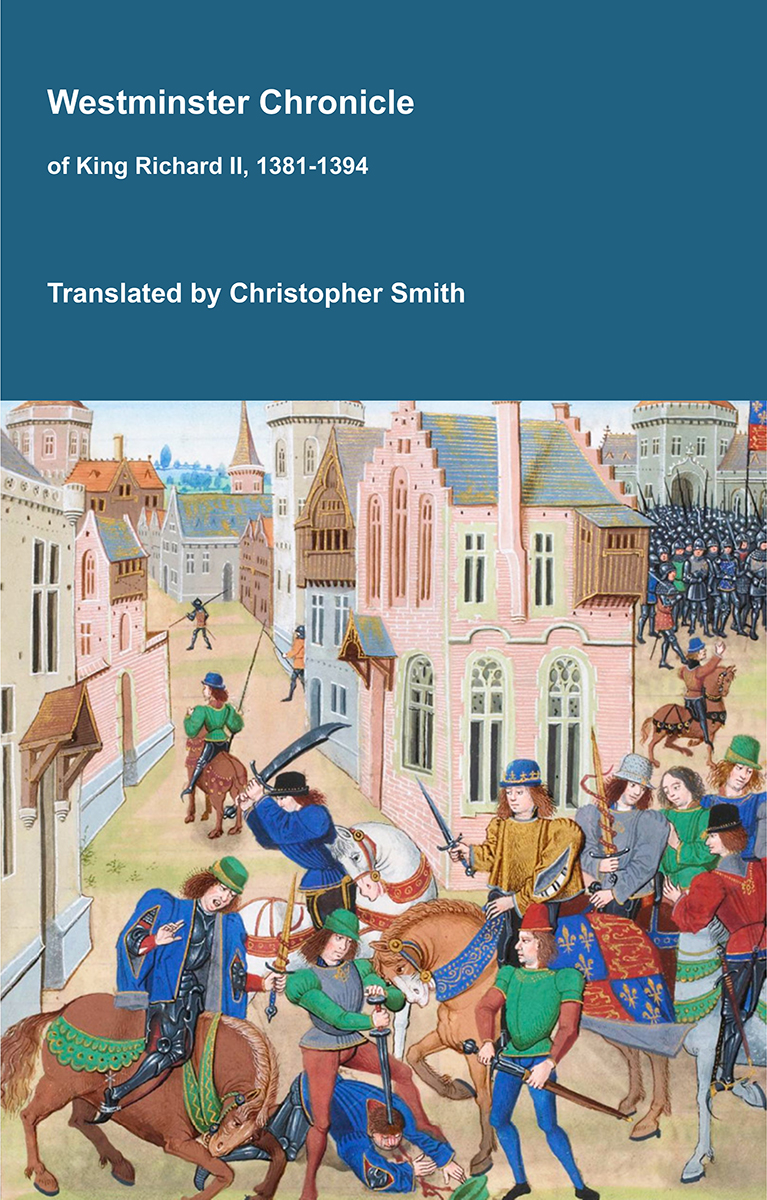
Westminster Chronicle of King Richard II, 1381-1394
The Westminster Chronicle is one of the most vivid and important narrative sources for the reign of Richard II. Written by an anonymous chronicler closely connected with Westminster Abbey, it covers the years 1381 to 1394, from the Peasants’ Revolt to the political tensions, court ceremonies, diplomatic negotiations, royal progresses, and public crises of Richard’s later reign. Rich in detail the chronicle records major events such as the conflicts between the King and Lords Appellant, King and the City of London, negotiations with France and Scotland, the death and funeral of Queen Anne of Bohemia, the illness of Charles VI of France, and the changing fortunes of leading nobles including John of Gaunt, Thomas of Gloucester, Robert de Vere, and the Earl of Arundel. The Chronicle offers readers a remarkable window into late fourteenth-century England, combining political observation, courtly spectacle, urban drama, ecclesiastical affairs, and moral judgement. It is an essential source for anyone interested in medieval monarchy, London, Westminster, and the troubled reign of Richard II.
Available at Amazon in eBook and Paperback format.
On 14th September 1852 Arthur Wellesley 1st Duke Wellington [aged 83] died at Deal Castle [Map]. His son Arthur [aged 45] succeeded 2nd Duke Wellington, 2nd Viscount Wellington of Talavera. Elizabeth Hay Duchess Wellington [aged 31] by marriage Duchess Wellington.
George Gammon Adams [aged 31] took the death mask of the Duke of Wellington, the marble bust he executed from it being highly regarded by the Duke's heirs.


The May 1648 Kentish Rebellion was, in effect, the commencement of the Second Civil War of 1648. The rebels, commanded by George Goring 1st Earl Norwich, raised forces across Kent. Deal Castle [Map], Walmer Castle [Map] and Sandown Castle surrendered. The rebels then besieged Dover Castle [Map]. Parliament dispatched troops commanded by Nathaniel Rich of Stondon to suppress the rebels.
Goodwin Sands [Map]. A 16 km sandbank at the southern end of the North Sea lying 10 km off the Deal, Kent [Map] coast in Kent, England.
On 5th December 1657 John Reynolds [aged 32] was drowned when the ship on which he was sailing was wrecked on the Goodwin Sands [Map] when travelling to England from Mardyke Fort; see Archives of Venice and State Papers Commwealth, page 213. By his will, which was disputed, Reynolds left the manor of Carrick to his brother Robert, and his other lands in England and Ireland to James Calthorpe, the husband of his sister Dorothy. On 20th July 1659 the House of Commons declared the will valid, and ordered Robert Reynolds to be given possession of Carrick
Calendar of State Papers in the Archives of Venice. The fortifications of Mardich being completed so that the English consider them strong enough to repel any Spanish attack, and the enemy's army not being thought strong enough to venture on an attack in such severe weather, General Rinaldi, his lieutenant Veit, and other officers of the English army, asked his Highness's permission to return home during the winter. The permission was granted, and being eager to cross the sea soon they embarked on a small skiff; but a storm drove them on to certain sands [Goodwin Sands [Map]], where the vessel was wrecked and all drowned1. It is deeply felt, as the death of Rinaldi and so many brave officers is a serious loss to the state. The palace does not issue the news as certain, saying that it is only a conjecture from the time of sailing and the delay in arriving; but there seems no doubt of its truth, and some say they have seen chests and other articles belonging to Rinaldi and his colleagues tossing about in the sea.
The winds are so violent this winter that they seriously injure this mart. A number of ships from different places bringing precious goods to England have perished with considerable loss to the interested parties.
Note 1. They were crossing in a pink which was wrecked on the Goodwin Sands on 5–15 December. Calendar State Papers, Domestic, 1657–8, page 213.
Samuel Pepys' Diary. 9th April 1660. This afternoon I first saw France and Calais [Map], with which I was much pleased, though it was at a distance. About five o'clock we came to the Goodwin [Map], so to the Castles about Deal [Map]; where our Fleet lay, among whom we anchored. Great was the shout of guns from the castles and ships, and our answers, that I never heard yet so great rattling of guns. Nor could we see one another on board for the smoke that was among us, nor one ship from another. Soon as we came to anchor, the captains came from on board their ships all to us on board. This afternoon I wrote letters for my Lord to the Council, &c., which Mr. Dickering was to carry, who took his leave this night of my Lord, and Balty [aged 20] after I had wrote two or three letters by him to my wife and Mr. Bowyer, and had drank a bottle of wine with him in my cabin which J. Goods and W. Howe brought on purpose, he took leave of me too to go away to-morrow morning with Mr. Dickering. I lent Balty 15s. which he was to pay to my wife. It was one in the morning before we parted. This evening Mr. Sheply came on board, having escaped a very great danger upon a sand coming from Chatham.
Samuel Pepys' Diary. 3rd February 1665. So back again on foot to the 'Change [Map], in my way taking my books from binding from my bookseller's. My bill for the rebinding of some old books to make them suit with my study, cost me, besides other new books in the same bill, £3; but it will be very handsome. At the 'Change [Map] did several businesses, and here I hear that newes is come from Deale [Map], that the same day my Lord Sandwich [aged 39] sailed thence with the fleete, that evening some Dutch men of warr were seen on the back side of the Goodwin [Map], and, by all conjecture, must be seen by my Lord's fleete; which, if so, they must engage.
Samuel Pepys' Diary. 4th June 1666. Up, and with Sir J. Minnes [aged 67] and Sir W. Pen [aged 45] to White Hall in the latter's coach, where, when we come, we find the Duke [aged 32] at St. James's, whither he is lately gone to lodge. So walking through the Parke we saw hundreds of people listening at the Gravel-pits, [Kensington] and to and again in the Parke to hear the guns, and I saw a letter, dated last night, from Strowd [aged 38], Governor of Dover Castle, which says that the Prince [aged 46] come thither the night before with his fleete, but that for the guns which we writ that we heard, it is only a mistake for thunder1 and so far as to yesterday it is a miraculous thing that we all Friday, and Saturday and yesterday, did hear every where most plainly the guns go off, and yet at Deale [Map] and Dover, Kent [Map] to last night they did not hear one word of a fight, nor think they heard one gun. This, added to what I have set down before the other day about the Katharine, makes room for a great dispute in philosophy, how we should hear it and they not, the same wind that brought it to us being the same that should bring it to them: but so it is. Major Halsey, however (he was sent down on purpose to hear newes), did bring newes this morning that he did see the Prince and his fleete at nine of the clock yesterday morning, four or five leagues to sea behind the Goodwin [Map], so that by the hearing of the guns this morning we conclude he is come to the fleete.
Note 1. Evelyn [aged 45] was in his garden when he heard the guns, and be at once set off to Rochester, Kent [Map] and the coast, but he found that nothing had been heard at Deal (see his "Diary", June 1st, 1666).